Two-for-One Twister
ProductOverview
A two-for-one twister combines two single yarns (called "singles") into a plied yarn. The machine takes bobbin after bobbin of identical singles from a large Input Bobbin Creel and feeds two at a time toward the Spindle Unit, which rotates at 2000–12000 rpm. As the spindle rotates, the two yarns wrap around each other, creating a helical structure that locks them together. The twisted pair is then wound onto a Take-Up Winder spool at a synchronized speed, building up a full package. This two-for-one process is fundamental to the yarn supply chain: it takes many individual singles and converts them into balanced, robust plied yarns for knitting and weaving.
The Main Frame is a sturdy cast-iron structure. The Input Bobbin Creel is a rotating stand holding dozens or hundreds of input bobbins. Two bobbins are positioned in the nip, and yarn is fed from each through Tension Control System discs that keep the yarns at equal tension, then through Yarn Guide System toward the Spindle Unit. The spindle, driven by the Spindle Drive Motor, rotates at a precise speed; as it rotates, the two yarns wrap around each other in the Twist Nip zone. The finished twisted yarn is drawn away by the Take-Up Winder, which rotates at a carefully synchronized speed to maintain consistent tension. The Control System manages spindle and take-up speeds, monitors for yarn breaks, and logs production.
How it works
The process is elegant in its simplicity. Two individual-ply yarns, call them Yarn A and Yarn B, each wound on its own bobbin, feed into the twisting zone from opposite sides. The Tension Control System applies equal back-tension to both yarns (typically 50–200 grams depending on yarn weight and fiber), preventing them from over-loosening or breaking.
The yarns converge at the Twist Nip, a small point just before the Spindle Unit. The spindle rotates rapidly, say, 5000 rpm for a medium yarn. As it rotates, the geometry of the twist zone causes Yarn A and Yarn B to wrap around each other, forming a helix. The faster the spindle, the tighter (more turns per cm) the twist; the slower the spindle relative to the take-up speed, the looser the twist. The Control System adjusts this ratio via the Spindle VFD on both the spindle and the Take-Up Motor, maintaining consistent twist.
The twisted pair is then drawn toward the Take-Up Winder, which is driven by its own Take-Up VFD at a speed that pulls the yarn away at a constant rate (typically 200–600 m/min depending on yarn type). The winder winds the plied yarn onto a spool or bobbin, building up a package.
Twist and balancing
The twist direction, whether the wrapping spirals to the right (Z twist) or left (S twist), is determined by the spindle rotation direction. Most machinery uses Z twist, but S twist is available by reversing the spindle. A balanced 2-ply yarn uses the same twist direction in both the single input yarns and the plying: if the singles are Z-twisted, the plied yarn should also be Z-twisted, creating visual and mechanical consistency.
The amount of twist, measured in turns per inch (TPI) or turns per cm, affects yarn properties. Higher twist creates a stronger, denser yarn; lower twist gives a loftier, bulkier feel. Typical 2-ply yarns range from 0.5 to 1.5 TPI plying twist, added on top of the single's twist. The total twist is the sum of the single's twist and the plying twist, and this total determines the final yarn's strength, stretch, and appearance.
Creel management and changeover
The Input Bobbin Creel is either a fixed array of spindles or a rotating carousel. A fixed creel requires the operator to swap out all 50–400 bobbins at once, a time-consuming operation. A rotating creel allows one bobbin to be removed and a fresh one inserted while the machine continues running, advancing the creel position automatically via the Creel Index Motor motor. This "on-the-fly" changeover dramatically improves uptime and is standard on modern machines.
Creel design also affects yarn quality. Bobbins must be arranged so the yarn paths to the tensioner are equal lengths; unequal paths cause differential tension and an uneven plied yarn. Some machines have compensating idlers or adjustable creel arms to equalize path lengths.
Tension balancing and yarn break avoidance
The two input yarns must have equal tension; unequal tension causes one yarn to be looser and more likely to break, creating a weak spot in the plied yarn. The Tension Control System system, typically dual disc tensioners (one per yarn), applies equal load to both yarns. The tension setting, adjusted via the Tension Adjuster knob, is typically 50–200 grams depending on the single's denier and fiber type. Too low and the yarn sags and gets twisted unevenly; too high and the yarn breaks under spindle drag.
The Yarn-Break Sensor continuously monitors yarn health. Most systems use a tension or load cell on the output that detects a sudden drop if either input yarn breaks. When a break is detected, the Control System immediately halts the machine, signaling the operator to re-thread and restart.
Production rate and energy efficiency
A modern two-for-one twister can process 300–600 m/min of plied yarn, depending on the single yarn weight and target twist level. Finer singles (low denier) run faster; coarser singles run slower because the spindle drag and inertia increase. A single machine, running continuously, can produce 200–400 kg of plied yarn per 8-hour shift.
Energy consumption is dominated by the Spindle Motor, which runs continuously at high speed. Bearing friction and air resistance account for most of the load; newer machines use ceramic hybrid bearings and streamlined spindle designs to reduce losses. The Take-Up Motor is smaller and runs at a fraction of the spindle speed, so its power draw is minor.
Yarn properties and applications
The output 2-ply yarn is used in knitting, weaving, and sewing. Knit fabrics often use 2-ply or 3-ply to achieve adequate strength and elasticity; woven fabrics use similar yarns for warp and weft. The twist creates a yarn that is stronger than the sum of its singles, a 2-ply yarn with 50g singles is not 100g in tensile strength, but perhaps 120–130g because the twist locks the fibers together and provides load sharing.
Different fiber combinations can be twisted together: two identical fiber-type singles (pure plying), or one natural and one synthetic (blended plying) to achieve mixed-fiber properties in a single yarn. This flexibility makes the twister a key machine in yarn creation.
Two-for-One Twister parts and their functions
8 top-level parts · 107 parts in total · full bill of materials below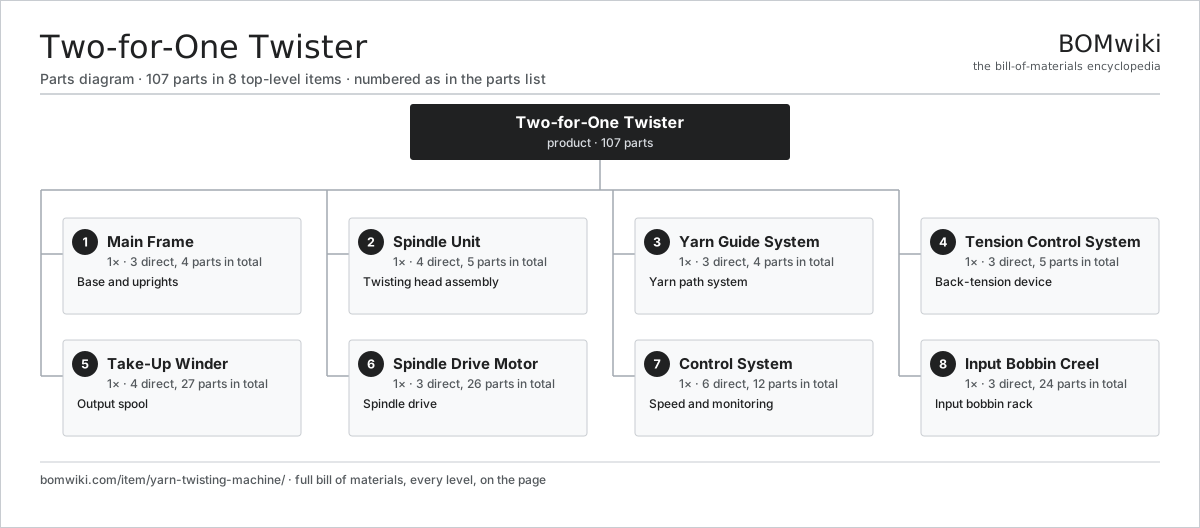
| # | Part | Qty | What it does |
|---|---|---|---|
| 1 | Main Frame 3 parts | 1× | Base and uprights |
| 2 | Spindle Unit 4 parts | 1× | Twisting head assembly |
| 3 | Yarn Guide System 3 parts | 1× | Yarn path system |
| 4 | Tension Control System 3 parts | 1× | Back-tension device |
| 5 | Take-Up Winder 4 parts | 1× | Output spool |
| 6 | Spindle Drive Motor 3 parts | 1× | Spindle drive |
| 7 | Control System 6 parts | 1× | Speed and monitoring |
| 8 | Input Bobbin Creel 3 parts | 1× | Input bobbin rack |
3D model
No 3D model yet. Have a CAD file of this? Add a 3D model. STL renders right on this page; STEP, FreeCAD, and OpenSCAD sources are welcome too (openly licensed, like all 3D models on BOMwiki).
Build & assembly graph
expand / collapse · shared sub-assemblies converge · links to related products · est. labourTap an assembly to expand/collapse · tap a part to open it · use “Open page” for any node · drag to pan, scroll to zoom.
Bill of materials for Two-for-One Twister
8 top-level lines · 45 rows shown · 107 parts total · indented to 3 levels| # | Item / sub-assembly | Part no. | Qty/assy | Ext. qty | Parts | Type |
|---|---|---|---|---|---|---|
| 1 | Main Frame 3 parts | yarn-twisting-machine-frame | 1× | 1 | 4 | assembly |
| 1.1 | Base Bed | yarn-twisting-machine-base-bed | 1× | 1 | · | part |
| 1.2 | Vertical Frame | yarn-twisting-machine-vertical-frame | 2× | 2 | · | part |
| 1.3 | Creel Support | yarn-twisting-machine-creel-support | 1× | 1 | · | part |
| 2 | Spindle Unit 4 parts | yarn-twisting-machine-spindle-unit | 1× | 1 | 5 | assembly |
| 2.1 | Spindle Shaft | yarn-twisting-machine-spindle-shaft | 1× | 1 | · | part |
| 2.2 | Spindle Bearing | yarn-twisting-machine-spindle-bearing | 2× | 2 | · | part |
| 2.3 | Spindle Whorl | yarn-twisting-machine-spindle-whorl | 1× | 1 | · | part |
| 2.4 | Spindle Flyer | yarn-twisting-machine-spindle-flyer | 1× | 1 | · | part |
| 3 | Yarn Guide System 3 parts | yarn-twisting-machine-yarn-guides | 1× | 1 | 4 | assembly |
| 3.1 | Input Eyelet | yarn-twisting-machine-input-eyelet | 2× | 2 | · | part |
| 3.2 | Twist Nip | yarn-twisting-machine-twist-nip | 1× | 1 | · | part |
| 3.3 | Guide Bracket | yarn-twisting-machine-guide-bracket | 1× | 1 | · | part |
| 4 | Tension Control System 3 parts | yarn-twisting-machine-tension-control | 1× | 1 | 5 | assembly |
| 4.1 | Tension Disc | yarn-twisting-machine-disc-tensioner | 2× | 2 | · | part |
| 4.2 | Tension Spring | yarn-twisting-machine-tension-spring | 2× | 2 | · | part |
| 4.3 | Tension Adjuster | yarn-twisting-machine-tension-adjuster | 1× | 1 | · | part |
| 5 | Take-Up Winder 4 parts | yarn-twisting-machine-takeup-winder | 1× | 1 | 27 | assembly |
| 5.1 | Take-Up Spindle | yarn-twisting-machine-takeup-spindle | 1× | 1 | · | part |
| 5.2 | Take-Up Motor 3 parts | yarn-twisting-machine-takeup-motor | 1× | 1 | 23 | assembly |
| 5.2.1 | Stator Assembly 3 parts + deeper › | stator-assembly | 1× | 1 | 3 | assembly |
| 5.2.2 | Rotor Assembly 4 parts + deeper › | rotor-assembly | 1× | 1 | 19 | assembly |
| 5.2.3 | Encoder | encoder | 1× | 1 | · | part |
| 5.3 | Take-Up Pulley | yarn-twisting-machine-takeup-pulley | 2× | 2 | · | part |
| 5.4 | Encoder | encoder | 1× | 1 | · | part |
| 6 | Spindle Drive Motor 3 parts | yarn-twisting-machine-drive-motor | 1× | 1 | 26 | assembly |
| 6.1 | Spindle Motor 3 parts | yarn-twisting-machine-spindle-motor | 1× | 1 | 24 | assembly |
| 6.1.1 | Stator Assembly 3 parts + deeper › | stator-assembly | 1× | 1 | 3 | assembly |
| 6.1.2 | Rotor Assembly 4 parts + deeper › | rotor-assembly | 1× | 1 | 19 | assembly |
| 6.1.3 | Ball Bearing | ball-bearing | 2× | 2 | · | part |
| 6.2 | Drive Pulley | yarn-twisting-machine-drive-pulley | 1× | 1 | · | part |
| 6.3 | Drive Belt | drive-belt | 1× | 1 | · | part |
| 7 | Control System 6 parts | yarn-twisting-machine-control-system | 1× | 1 | 12 | assembly |
| 7.1 | Spindle VFD | yarn-twisting-machine-vfd | 1× | 1 | · | part |
| 7.2 | Take-Up VFD | yarn-twisting-machine-takeup-vfd | 1× | 1 | · | part |
| 7.3 | Yarn-Break Sensor | yarn-twisting-machine-break-sensor | 1× | 1 | · | part |
| 7.4 | Relay | relay | 2× | 2 | · | part |
| 7.5 | Connector | connector | 6× | 6 | · | part |
| 7.6 | Power Supply | power-supply | 1× | 1 | · | part |
| 8 | Input Bobbin Creel 3 parts | yarn-twisting-machine-creel | 1× | 1 | 24 | assembly |
| 8.1 | Creel Rail | yarn-twisting-machine-creel-rail | 1× | 1 | · | part |
| 8.2 | Creel Index Motor 2 parts | yarn-twisting-machine-creel-rotation | 1× | 1 | · | part |
| 8.2.1 | Stator Assembly 3 parts + deeper › | stator-assembly | 1× | 1 | 3 | assembly |
| 8.2.2 | Rotor Assembly 4 parts + deeper › | rotor-assembly | 1× | 1 | 19 | assembly |
| 8.3 | Bobbin Support | yarn-twisting-machine-bobbin-support | 1× | 1 | · | part |
Something wrong in this list? Report a problem with this BOM.
Sourcing: possible vendors
Browse the supplier directory → Prices, MOQ, and lead times are algorithmic estimates, not quotes, and not claims about these companies. Company mappings are curated by keyword; est. price band $10k–$1M. How estimates work| Vendor | HQ | Specialty | MOQ | Lead time |
|---|---|---|---|---|
|
🇨🇭Rieter
rieter.com ↗
|
Winterthur, CH | Spinning machinery | 10 units | 14–24 wks |
| truetzschler.com ↗ | Mönchengladbach, DE | Textile machinery | 10 units | 14–24 wks |
|
🇧🇪Picanol
picanol.be ↗
|
Ypres, BE | Weaving machines | 10 units | 14–24 wks |
| karlmayer.com ↗ | Obertshausen, DE | Warp knitting machines | 10 units | 14–24 wks |
|
🇨🇭Saurer
saurer.com ↗
|
Arbon, CH | Spinning & embroidery | 10 units | 14–24 wks |
1,194-word article