Zigzag Spring Former
ProductOverview
The zigzag spring former (also called sinusoidal spring maker or wave spring former) is an industrial production machine that continuously bends high-carbon steel wire into a repeating zigzag or sinusoidal profile. Unlike helical coil springs (which wrap around a mandrel), zigzag springs are formed by reciprocating dies that bend the wire up and down in smooth arcs, creating a flat strip of connected wave loops. These springs are economical to produce, require minimal material waste, and are widely used in budget and mid-range mattresses, upholstered furniture, and automotive seat cushions.
The machine unwinds wire from a spool, feeds it into oscillating forming dies at high speed, advances the wire axially by a programmed pitch distance after each wave is formed, and cuts the finished spring (one continuous wave) using a pneumatic blade. Production rates typically reach 200–600 springs per minute, with individual springs ranging from 900 mm (twin mattress width) to 2000 mm (California king) in length.
How it works
The wire feed system begins with a spool of high-carbon steel wire (1.2–2.5 mm diameter, typically oil-tempered grade). A stepper motor drives grooved pressure rollers that unwound and advance the wire at constant speed (up to 100 mm/s). A load cell continuously measures wire tension; if tension drifts (due to spool diameter changes as wire unwinds), a pneumatic brake solenoid engages or releases, maintaining constant tension. This tension control prevents wire skip and ensures uniform forming.
The wire enters the forming die assembly, which consists of an upper die (hardened steel, 58+ HRC) and a lower anvil die (stationary). The dies have matching curved profiles (arc-shaped cavities). The upper die is driven by an eccentric cam on a rotating shaft powered by a 3–5 kW AC motor. The cam converts continuous rotation into reciprocating vertical motion (approximately 30–80 mm stroke) via a mechanical linkage arm.
As the upper die oscillates up and down at 600–1200 cycles per minute, the wire fed between the dies is bent into an arc wave. The die cavity guide channel directs the wire to the correct forming position. Each complete up-down cycle of the upper die forms one wave arc in the wire. The wire remains slightly slack between die closures, allowing natural bending rather than compression. As the upper die descends, it bends the wire downward into the arc profile; as it ascends, the wire naturally springs back, holding the formed arc shape. The lower die anvil provides the backing force.
Between forming cycles, the pitch advance system activates. A NEMA 23 stepper motor rotates a leadscrew that advances the wire axially by a programmed distance (typically 10–30 mm). This pitch distance determines the spacing between successive wave crests. The stepper is synchronized via the PLC to fire only after the upper die completes its upward stroke and the wire has set into shape.
A feedback encoder on the leadscrew verifies that the correct advance distance occurred; if not (indicating a jam or slip), the PLC triggers an alarm and halts production.
Once the finished spring (a continuous wave pattern, typically 900–2000 mm long depending on mattress width) is formed, the spring cutoff unit severs it. A pneumatic double-acting cylinder (bore 32 mm) drives a hardened steel blade (100–150 mm length, 58+ HRC) into the wire. The solenoid directional valve (5/2 spool) is triggered by the PLC at a precise moment in the forming cycle to ensure the blade cuts at a consistent location. The cut severs the spring from the incoming wire supply.
Immediately after the cut, a spring-biased ejector finger deflects the finished spring away from the cutting zone into a collection chute or conveyor. The wire continues to advance, and the forming cycle repeats with the next spring.
An optional exit straightening guide (a tapered hardened steel tube) can straighten the final wave exiting the forming die, improving the appearance and stackability of the finished spring.
Advantages of zigzag vs. helical springs
Zigzag springs offer several manufacturing and performance advantages:
- Material efficiency: ~95% of wire becomes finished spring (helical springs waste ~10–15% in coiling setup).
- Production speed: Forming cycle (600–1200 cycles/min) is faster than helical coiling (300–800 springs/min).
- Compact storage: Flat wave profile allows spring stacking without tangling.
- Cost: Simpler machine, fewer precision components compared to helical coilers with programmable cam systems.
- Consistent stiffness: The regular wave geometry produces predictable load-deflection curves.
Disadvantages:
- Wave height variability: If forming dies wear (>0.5 mm deflection), wave amplitude drifts, affecting spring stiffness.
- Lower load rating: Zigzag springs typically handle 30–50 kg load per wire gauge; helical springs (same wire) might handle 50–100 kg.
- Limited customization: Spring length is fixed by mattress width; different widths require die resets or manual cutting.
Control and automation
The PLC control system orchestrates the entire process:
- Cycle timing: PLC outputs pulse trains to pitch stepper synchronizing wire advance after each forming cycle.
- Cut trigger: Cutoff solenoid is fired at a calculated phase in the main motor rotation, ensuring consistent cut location.
- Speed control: Main motor AC drive (VFD option) allows operator to adjust forming speed from 50–100% for different wire diameters or operators.
- Alarm logic: Encoder mismatch or over-temperature on forming dies triggers fault mode, halting production and alerting operator.
Changeovers between wire gauges or spring pitches involve:
- Switching to appropriate forming dies (if available; otherwise, die sets are expensive and kept on-machine).
- Reprogramming PLC pitch advance distance (e.g., from 15 mm to 20 mm pitch).
- Adjusting tension brake setpoint.
- Manual adjustment of feed roller grooves (for significant wire diameter changes).
Die maintenance and wear
The upper and lower forming dies are the primary wear components. After ~5–10 million springs (50–100 hours continuous operation at maximum speed), die edges become rounded and stress-relief grooves appear. Wear is detected by:
- Decreasing wave amplitude (measured manually or with optical gauge).
- Increasing forming force (motor current rise).
- Visible surface cracking or banding on formed springs.
Die replacement (typically outsourced to specialized shops) costs $500–1500 per die set and requires 2–3 hours downtime for removal, installation, and re-alignment.
Integration with mattress assembly
Finished zigzag springs exit the machine and are stacked on a conveyor or collection table. In an automated line, springs flow directly to a carousel assembly station where they are layered horizontally (in parallel rows) and bonded together with adhesive or ultrasonic welding to form the spring core. The pocket spring assembler and tufting machine then complete the mattress stack.
Advantages for high-volume production
- Minimal labor: One operator can supervise 2–4 machines.
- High throughput: 200–600 springs per minute per machine; a 8-hour shift produces ~1–3 million springs.
- Low scrap: Material utilization >95%.
- Predictable quality: CNC-like repeatability via electronic advance control, independent of operator fatigue.
Zigzag Spring Former parts and their functions
8 top-level parts · 35 parts in total · full bill of materials below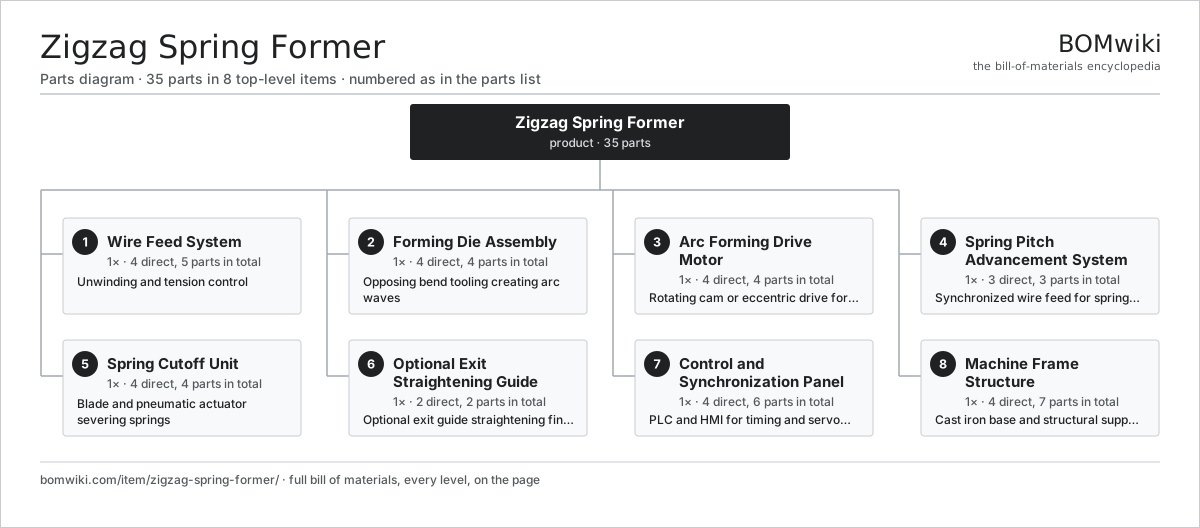
| # | Part | Qty | What it does |
|---|---|---|---|
| 1 | Wire Feed System 4 parts | 1× | Unwinding and tension control |
| 2 | Forming Die Assembly 4 parts | 1× | Opposing bend tooling creating arc waves |
| 3 | Arc Forming Drive Motor 4 parts | 1× | Rotating cam or eccentric drive forming curved sections |
| 4 | Spring Pitch Advancement System 3 parts | 1× | Synchronized wire feed for spring spacing |
| 5 | Spring Cutoff Unit 4 parts | 1× | Blade and pneumatic actuator severing springs |
| 6 | Optional Exit Straightening Guide 2 parts | 1× | Optional exit guide straightening final wave |
| 7 | Control and Synchronization Panel 4 parts | 1× | PLC and HMI for timing and servo coordination |
| 8 | Machine Frame Structure 4 parts | 1× | Cast iron base and structural support |
3D model
No 3D model yet. Have a CAD file of this? Add a 3D model. STL renders right on this page; STEP, FreeCAD, and OpenSCAD sources are welcome too (openly licensed, like all 3D models on BOMwiki).
Build & assembly graph
expand / collapse · shared sub-assemblies converge · links to related products · est. labourTap an assembly to expand/collapse · tap a part to open it · use “Open page” for any node · drag to pan, scroll to zoom.
Bill of materials for Zigzag Spring Former
8 top-level lines · 37 rows shown · 35 parts total · indented to 3 levels| # | Item / sub-assembly | Part no. | Qty/assy | Ext. qty | Parts | Type |
|---|---|---|---|---|---|---|
| 1 | Wire Feed System 4 parts | zigzag-spring-former-wire-feed | 1× | 1 | 5 | assembly |
| 1.1 | Wire Feed Stepper Motor | zigzag-spring-former-wire-motor | 1× | 1 | · | part |
| 1.2 | Grooved Pressure Roller Pair | zigzag-spring-former-feed-rollers | 2× | 2 | · | part |
| 1.3 | Wire Tension Load Cell | zigzag-spring-former-tension-sensor | 1× | 1 | · | part |
| 1.4 | Tension Brake Solenoid | zigzag-spring-former-brake-solenoid | 1× | 1 | · | part |
| 2 | Forming Die Assembly 4 parts | zigzag-spring-former-forming-dies | 1× | 1 | 4 | assembly |
| 2.1 | Upper Forming Die | zigzag-spring-former-upper-die | 1× | 1 | · | part |
| 2.2 | Lower Anvil Die | zigzag-spring-former-lower-die | 1× | 1 | · | part |
| 2.3 | Die Support Bearing | zigzag-spring-former-die-bearing | 1× | 1 | · | part |
| 2.4 | Wire Guide Channel | zigzag-spring-former-die-guide | 1× | 1 | · | part |
| 3 | Arc Forming Drive Motor 4 parts | zigzag-spring-former-arc-former | 1× | 1 | 4 | assembly |
| 3.1 | Main Forming Drive Motor | zigzag-spring-former-main-motor | 1× | 1 | · | part |
| 3.2 | Eccentric Forming Cam | zigzag-spring-former-eccentric-cam | 1× | 1 | · | part |
| 3.3 | Cam Follower Roller Bearing | zigzag-spring-former-cam-follower | 1× | 1 | · | part |
| 3.4 | Mechanical Die Linkage Arm | zigzag-spring-former-linkage-arm | 1× | 1 | · | part |
| 4 | Spring Pitch Advancement System 3 parts | zigzag-spring-former-pitch-advance | 1× | 1 | 3 | assembly |
| 4.1 | Pitch Advance Stepper Motor | zigzag-spring-former-pitch-stepper | 1× | 1 | · | part |
| 4.2 | Pitch Advancement Leadscrew | zigzag-spring-former-advance-screw | 1× | 1 | · | part |
| 4.3 | Pitch Advance Feedback Encoder | zigzag-spring-former-pitch-encoder | 1× | 1 | · | part |
| 5 | Spring Cutoff Unit 4 parts | zigzag-spring-former-cutoff | 1× | 1 | 4 | assembly |
| 5.1 | Hardened Spring Cutoff Blade | zigzag-spring-former-cutoff-blade | 1× | 1 | · | part |
| 5.2 | Pneumatic Cutter Drive Cylinder | zigzag-spring-former-cutter-cylinder | 1× | 1 | · | part |
| 5.3 | Cutter Solenoid Directional Valve | zigzag-spring-former-air-valve | 1× | 1 | · | part |
| 5.4 | Spring-Biased Ejector Finger | zigzag-spring-former-ejector-spring | 1× | 1 | · | part |
| 6 | Optional Exit Straightening Guide 2 parts | zigzag-spring-former-straightening | 1× | 1 | 2 | assembly |
| 6.1 | Hardened Exit Guide Tube | zigzag-spring-former-guide-tube | 1× | 1 | · | part |
| 6.2 | Guide Tube Support Bearing | zigzag-spring-former-guide-bearing | 1× | 1 | · | part |
| 7 | Control and Synchronization Panel 4 parts | zigzag-spring-former-control-panel | 1× | 1 | 6 | assembly |
| 7.1 | Microcontroller | mcu | 1× | 1 | · | part |
| 7.2 | LCD Panel | lcd-panel | 1× | 1 | · | part |
| 7.3 | Relay | relay | 3× | 3 | · | part |
| 7.4 | Power Supply | power-supply | 1× | 1 | · | part |
| 8 | Machine Frame Structure 4 parts | zigzag-spring-former-frame | 1× | 1 | 7 | assembly |
| 8.1 | Cast Iron Machine Base | zigzag-spring-former-base-casting | 1× | 1 | · | part |
| 8.2 | Structural Side Frame Member | zigzag-spring-former-side-frame | 2× | 2 | · | part |
| 8.3 | Fastener Set | fastener-set | 1× | 1 | · | part |
| 8.4 | Elastomer Vibration Mount | zigzag-spring-former-vibration-feet | 3× | 3 | · | part |
Something wrong in this list? Report a problem with this BOM.
Sourcing: possible vendors
Browse the supplier directory → Prices, MOQ, and lead times are algorithmic estimates, not quotes, and not claims about these companies. Company mappings are curated by keyword; est. price band $10k–$1M. How estimates work| Vendor | HQ | Specialty | MOQ | Lead time |
|---|---|---|---|---|
|
🇨🇭Rieter
rieter.com ↗
|
Winterthur, CH | Spinning machinery | 10 units | 14–24 wks |
| truetzschler.com ↗ | Mönchengladbach, DE | Textile machinery | 10 units | 14–24 wks |
|
🇧🇪Picanol
picanol.be ↗
|
Ypres, BE | Weaving machines | 10 units | 14–24 wks |
| karlmayer.com ↗ | Obertshausen, DE | Warp knitting machines | 10 units | 14–24 wks |
|
🇨🇭Saurer
saurer.com ↗
|
Arbon, CH | Spinning & embroidery | 10 units | 14–24 wks |
1,294-word article