Backyard Zipline Kit
ProductOverview
A backyard zipline kit is a recreational apparatus consisting of a tensioned cable running downhill between two anchor points, with a wheeled trolley that a rider straddles and rides from launch platform to landing zone. The rider holds the trolley's handlebar and uses a hand brake to control descent speed. Commercial and residential zipline kits range from simple fixed-cable systems to adjustable, multi-course parks.
The basic physics is straightforward: gravity pulls the rider and trolley down the inclined cable, accelerating them to a terminal velocity where friction from wheels and cable equals gravitational pull. The brake mechanism applies frictional resistance, slowing descent as needed. The cable must be properly tensioned and angled to ensure smooth rolling and safe stopping.
How it works
Cable Installation and Tensioning. The Cable Assembly runs between a high anchor point (typically a tree limb or tall post) and a low anchor point 100–300 feet away, sloping downward at 4–8 degrees. The cable terminations are secured with Anchor Hardware (shackles and bolts through mounting plates). The cable is pre-tensioned using Tensioner Turnbuckle to approximately 1000–2000 lbs, creating slight sag (droop) of 2–5 feet at midspan. This sag improves wheel grip and distributes load across the cable span; too tight and the wheels slip or the cable stretches; too loose and the ride becomes bumpy.
Trolley Mechanics. The Trolley Assembly is a wheeled carriage, typically three sealed-bearing wheels: one leading and two trailing, riding on top of the cable. The rider sits on or straddles the trolley's frame, holding a handlebar, with legs dangling or resting on a foot platform. As the rider's weight (150–300 lbs) plus trolley (12–18 lbs) rolls down the cable, gravity accelerates the system. The wheel bearings must be sealed to resist moisture and dirt; maintenance involves periodic bearing lubrication every 50 hours of use.
Braking and Deceleration. The Brake System is a friction device typically mounted on the trolley frame, operated by the rider pulling a lever. The brake presses friction pads against the cable (or a drum in some designs), creating resistance. As the rider approaches the landing zone, they gradually increase brake pressure, slowing the trolley. Properly adjusted, the rider coasts to a stop at the landing platform or catch net.
Landing and Dismount. At the end of the cable run, the Landing Zone provides a catch mechanism: either a net and foam padding, or a gentle run-out slope where the braked trolley glides to rest. The rider is tethered to the trolley via carabiners in their harness; they step off onto the landing platform once the trolley stops completely.
Cable Material and Longevity
The cable is hot-dip galvanized steel wire rope (3/8 to 1/2 inch diameter, typically 6×19 or 7×19 construction), rated for a 10:1 or greater safety factor. Galvanizing provides corrosion protection in outdoor environments; UV exposure and moisture gradually degrade the zinc coating. Residential ziplines typically last 5–10 years before cable replacement is needed due to corrosion and wear flattening.
Wheel friction gradually polishes and scratches the cable surface, accelerating oxidation and corrosion in unprotected areas. Some kits specify periodic cable coating (dry-film lubricant spray) to extend life. The Wheel Set urethane tread wears gradually; tread replacement occurs every 20–30 hours of heavy use.
Safety and Standards
Consumer residential ziplines are not currently regulated by a single national standard in the USA; commercial ziplines used in parks or tours must meet ASTM F2959-21 (Standard Practice for Aerial Adventure Courses). Residential kits often follow manufacturer guidelines or are installed under contractor oversight.
Safety components include:
- Harness: Full-body climbing harness with dual anchor points, connecting rider to the Trolley Assembly via redundant Carabiner Connect.
- Helmet: Impact-rated helmet meeting ASTM F1447 (skiing/snowboarding) or equivalent.
- Gloves: Work or cycling gloves for grip and heat protection during braking.
The rider must be able to operate the brake safely and reach handlebar and brake lever comfortably.
Installation and Maintenance
Installation requires identifying two anchor points (trees, posts, or structures) with sufficient strength to support peak load (300 lbs rider + 18 lbs trolley + safety margin = ~4000 lbs horizontal tensioning force). Bolts must penetrate solid structure and be rated for load; many residential installations use large tree limbs (8+ inch diameter) with specially designed bolts.
Pre-ride inspection includes:
- Visual check for cable fraying, corrosion, or damage.
- Brake pad wear (replace when thickness < 1/8 inch).
- Wheel bearing spin test (should rotate freely with minimal drag).
- Cable tension measurement (should be within 10% of design spec).
- Harness straps and carabiners for cracks or deformation.
Riders under 10 years old or over 250 lbs are typically not recommended without specialized equipment adjustments.
Backyard Zipline Kit parts and their functions
7 top-level parts · 67 parts in total · full bill of materials below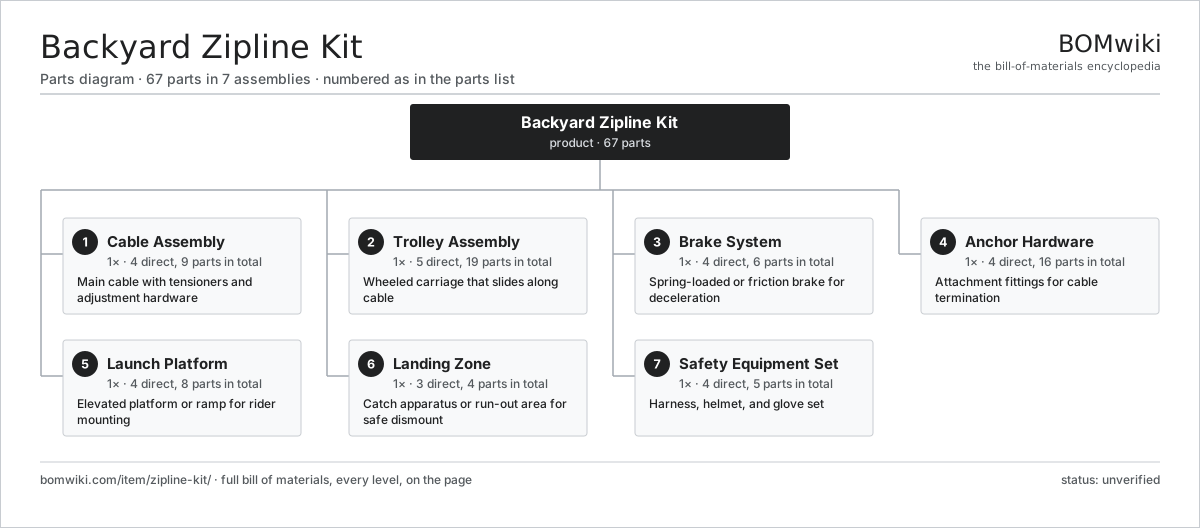
| # | Part | Qty | What it does |
|---|---|---|---|
| 1 | Cable Assembly 4 parts | 1× | Main cable with tensioners and adjustment hardware |
| 2 | Trolley Assembly 5 parts | 1× | Wheeled carriage that slides along cable |
| 3 | Brake System 4 parts | 1× | Spring-loaded or friction brake for deceleration |
| 4 | Anchor Hardware 4 parts | 1× | Attachment fittings for cable termination |
| 5 | Launch Platform 4 parts | 1× | Elevated platform or ramp for rider mounting |
| 6 | Landing Zone 3 parts | 1× | Catch apparatus or run-out area for safe dismount |
| 7 | Safety Equipment Set 4 parts | 1× | Harness, helmet, and glove set |
3D model
No 3D model yet. Have a CAD file of this? Add a 3D model — STL renders right on this page; STEP, FreeCAD, and OpenSCAD sources are welcome too (openly licensed, like all 3D models on BOMwiki).
Build & assembly graph
expand / collapse · shared sub-assemblies converge · links to related products · est. labourTap an assembly to expand/collapse · tap a part to open it · use “Open page” for any node · drag to pan, scroll to zoom.
Bill of materials for Backyard Zipline Kit
7 top-level lines · 35 rows shown · 67 parts total · indented to 3 levels| # | Item / sub-assembly | Part no. | Qty/assy | Ext. qty | Parts | Type |
|---|---|---|---|---|---|---|
| 1 | Cable Assembly 4 parts | zipline-kit-cable-assembly | 1× | 1 | 9 | assembly |
| 1.1 | Main Cable | zipline-kit-main-cable | 1× | 1 | · | part |
| 1.2 | Cable Eye | zipline-kit-cable-eye | 2× | 2 | · | part |
| 1.3 | Tensioner Turnbuckle | zipline-kit-tensioner-turnbuckle | 2× | 2 | · | part |
| 1.4 | Cable Clamp | zipline-kit-cable-clamp | 4× | 4 | · | part |
| 2 | Trolley Assembly 5 parts | zipline-kit-trolley | 1× | 1 | 19 | assembly |
| 2.1 | Trolley Frame | zipline-kit-trolley-frame | 1× | 1 | · | part |
| 2.2 | Wheel Set | zipline-kit-wheel-set | 3× | 3 | · | part |
| 2.3 | Handlebar | zipline-kit-handlebar | 1× | 1 | · | part |
| 2.4 | Trolley Bolt | zipline-kit-trolley-bolt | 8× | 8 | · | part |
| 2.5 | Ball Bearing | ball-bearing | 6× | 6 | · | part |
| 3 | Brake System 4 parts | zipline-kit-brake-system | 1× | 1 | 6 | assembly |
| 3.1 | Brake Lever | zipline-kit-brake-lever | 1× | 1 | · | part |
| 3.2 | Friction Pad | zipline-kit-friction-pad | 2× | 2 | · | part |
| 3.3 | Brake Spring | zipline-kit-brake-spring | 2× | 2 | · | part |
| 3.4 | Brake Mount | zipline-kit-brake-mount | 1× | 1 | · | part |
| 4 | Anchor Hardware 4 parts | zipline-kit-anchor-hardware | 1× | 1 | 16 | assembly |
| 4.1 | Anchor Shackle | zipline-kit-anchor-shackle | 4× | 4 | · | part |
| 4.2 | Anchor Mount Plate | zipline-kit-anchor-mount-plate | 2× | 2 | · | part |
| 4.3 | Anchor Bolt | zipline-kit-anchor-bolt | 8× | 8 | · | part |
| 4.4 | Fastener Set | fastener-set | 2× | 2 | · | part |
| 5 | Launch Platform 4 parts | zipline-kit-launch-platform | 1× | 1 | 8 | assembly |
| 5.1 | Platform Deck | zipline-kit-platform-deck | 1× | 1 | · | part |
| 5.2 | Platform Railing | zipline-kit-platform-railing | 1× | 1 | · | part |
| 5.3 | Platform Mounting | zipline-kit-platform-mounting | 4× | 4 | · | part |
| 5.4 | Launch Harness Ring | zipline-kit-launch-harness-ring | 2× | 2 | · | part |
| 6 | Landing Zone 3 parts | zipline-kit-landing-zone | 1× | 1 | 4 | assembly |
| 6.1 | Landing Platform | zipline-kit-landing-platform | 1× | 1 | · | part |
| 6.2 | Landing Net or Catch Bag | zipline-kit-landing-net-or-bag | 1× | 1 | · | part |
| 6.3 | Landing Padding | zipline-kit-landing-padding | 2× | 2 | · | part |
| 7 | Safety Equipment Set 4 parts | zipline-kit-safety-equipment | 1× | 1 | 5 | assembly |
| 7.1 | Harness | zipline-kit-harness | 1× | 1 | · | part |
| 7.2 | Helmet | zipline-kit-helmet | 1× | 1 | · | part |
| 7.3 | Gloves | zipline-kit-gloves | 1× | 1 | · | part |
| 7.4 | Carabiner Connect | zipline-kit-carabiner-connect | 2× | 2 | · | part |
Sourcing: possible vendors
Prices, MOQ, and lead times are algorithmic estimates, not quotes, and not claims about these companies. Company mappings are curated by keyword; est. price band $20–$3k. How estimates work| Vendor | HQ | Specialty | MOQ | Lead time |
|---|---|---|---|---|
|
🇩🇰LEGO
lego.com ↗
|
Billund, DK | Construction toys | 2,000 units | 6–10 wks |
|
🇺🇸Mattel
mattel.com ↗
|
El Segundo, US | Toys | 2,000 units | 6–10 wks |
|
🇺🇸Hasbro
hasbro.com ↗
|
Pawtucket, US | Toys & games | 2,000 units | 6–10 wks |
| bandainamco.co.jp ↗ | Tokyo, JP | Toys & amusement | 2,000 units | 6–10 wks |
| spinmaster.com ↗ | Toronto, CA | Toys | 2,000 units | 6–10 wks |
810-word article