Zipper Making Machine
ProductOverview
A zipper-making machine is a highly integrated automation line that transforms a plain fabric tape into a finished zipper. The process unfolds station by station: teeth are stamped or molded and positioned on the tape one by one, the slider is inserted and seated, and the final unit is cut to length. The entire sequence is timed by a single main drive shaft with indexing cams, so all stations move in lockstep. A single operator loads raw materials (blank teeth, tape, sliders) and unloads finished zippers; the machine handles all joining and assembly internally.
The Main Frame anchors several specialized assemblies. The Teeth Stamping / Injection Unit stamps or injects individual teeth or a continuous tooth strip; the Tape Feed System advances the tape in precise increments; the Tooth Application Station affixes each tooth to the tape with adhesive or a clinched metal collar; the Slider Assembly Station inserts and seats a slider at the top of the tape; and the Cutting Unit cuts the finished zipper to the required length. The Main Drive System synchronizes all stations using a rotating cam shaft and indexing gearbox. The Control System allows the operator to set production speed, zipper length, and tooth pitch, and stores recipes for common zipper sizes.
How it works
The basic cycle is simple but rapid. The tape is held in position on a series of cam-driven carriers. The Teeth Stamping / Injection Unit punches or molds a tooth and deposits it into a gripper at the current tape position. The Tooth Application Station station applies a small dot of thermoplastic adhesive or mechanical clinch, and presses the tooth onto the tape, bonding it in place. The Tape Feed System stepper then advances the tape by one tooth spacing (typically 3 mm). This repeats until the tape is full of teeth, covering the full length of the tape (usually 10–80 cm depending on the zipper type).
At the top end of the partially completed zipper, the Slider Assembly Station is now waiting. A slider blank has been positioned in a gripper; once the tape reaches it, the gripper presses the slider onto the tape so the slider ears engage over the teeth. Simultaneously, a small puller-tab (a fabric or plastic loop) is inserted through the slider and glued or riveted in place. The slider is now integrated into the top of the zipper.
Finally, the Cutting Unit cuts the completed zipper to final length using a hot wire, guillotine, or rotary cutter. The severed zipper falls into a collection bin or onto a conveyor for packing.
The coordination is achieved through the Main Drive System: a single motor at 30–100 rpm drives a Index Gearbox with multiple output shafts, each carrying a cam. Each station's actuators, the tooth stamper, the tape feed motor, the tooth applicator, the slider press, the cutter, are driven by a cam follower that rides on these rotating cams. As the main shaft rotates once per complete zipper, each cam lobe pushes or pulls its follower, executing the required motion at the right instant. Some modern machines replace mechanical cams with electronically timed solenoid valves and stepper motors, allowing recipe changes without physical cam swaps.
Tooth attachment methods
Teeth are bonded to tape using one of two methods. In adhesive systems, a small metering pump or heated-melt dispenser applies a dot of thermoplastic at the tooth root; the Pressing Head then presses the tooth into the adhesive and holds it for a few seconds as it cools. In mechanical systems, especially metal zippers, the tooth is clinched: a punch drives a small tab on the tooth shank through the tape and bends it over on the back side, mechanically locking the tooth. Metal zippers use mechanical clinch almost exclusively; nylon and polyester coil zippers typically use adhesive.
Adhesive zippers require careful temperature and timing control. If the melt is too cool, the bond is weak; if too hot, it may drip or char. The dwell time, how long the tooth is held under pressure, is critical; too short and the bond fails, too long and cycle time suffers. Industrial machines often monitor curing with thermal or ultrasonic sensors and adjust timing automatically.
Slider and puller-tab assembly
The slider is the U-shaped component that rides on the teeth and opens or closes the zipper. It arrives at the assembly station pre-formed (most commonly injection-molded plastic or die-cast metal). The Slider Assembly Station grips the slider and positions it over the top edge of the completed tooth tape. A pneumatic clamp or press lowers the slider over the tape so the slider ears (the parts that engage the tooth valleys) seat firmly on the tape and engage the teeth.
The puller-tab, usually a small nylon or polyester loop 20–30 mm long, is inserted through an opening in the slider simultaneously or immediately after the slider seating, and is adhesively bonded or riveted. The puller-tab is what a user grasps when pulling the zipper open; it is the only exposed part and often receives branding or color.
Production economics and changeover
Modern machines produce 300–1000 finished zippers per minute depending on the zipper length. A 20 cm metal zipper, which is quick to cut, may reach 1000 units/min; an 80 cm plastic coil zipper, which requires more tooth application time, might hit 300 units/min. Changeover between zipper sizes or styles involves recipe selection on the PLC, loading pre-programmed speed, tooth spacing, and cut length. On machines with mechanical cams, a true changeover requires removing and swapping cams, which is time-consuming. This is one reason modern machines trend toward cam-less, fully electronic sequencing.
Tooth waste during stamping varies with design efficiency; typical stamped-metal zippers generate 20–30% waste as edge trim and skeleton material. Nylon coil zippers have minimal waste because the coil wire is drawn continuously. Setting the tooth pitch (spacing) and adjusting die clearances are the main levers for reducing scrap.
Zipper Making Machine parts and their functions
8 top-level parts · 142 parts in total · full bill of materials below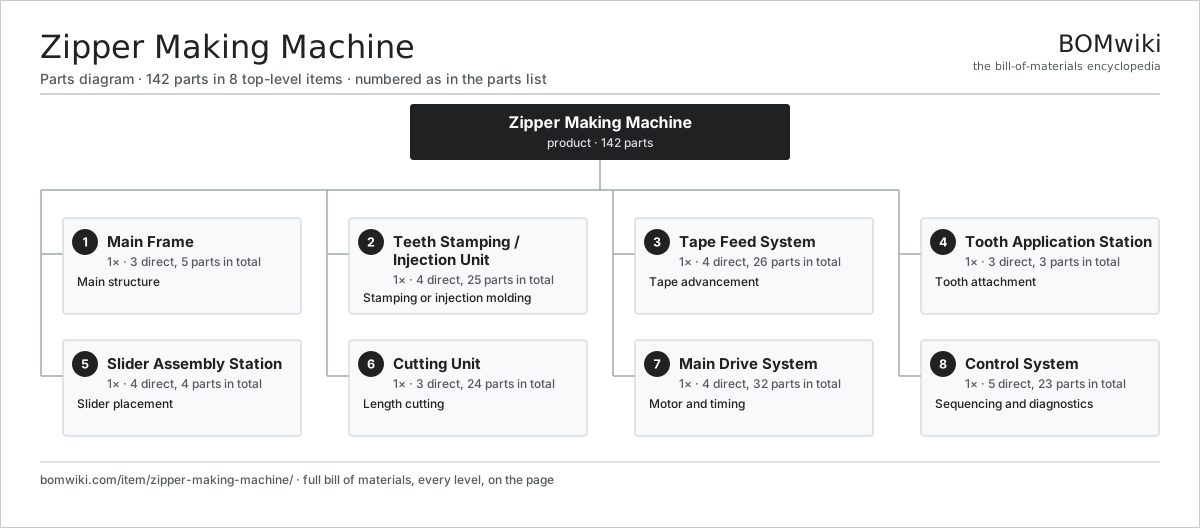
| # | Part | Qty | What it does |
|---|---|---|---|
| 1 | Main Frame 3 parts | 1× | Main structure |
| 2 | Teeth Stamping / Injection Unit 4 parts | 1× | Stamping or injection molding |
| 3 | Tape Feed System 4 parts | 1× | Tape advancement |
| 4 | Tooth Application Station 3 parts | 1× | Tooth attachment |
| 5 | Slider Assembly Station 4 parts | 1× | Slider placement |
| 6 | Cutting Unit 3 parts | 1× | Length cutting |
| 7 | Main Drive System 4 parts | 1× | Motor and timing |
| 8 | Control System 5 parts | 1× | Sequencing and diagnostics |
3D model
No 3D model yet. Have a CAD file of this? Add a 3D model. STL renders right on this page; STEP, FreeCAD, and OpenSCAD sources are welcome too (openly licensed, like all 3D models on BOMwiki).
Build & assembly graph
expand / collapse · shared sub-assemblies converge · links to related products · est. labourTap an assembly to expand/collapse · tap a part to open it · use “Open page” for any node · drag to pan, scroll to zoom.
Bill of materials for Zipper Making Machine
8 top-level lines · 50 rows shown · 142 parts total · indented to 3 levels| # | Item / sub-assembly | Part no. | Qty/assy | Ext. qty | Parts | Type |
|---|---|---|---|---|---|---|
| 1 | Main Frame 3 parts | zipper-making-machine-frame | 1× | 1 | 5 | assembly |
| 1.1 | Base Plate | zipper-making-machine-base-plate | 1× | 1 | · | part |
| 1.2 | Vertical Post | zipper-making-machine-vertical-posts | 2× | 2 | · | part |
| 1.3 | Cross Beam | zipper-making-machine-crossbeam | 2× | 2 | · | part |
| 2 | Teeth Stamping / Injection Unit 4 parts | zipper-making-machine-teeth-unit | 1× | 1 | 25 | assembly |
| 2.1 | Punch Die Set | zipper-making-machine-punch-die | 1× | 1 | · | part |
| 2.2 | Punch Ram | zipper-making-machine-punch-ram | 1× | 1 | · | part |
| 2.3 | Material Hopper | zipper-making-machine-material-hopper | 1× | 1 | · | part |
| 2.4 | Teeth Unit Motor 2 parts | zipper-making-machine-teeth-motor | 1× | 1 | 22 | assembly |
| 2.4.1 | Stator Assembly 3 parts + deeper › | stator-assembly | 1× | 1 | 3 | assembly |
| 2.4.2 | Rotor Assembly 4 parts + deeper › | rotor-assembly | 1× | 1 | 19 | assembly |
| 3 | Tape Feed System 4 parts | zipper-making-machine-tape-feed | 1× | 1 | 26 | assembly |
| 3.1 | Feed Roller | zipper-making-machine-feed-roller | 2× | 2 | · | part |
| 3.2 | Tape Feed Motor 2 parts | zipper-making-machine-feed-motor | 1× | 1 | 22 | assembly |
| 3.2.1 | Stator Assembly 3 parts + deeper › | stator-assembly | 1× | 1 | 3 | assembly |
| 3.2.2 | Rotor Assembly 4 parts + deeper › | rotor-assembly | 1× | 1 | 19 | assembly |
| 3.3 | Encoder | encoder | 1× | 1 | · | part |
| 3.4 | Helical Gear Pair | gear-pair | 1× | 1 | · | part |
| 4 | Tooth Application Station 3 parts | zipper-making-machine-tooth-application | 1× | 1 | 3 | assembly |
| 4.1 | Glue Applicator | zipper-making-machine-glue-applicator | 1× | 1 | · | part |
| 4.2 | Tooth Gripper | zipper-making-machine-tooth-gripper | 1× | 1 | · | part |
| 4.3 | Pressing Head | zipper-making-machine-pressing-head | 1× | 1 | · | part |
| 5 | Slider Assembly Station 4 parts | zipper-making-machine-slider-assembly-station | 1× | 1 | 4 | assembly |
| 5.1 | Slider Hopper | zipper-making-machine-slider-hopper | 1× | 1 | · | part |
| 5.2 | Slider Gripper | zipper-making-machine-slider-gripper | 1× | 1 | · | part |
| 5.3 | Puller Tab Inserter | zipper-making-machine-puller-tab-inserter | 1× | 1 | · | part |
| 5.4 | Slider Press | zipper-making-machine-slider-press | 1× | 1 | · | part |
| 6 | Cutting Unit 3 parts | zipper-making-machine-cutting-unit | 1× | 1 | 24 | assembly |
| 6.1 | Cutting Blade | zipper-making-machine-cutting-blade | 1× | 1 | · | part |
| 6.2 | Cutting Motor 2 parts | zipper-making-machine-cutting-motor | 1× | 1 | 22 | assembly |
| 6.2.1 | Stator Assembly 3 parts + deeper › | stator-assembly | 1× | 1 | 3 | assembly |
| 6.2.2 | Rotor Assembly 4 parts + deeper › | rotor-assembly | 1× | 1 | 19 | assembly |
| 6.3 | Length Stop | zipper-making-machine-cut-length-stop | 1× | 1 | · | part |
| 7 | Main Drive System 4 parts | zipper-making-machine-main-drive | 1× | 1 | 32 | assembly |
| 7.1 | Drive Motor 3 parts | zipper-making-machine-drive-motor | 1× | 1 | 24 | assembly |
| 7.1.1 | Stator Assembly 3 parts + deeper › | stator-assembly | 1× | 1 | 3 | assembly |
| 7.1.2 | Rotor Assembly 4 parts + deeper › | rotor-assembly | 1× | 1 | 19 | assembly |
| 7.1.3 | Ball Bearing | ball-bearing | 2× | 2 | · | part |
| 7.2 | Index Gearbox 3 parts | zipper-making-machine-index-gearbox | 1× | 1 | 6 | assembly |
| 7.2.1 | Gearbox Housing | gearbox-housing | 1× | 1 | · | part |
| 7.2.2 | Helical Gear Pair | gear-pair | 2× | 2 | · | part |
| 7.2.3 | Ball Bearing | ball-bearing | 3× | 3 | · | part |
| 7.3 | Cam Shaft | zipper-making-machine-cam-shaft | 1× | 1 | · | part |
| 7.4 | Drive Belt | drive-belt | 1× | 1 | · | part |
| 8 | Control System 5 parts | zipper-making-machine-control-system | 1× | 1 | 23 | assembly |
| 8.1 | PLC Board | zipper-making-machine-plc | 1× | 1 | · | part |
| 8.2 | VFD | zipper-making-machine-vfd | 1× | 1 | · | part |
| 8.3 | Relay | relay | 8× | 8 | · | part |
| 8.4 | Connector | connector | 12× | 12 | · | part |
| 8.5 | Power Supply | power-supply | 1× | 1 | · | part |
Something wrong in this list? Report a problem with this BOM.
Related products
same domain, ranked by shared parts Automatic Fabric Cutting Machine
1,695 parts · shares 1 with this page
Automatic Pocket Welt Machine
98 parts · shares 1 with this page
Automatic Winding Machine
288 parts · shares 1 with this page
Belt Loop Attaching Machine
84 parts · shares 1 with this page
Blindstitch Hemming Machine
67 parts · shares 1 with this page
Automatic Fabric Cutting Machine
1,695 parts · shares 1 with this page
Automatic Pocket Welt Machine
98 parts · shares 1 with this page
Automatic Winding Machine
288 parts · shares 1 with this page
Belt Loop Attaching Machine
84 parts · shares 1 with this page
Blindstitch Hemming Machine
67 parts · shares 1 with this page
Sourcing: possible vendors
Browse the supplier directory → Prices, MOQ, and lead times are algorithmic estimates, not quotes, and not claims about these companies. Company mappings are curated by keyword; est. price band $10k–$1M. How estimates work| Vendor | HQ | Specialty | MOQ | Lead time |
|---|---|---|---|---|
|
🇨🇭Rieter
rieter.com ↗
|
Winterthur, CH | Spinning machinery | 10 units | 14–24 wks |
| truetzschler.com ↗ | Mönchengladbach, DE | Textile machinery | 10 units | 14–24 wks |
|
🇧🇪Picanol
picanol.be ↗
|
Ypres, BE | Weaving machines | 10 units | 14–24 wks |
| karlmayer.com ↗ | Obertshausen, DE | Warp knitting machines | 10 units | 14–24 wks |
|
🇨🇭Saurer
saurer.com ↗
|
Arbon, CH | Spinning & embroidery | 10 units | 14–24 wks |
1,046-word article