Zoetrope
ProductOverview
A zoetrope is one of the earliest animation devices, predating motion pictures by decades. The name derives from Greek: ''zoe'' (life) and ''tropos'' (turning). The device consists of a rotating cylinder (Drum Cylinder) with regularly spaced vertical slots cut into its wall. Inside the cylinder, a strip of sequential illustrations (Animation Strip) is affixed to the interior wall, one image per slot spacing.
When the cylinder is rotated and an observer peers through the moving slots, optical persistence of vision causes the brain to perceive the static images as continuous, smooth animation. A single figure appears to jump, walk, gallop, or perform any motion captured in the sequential frames. The Spindle and Bearing Assembly allows low-friction rotation, while the Base Assembly provides stable support. An optional Mirror or Reflective Insert allows direct viewing of the animation by reflection instead of through slots.
How it works
The optical principle is persistence of vision: the human eye retains an image for approximately 10–100 milliseconds after the visual stimulus is removed. A zoetrope exploits this by blocking the viewer's sight line with a slot, exposing a new image, blocking again, and exposing the next image in rapid succession.
As the Drum Cylinder rotates, each slot passes in front of the observer's eye. While a slot is aligned, the viewer sees the corresponding illustration on the Animation Strip through that slot. The cylinder rotates continuously; the next slot arrives, showing the next frame. The rapidly alternating images, each visible for a fraction of a second, fuse into perceived motion.
The animation speed is determined by the rotation rate and slot count. For example, a 16-slot zoetrope rotating at 60 RPM presents images at a rate of 16 × 60 / 60 = 16 frames per second (FPS), a typical film frame rate. Faster rotation increases FPS, making motion appear faster or smoother. Slower rotation decreases FPS, making motion appear jerky.
Slot and Frame Relationship
The number of slots directly corresponds to the number of sequential illustrations required for one complete cycle. An 8-slot zoetrope requires 8 distinct images showing the 8 phases of a motion (e.g., a walking figure). A 16-slot version requires 16 images for smoother animation. The Slot Pattern System is precisely spaced; for a cylinder of circumference C with N slots, each slot is spaced C/N apart.
Base and Bearing System
The Base Assembly is a stable circular platform, typically made of wood or cast metal. At its center, the Spindle Housing contains a Bearing Race, which supports a Spindle Shaft, a vertical rod passing through the drum center. The bearing may be a ball bearing (for low-friction, long-duration spinning) or a bronze/polymer bushing (simpler, lower cost).
The Stabilizing Weight, lead or iron weights embedded in the base, increases rotational inertia, allowing the drum to coast smoothly when hand-spun and reducing vibration-induced image blur.
A Spindle Top Cup at the top of the shaft provides a conical or flat surface supporting the weight of the drum. The Spindle Bottom Collar prevents the spindle from being pulled upward through the bearing.
Animation Strip Preparation
The Animation Strip is a paper or polyester film band (typically 2–4 inches tall and as long as the cylinder circumference) with sequential illustrations printed or hand-drawn. The images must be registered precisely to the Slot Pattern System; each illustration aligns with one slot. Registration marks (guides or grid lines) on the strip aid alignment during installation.
The strip is affixed to the interior cylinder wall using Strip Adhesive, double-sided tape or contact cement. Proper alignment is critical; if images are misaligned by even 0.1 inches, the animation becomes jumpy or distorted.
Mirror-Based Viewing
Early zoetropes required observers to peer through the slots. The Mirror or Reflective Insert, a flat or slightly concave mirror mounted on the drum's central axis below the animation strip, enables an alternative viewing method. The mirror reflects the images toward the observer's eye, allowing the animation to be viewed from above or at an angle, improving visibility and reducing the awkward posture required for slot-based viewing.
Historical Development
The zoetrope was invented in 1834 by William George Horner and patented as the "Daedaleum." It was rediscovered and commercialized in the 1860s under the name "Zoetrope," becoming a popular parlor novelty and educational device. Thousands of zoetrope strip designs, from dancing figures to naturalistic animals, were commercially produced throughout the 19th and early 20th centuries.
The zoetrope is a direct ancestor of the motion picture. The principle of persistence of vision, demonstrated by the zoetrope, was essential to the invention of cinema. Early film cameras captured 12–16 frames per second, similar to a moderately spun zoetrope.
Modern Uses and Variants
Traditional zoetropes have largely been displaced by digital animation and video. However, they remain valuable as:
- Educational tools demonstrating the principles of animation and persistence of vision.
- Artistic installations in museums and galleries, often with elaborate or interactive designs.
- Maker projects where enthusiasts create custom animation strips for handmade zoetropes.
Modern zoetropes may use:
- Electric motors instead of hand-spinning, for continuous operation.
- LED illumination instead of relying on ambient light, improving visibility in dim conditions.
- Printed plastic drums instead of cardboard, for durability.
- Multiple concentric cylinders with different animation speeds and patterns.
Relationship to Related Devices
The zoetrope is one of several pre-cinema animation devices:
- Phenakistoscope (1833): A rotating disk with images and radial slots, viewed in a mirror.
- Praxinoscope (1877): A refinement using interior mirrors instead of slots, producing clearer images.
- Flip books: Sequential drawings in a book, animated by rapid page-turning.
The zoetrope's advantage was its ease of manufacture and reusability, animation strips could be swapped, and a single device could display many different animations.
Zoetrope parts and their functions
5 top-level parts · 24 parts in total · full bill of materials below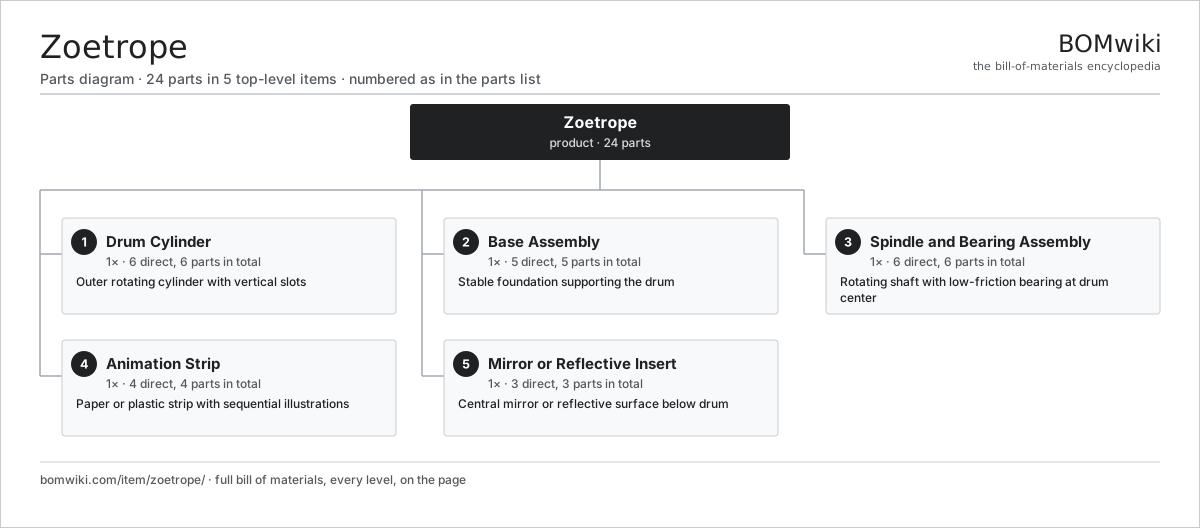
| # | Part | Qty | What it does |
|---|---|---|---|
| 1 | Drum Cylinder 6 parts | 1× | Outer rotating cylinder with vertical slots |
| 2 | Base Assembly 5 parts | 1× | Stable foundation supporting the drum |
| 3 | Spindle and Bearing Assembly 6 parts | 1× | Rotating shaft with low-friction bearing at drum center |
| 4 | Animation Strip 4 parts | 1× | Paper or plastic strip with sequential illustrations |
| 5 | Mirror or Reflective Insert 3 parts | 1× | Central mirror or reflective surface below drum |
3D model
No 3D model yet. Have a CAD file of this? Add a 3D model. STL renders right on this page; STEP, FreeCAD, and OpenSCAD sources are welcome too (openly licensed, like all 3D models on BOMwiki).
Build & assembly graph
expand / collapse · shared sub-assemblies converge · links to related products · est. labourTap an assembly to expand/collapse · tap a part to open it · use “Open page” for any node · drag to pan, scroll to zoom.
Bill of materials for Zoetrope
5 top-level lines · 29 rows shown · 24 parts total · indented to 3 levels| # | Item / sub-assembly | Part no. | Qty/assy | Ext. qty | Parts | Type |
|---|---|---|---|---|---|---|
| 1 | Drum Cylinder 6 parts | zoetrope-drum-cylinder | 1× | 1 | 6 | assembly |
| 1.1 | Cylinder Wall | zoetrope-cylinder-wall | 1× | 1 | · | part |
| 1.2 | Slot Pattern System | zoetrope-cylinder-slot-pattern | 1× | 1 | · | part |
| 1.3 | Top Reinforcing Rim | zoetrope-cylinder-rim-top | 1× | 1 | · | part |
| 1.4 | Bottom Reinforcing Rim | zoetrope-cylinder-rim-bottom | 1× | 1 | · | part |
| 1.5 | Slot Edge Treatment | zoetrope-slot-finishing | 1× | 1 | · | part |
| 1.6 | Fastener Set | fastener-set | 1× | 1 | · | part |
| 2 | Base Assembly 5 parts | zoetrope-base-assembly | 1× | 1 | 5 | assembly |
| 2.1 | Base Platform | zoetrope-base-platform | 1× | 1 | · | part |
| 2.2 | Spindle Housing | zoetrope-spindle-housing | 1× | 1 | · | part |
| 2.3 | Friction Bushing | zoetrope-spindle-bushing | 1× | 1 | · | part |
| 2.4 | Stabilizing Weight | zoetrope-base-weight | 1× | 1 | · | part |
| 2.5 | Fastener Set | fastener-set | 1× | 1 | · | part |
| 3 | Spindle and Bearing Assembly 6 parts | zoetrope-spindle-bearing | 1× | 1 | 6 | assembly |
| 3.1 | Spindle Shaft | zoetrope-spindle-shaft | 1× | 1 | · | part |
| 3.2 | Bearing Race | zoetrope-spindle-bearing-race | 1× | 1 | · | part |
| 3.3 | Spindle Top Cup | zoetrope-spindle-top-cup | 1× | 1 | · | part |
| 3.4 | Spindle Bottom Collar | zoetrope-spindle-bottom-collar | 1× | 1 | · | part |
| 3.5 | Ball Bearing | ball-bearing | 1× | 1 | · | part |
| 3.6 | Fastener Set | fastener-set | 1× | 1 | · | part |
| 4 | Animation Strip 4 parts | zoetrope-animation-strip | 1× | 1 | 4 | assembly |
| 4.1 | Strip Substrate | zoetrope-strip-substrate | 1× | 1 | · | part |
| 4.2 | Sequential Illustrations | zoetrope-strip-illustrations | 1× | 1 | · | part |
| 4.3 | Registration Marks | zoetrope-strip-registration-marks | 1× | 1 | · | part |
| 4.4 | Strip Adhesive | zoetrope-strip-adhesive-backing | 1× | 1 | · | part |
| 5 | Mirror or Reflective Insert 3 parts | zoetrope-mirror-insert | 1× | 1 | 3 | assembly |
| 5.1 | Central Mirror | zoetrope-mirror-central | 1× | 1 | · | part |
| 5.2 | Mirror Housing | zoetrope-mirror-housing | 1× | 1 | · | part |
| 5.3 | Fastener Set | fastener-set | 1× | 1 | · | part |
Something wrong in this list? Report a problem with this BOM.
Related products
same domain, ranked by shared parts Camera Gimbal Stabilizer
177 parts · shares 1 with this page
Camera Gimbal Stabilizer
177 parts · shares 1 with this page
 Camera Jib Crane
67 parts · shares 1 with this page
Camera Jib Crane
67 parts · shares 1 with this page
 Camera Motion Control Rig
210 parts · shares 1 with this page
Camera Motion Control Rig
210 parts · shares 1 with this page
 Computerized GoTo Telescope
320 parts · shares 1 with this page
Computerized GoTo Telescope
320 parts · shares 1 with this page
 Digital Cinema Camera
305 parts · shares 1 with this page
Digital Cinema Camera
305 parts · shares 1 with this page
Sourcing: possible vendors
Browse the supplier directory → Prices, MOQ, and lead times are algorithmic estimates, not quotes, and not claims about these companies. Company mappings are curated by keyword; est. price band $100–$8k. How estimates work| Vendor | HQ | Specialty | MOQ | Lead time |
|---|---|---|---|---|
|
🇯🇵Canon
canon.com ↗
|
Tokyo, JP | Imaging & optics | 500 units | 10–16 wks |
|
🇯🇵Nikon
nikon.com ↗
|
Tokyo, JP | Imaging & optics | 500 units | 10–16 wks |
|
🇩🇪ZEISS
zeiss.com ↗
|
Oberkochen, DE | Optics & optoelectronics | 500 units | 10–16 wks |
| leica-camera.com ↗ | Wetzlar, DE | Cameras & optics | 500 units | 10–16 wks |
| flir.com ↗ | Wilsonville, US | Thermal imaging | 500 units | 10–16 wks |
983-word article