Access Control Panel
ProductOverview
An access control panel is the central nervous system of a physical security system. It reads identity credentials from card readers and keypads, consults its internal credential database to make an access decision, and commands door locks to open or remain closed. The panel operates as a standalone controller (typically serving 1–4 doors) or as a network-connected node in a larger distributed system managed from a central server.
Panels are found on office building entrances, data centers, hospitals, manufacturing facilities, and secured government buildings. They provide real-time access logging, tamper alerts, and integration with video surveillance and alarm systems. Most panels are installed in wall-mount or rack-mount enclosures near the doors they control, with hardwired or networked readers and locks.
How it works
The main controller board runs embedded access control firmware that implements the core decision logic. The flow is:
Read credential: A card swipe or keypad entry transmits card number and PIN via Wiegand or RS485 protocol to the reader interface module.
Consult database: The MCU firmware searches its credential table (stored in Flash) to match the scanned card against known good card numbers. If a PIN is required, it validates the entered PIN against the stored credential.
Check time and rules: The panel evaluates access rules: Is this credential valid today? Is this time window allowed for this cardholder? Are there any active exceptions or lockouts?
Make decision: If all checks pass, the MCU energizes a relay connected to the door lock (e.g., electric strike or magnetic lock).
Log event: The panel records the timestamp, card number, result (granted or denied), and reader ID in non-volatile memory.
Credential and time management
The panel stores credential records as structured data: card number, PIN, access groups, and validity dates. Each cardholder is assigned to one or more access groups, and each group has associated time schedules. For example, the "Engineering" group might have access to the server room 24/7, while the "Visitor" group can only access the lobby 9 AM–5 PM, Monday–Friday.
The MCU includes a real-time clock (RTC) with NTP synchronization capability. This ensures that time-based rules are evaluated accurately even if the mains power or network is temporarily lost. A tamper-evident battery backs the RTC so that the correct time persists even if the panel is unplugged.
For distributed systems, the central management server pushes credential updates to the panel via the network gateway. Credential changes (new cards, revoked access, group membership updates) propagate to the panel every 15–60 minutes, depending on system configuration. This latency is typically acceptable for security; in high-risk scenarios, a denied cardholder is physically unable to enter until the local credential database is refreshed.
Reader interfaces and multimodal support
The reader interface module decodes Wiegand, RS485, or other standard access control protocols. The most common protocol is Wiegand, a simple binary encoding used by legacy card readers, fingerprint scanners, and iris readers. The reader pulls data and clock lines low in a timed pattern; the interface module reconstructs 26-bit or 34-bit card numbers from this signaling.
Modern panels support multiple reader types on the same circuit:
- Proximity cards (125 kHz or 13.56 MHz) read by passive RFID readers
- PIN keypads (12-button or 16-button) for multi-factor access (card + PIN)
- Biometric readers (fingerprint or facial) that output Wiegand or RS485
- Mobile credential via Bluetooth or NFC to smartphones (requires networked MCU)
Multimodal readers improve security: a cardholder must present both a valid credential AND a correct PIN before the panel grants access. The time-based rate limiting (no more than 2 access events per second) prevents rapid-fire card swiping attacks.
Relay outputs and lock control
The relay module is a bank of high-current relays controlled by the MCU via low-current drive transistors. Each relay output is typically wired to:
- A strike lock (energized for 0.5–2 seconds to release the latch)
- A magnetic lock (energized continuously to hold the door)
- An alarm siren or notification light
- A video camera recording trigger
The power board provides 24 VDC to the relays; the MCU firmware sequences relay energization and timing. For example, when a valid credential is presented:
- MCU energizes the door-unlock relay for 1 second (commands the electric strike to release).
- MCU optionally energizes a green LED relay in the reader to indicate "Access Granted."
- MCU logs the event with timestamp and card number.
If an invalid credential is presented or a cardholder has no access during the current time window:
- MCU de-energizes any active relays.
- MCU optionally energizes a red LED or buzzer relay to indicate "Access Denied."
- If multiple consecutive denials occur (3–5 in 1 minute), the MCU triggers an alarm relay or sends a notification to the central server.
Battery backup and fail-safe operation
The battery backup module contains a sealed lead-acid battery that keeps the panel (and connected locks) functional during a mains power outage. The power board includes a charger circuit that maintains the battery at full capacity whenever mains power is available.
If mains power is lost, the battery supplies 24 VDC to the MCU and relays. Most facilities configure fail-safe behavior: the panel remains powered long enough to allow occupants to press an emergency exit button, which commands a relay to energize the door unlock indefinitely. This ensures life-safety egress even during an extended power outage.
Battery runtime depends on load: a typical 12 Ah battery at 2 A draw provides 6 hours of panel operation and 2–3 hours of continuous door unlock. For critical facilities (hospitals, data centers), larger batteries or multiple panels with separate backup supplies are deployed.
Network integration and remote management
Networked panels include the network gateway module, which provides Ethernet (RJ45) or cellular connectivity (LTE CAT-M, NB-IoT) to a central management server. The server is typically a rack-mounted appliance running access control software (e.g., Genetec SYNERGIS, SALTO XS, Honeywell Pro Watch).
The network link enables:
- Remote credential provisioning: New cards are added to the central database and pushed to panels within minutes.
- Live monitoring: Security staff see real-time access events and can grant or revoke access remotely.
- Automated alerts: Tamper events, battery low, communication loss, or suspicious access patterns trigger notifications.
- Video integration: The panel can command a camera to start recording when an access event occurs.
- Audit compliance: All access events are logged to the server with full event details (card, reader, time, result).
For offline operation (network failure), the panel falls back to its local credential database and continues to authorize access based on the last-known good credential set. When the network recovers, the panel synchronizes with the server to pick up any credential changes that occurred while offline.
Security and tamper protection
The cabinet enclosure is a physical tamper barrier: the front door is secured with a lock, and the panels are typically installed in secure locations (server room, management office). The MCU monitors several tamper sensors:
- Enclosure tamper switch: Signals if someone opens the cabinet without authorization.
- Battery tamper switch: Alerts if someone removes or disconnects the backup battery.
- Reader wiring integrity: Checks for cut or shorted reader input lines.
A tamper event triggers an alarm relay and may lock down the panel, denying all further access until manually cleared by security personnel.
The credential database is stored in encrypted Flash memory; card numbers and PIN codes are hashed and salted, preventing easy extraction if the panel is stolen. Modern panels include secure boot and firmware signing, preventing installation of malicious firmware.
Diagnostics and maintenance
The panel displays status on an LED indicator or small LCD panel. Green typically indicates normal operation; amber indicates warnings (low battery, communication loss); red indicates critical faults (power failure, relay stuck, credential database corruption).
Periodic maintenance includes:
- Battery test: The panel self-tests the battery quarterly or monthly to verify capacity.
- Reader and lock functional test: Security staff periodically swipe a test card to verify the reader and lock respond.
- Log review: The panel stores access event logs locally; these are periodically downloaded to the central server for audit and investigation.
Common failure modes include relay contactors sticking closed (preventing lock reset), Wiegand reader data corruption (misreading card numbers), and network module timeout (requiring manual credential updates). Modern panels include built-in diagnostics to detect and report these issues.
Access Control Panel parts and their functions
8 top-level parts · 52 parts in total · full bill of materials below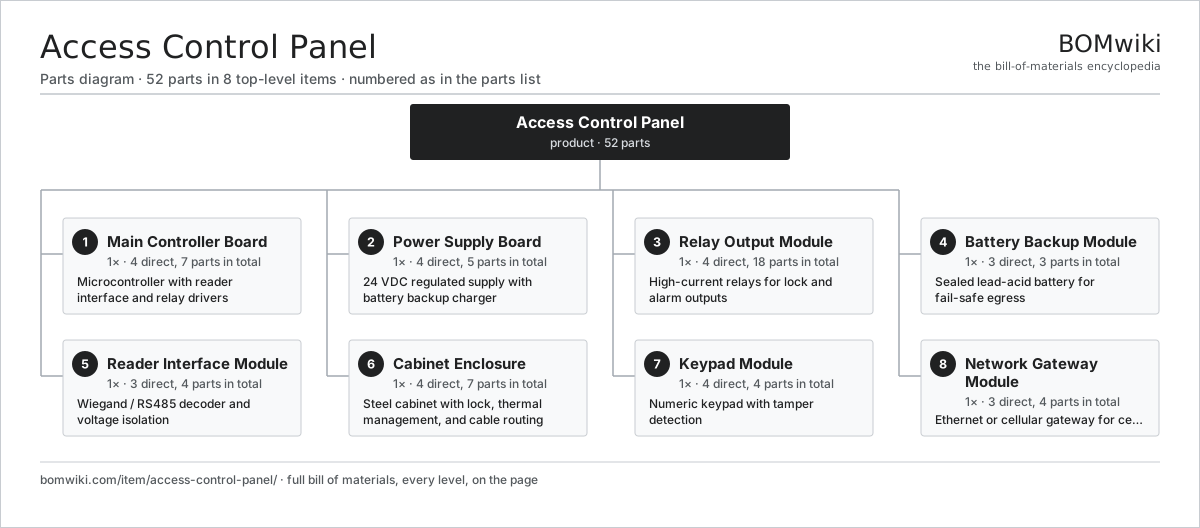
| # | Part | Qty | What it does |
|---|---|---|---|
| 1 | Main Controller Board 4 parts | 1× | Microcontroller with reader interface and relay drivers |
| 2 | Power Supply Board 4 parts | 1× | 24 VDC regulated supply with battery backup charger |
| 3 | Relay Output Module 4 parts | 1× | High-current relays for lock and alarm outputs |
| 4 | Battery Backup Module 3 parts | 1× | Sealed lead-acid battery for fail-safe egress |
| 5 | Reader Interface Module 3 parts | 1× | Wiegand / RS485 decoder and voltage isolation |
| 6 | Cabinet Enclosure 4 parts | 1× | Steel cabinet with lock, thermal management, and cable routing |
| 7 | Keypad Module 4 parts | 1× | Numeric keypad with tamper detection |
| 8 | Network Gateway Module 3 parts | 1× | Ethernet or cellular gateway for central system |
3D model
No 3D model yet. Have a CAD file of this? Add a 3D model. STL renders right on this page; STEP, FreeCAD, and OpenSCAD sources are welcome too (openly licensed, like all 3D models on BOMwiki).
Build & assembly graph
expand / collapse · shared sub-assemblies converge · links to related products · est. labourTap an assembly to expand/collapse · tap a part to open it · use “Open page” for any node · drag to pan, scroll to zoom.
Bill of materials for Access Control Panel
8 top-level lines · 37 rows shown · 52 parts total · indented to 3 levels| # | Item / sub-assembly | Part no. | Qty/assy | Ext. qty | Parts | Type |
|---|---|---|---|---|---|---|
| 1 | Main Controller Board 4 parts | access-control-panel-main-board | 1× | 1 | 7 | assembly |
| 1.1 | Microcontroller | mcu | 1× | 1 | · | part |
| 1.2 | Bare PCB | pcb-bare | 1× | 1 | · | part |
| 1.3 | SMD Passive (R/C/L) | smd-passives | 1× | 1 | · | part |
| 1.4 | Connector | connector | 4× | 4 | · | part |
| 2 | Power Supply Board 4 parts | access-control-panel-power-board | 1× | 1 | 5 | assembly |
| 2.1 | Power Supply | power-supply | 1× | 1 | · | part |
| 2.2 | Bare PCB | pcb-bare | 1× | 1 | · | part |
| 2.3 | SMD Passive (R/C/L) | smd-passives | 1× | 1 | · | part |
| 2.4 | Connector | connector | 2× | 2 | · | part |
| 3 | Relay Output Module 4 parts | access-control-panel-relay-module | 1× | 1 | 18 | assembly |
| 3.1 | Relay | relay | 8× | 8 | · | part |
| 3.2 | Bare PCB | pcb-bare | 1× | 1 | · | part |
| 3.3 | Power MOSFET | mosfet | 8× | 8 | · | part |
| 3.4 | Connector | connector | 1× | 1 | · | part |
| 4 | Battery Backup Module 3 parts | access-control-panel-battery-backup | 1× | 1 | 3 | assembly |
| 4.1 | 12 V Battery | lv-battery | 1× | 1 | · | part |
| 4.2 | Connector | connector | 1× | 1 | · | part |
| 4.3 | Coil Spring | coil-spring | 1× | 1 | · | part |
| 5 | Reader Interface Module 3 parts | access-control-panel-reader-interface | 1× | 1 | 4 | assembly |
| 5.1 | Bare PCB | pcb-bare | 1× | 1 | · | part |
| 5.2 | Connector | connector | 2× | 2 | · | part |
| 5.3 | SMD Passive (R/C/L) | smd-passives | 1× | 1 | · | part |
| 6 | Cabinet Enclosure 4 parts | access-control-panel-enclosure | 1× | 1 | 7 | assembly |
| 6.1 | Sheet Metal Panel | sheet-panel | 4× | 4 | · | part |
| 6.2 | Fastener Set | fastener-set | 1× | 1 | · | part |
| 6.3 | Connector | connector | 1× | 1 | · | part |
| 6.4 | O-Ring Set | oring-set | 1× | 1 | · | part |
| 7 | Keypad Module 4 parts | access-control-panel-keypad-module | 1× | 1 | 4 | assembly |
| 7.1 | Bare PCB | pcb-bare | 1× | 1 | · | part |
| 7.2 | Touch Digitizer | touch-digitizer | 1× | 1 | · | part |
| 7.3 | Connector | connector | 1× | 1 | · | part |
| 7.4 | SMD Passive (R/C/L) | smd-passives | 1× | 1 | · | part |
| 8 | Network Gateway Module 3 parts | access-control-panel-network-module | 1× | 1 | 4 | assembly |
| 8.1 | Compute SoC Module | soc-module | 1× | 1 | · | part |
| 8.2 | Bare PCB | pcb-bare | 1× | 1 | · | part |
| 8.3 | Connector | connector | 2× | 2 | · | part |
Something wrong in this list? Report a problem with this BOM.
Related products
same domain, ranked by shared parts Intrusion Alarm Panel
40 parts · shares 9 with this page
Intrusion Alarm Panel
40 parts · shares 9 with this page
 Electronic Key Cabinet
92 parts · shares 8 with this page
Electronic Key Cabinet
92 parts · shares 8 with this page
 Automatic Swing Door Operator
43 parts · shares 7 with this page
Automatic Swing Door Operator
43 parts · shares 7 with this page
 Smart Parcel Locker
278 parts · shares 6 with this page
Smart Parcel Locker
278 parts · shares 6 with this page
 Video Intercom System
110 parts · shares 5 with this page
Video Intercom System
110 parts · shares 5 with this page
 Mantrap Interlock Portal
82 parts · shares 6 with this page
Mantrap Interlock Portal
82 parts · shares 6 with this page
Sourcing: possible vendors
Browse the supplier directory → Prices, MOQ, and lead times are algorithmic estimates, not quotes, and not claims about these companies. Company mappings are curated by keyword; est. price band $50–$10k. How estimates work| Vendor | HQ | Specialty | MOQ | Lead time |
|---|---|---|---|---|
| assaabloy.com ↗ | Stockholm, SE | Locks & access | 1,000 units | 8–12 wks |
|
🇺🇸Allegion
allegion.com ↗
|
Dublin, US | Security products (Schlage) | 1,000 units | 8–12 wks |
| dormakaba.com ↗ | Rümlang, CH | Access & door systems | 1,000 units | 8–12 wks |
| honeywell.com ↗ | Charlotte, US | Building & safety tech | 1,000 units | 8–12 wks |
| hikvision.com ↗ | Hangzhou, CN | Surveillance & security | 1,000 units | 8–12 wks |
1,489-word article