Action Camera Product
Overview
An action camera is a compact, ruggedised camera built to record point-of-view video and stills in motion, underwater, and in conditions that would disable a conventional camera. It trades interchangeable optics and a large sensor for sealing, impact resistance, and aggressive image stabilisation in a body small enough to clip to a helmet, handlebar, or chest harness. The fixed ultra-wide lens captures an immersive field of view, while on-board processing crops and warps each frame to hold the horizon level despite violent camera shake.
How it works
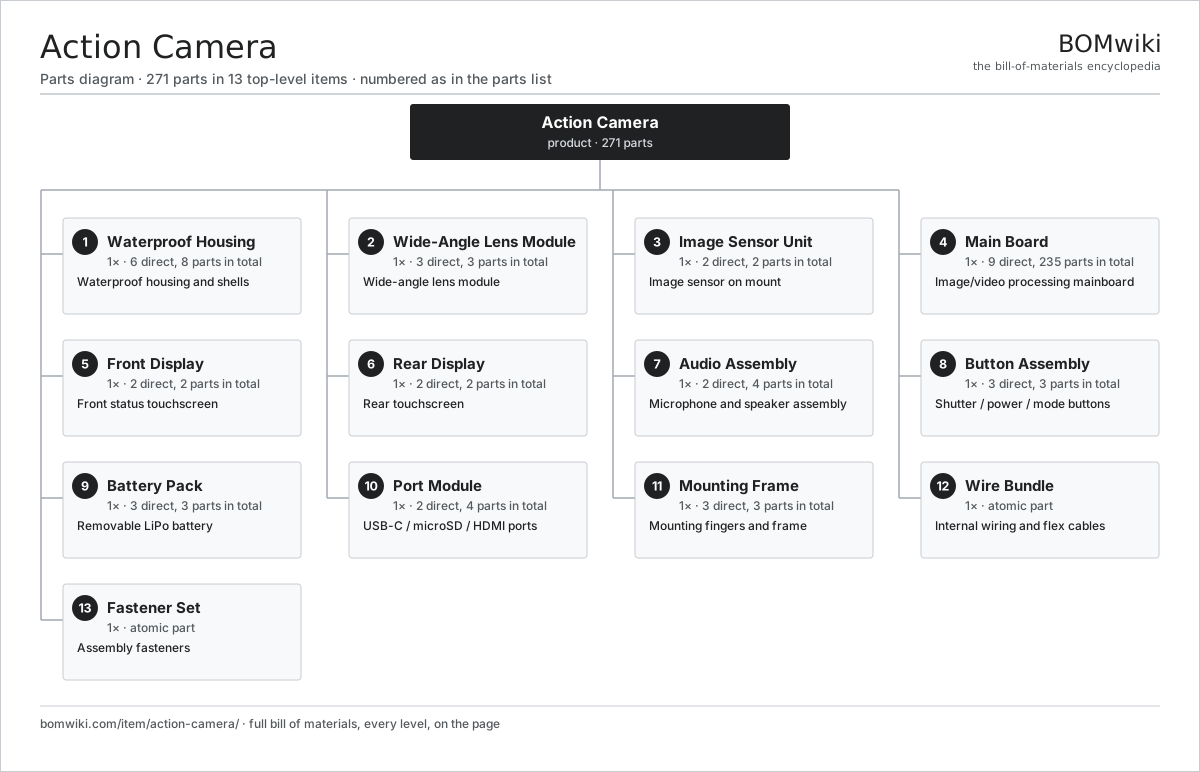
Scene light passes through the Wide-Angle Lens Module, whose wide-angle group and IR-cut filter project an image onto the Image Sensor Unit. The CMOS sensor converts that image to a high-bandwidth digital stream that the Main Board encodes in real time: its image/video SoC handles debayering, tone mapping, and H.265 compression, while an on-board IMU feeds the electronic stabilisation that counter-rotates each frame.
A sealed Waterproof Housing with O-ring seals and a hardened lens port keeps water and dust out, and the entire optical stack is held in alignment by a precision sensor mount behind the lens. Framing and playback use two screens: the small Front Display for self-framing and the larger Rear Display touchscreen for menus and review. Three MEMS microphones in the Audio Assembly assembly capture directional sound with wind-noise suppression.
Power comes from a removable Battery Pack pack with its own protection board, and footage is written to a microSD card through the Port Module module, which also carries USB-C and micro-HDMI. Folding fingers on the Mounting Frame snap into the broad ecosystem of quick-release mounts, letting one camera move between a helmet, a chest rig, and an underwater pole. The result is a camera that records usable, stabilised footage in places no other camera survives.', },
'binoculars': { specs: [ ['Type', 'Roof-prism binocular'], ['Configuration', '10 × 42'], ['Magnification', '10×'], ['Objective diameter', '42 mm'], ['Prism type', 'Schmidt-Pechan roof, phase-coated'], ['Exit pupil', '4.2 mm'], ['Field of view', '113 m at 1000 m (6.5°)'], ['Eye relief', '17 mm'], ['Close focus', '2.0 m'], ['Coatings', 'Fully multi-coated, dielectric'], ['Waterproofing', 'Nitrogen-purged, fogproof'], ['Chassis', 'Magnesium, rubber-armored'], ['Weight', '650 g'], ], body: '## Overview
Binoculars are a pair of matched refracting telescopes mounted side by side so both eyes view a magnified, erect image at once. The 10 × 42 configuration delivers ten times magnification through 42 mm objectives, a balance of reach, brightness, and hand-holdability favoured for birding, hunting, and general field use. A roof-prism design folds the light path into a straight, compact barrel rather than the offset shape of porro-prism designs, at the cost of requiring phase-correction coatings to preserve resolution.
Construction
Each side is a sealed Optical Barrel containing three optical stages. The Objective Lens Group gathers and focuses incoming light; a Roof Prism Cluster of Schmidt-Pechan roof prisms erects and reverts the image while folding the path back on itself; and the Eyepiece Lens Group presents the corrected image to the eye. The roof prisms split the wavefront, so a phase-correction coating and a dielectric mirror coating are applied to restore contrast and reflectivity.
Both barrels mount to a Chassis of magnesium body halves joined by a central hinge, letting the user set interpupillary distance to match their eyes; rubber armor over the chassis adds grip and impact protection. A single Focus System drives an internal moving lens in each barrel from one center wheel, with a diopter ring on one side compensating for differences between the user's eyes.
To stay usable in weather, the instrument is sealed and dry-nitrogen purged by the Waterproof Seal Set assembly, which eliminates internal fogging across temperature swings and blocks water intrusion. Twist-up Twist-Up Eyecup collars set the correct eye position for spectacle and non-spectacle wearers alike. A tripod adapter thread and neck-strap lugs complete the body, allowing extended glassing without arm fatigue.', },
'dslr-camera': { specs: [ ['Type', 'Digital single-lens reflex'], ['Image sensor', 'APS-C CMOS, 24.2 MP'], ['Sensor size', '23.5 × 15.6 mm'], ['Image resolution', '6000 × 4000'], ['Lens mount', 'Bayonet, electronic contacts'], ['Viewfinder', 'Pentaprism optical, 0.82× mag'], ['Shutter', 'Focal-plane, 1/4000–30 s'], ['Continuous shooting', '7 fps'], ['Autofocus', '45-point phase-detect'], ['ISO range', '100–25600'], ['Rear LCD', '3.2" 1.04M-dot touchscreen'], ['Kit lens', '18–55 mm f/3.5–5.6 IS'], ['Battery', 'Removable LiPo, ~1200 shots'], ['Weight', '700 g body only'], ], body: '## Overview
A digital single-lens reflex camera routes the image from a single taking lens through a moving mirror to an optical viewfinder, so the photographer composes through the exact optics that will expose the sensor. Pressing the shutter flips the mirror up, opens a mechanical focal-plane shutter, and exposes a digital image sensor. The reflex mirror box and pentaprism are what distinguish a DSLR from mirrorless cameras, giving a lag-free optical view at the cost of bulk and mechanical complexity.
How it works
Light enters through the lens and strikes the Mirror Box: the main reflex mirror reflects most of it up through a focusing screen and pentaprism to the Optical Viewfinder, while a sub-mirror passes a portion down to the Autofocus Module for phase-detect focusing. At exposure the mirror swings up, the Focal-Plane Shutter runs its front and rear curtains across the frame to time the exposure precisely, and light reaches the Image Sensor Module, a CMOS sensor behind an IR/anti-alias filter with ultrasonic dust shaking.
The Main Processor Board carries the image-processor SoC that demosaics, denoises, and compresses each capture into the buffer before writing it to the memory card. The whole mechanism is built on a Body Chassis of magnesium and polycarbonate with a moulded grip, and lenses attach through the Lens Mount, a bayonet ring whose electrical contacts pass focus and aperture commands to the lens.
The camera ships with a Kit Zoom Lens, an 18–55 mm stabilised zoom containing its own focus, zoom, aperture, and image-stabilisation groups driven by a lens CPU board. Controls, a pop-up flash, a rear touchscreen, a top status LCD, and I/O ports round out the body, making a self-contained system camera that accepts the full range of mount-compatible optics.', },
'gimbal-stabilizer': { specs: [ ['Type', '3-axis handheld camera gimbal'], ['Stabilised axes', 'Pan, tilt, roll'], ['Motors', '3 × brushless direct-drive (BLDC)'], ['Payload', '0.2–2.0 kg'], ['Sensor', '6-axis IMU on camera tray'], ['Position feedback', 'Absolute magnetic encoders'], ['Display', '1.4" colour touchscreen'], ['Battery', '2-cell Li-ion, ~12 h runtime'], ['Charge port', 'USB-C'], ['Wireless', 'Bluetooth 5.0 + Wi-Fi'], ['Mount base', '1/4-20 tripod thread'], ['Quick release', 'Dovetail plate'], ['Weight', '1.0 kg'], ], body: '## Overview
A camera gimbal stabilizer holds a camera steady against the operator's unwanted motion using three motorised axes. An inertial sensor measures how the camera is moving, and three brushless motors counter-rotate pan, tilt, and roll fast enough to cancel shake, drift, and walking bounce. The result is fluid, tripod-smooth footage from a handheld rig, with the same motors able to execute deliberate moves on command.
How it works
A 6-axis Camera Tray carries the camera and the reference IMU that senses orientation hundreds of times per second. The Main Control Board runs the stabilization loop, comparing the measured orientation against the target and commanding three direct-drive motors: the Pan BLDC Motor for yaw, the Tilt BLDC Motor for pitch, and the Roll BLDC Motor for roll. Each motor carries an absolute magnetic encoder so the controller always knows its joint angle, and hollow shafts with slip rings route power and signal across continuously rotating axes without tangling wires.
The motors are linked by the Pan Arm and roll arm into a nested yoke, so a correction on one axis stays mechanically independent of the others. The operator holds the Handle Grip, an overmoulded grip housing the removable battery and the tripod-thread base, and steers through the Control Board and its joystick, trigger, mode wheel, and touchscreen.
Because the motors must hold the rig in balance with minimum effort, the camera is first mechanically balanced on the dovetail quick-release plate before power-up; well-balanced loads draw little current and run cooler and quieter. A wireless module links to a phone app and to the camera itself for shutter and focus control, and an external focus wheel drives the lens. Combined, these parts turn a shaky handheld shot into a controlled, repeatable camera move.', },
'night-vision-goggle': { specs: [ ['Type', 'Gen-3 image-intensifier monocular'], ['Intensifier tube', 'Gen-3 GaAs, autogated'], ['Photocathode', 'Gallium-arsenide, ion-barrier film'], ['Phosphor screen', 'P43 green (or white P45)'], ['Magnification', '1× (unity)'], ['Objective', 'f/1.2, fixed focal length'], ['Field of view', '40°'], ['Resolution', '64–72 lp/mm'], ['Gain', 'High-voltage, ABC + auto-gating'], ['IR illuminator', 'Built-in near-IR emitter'], ['Power', 'Single cell (AA / rechargeable)'], ['Housing', 'Sealed, nitrogen-purged'], ['Mount', 'Dovetail helmet shroud, flip-up'], ], body: '## Overview
A night vision goggle amplifies faint ambient light, starlight, moonlight, and airglow, into a visible image bright enough to navigate and operate by in near-total darkness. This Gen-3 image-intensifier design uses a vacuum tube with a gallium-arsenide photocathode and a microchannel plate to multiply each captured photon thousands-fold, presenting the scene as a sharp green (or white-phosphor) image at unity magnification so the user retains natural depth and scale.
How it works
The Objective Lens Assembly gathers scene light through a fast f/1.2 lens and focuses it onto the front face of the Image-Intensifier Tube. There the GaAs photocathode releases electrons in proportion to the light it receives; those electrons accelerate into the Microchannel Plate (MCP), a glass wafer of millions of biased micro-channels that cascade-multiply each electron. The amplified electron stream strikes a phosphor screen, which glows to recreate the image, and a fiber-optic inverter carries and re-orients that image to the rear optics. The Eyepiece Lens Assembly then magnifies the phosphor image for the eye with a dioptre ring for focus correction.
Driving the tube requires several kilovolts, generated by the High-Voltage Power Supply, an epoxy-potted step-up board whose automatic brightness control and auto-gating throttle gain so that bright lights neither bloom across the image nor damage the tube. A built-in IR Illuminator floods the scene with invisible near-IR light for use in total darkness where no ambient light exists.
The optics, tube, and electronics are aligned inside a sealed Housing, a machined aluminium body tube and clamshell, nitrogen-purged against internal fogging and protected by a replaceable sacrificial window. A Helmet Mount Bracket couples the monocular to a helmet shroud through a J-arm and flip-up dovetail, letting the user stow it out of view and breakaway under load.', },
'telescope': { specs: [ ['Type', 'Newtonian reflector, GoTo'], ['Optical design', 'Parabolic Newtonian'], ['Aperture', '130 mm'], ['Focal length', '650 mm'], ['Focal ratio', 'f/5'], ['Mount', 'Motorised equatorial (GoTo)'], ['Drive axes', 'RA + DEC worm-driven'], ['Eyepieces', '25 mm + 10 mm Plössl (1.25")'], ['Accessories', '2× Barlow, star diagonal'], ['Finder', 'Optical finderscope'], ['Object database', '40,000+ catalog objects'], ['Positioning', 'GPS + optical encoders'], ['Power', '8 × 18650 cells'], ], body: '## Overview
A computerized GoTo telescope is a Newtonian reflector mounted on a motorised equatorial head that can find and track celestial objects automatically. The user aligns the instrument on a few reference stars, then selects a target from the hand controller's database; geared stepper motors slew both axes to point the tube and then drive the right-ascension axis at sidereal rate to keep the object centred against Earth's rotation. It removes the hardest part of amateur astronomy, locating faint objects by hand, while a fast f/5 mirror delivers bright, wide views.
How it works
The Optical Tube Assembly is a Newtonian: a parabolic primary mirror at the base, held in the collimatable Primary Mirror Cell, reflects light back up the tube to a flat Secondary Mirror Assembly mirror angled at 45°, which diverts the focused cone out the side into the Rack-and-Pinion Focuser. A rack-and-pinion focuser racks the drawtube and eyepiece to the focal plane, and an attached finderscope aids initial pointing.
Image magnification comes from the eyepieces. A four-element Plossl Eyepiece Plössl in a 1.25-inch barrel, supported by a Barlow and star diagonal in the Barlow & Diagonal Set set, gives a range of powers from one mirror. The whole tube rides on the Equatorial GoTo Mount Head, an equatorial head whose RA and DEC axes are each a worm-and-wheel drive turned by a geared GoTo Stepper Motor stepper with an optical encoder for position feedback; counterweights balance the tube about the polar axis.
The Mount Control Board commands the steppers and reads a GPS module for automatic time and location, while the Hand Controller holds the object database and slew keypad. With one polar-aligned setup, the mount can sweep across the sky to any catalog object and hold it steady for visual observation or long-exposure imaging.', },
'thermal-camera': { specs: [ ['Type', 'Handheld thermal imager'], ['Detector', 'Uncooled microbolometer FPA'], ['Thermal resolution', '384 × 288 pixels'], ['Spectral band', 'Long-wave IR, 8–14 µm'], ['Pixel pitch', '17 µm'], ['Thermal sensitivity (NETD)', '< 40 mK'], ['Lens', 'Germanium, AR-coated, f/1.0'], ['Field of view', '24° × 18°'], ['Temperature range', '−20 °C to 550 °C'], ['Visible camera', '5 MP CMOS for fusion'], ['Display', '3.5" colour LCD touchscreen'], ['Calibration', 'NUC shutter, TEC-stabilised'], ['Storage', 'microSD'], ['Battery', 'Rechargeable LiPo, USB-C'], ], body: '## Overview
A thermal imaging camera makes heat visible. Every object above absolute zero emits long-wave infrared radiation, and the amount it emits rises sharply with temperature; this camera focuses that radiation onto an uncooled microbolometer array, reads the tiny temperature change at each pixel, and renders the scene as a false-colour map of surface temperature. It sees through total darkness, smoke, and glare, which makes it a working tool for electricians, building inspectors, firefighters, and mechanics who need to find hot connections, missing insulation, or trapped heat.
How it works
Infrared cannot pass through ordinary glass, so the Germanium Lens Assembly uses germanium elements with an anti-reflection coating, the standard optical material transparent in the 8–14 µm band. It focuses scene radiation onto the Microbolometer Detector, an uncooled focal-plane array of microbolometers whose pixels each change resistance as they absorb IR; a readout IC, a thermoelectric stabiliser, and a periodic NUC shutter flag keep the array calibrated against drift.
The Sensor Front-End Board interfaces the detector and digitises its low-level analogue signal through a high-resolution ADC. From there the Main Processor Board image-processor SoC applies non-uniformity correction, maps temperature to a colour palette, and composites the result for the Display Module colour touchscreen. To make warm objects easier to identify, a separate Visible-Light Camera CMOS camera captures the scene in visible light, and the processor fuses its edge detail with the thermal image.
The optics and electronics sit in a sealed Housing Assembly with an overmoulded grip and weather seal, sized for one-handed use. A Battery Pack LiPo pack powers the unit, a laser pointer marks the measured spot, and a trigger captures radiometric images to microSD, each frame storing a full temperature value per pixel for later analysis.
Build & assembly graph
expand / collapse · shared sub-assemblies converge · links to related products · est. labourTap an assembly to expand/collapse · tap a part to open it · use “Open page” for any node · drag to pan, scroll to zoom.
Bill of materials
13 top-level lines · 55 rows shown · 271 parts total · indented to 3 levels| # | Item / sub-assembly | Part no. | Qty/assy | Ext. qty | Parts | Type |
|---|---|---|---|---|---|---|
| 1 | Waterproof Housing 6 parts | action-camera-housing | 1× | 1 | 8 | assembly |
| 1.1 | Front Shell | action-camera-front-shell | 1× | 1 | — | part |
| 1.2 | Rear Shell | action-camera-rear-shell | 1× | 1 | — | part |
| 1.3 | O-Ring Set | oring-set | 1× | 1 | — | part |
| 1.4 | Lens Port Glass | action-camera-lens-port | 1× | 1 | — | part |
| 1.5 | Battery / Card Door 3 parts | action-camera-door | 1× | 1 | 3 | assembly |
| 1.5.1 | Door Cover | action-camera-door-cover | 1× | 1 | — | part |
| 1.5.2 | Door Latch | action-camera-door-latch | 1× | 1 | — | part |
| 1.5.3 | O-Ring Set | oring-set | 1× | 1 | — | part |
| 1.6 | Fastener Set | fastener-set | 1× | 1 | — | part |
| 2 | Wide-Angle Lens Module 3 parts | action-camera-lens-module | 1× | 1 | 3 | assembly |
| 2.1 | Lens Assembly | camera-lens | 1× | 1 | — | part |
| 2.2 | IR-Cut Filter | action-camera-ir-filter | 1× | 1 | — | part |
| 2.3 | Lens Holder | action-camera-lens-holder | 1× | 1 | — | part |
| 3 | Image Sensor Unit 2 parts | action-camera-sensor-unit | 1× | 1 | 2 | assembly |
| 3.1 | CMOS Image Sensor | image-sensor | 1× | 1 | — | part |
| 3.2 | Sensor Mount | action-camera-sensor-mount | 1× | 1 | — | part |
| 4 | Main Board 9 parts | action-camera-main-board | 1× | 1 | 235 | assembly |
| 4.1 | Bare PCB | pcb-bare | 1× | 1 | — | part |
| 4.2 | Compute SoC Module | soc-module | 1× | 1 | — | part |
| 4.3 | Microcontroller | mcu | 1× | 1 | — | part |
| 4.4 | RAM / Flash Memory IC | action-camera-ram | 1× | 1 | — | part |
| 4.5 | SMD Passive (R/C/L) | smd-passives | 220× | 220 | — | part |
| 4.6 | Wi-Fi / BLE Module | action-camera-wifi-module | 1× | 1 | — | part |
| 4.7 | Wireless Antenna | action-camera-antenna | 1× | 1 | — | part |
| 4.8 | IMU (6-axis) | imu | 1× | 1 | — | part |
| 4.9 | Connector | connector | 8× | 8 | — | part |
| 5 | Front Display 2 parts | action-camera-front-display | 1× | 1 | 2 | assembly |
| 5.1 | LCD Panel | lcd-panel | 1× | 1 | — | part |
| 5.2 | Touch Digitizer | touch-digitizer | 1× | 1 | — | part |
| 6 | Rear Display 2 parts | action-camera-rear-display | 1× | 1 | 2 | assembly |
| 6.1 | LCD Panel | lcd-panel | 1× | 1 | — | part |
| 6.2 | Touch Digitizer | touch-digitizer | 1× | 1 | — | part |
| 7 | Audio Assembly 2 parts | action-camera-audio | 1× | 1 | 4 | assembly |
| 7.1 | MEMS Microphone | action-camera-mic | 3× | 3 | — | part |
| 7.2 | Speaker | speaker | 1× | 1 | — | part |
| 8 | Button Assembly 3 parts | action-camera-buttons | 1× | 1 | 3 | assembly |
| 8.1 | Shutter Button | action-camera-shutter-button | 1× | 1 | — | part |
| 8.2 | Power Button | action-camera-power-button | 1× | 1 | — | part |
| 8.3 | Mode Button | action-camera-mode-button | 1× | 1 | — | part |
| 9 | Battery Pack 3 parts | action-camera-battery | 1× | 1 | 3 | assembly |
| 9.1 | LiPo Cell | lipo-cell | 1× | 1 | — | part |
| 9.2 | BMS Board | bms-board | 1× | 1 | — | part |
| 9.3 | Battery Contact Block | action-camera-battery-contacts | 1× | 1 | — | part |
| 10 | Port Module 4 parts | action-camera-ports | 1× | 1 | 4 | assembly |
| 10.1 | Connector | connector | 1× | 1 | — | part |
| 10.2 | Connector | connector | 1× | 1 | — | part |
| 10.3 | Connector | connector | 1× | 1 | — | part |
| 10.4 | Bare PCB | pcb-bare | 1× | 1 | — | part |
| 11 | Mounting Frame 3 parts | action-camera-mounting-frame | 1× | 1 | 3 | assembly |
| 11.1 | Mounting Fingers | action-camera-mount-fingers | 1× | 1 | — | part |
| 11.2 | Mount Thumb Pin | action-camera-mount-pin | 1× | 1 | — | part |
| 11.3 | Fastener Set | fastener-set | 1× | 1 | — | part |
| 12 | Wire Bundle | wire-bundle | 1× | 1 | — | part |
| 13 | Fastener Set | fastener-set | 1× | 1 | — | part |
Sourcing — likely vendors
Companies that make this · indicative price $100–$8k · MOQ & lead are typical| Vendor | HQ | Specialty | MOQ | Lead time |
|---|---|---|---|---|
| 🇯🇵Canon canon.com ↗ | Tokyo, JP | Imaging & optics | 500 units | 10–16 wks |
| 🇯🇵Nikon nikon.com ↗ | Tokyo, JP | Imaging & optics | 500 units | 10–16 wks |
| 🇩🇪ZEISS zeiss.com ↗ | Oberkochen, DE | Optics & optoelectronics | 500 units | 10–16 wks |
| leica-camera.com ↗ | Wetzlar, DE | Cameras & optics | 500 units | 10–16 wks |
| flir.com ↗ | Wilsonville, US | Thermal imaging | 500 units | 10–16 wks |
2,642-word article