ADAS Calibration System
ProductOverview
Modern vehicles pack sensors for autonomous and semi-autonomous features: forward-facing cameras for lane-keep assist, radar for adaptive cruise control, and lidar or additional cameras for obstacle detection. These sensors must be precisely aligned, a camera 1° off-axis will cause the lane-keep assist to steer into a lane marker 18 inches away within 300 feet. After a collision, frame straightening, or even a routine wheel alignment, these sensors need recalibration to restore their accuracy. An ADAS calibration system is a specialized optical and measurement tool that performs this recalibration without taking the vehicle to a dealership.
The Calibration Target Boards are large reflective or printed targets placed 15–30 feet in front of the vehicle, displaying high-contrast grids and alignment marks. The Alignment Reference Frame is a rigid jig clamping to the vehicle and defining the vertical and horizontal reference planes using laser levels and a Laser Level. The Wheel Alignment Clamps hold the vehicle level and straight, with Turntable Pad allowing precise steering angle adjustments for radar testing. The Camera Module is a calibration-grade camera that photographs the targets and computes how the vehicle's forward camera is misaligned. The Radar Reflector Target is a corner reflector at a known distance; by measuring the radar's detection of it, the system infers whether the radar pitch and range are correct. The Lidar Retroreflector Array is a retroreflector array allowing lidar tests. The Software Tablet runs calibration software, communicates with the vehicle via Vehicle Interface Adapters, and guides the technician through the procedure step by step.
How it works
Monocular camera calibration is a classic computer-vision problem. The calibration camera photographs the known target pattern, and software solves for the camera intrinsics (focal length, principal point, lens distortion) and the camera's extrinsic pose (rotation and translation relative to the targets). If the vehicle's forward camera (which has the same nominal focal length and sensor size) is aligned correctly, the two cameras' views of the targets should be identical. If they differ, the vehicle camera is misaligned in pitch, yaw, or roll. By comparing the target feature points detected in both cameras, software computes the misalignment angle and displays it on the tablet: "pitch: +0.8°, yaw: −0.3°" tells the technician the vehicle camera is tilted nose-down and slightly left. The vehicle is then adjusted (if possible) or the camera is shimmed or recalibrated in the vehicle's firmware to correct the error.
Stereo cameras are more complex. Modern vehicles often use paired forward cameras for true 3D depth. The calibration system must verify both the internal alignment between the two cameras (the baseline and convergence angle) and their external pose. A stereo rig photograph of the target boards reveals misalignment instantly: if the two cameras are no longer looking at the same scene at the correct baseline, the disparity will be wrong, and the depth will be systematically biased (too close or too far) across the entire image. Calibration restores the baseline and convergence angle by shimming or firmware adjustment.
Radar calibration is different. Millimeter-wave radar at 77 GHz measures target distance and angle using time-of-flight and beamforming. The Radar Reflector Target is a corner reflector placed at a precise distance; by measuring the radar's reported range and comparing it to the true distance (measured by the Distance Laser), the technician can verify whether the radar range is accurate. If the radar reports 25 feet when the target is actually 24 feet, the radar pitch is off by 2.4°, because range error in millimeter-wave radar typically arises from pitch tilt in the antenna. Adjusting the radar mount or the radar's angle offset in firmware corrects this.
Lidar is similar: the Lidar Retroreflector Array array returns pulses with high reflectance, allowing the lidar to measure the true distance and angle to the array. If lidar reports a reflector at 25 feet when it is at 24 feet, the vertical angle (pitch) is misaligned. Lidar also allows testing of the point-cloud geometry; if the reflector appears as a warped blob instead of a clean cluster, the lidar beam direction or focusing is off.
Steering angle and multi-sensor alignment
Cameras and radar see the road from different perspectives. A camera is typically mounted on the bumper or above the windshield; radar is mounted lower, in the bumper. They have different fields of view and intrinsic distortions. When both are feeding the same ADAS algorithm (e.g., adaptive cruise control), any misalignment between them will cause the vehicle to steer wrong or apply brakes at the wrong time.
The Wheel Alignment Clamps and Turntable Pad allow the technician to rotate the vehicle's steering angle while holding the body rigidly still. By turning the wheels to ±3°, the radar (which is mounted to the body) will reflect differently, allowing its angular calibration to be verified. Similarly, a camera mounted on a steerable column can be shimmed or recalibrated independently. The system measures how each sensor's output changes with steering angle and verifies the relationship matches the known vehicle geometry.
Procedure and documentation
A typical calibration takes 15–45 minutes. The technician clamps the vehicle in the calibration stall, places the target boards at the correct distance (usually 20 feet), and runs the software on the Software Tablet. The software walks through a sequence:
- Verify vehicle level: Use the Height Adjuster to ensure the vehicle is level side-to-side and front-to-rear.
- Capture camera images: The calibration camera photographs the targets. Software detects feature points and computes misalignment.
- Measure radar: The Radar Reflector Target is placed at the target distance; the vehicle radar reports its measured distance. Any discrepancy is logged.
- Test steering angles: The Turntable Pad are rotated; the system verifies radar and camera consistency.
- Upload corrections: If misalignment is detected, the system generates shimming instructions or firmware parameters and uploads them to the vehicle (if supported by the OEM).
Documentation is critical. Most jurisdictions and OEM warranty programs require proof of calibration, a calibration report with timestamps, target distances, measured values, and corrected values. The Software Tablet software generates this automatically.
ADAS Calibration System parts and their functions
8 top-level parts · 55 parts in total · full bill of materials below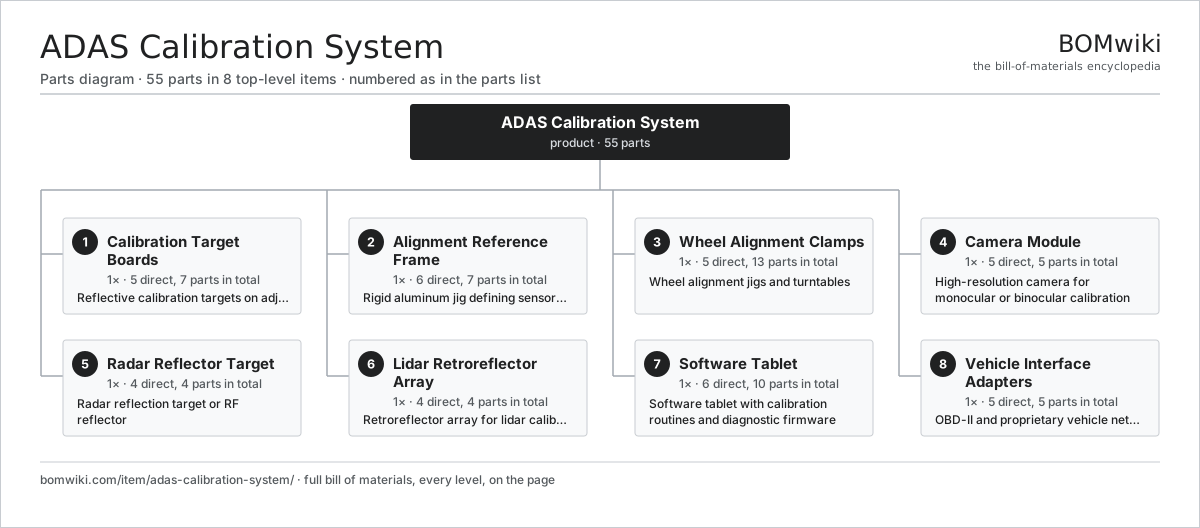
| # | Part | Qty | What it does |
|---|---|---|---|
| 1 | Calibration Target Boards 5 parts | 1× | Reflective calibration targets on adjustable stands |
| 2 | Alignment Reference Frame 6 parts | 1× | Rigid aluminum jig defining sensor alignment plane and reference points |
| 3 | Wheel Alignment Clamps 5 parts | 1× | Wheel alignment jigs and turntables |
| 4 | Camera Module 5 parts | 1× | High-resolution camera for monocular or binocular calibration |
| 5 | Radar Reflector Target 4 parts | 1× | Radar reflection target or RF reflector |
| 6 | Lidar Retroreflector Array 4 parts | 1× | Retroreflector array for lidar calibration |
| 7 | Software Tablet 6 parts | 1× | Software tablet with calibration routines and diagnostic firmware |
| 8 | Vehicle Interface Adapters 5 parts | 1× | OBD-II and proprietary vehicle network adapters |
3D model
No 3D model yet. Have a CAD file of this? Add a 3D model. STL renders right on this page; STEP, FreeCAD, and OpenSCAD sources are welcome too (openly licensed, like all 3D models on BOMwiki).
Build & assembly graph
expand / collapse · shared sub-assemblies converge · links to related products · est. labourTap an assembly to expand/collapse · tap a part to open it · use “Open page” for any node · drag to pan, scroll to zoom.
Bill of materials for ADAS Calibration System
8 top-level lines · 53 rows shown · 55 parts total · indented to 3 levels| # | Item / sub-assembly | Part no. | Qty/assy | Ext. qty | Parts | Type |
|---|---|---|---|---|---|---|
| 1 | Calibration Target Boards 5 parts | acs-target-boards | 1× | 1 | 7 | assembly |
| 1.1 | Target Panel | acs-large-target | 2× | 2 | · | part |
| 1.2 | Target Stand | acs-target-stand | 2× | 2 | · | part |
| 1.3 | Alignment Pattern | acs-alignment-pattern | 1× | 1 | · | part |
| 1.4 | Retroreflective Tape | acs-retroreflective-tape | 1× | 1 | · | part |
| 1.5 | Fastener Set | fastener-set | 1× | 1 | · | part |
| 2 | Alignment Reference Frame 6 parts | acs-alignment-frame | 1× | 1 | 7 | assembly |
| 2.1 | Frame Rail | acs-frame-rail | 1× | 1 | · | part |
| 2.2 | Laser Level | acs-laser-level | 1× | 1 | · | part |
| 2.3 | Vertical Laser | acs-vertical-reference | 1× | 1 | · | part |
| 2.4 | Boresight Indicator | acs-boresight-indicator | 1× | 1 | · | part |
| 2.5 | Ball Bearing | ball-bearing | 2× | 2 | · | part |
| 2.6 | Fastener Set | fastener-set | 1× | 1 | · | part |
| 3 | Wheel Alignment Clamps 5 parts | acs-wheel-clamps | 1× | 1 | 13 | assembly |
| 3.1 | Wheel Clamp Frame | acs-wheel-clamp-frame | 1× | 1 | · | part |
| 3.2 | Turntable Pad | acs-turntable-pad | 2× | 2 | · | part |
| 3.3 | Height Adjuster | acs-height-adjuster | 1× | 1 | · | part |
| 3.4 | Ball Bearing | ball-bearing | 8× | 8 | · | part |
| 3.5 | Pressure Sensor | pressure-sensor | 1× | 1 | · | part |
| 4 | Camera Module 5 parts | acs-camera-module | 1× | 1 | 5 | assembly |
| 4.1 | Camera Sensor | acs-camera-sensor | 1× | 1 | · | part |
| 4.2 | Calibration Lens | acs-camera-lens | 1× | 1 | · | part |
| 4.3 | Image Processor | acs-camera-processor | 1× | 1 | · | part |
| 4.4 | Camera Housing | acs-camera-housing | 1× | 1 | · | part |
| 4.5 | Connector | connector | 1× | 1 | · | part |
| 5 | Radar Reflector Target 4 parts | acs-radar-simulator | 1× | 1 | 4 | assembly |
| 5.1 | Corner Reflector | acs-corner-reflector | 1× | 1 | · | part |
| 5.2 | Reflector Stand | acs-reflector-stand | 1× | 1 | · | part |
| 5.3 | Return Monitor | acs-return-monitor | 1× | 1 | · | part |
| 5.4 | Fastener Set | fastener-set | 1× | 1 | · | part |
| 6 | Lidar Retroreflector Array 4 parts | acs-lidar-simulator | 1× | 1 | 4 | assembly |
| 6.1 | Retroreflector Array | acs-retroreflector-array | 1× | 1 | · | part |
| 6.2 | Lidar Target Stand | acs-lidar-target-stand | 1× | 1 | · | part |
| 6.3 | Distance Laser | acs-distance-laser | 1× | 1 | · | part |
| 6.4 | Fastener Set | fastener-set | 1× | 1 | · | part |
| 7 | Software Tablet 6 parts | acs-control-tablet | 1× | 1 | 10 | assembly |
| 7.1 | Tablet CPU | acs-tablet-cpu | 1× | 1 | · | part |
| 7.2 | Touchscreen | acs-tablet-screen | 1× | 1 | · | part |
| 7.3 | Tablet Battery | acs-tablet-battery | 1× | 1 | · | part |
| 7.4 | Calibration Software | acs-calibration-software | 1× | 1 | · | part |
| 7.5 | Vehicle Interface Adapters 5 parts | acs-vehicle-interface | 1× | 1 | 5 | assembly |
| 7.5.1 | OBD-II Adapter | acs-obd-adapter | 1× | 1 | · | part |
| 7.5.2 | CAN Interface | acs-can-interface | 1× | 1 | · | part |
| 7.5.3 | OEM Adapter | acs-proprietary-link | 1× | 1 | · | part |
| 7.5.4 | Connector | connector | 1× | 1 | · | part |
| 7.5.5 | Interface Firmware | acs-interface-firmware | 1× | 1 | · | part |
| 7.6 | Connector | connector | 1× | 1 | · | part |
| 8 | Vehicle Interface Adapters 5 parts | acs-vehicle-interface | 1× | 1 | 5 | assembly |
| 8.1 | OBD-II Adapter | acs-obd-adapter | 1× | 1 | · | part |
| 8.2 | CAN Interface | acs-can-interface | 1× | 1 | · | part |
| 8.3 | OEM Adapter | acs-proprietary-link | 1× | 1 | · | part |
| 8.4 | Connector | connector | 1× | 1 | · | part |
| 8.5 | Interface Firmware | acs-interface-firmware | 1× | 1 | · | part |
Something wrong in this list? Report a problem with this BOM.
Related products
same domain, ranked by shared parts Automotive Paint Booth
59 parts · shares 4 with this page
Automotive Paint Booth
59 parts · shares 4 with this page
 Undercoating Sprayer
59 parts · shares 3 with this page
Tire Tread Scanner
95 parts · shares 3 with this page
Two-Post Vehicle Lift
44 parts · shares 2 with this page
Undercoating Sprayer
59 parts · shares 3 with this page
Tire Tread Scanner
95 parts · shares 3 with this page
Two-Post Vehicle Lift
44 parts · shares 2 with this page
 Paint Thickness Gauge
88 parts · shares 2 with this page
Frame Straightening Rack
80 parts · shares 2 with this page
Paint Thickness Gauge
88 parts · shares 2 with this page
Frame Straightening Rack
80 parts · shares 2 with this page
Sourcing: possible vendors
Browse the supplier directory → Prices, MOQ, and lead times are algorithmic estimates, not quotes, and not claims about these companies. Company mappings are curated by keyword; est. price band $0.50–$100. How estimates work| Vendor | HQ | Specialty | MOQ | Lead time |
|---|
1,047-word article