Adhesive Reactor
ProductOverview
An adhesive reactor is a specialized batch chemical vessel for synthesizing hot-melt, solvent-based, and reactive polyurethane adhesives. Typical reactions include unsaturated polyester esterification, epoxy-amine cross-linking, and acrylic monomer polymerization.
The reactor controls exothermic reaction kinetics through precise temperature management and metered monomer/catalyst addition. Hot-melt adhesives (thermoplastic polyolefins, polyesters, polyamides) require stable heating; reactive adhesives (polyurethanes, epoxies) demand rapid cooling during exotherm.
How it works
The operator charges a pre-measured Vessel Main Cylinder with base resin or polyol. The Heating and Cooling System system warms the batch to reaction start temperature (typically 60–80°C), held by the Temperature Thermostat at ±0.5°C.
The PLC and Recipe Automation PLC loads a recipe specifying monomer feed rate, catalyst addition timing, and temperature profile. The Monomer Feed System pump meter-dispenses monomer into the reactor at the programmed rate (e.g., 2 L/min). Simultaneously, the Initiator/Catalyst Feed catalyst pump meters a slow catalyst dose (e.g., 0.05 L/min).
As monomer reacts, heat is released (exothermic). The Heating and Cooling System system's Jacket Pump circulates hot oil through the Heat-Transfer Jacket at up to 5 bar pressure. If heat generation exceeds the Electric Oil Heater removal rate, the optional Chiller Unit kicks in to dump excess heat via chilled oil circulation.
The Variable-Speed Agitator (anchor blade at 50 rpm) tumbles the reacting mass, ensuring uniform mixing and heat distribution. The PLC and Recipe Automation monitor Thermowell temperature; if it exceeds the profile setpoint, the PLC slows Monomer Feed System or activates Chiller Unit, preventing runaway exotherm.
Optional Vapor Condenser (Optional) overhead collection removes water byproduct (e.g., from esterification) and recovers unreacted monomer. The Distillate Receiver collects condensate.
At the end of the feed sequence, the PLC and Recipe Automation hold final temperature for a dwell time (e.g., 30 minutes), allowing completion reactions. The batch then cools to discharge temperature (~50°C) via Chiller Unit, and is drained via Bottom Discharge Valve.
Key subsystems
Reaction vessel: The Vessel Main Cylinder is stainless steel 316L, ASME-stamped to 5 bar gauge pressure. The Heat-Transfer Jacket is integral, bonded around the cylinder, providing 360-degree heat transfer surface. Level Indicator and Thermowell allow level and temperature visibility.
Heat management: The Heating and Cooling System combines a Electric Oil Heater (10–50 kW electric immersion or steam exchanger) and optional Chiller Unit. The Jacket Pump (50–200 L/min) circulates oil continuously at 5 bar. The Temperature Thermostat modulates heater and cooler proportional valves to maintain setpoint.
Monomer feed: The Monomer Feed System system includes a Peristaltic Pump (peristaltic for shear-sensitive monomers) driven by a Pump Drive Motor. A Monomer Solenoid Valve gate valve allows timed addition pulses. The Feed Filter (10 micron) protects the pump. A Check Valve prevents backflow to the feed drum.
Catalyst feed: The Initiator/Catalyst Feed uses a separate Initiator Pump (very low flow, 0.01–1 L/min) for precise catalyst metering. The Catalyst Flow Meter provides a visual indicator of catalyst flow rate. PLC commands open the Initiator Solenoid on a timed schedule.
Overhead condensing (optional): The Vapor Condenser (Optional) captures water and monomer vapors. A Fractionation Column separates lighter volatiles from the reactor charge. Condensate drips into Distillate Receiver.
Safety: The Pressure Relief Valve (2–5 bar setpoint) vents excess pressure. A Rupture Disc provides redundant relief at 1.5× main relief. The Safety and Pressure Control Emergency Solenoid instantly shuts off feed pumps on emergency stop.
Control automation: The PLC and Recipe Automation PLC executes recipes with precise step-by-step sequences: start temp, monomer feed ramp, catalyst addition schedule, exotherm management, final dwell, and cool-down. The Touchscreen HMI allows recipe editing and displays real-time temperature, feed rate, and pressure trends.
Materials and design
Vessel: Stainless steel 316L is standard for broad chemical compatibility (epoxies, polyols, acids, bases). Internal surfaces are electropolished (20 µin Ra) to minimize residue adhesion.
Jacket design: Double-wall construction with brazed or rolled inlet/outlet ports. Typical jacket thickness is 8–10 mm with 10–15 mm spacing to main vessel, optimizing heat transfer without excessive pressure drop.
Agitator: Anchor blade or paddle, stainless steel, operating at 20–100 rpm. Low speeds (50 rpm) are typical for viscous adhesive resin to prevent foaming and air incorporation.
Pumps: Monomer pump is peristaltic (gentle, no shear-sensitive damage to prepolymers) or internal gear (cheaper, for robust monomers). Catalyst pump is ultra-small displacement (0.01–0.5 mL/rev) for microliter-scale accuracy.
Sealing: All dynamic seals in contact with reactive chemicals are Viton or PTFE. Catalysts are often solvents that swell Buna-N; PTFE is preferred.
Operating sequence
- Weigh and charge pre-polyol into Vessel Main Cylinder, e.g., 500 kg for 1000 L batch.
- Close and lock vessel lid.
- Start Jacket Pump; verify jacket pressure on gauge (1–2 bar).
- Set Electric Oil Heater thermostat to start temperature, e.g., 75°C.
- Load recipe on Touchscreen HMI; verify monomer and catalyst feed rates and dwell time.
- Start heater; monitor Thermowell temperature rise.
- When start temperature is reached (30–60 minutes), begin Monomer Feed System at programmed rate.
- Monitor Variable-Speed Agitator torque indicator; exotherm should stabilize at setpoint via Temperature Thermostat.
- Catalyst addition starts per recipe (typically 30–60 minutes after monomer start).
- As heat generation peaks, Chiller Unit chiller engages to maintain temperature slope.
- At the end of monomer feed (typically 2–4 hours), stop all pumps.
- Hold final temperature (e.g., 130°C) for dwell time (30–60 minutes) per recipe.
- Cool to discharge temperature (50°C) via chiller (1–2 hours).
- Open Bottom Discharge Valve and gravity-drain product into totes.
- Rinse vessel with solvent; run Variable-Speed Agitator empty at low speed to dry.
Process control strategies
Exotherm management: Adhesive synthesis is highly exothermic. The operator or PLC must continuously balance:
- Monomer feed rate (faster = more heat)
- Heating via Temperature Thermostat (for slow reactions or startup)
- Cooling via Chiller Unit (for exotherm periods)
Typical exothermic peak is 5–15°C above setpoint; control limits are ±2°C to prevent degradation or runaway.
Reaction time: Most adhesive syntheses are 3–6 hours. Initial monomer addition is slow (to avoid thermal shock), then ramps up. Catalyst is added mid-way to accelerate polymerization. Final dwell allows post-reaction completion.
Vapor condensing: If Vapor Condenser (Optional) is used, distillate composition tells reaction progress: early distillate is mostly water (esterification byproduct, ~100°C); late distillate is unreacted monomer (145–180°C, higher boiling point as polymerization advances).
Pressure: Typical reactor pressure is atmospheric (0 bar gauge) unless the reaction is air-sensitive (inert blanket via Atmospheric Breaker modifications). Pressure builds only if thermal runaway forces vapors out; Pressure Relief Valve then vents safely.
Variants and configurations
Polyol/polyisocyanate reactors: For polyurethane synthesis, dual-feed reactors meter polyol and isocyanate separately, mixing in a static in-line mixer before entering the reactor jacket, critical for stoichiometric control.
Reactive monomer systems: For epoxy-amine systems, epoxy resin and hardener are stored separately and fed sequentially; precise catalyst addition controls gelling time.
Vacuum-capable reactors: Some adhesive chemistry requires oxygen-free environments; reactors with vacuum ports enable degassing under 0.1 bar absolute, removing dissolved air and moisture.
Thin-film coolers: High-viscosity adhesives (e.g., hot-melts) require rapid cooling after synthesis; some reactors include a thin-film evaporative cooler inline for flash cooling.
Data logging and traceability: Modern plants require GMP-compliant batch logs; reactors with Data Logger and cloud connectivity enable recipe archiving and Reason-for-Change tracking.
Adhesive Reactor parts and their functions
8 top-level parts · 44 parts in total · full bill of materials below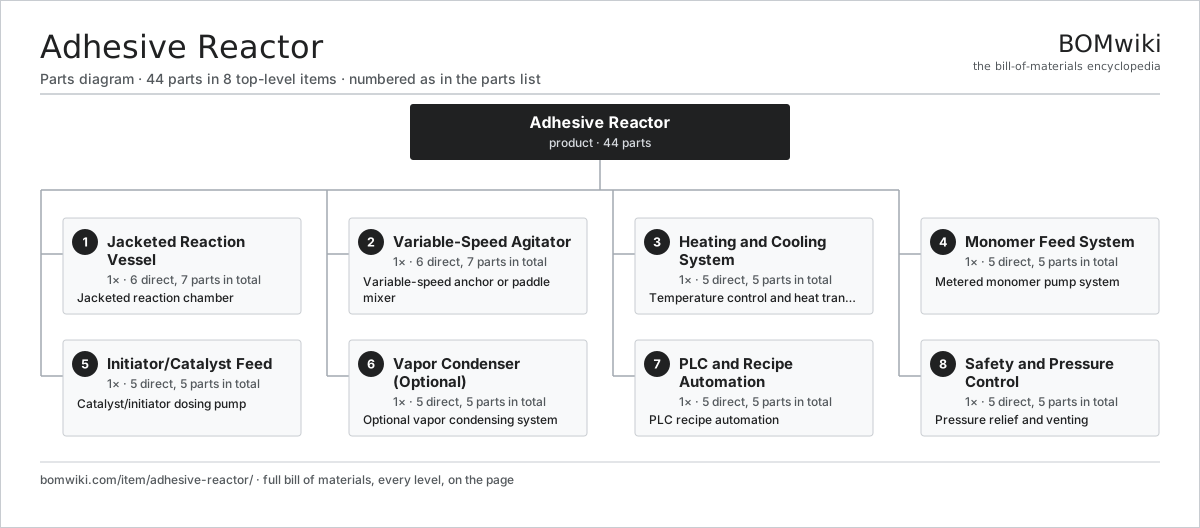
| # | Part | Qty | What it does |
|---|---|---|---|
| 1 | Jacketed Reaction Vessel 6 parts | 1× | Jacketed reaction chamber |
| 2 | Variable-Speed Agitator 6 parts | 1× | Variable-speed anchor or paddle mixer |
| 3 | Heating and Cooling System 5 parts | 1× | Temperature control and heat transfer |
| 4 | Monomer Feed System 5 parts | 1× | Metered monomer pump system |
| 5 | Initiator/Catalyst Feed 5 parts | 1× | Catalyst/initiator dosing pump |
| 6 | Vapor Condenser (Optional) 5 parts | 1× | Optional vapor condensing system |
| 7 | PLC and Recipe Automation 5 parts | 1× | PLC recipe automation |
| 8 | Safety and Pressure Control 5 parts | 1× | Pressure relief and venting |
3D model
No 3D model yet. Have a CAD file of this? Add a 3D model. STL renders right on this page; STEP, FreeCAD, and OpenSCAD sources are welcome too (openly licensed, like all 3D models on BOMwiki).
Build & assembly graph
expand / collapse · shared sub-assemblies converge · links to related products · est. labourTap an assembly to expand/collapse · tap a part to open it · use “Open page” for any node · drag to pan, scroll to zoom.
Bill of materials for Adhesive Reactor
8 top-level lines · 50 rows shown · 44 parts total · indented to 3 levels| # | Item / sub-assembly | Part no. | Qty/assy | Ext. qty | Parts | Type |
|---|---|---|---|---|---|---|
| 1 | Jacketed Reaction Vessel 6 parts | adhesive-reactor-vessel | 1× | 1 | 7 | assembly |
| 1.1 | Vessel Main Cylinder | adhesive-reactor-vessel-shell | 1× | 1 | · | part |
| 1.2 | Heat-Transfer Jacket | adhesive-reactor-jacket | 1× | 1 | · | part |
| 1.3 | Bottom Discharge Valve | adhesive-reactor-drain-valve | 1× | 1 | · | part |
| 1.4 | Thermowell | adhesive-reactor-thermometer-pocket | 1× | 1 | · | part |
| 1.5 | Level Indicator | adhesive-reactor-sight-glass | 1× | 1 | · | part |
| 1.6 | O-Ring Set | oring-set | 2× | 2 | · | part |
| 2 | Variable-Speed Agitator 6 parts | adhesive-reactor-agitator | 1× | 1 | 7 | assembly |
| 2.1 | Main Drive Motor | adhesive-reactor-motor | 1× | 1 | · | part |
| 2.2 | Variable-Frequency Drive | adhesive-reactor-vfd | 1× | 1 | · | part |
| 2.3 | Speed-Reduction Gearbox | adhesive-reactor-gearbox | 1× | 1 | · | part |
| 2.4 | Agitator Blade | adhesive-reactor-agitator-blade | 1× | 1 | · | part |
| 2.5 | Ball Bearing | ball-bearing | 2× | 2 | · | part |
| 2.6 | Oil Seal | oil-seal | 1× | 1 | · | part |
| 3 | Heating and Cooling System 5 parts | adhesive-reactor-heating | 1× | 1 | 5 | assembly |
| 3.1 | Electric Oil Heater | adhesive-reactor-heater-unit | 1× | 1 | · | part |
| 3.2 | Chiller Unit | adhesive-reactor-cooler-unit | 1× | 1 | · | part |
| 3.3 | Jacket Pump | adhesive-reactor-circulation-pump | 1× | 1 | · | part |
| 3.4 | Temperature Thermostat | adhesive-reactor-jacket-thermostat | 1× | 1 | · | part |
| 3.5 | Jacket Relief Valve | adhesive-reactor-jacket-relief | 1× | 1 | · | part |
| 4 | Monomer Feed System 5 parts | adhesive-reactor-monomer-feed | 1× | 1 | 5 | assembly |
| 4.1 | Peristaltic Pump | adhesive-reactor-monomer-pump | 1× | 1 | · | part |
| 4.2 | Pump Drive Motor | adhesive-reactor-monomer-motor | 1× | 1 | · | part |
| 4.3 | Monomer Solenoid Valve | adhesive-reactor-monomer-solenoid | 1× | 1 | · | part |
| 4.4 | Feed Filter | adhesive-reactor-monomer-filter | 1× | 1 | · | part |
| 4.5 | Check Valve | adhesive-reactor-monomer-check-valve | 1× | 1 | · | part |
| 5 | Initiator/Catalyst Feed 5 parts | adhesive-reactor-initiator-feed | 1× | 1 | 5 | assembly |
| 5.1 | Initiator Pump | adhesive-reactor-initiator-pump | 1× | 1 | · | part |
| 5.2 | Initiator Motor | adhesive-reactor-initiator-motor | 1× | 1 | · | part |
| 5.3 | Catalyst Flow Meter | adhesive-reactor-initiator-rotameter | 1× | 1 | · | part |
| 5.4 | Initiator Solenoid | adhesive-reactor-initiator-solenoid | 1× | 1 | · | part |
| 5.5 | Injection Manifold | adhesive-reactor-initiator-manifold | 1× | 1 | · | part |
| 6 | Vapor Condenser (Optional) 5 parts | adhesive-reactor-condenser | 1× | 1 | 5 | assembly |
| 6.1 | Condenser Heat Exchanger | adhesive-reactor-condenser-coil | 1× | 1 | · | part |
| 6.2 | Fractionation Column | adhesive-reactor-distillation-column | 1× | 1 | · | part |
| 6.3 | Distillate Receiver | adhesive-reactor-receiver-bottle | 1× | 1 | · | part |
| 6.4 | Distillate Thermometer | adhesive-reactor-condenser-thermometer | 1× | 1 | · | part |
| 6.5 | Overhead Check Valve | adhesive-reactor-condenser-check-valve | 1× | 1 | · | part |
| 7 | PLC and Recipe Automation 5 parts | adhesive-reactor-controls | 1× | 1 | 5 | assembly |
| 7.1 | Programmable Logic Controller | adhesive-reactor-plc | 1× | 1 | · | part |
| 7.2 | Touchscreen HMI | adhesive-reactor-hmi-panel | 1× | 1 | · | part |
| 7.3 | Real-Time Clock | adhesive-reactor-rtc-module | 1× | 1 | · | part |
| 7.4 | Data Logger | adhesive-reactor-temperature-logger | 1× | 1 | · | part |
| 7.5 | 24 VDC Supply | adhesive-reactor-power-supply | 1× | 1 | · | part |
| 8 | Safety and Pressure Control 5 parts | adhesive-reactor-safety-systems | 1× | 1 | 5 | assembly |
| 8.1 | Pressure Relief Valve | adhesive-reactor-pressure-relief | 1× | 1 | · | part |
| 8.2 | Rupture Disc | adhesive-reactor-rupture-disc | 1× | 1 | · | part |
| 8.3 | Vent Condenser | adhesive-reactor-vent-condenser | 1× | 1 | · | part |
| 8.4 | Emergency Solenoid | adhesive-reactor-estop-solenoid | 1× | 1 | · | part |
| 8.5 | Atmospheric Breaker | adhesive-reactor-vacuum-breaker | 1× | 1 | · | part |
Something wrong in this list? Report a problem with this BOM.
Related products
same domain, ranked by shared parts Continuous Galvanizing Line
1,296 parts · shares 3 with this page
Continuous Galvanizing Line
1,296 parts · shares 3 with this page
 Decanter Centrifuge
172 parts · shares 3 with this page
Emulsion Reactor
48 parts · shares 3 with this page
Decanter Centrifuge
172 parts · shares 3 with this page
Emulsion Reactor
48 parts · shares 3 with this page
Sourcing: possible vendors
Browse the supplier directory → Prices, MOQ, and lead times are algorithmic estimates, not quotes, and not claims about these companies. Company mappings are curated by keyword; est. price band $5k–$2M. How estimates work| Vendor | HQ | Specialty | MOQ | Lead time |
|---|---|---|---|---|
| atlascopco.com ↗ | Stockholm, SE | Compressors & industrial | 10 units | 12–20 wks |
|
🇦🇹Andritz
andritz.com ↗
|
Graz, AT | Process plants & machinery | 10 units | 12–20 wks |
| buhlergroup.com ↗ | Uzwil, CH | Food & materials processing | 10 units | 12–20 wks |
| gea.com ↗ | Düsseldorf, DE | Process technology | 10 units | 12–20 wks |
| mhi.com ↗ | Tokyo, JP | Heavy machinery | 10 units | 12–20 wks |
1,359-word article