Aeroponic Tower
ProductOverview
Aeroponics is the most advanced hydroponic cultivation method, where plant roots are suspended in air and exposed continuously to a fine nutrient mist. A high-pressure pump (40–100 PSI) atomizes nutrient solution into a sub-100-micron aerosol, delivered via nozzles every 2–5 minutes for 15–30 seconds. Between mist pulses, roots remain in saturated air (90–100% humidity), maximizing oxygen availability for respiration.
An aeroponic tower vertically stacks 36–48 plant pockets in a compact cylinder (0.4 m² footprint, 4–6 m height), making it ideal for urban farming, research facilities, and commercial operations with limited space. Growth rates exceed traditional methods by 25–50% because roots achieve simultaneous access to oxygen, nutrients, and water without the diffusion delays of soil or media-based systems.
How It Works
The Misting Cycle Timer triggers the Misting Pump every 2–5 minutes on a 24-hour cycle. The pump draws oxygenated nutrient solution from the Nutrient Reservoir through a Pump Inlet Strainer, pressurizing it to 40–80 psi via a brushless high-speed motor.
Pressurized solution exits through a high-pressure Pump Discharge Hose into the Spray Manifold at the tower top. The manifold distributes flow across eight Spray Nozzle openings, each creating a cone or mist-pattern aerosol. A Check Valve prevents backflow when the pump shuts off, protecting nozzles from dripping.
The fine mist (50–150 micron droplets) falls inside the Tower Body, enveloping the bare roots suspended in the air gap. Plant roots absorb both water and dissolved nutrients (EC 0.8–1.2 mS/cm) from the mist particles. Simultaneously, roots are exposed to near-ambient air, achieving 18–21% O2 availability, the highest of any cultivation method.
Mist not immediately absorbed by roots falls by gravity and collects in the Pocket Drain Slot openings beneath each Plant Pocket Array. Drainage cascades internally through the tower and returns via the Return Manifold back into the Sump Tank.
A Float Switch monitors sump level; if below 2 L, the pump automatically shuts off, preventing cavitation and root desiccation. The Pressure Relief Valve ensures pressure never exceeds 80 psi, protecting nozzles.
Root temperature is critical in aeroponics; exposed roots lack the thermal mass of media or water. The Cooler/Heater Unit maintains 18–24°C, essential for preventing fungal infection and maximizing growth. The Environmental Monitor tracks humidity (target 90–95% RH), temperature, and EC, providing real-time feedback for nutrient and cycle adjustments.
Nutrient Uptake Dynamics
Bare roots in mist have enormous surface area exposed to both water and air. The rapid 2–5 minute cycle means roots never fully dry out, preventing wilting, yet never become waterlogged. This intermittent saturation mimics ideal conditions for ion transport: nutrient films are thin (~0.5 mm), reducing diffusion distance for nutrient molecules and O2.
Growth rates in aeroponics are 25–50% faster than deep-water culture or media-based systems, with biomass increasing at ~1.5–2.5 g/day per plant (vs. 0.8–1.5 g/day in NFT or flood tables).
Microbial Control and Sterility
Fine misting creates an environment hostile to root pathogens. Pythium zoospores, which swim in water films, cannot survive exposed to air. Rhizoctonia and Fusarium, which thrive in waterlogged media, are suppressed by continuous air exposure. Bacterial wilt (Ralstonia) is less common in aeroponics than in other systems.
However, aeroponics demands exceptional hygiene: any biofilm or algae in the Pre-Pump Filtration or nozzles can block spray and harbor pathogens. Pre-pump filtration (100–200 micron) is mandatory; many growers add in-line UV sterilization for added security.
System Failures and Risk
Aeroponics has a critical flaw: total system failure leads to rapid root desiccation. If power is lost or the pump fails, roots can die in 10–20 minutes. Backup power (battery or generator) is essential for commercial installations. Similarly, any Spray Nozzle blockage leaves local roots dry; the system requires weekly nozzle inspection and cleaning.
This risk is offset by superior growth and water efficiency, but it demands more active management than ebb-flow or NFT systems.
Scaling and Multiunit Arrays
Single towers are compact but limited to 36–48 plants. Commercial farms install 10–100 towers in parallel, each on a shared nutrient reservoir. This approach achieves high per-square-meter density: a 10 m × 10 m room holds ~250 towers (10,000+ plants) producing 500+ kg fresh greens per 8-week cycle.
Towers are modular: Tower Section segments stack easily, and additional towers simply connect to the main manifold. Scaling is primarily a matter of pump and reservoir sizing.
Crop Applications
Best suited for fast-growing crops: lettuce and leafy greens (3–5 weeks), herbs (basil, cilantro, parsley, 6–8 weeks), microgreens (10–14 days), and strawberries (8–12 weeks to first fruit). Fruiting plants (tomatoes, peppers) can grow but require deeper root exposure and longer cycles (16+ weeks), making them less economical per harvest cycle.
Research has shown exceptional results with high-value ornamental and medicinal plants: ginseng, goji berries, and saffron crocus show 2–3× yield increases in aeroponic towers.
Maintenance Protocol
Daily: Check Float Switch operation and Environmental Monitor readings (humidity, temperature, EC).
Weekly: Inspect all Spray Nozzle openings for biofilm or clogging; soak in 5% bleach solution if blocked.
Bi-weekly: Replace Filter Cartridge if pressure gauge at Pre-Pump Filtration exceeds 2 psi.
Monthly: Test EC Sensor and pH against known standards; recalibrate if drift detected.
Quarterly: Clean Sump Tank and Return Manifold with dilute hydrogen peroxide (3%) to dissolve biofilm.
Crop end: Flush entire system with 1:10 household bleach solution; run pump for 30 minutes, then drain and air dry. UV sterilize nozzles separately.
Energy and Water Balance
Water efficiency is exceptional: no media to hold residual moisture, no continuous flow waste. Total water loss = plant transpiration only, typically 10–20 L/day for a full tower (vs. 40–60 L/day for ebb-flow, 100+ L/day for drip). This is the lowest water footprint of any commercial cultivation method.
Power draw is higher per plant (pump is energy-intensive at 500–2000W) but amortized across large crops, typical systems use 0.5–1 kWh per kg fresh product, competitive with conventional greenhouses.
Aeroponic Tower parts and their functions
8 top-level parts · 151 parts in total · full bill of materials below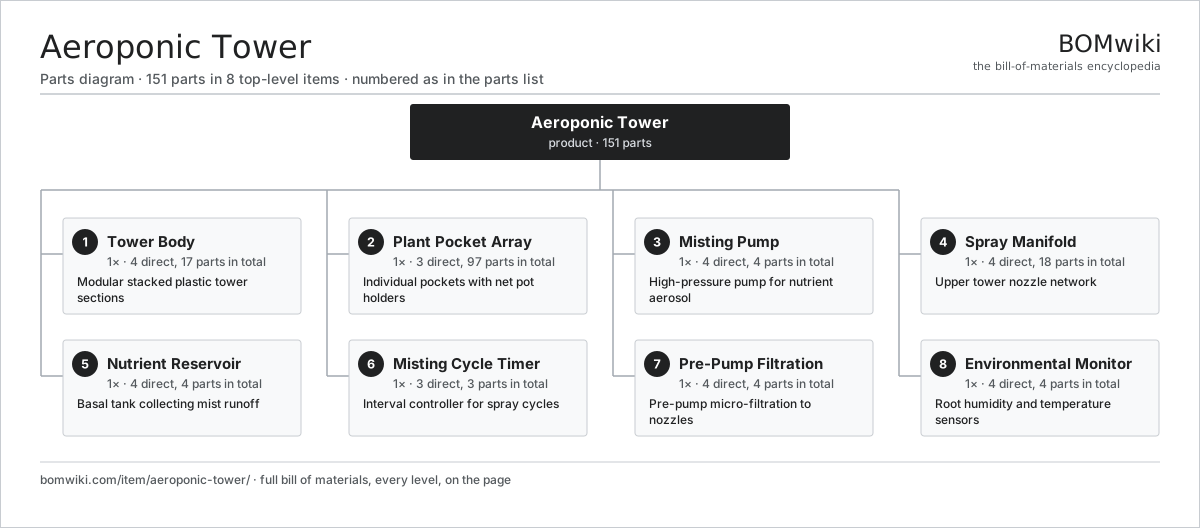
| # | Part | Qty | What it does |
|---|---|---|---|
| 1 | Tower Body 4 parts | 1× | Modular stacked plastic tower sections |
| 2 | Plant Pocket Array 3 parts | 1× | Individual pockets with net pot holders |
| 3 | Misting Pump 4 parts | 1× | High-pressure pump for nutrient aerosol |
| 4 | Spray Manifold 4 parts | 1× | Upper tower nozzle network |
| 5 | Nutrient Reservoir 4 parts | 1× | Basal tank collecting mist runoff |
| 6 | Misting Cycle Timer 3 parts | 1× | Interval controller for spray cycles |
| 7 | Pre-Pump Filtration 4 parts | 1× | Pre-pump micro-filtration to nozzles |
| 8 | Environmental Monitor 4 parts | 1× | Root humidity and temperature sensors |
3D model
No 3D model yet. Have a CAD file of this? Add a 3D model. STL renders right on this page; STEP, FreeCAD, and OpenSCAD sources are welcome too (openly licensed, like all 3D models on BOMwiki).
Build & assembly graph
expand / collapse · shared sub-assemblies converge · links to related products · est. labourTap an assembly to expand/collapse · tap a part to open it · use “Open page” for any node · drag to pan, scroll to zoom.
Bill of materials for Aeroponic Tower
8 top-level lines · 38 rows shown · 151 parts total · indented to 3 levels| # | Item / sub-assembly | Part no. | Qty/assy | Ext. qty | Parts | Type |
|---|---|---|---|---|---|---|
| 1 | Tower Body 4 parts | aeroponic-tower-body | 1× | 1 | 17 | assembly |
| 1.1 | Tower Section | aeroponic-tower-section-cylinder | 8× | 8 | · | part |
| 1.2 | Stackable Bracket | aeroponic-tower-stackable-bracket | 7× | 7 | · | part |
| 1.3 | Base Ring | aeroponic-tower-base-ring | 1× | 1 | · | part |
| 1.4 | Top Cap | aeroponic-tower-top-cap | 1× | 1 | · | part |
| 2 | Plant Pocket Array 3 parts | aeroponic-tower-plant-sites | 1× | 1 | 97 | assembly |
| 2.1 | Pocket Sleeve | aeroponic-tower-pocket-sleeve | 48× | 48 | · | part |
| 2.2 | Pocket Ring | aeroponic-tower-pocket-ring | 1× | 1 | · | part |
| 2.3 | Pocket Drain Slot | aeroponic-tower-pocket-drain-slot | 48× | 48 | · | part |
| 3 | Misting Pump 4 parts | aeroponic-tower-misting-pump | 1× | 1 | 4 | assembly |
| 3.1 | Pump Motor | aeroponic-tower-pump-motor | 1× | 1 | · | part |
| 3.2 | Pump Inlet Strainer | aeroponic-tower-pump-inlet-strainer | 1× | 1 | · | part |
| 3.3 | Pump Discharge Hose | aeroponic-tower-pump-discharge-line | 1× | 1 | · | part |
| 3.4 | Pressure Relief Valve | aeroponic-tower-pressure-relief-valve | 1× | 1 | · | part |
| 4 | Spray Manifold 4 parts | aeroponic-tower-spray-manifold | 1× | 1 | 18 | assembly |
| 4.1 | Manifold Header | aeroponic-tower-manifold-header | 1× | 1 | · | part |
| 4.2 | Spray Nozzle | aeroponic-tower-spray-nozzle | 8× | 8 | · | part |
| 4.3 | Nozzle Holder | aeroponic-tower-nozzle-holder | 8× | 8 | · | part |
| 4.4 | Check Valve | aeroponic-tower-check-valve | 1× | 1 | · | part |
| 5 | Nutrient Reservoir 4 parts | aeroponic-tower-nutrient-reservoir | 1× | 1 | 4 | assembly |
| 5.1 | Sump Tank | aeroponic-tower-sump-tank | 1× | 1 | · | part |
| 5.2 | Float Switch | aeroponic-tower-float-switch | 1× | 1 | · | part |
| 5.3 | Return Manifold | aeroponic-tower-return-manifold | 1× | 1 | · | part |
| 5.4 | Cooler/Heater Unit | aeroponic-tower-cooler-heater | 1× | 1 | · | part |
| 6 | Misting Cycle Timer 3 parts | aeroponic-tower-misting-timer | 1× | 1 | 3 | assembly |
| 6.1 | Timer Unit | aeroponic-tower-timer-unit | 1× | 1 | · | part |
| 6.2 | Timer Display | aeroponic-tower-timer-display | 1× | 1 | · | part |
| 6.3 | Power Supply | aeroponic-tower-power-supply | 1× | 1 | · | part |
| 7 | Pre-Pump Filtration 4 parts | aeroponic-tower-filtration-unit | 1× | 1 | 4 | assembly |
| 7.1 | Filter Housing | aeroponic-tower-filter-cartridge-housing | 1× | 1 | · | part |
| 7.2 | Filter Cartridge | aeroponic-tower-filter-cartridge | 1× | 1 | · | part |
| 7.3 | Filter Bypass Valve | aeroponic-tower-filter-bypass-valve | 1× | 1 | · | part |
| 7.4 | Filter Pressure Gauge | aeroponic-tower-filter-change-indicator | 1× | 1 | · | part |
| 8 | Environmental Monitor 4 parts | aeroponic-tower-environmental-monitor | 1× | 1 | 4 | assembly |
| 8.1 | Humidity Sensor | aeroponic-tower-humidity-sensor | 1× | 1 | · | part |
| 8.2 | Temperature Probe | aeroponic-tower-temperature-probe | 1× | 1 | · | part |
| 8.3 | EC Sensor | aeroponic-tower-ec-sensor | 1× | 1 | · | part |
| 8.4 | Data Display Unit | aeroponic-tower-data-display | 1× | 1 | · | part |
Something wrong in this list? Report a problem with this BOM.
Sourcing: possible vendors
Browse the supplier directory → Prices, MOQ, and lead times are algorithmic estimates, not quotes, and not claims about these companies. Company mappings are curated by keyword; est. price band $5k–$800k. How estimates work| Vendor | HQ | Specialty | MOQ | Lead time |
|---|---|---|---|---|
| deere.com ↗ | Moline, US | Agriculture & turf | made to order | 14–24 wks |
| cnh.com ↗ | Basildon, GB | Agriculture (Case IH, New Holland) | made to order | 14–24 wks |
|
🇺🇸AGCO
agcocorp.com ↗
|
Duluth, US | Agriculture (Fendt, Massey Ferguson) | made to order | 14–24 wks |
|
🇩🇪Claas
claas.com ↗
|
Harsewinkel, DE | Harvesters & tractors | made to order | 14–24 wks |
|
🇯🇵Kubota
kubota.com ↗
|
Osaka, JP | Compact tractors & equipment | made to order | 14–24 wks |
1,086-word article