Air Suspension System
ProductOverview
An air suspension system replaces conventional steel coil or leaf springs with pressurized rubber air springs, offering adjustable ride height, load leveling, and tunable comfort. The system continuously monitors vehicle height via sensors at all four wheels, commanding an electronically controlled solenoid valve block to modulate air pressure in each spring, automatically raising the vehicle when weight is added (towing, passengers) or lowering it for aerodynamic efficiency at highway speeds.
Air springs provide inherent advantages over mechanical springs: (1) linear spring rate (air follows Boyle's Law: P·V = constant), enabling consistent ride feel independent of compression; (2) rapid actuation (air can be added or vented in seconds), enabling dynamic height adjustments; (3) independent corner control (each wheel can be adjusted separately, improving stability); and (4) elegant simplicity (no moving parts in the spring itself, just compressed air in a rubber bladder).
The trade-off is system complexity: a compressor with desiccant dryer must run periodically to maintain pressure; the solenoid valve block requires continuous electronic control; and failure modes (compressor burnout, air leaks, solenoid failure) necessitate OEM service due to system integration with the powertrain control module.
How It Works
The core of the system is the Air Compressor Unit, a 12V or 24V electric motor driving a small reciprocating pump. The compressor draws ambient air through an Intake Air Filter and pressurizes it to 10–15 bar, delivering it to the Desiccant Air Dryer. The dryer removes moisture using silica gel, preventing water vapor from condensing inside the pressurized lines (which would cause rust and freeze-up at cold starts).
Dried, pressurized air flows into the Pressure Reservoir Tank, a 3–5 L steel tank acting as a pressure buffer. The compressor cycles on/off based on reservoir pressure setpoint: when pressure falls below ~9 bar, the Pump Check Valve opens and the compressor runs until pressure reaches ~15 bar, then shuts off. This intermittent duty cycle keeps power consumption low (100–200W average).
The Solenoid Valve Block is the command center: it contains four proportional solenoid valves (one per wheel). The solenoid valves receive PWM commands from the Suspension Control Module, the suspension control module. Based on signals from the four Ride Height Sensor Array (one at each wheel corner), the ECU calculates how much air each spring needs to achieve target height.
At cruise (no input), the system maintains preset height: typically 75–100 mm ground clearance at the wheel hub. If the driver adds 5 passengers (300 kg load), the vehicle squats (height drops). The height sensors detect this drop and signal the ECU. The ECU opens the solenoid valve for the affected springs (usually front and rear together for balanced load distribution), allowing pressurized air to flow into the Air Spring Assembly, increasing pressure and extending the bellows. In 2–5 seconds, the vehicle returns to preset height.
Conversely, at highway speeds (>100 km/h), the ECU command can lower the Air Spring Assembly by 20–50 mm to reduce aerodynamic drag and improve fuel economy. The solenoid valves vent pressurized air back to atmosphere through a Exhaust Muffler (a small silencer that reduces noise to 70–75 dB), depressurizing the springs.
The Air Spring Assembly themselves are sealed rubber bellows (reinforced with cord or fabric) containing compressed air and an integrated Damping Chamber, a secondary elastomer chamber providing progressive spring rate and vibration damping. The bellows are rated to 12 bar internal pressure and remain flexible across temperature (−40°C to +80°C).
Ride Height and Load Leveling
Air suspensions maintain ride height regardless of load, a fundamental advantage over mechanical springs. A mechanical spring compresses more under load (soft ride for light vehicles, hard ride when fully loaded). An air spring maintains near-constant height by increasing internal pressure proportionally to load, preserving ride comfort and vehicle geometry.
Load leveling is automatic: as weight is added, height sensors detect the drop, the ECU increases air pressure in the springs, and the vehicle returns to level. Towing a 1000 kg trailer or carrying five passengers causes minimal change in vehicle height (±20–50 mm), compared to 50–100 mm squat with coil springs.
Ride Modes and Comfort Tuning
Modern air suspension systems offer selectable comfort modes: Sport (high pressure, stiff, responsive), Normal (balanced), and Comfort (lower pressure, softer, more compliant). The driver selects mode via the vehicle's infotainment screen. The ECU adjusts target spring pressure setpoints for each mode, Sport might target 12 bar, Normal 10 bar, Comfort 8 bar.
Independent corner control enables anti-roll features: if the vehicle leans during cornering (outer spring compresses), the ECU can increase pressure in the outer spring and decrease it in the inner spring, counteracting lean and improving handling.
Desiccant Dryer and Maintenance
Atmospheric air contains moisture. As air is compressed, relative humidity increases, saturated air becomes even more saturated. Without drying, water vapor will condense inside the pressurized lines and reservoir, causing rust and corrosion, eventually leading to leaks.
The Desiccant Air Dryer contains silica gel beads that absorb moisture (up to 30% of cartridge mass). The silica is color-indicating: blue when dry, pink when saturated. Periodic cartridge replacement (every 60,000–100,000 km or annually) maintains system health.
If the cartridge becomes saturated without replacement, the Dryer Bypass Valve activates, allowing air to bypass the dryer and reach the springs (though wet). System function continues, but corrosion progresses invisibly, eventually causing leaks.
Compressor Operation and Duty Cycle
The Air Compressor Unit is not meant to run continuously. At typical highway cruise with no load changes, the system is in equilibrium, pressure steady, springs holding height. The compressor might run for 30 seconds every 10 minutes (5% duty cycle), refreshing any minor leakage.
Under high demand (towing, heavy load, aggressive height adjustments), compressor runtime increases. In extreme conditions (adding 500 kg load, then raising height to maintain level), the compressor could run for minutes continuously. Modern compressors have thermal overload protection, if winding temperature exceeds ~120°C, the motor shuts down and won't restart until cooled (5–15 minutes).
System Electronics and Redundancy
The Suspension Control Module is a microcontroller-based module, often integrated with the main vehicle body control module via CAN-bus. It continuously reads the four Ride Height Sensor Array, calculates target spring pressures, and commands the proportional solenoid valve positions via PWM signals.
Safety is paramount: if the ECU fails or loses signal, the Watchdog Relay (a watchdog timer) de-energizes all solenoids within 100 milliseconds, venting all springs to atmosphere through the Exhaust Muffler. The vehicle settles onto the wheels' lowest point, allowing safe (if uncomfortable) driving to a service center at reduced speed. Redundant pressure sensors provide fault detection if a spring loses pressure catastrophically.
Failure Modes
Compressor burnout: The compressor motor overheats and fails, typically after 100,000+ km. Repair requires OEM replacement (compressor assembly is not field-serviceable).
Air leaks: Seal failure in springs, valve block, or line fittings causes slow pressure loss. The compressor runs more frequently, and the vehicle eventually cannot maintain height. Leaks are detected via pressure sensor drift.
Solenoid stiction: Varnish deposits prevent solenoid plunger movement, causing a single spring to remain pressurized or depressurized. The vehicle tilts to one side.
Height sensor failure: A faulty sensor gives false height reading, causing the ECU to over-pressurize or under-pressurize a spring. The vehicle tilts or leans.
Desiccant saturation: Without cartridge replacement, water accumulates, leading to rust, corrosion, and eventual line rupture.
Bellows rupture: A tear in a spring bellows causes catastrophic pressure loss (minutes to complete deflation). The vehicle corner drops until bottom-out. Repair requires spring replacement.
Variants and Modern Integration
Luxury vehicles (Mercedes-Benz E-Class, Range Rover, Lexus LS) standardly include air suspension. Sports-oriented air suspensions offer lower comfort mode stiffness for track driving.
Hybrid air-mechanical systems combine a mechanical coil spring with a small air spring in parallel, providing air-spring benefits while maintaining mechanical spring as a backup in case of air system failure.
Some modern systems integrate with adaptive dampers, offering continuously variable damping in addition to height adjustment, creating a semi-active suspension system with superior ride and handling.
Connected vehicle platforms allow the suspension ECU to read map data and vehicle speed, automatically adjusting height proactively, lowering for highway cruise to save fuel, raising for off-road terrain to increase clearance.
Air Suspension System parts and their functions
8 top-level parts · 32 parts in total · full bill of materials below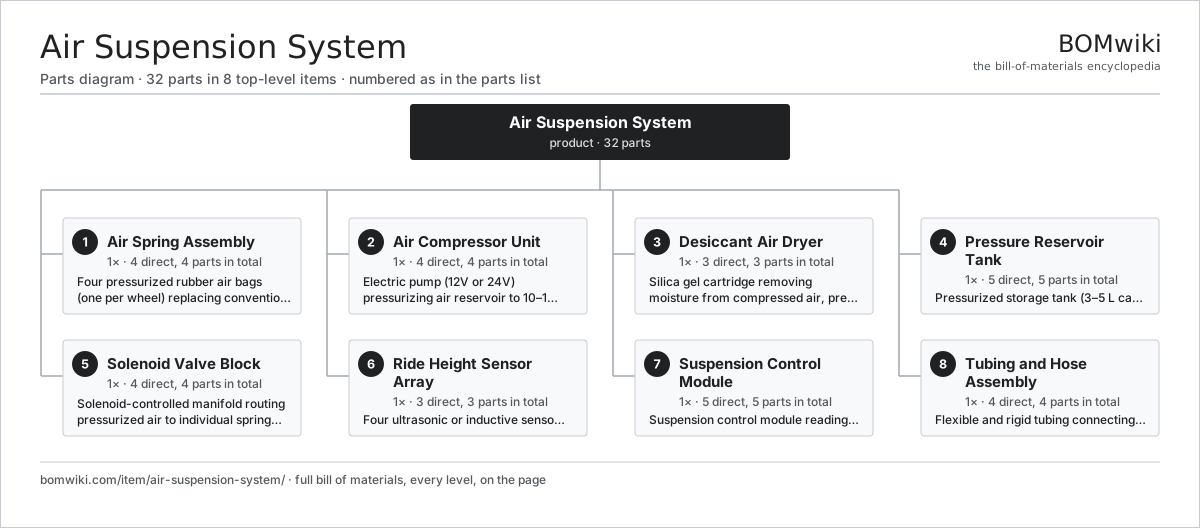
| # | Part | Qty | What it does |
|---|---|---|---|
| 1 | Air Spring Assembly 4 parts | 1× | Four pressurized rubber air bags (one per wheel) replacing conventional steel coil springs |
| 2 | Air Compressor Unit 4 parts | 1× | Electric pump (12V or 24V) pressurizing air reservoir to 10–15 bar |
| 3 | Desiccant Air Dryer 3 parts | 1× | Silica gel cartridge removing moisture from compressed air, preventing rust and freeze |
| 4 | Pressure Reservoir Tank 5 parts | 1× | Pressurized storage tank (3–5 L capacity) buffering compressor output |
| 5 | Solenoid Valve Block 4 parts | 1× | Solenoid-controlled manifold routing pressurized air to individual springs or venting to atmosphere |
| 6 | Ride Height Sensor Array 3 parts | 1× | Four ultrasonic or inductive sensors measuring ride height at each wheel |
| 7 | Suspension Control Module 5 parts | 1× | Suspension control module reading sensors and commanding solenoid valve position |
| 8 | Tubing and Hose Assembly 4 parts | 1× | Flexible and rigid tubing connecting compressor, dryer, valve block, and air springs |
3D model
No 3D model yet. Have a CAD file of this? Add a 3D model. STL renders right on this page; STEP, FreeCAD, and OpenSCAD sources are welcome too (openly licensed, like all 3D models on BOMwiki).
Build & assembly graph
expand / collapse · shared sub-assemblies converge · links to related products · est. labourTap an assembly to expand/collapse · tap a part to open it · use “Open page” for any node · drag to pan, scroll to zoom.
Bill of materials for Air Suspension System
8 top-level lines · 40 rows shown · 32 parts total · indented to 3 levels| # | Item / sub-assembly | Part no. | Qty/assy | Ext. qty | Parts | Type |
|---|---|---|---|---|---|---|
| 1 | Air Spring Assembly 4 parts | air-suspension-system-air-springs | 1× | 1 | 4 | assembly |
| 1.1 | Rubber Air Bellows | air-suspension-system-spring-bellows | 1× | 1 | · | part |
| 1.2 | Spring Top Cap | air-suspension-system-spring-cap | 1× | 1 | · | part |
| 1.3 | Spring Bottom Base | air-suspension-system-spring-base | 1× | 1 | · | part |
| 1.4 | Damping Chamber | air-suspension-system-damping-chamber | 1× | 1 | · | part |
| 2 | Air Compressor Unit 4 parts | air-suspension-system-compressor | 1× | 1 | 4 | assembly |
| 2.1 | Compressor Motor | air-suspension-system-compressor-motor | 1× | 1 | · | part |
| 2.2 | Pump Displacement | air-suspension-system-pump-head | 1× | 1 | · | part |
| 2.3 | Pump Check Valve | air-suspension-system-check-valve | 1× | 1 | · | part |
| 2.4 | Intake Air Filter | air-suspension-system-intake-filter | 1× | 1 | · | part |
| 3 | Desiccant Air Dryer 3 parts | air-suspension-system-desiccant-dryer | 1× | 1 | 3 | assembly |
| 3.1 | Silica Gel Desiccant | air-suspension-system-silica-cartridge | 1× | 1 | · | part |
| 3.2 | Dryer Housing | air-suspension-system-dryer-housing | 1× | 1 | · | part |
| 3.3 | Dryer Bypass Valve | air-suspension-system-bypass-valve | 1× | 1 | · | part |
| 4 | Pressure Reservoir Tank 5 parts | air-suspension-system-air-reservoir | 1× | 1 | 5 | assembly |
| 4.1 | Tank Pressure Vessel | air-suspension-system-tank-body | 1× | 1 | · | part |
| 4.2 | Reservoir Inlet Port | air-suspension-system-tank-inlet | 1× | 1 | · | part |
| 4.3 | Reservoir Outlet Port | air-suspension-system-tank-outlet | 1× | 1 | · | part |
| 4.4 | Pressure Indicator | air-suspension-system-pressure-gauge | 1× | 1 | · | part |
| 4.5 | Tank Relief Valve | air-suspension-system-safety-relief-valve | 1× | 1 | · | part |
| 5 | Solenoid Valve Block 4 parts | air-suspension-system-valve-block | 1× | 1 | 4 | assembly |
| 5.1 | Corner Solenoid Valve | air-suspension-system-proportional-solenoid | 1× | 1 | · | part |
| 5.2 | Valve Spool Cartridge | air-suspension-system-valve-spool | 1× | 1 | · | part |
| 5.3 | Valve Block Casting | air-suspension-system-manifold-body | 1× | 1 | · | part |
| 5.4 | Exhaust Muffler | air-suspension-system-vent-muffler | 1× | 1 | · | part |
| 6 | Ride Height Sensor Array 3 parts | air-suspension-system-height-sensors | 1× | 1 | 3 | assembly |
| 6.1 | Ultrasonic Height Sensor | air-suspension-system-height-sensor | 1× | 1 | · | part |
| 6.2 | Sensor Bracket | air-suspension-system-sensor-mount-bracket | 1× | 1 | · | part |
| 6.3 | Sensor Wiring | air-suspension-system-sensor-harness | 1× | 1 | · | part |
| 7 | Suspension Control Module 5 parts | air-suspension-system-ecu | 1× | 1 | 5 | assembly |
| 7.1 | Suspension Microcontroller | air-suspension-system-ecu-processor | 1× | 1 | · | part |
| 7.2 | Sensor ADC Module | air-suspension-system-height-input-module | 1× | 1 | · | part |
| 7.3 | Solenoid Driver Circuit | air-suspension-system-solenoid-driver-stage | 1× | 1 | · | part |
| 7.4 | Power Supply Module | air-suspension-system-power-supply | 1× | 1 | · | part |
| 7.5 | Watchdog Relay | air-suspension-system-safety-relay | 1× | 1 | · | part |
| 8 | Tubing and Hose Assembly 4 parts | air-suspension-system-air-lines | 1× | 1 | 4 | assembly |
| 8.1 | Compressor Discharge Hose | air-suspension-system-main-line | 1× | 1 | · | part |
| 8.2 | Spring Feed Lines | air-suspension-system-spring-lines | 1× | 1 | · | part |
| 8.3 | Line Fittings | air-suspension-system-valve-fittings | 1× | 1 | · | part |
| 8.4 | Vent Line Silencer Feed | air-suspension-system-damping-loop | 1× | 1 | · | part |
Something wrong in this list? Report a problem with this BOM.
Sourcing: possible vendors
Browse the supplier directory → Prices, MOQ, and lead times are algorithmic estimates, not quotes, and not claims about these companies. Company mappings are curated by keyword; est. price band $8k–$90k. How estimates work| Vendor | HQ | Specialty | MOQ | Lead time |
|---|---|---|---|---|
|
🇯🇵Toyota
global.toyota ↗
|
Toyota City, JP | Automaker | made to order | 16–28 wks |
| volkswagen-group.com ↗ | Wolfsburg, DE | Automaker | made to order | 16–28 wks |
| gm.com ↗ | Detroit, US | Automaker | made to order | 16–28 wks |
| hyundai.com ↗ | Seoul, KR | Automaker | made to order | 16–28 wks |
|
🇨🇳BYD
byd.com ↗
|
Shenzhen, CN | EV & battery manufacturer | made to order | 16–28 wks |
1,453-word article