Aircraft APU
ProductOverview
The auxiliary power unit is the small gas turbine buried in an airliner's tailcone, the engine running when you board with the main engines silent. It exists because a parked aircraft still needs electricity for avionics and cabin systems, conditioned air for the cabin, and compressed air to start its own engines. The APU supplies all three from one Gas Turbine Core of about 330 kW, turning a AC Generator for 90 kVA of 115 V 400 Hz power and a Load Compressor for up to 1.5 kg/s of bleed air. Honeywell's 131-9 series, fitted to most A320s and 737s, is the reference example of the class.
It is also a certified flight article, not just ground equipment: ETOPS rules require the APU to start and carry essential electrical load at cruise altitude if an engine generator fails over an ocean.
The core
The architecture favours compactness and tolerance of thousands of start cycles over fuel efficiency. A single titanium Compressor Impeller, one centrifugal stage instead of an axial spool, compresses inlet air about 8:1. The Combustor is reverse-flow: gas turns 180 degrees through it, folding the engine to roughly half the length of a straight-through layout, which matters in a tailcone. Two nickel-alloy Turbine Wheel stages drive everything through the Main Shaft at a governed 49,000 rpm. Unlike a propulsion engine, the APU runs at constant speed from no load to full load, a requirement of the 400 Hz generator, whose frequency is locked to shaft rpm. Load changes are absorbed by fuel flow, not speed.
Output splits two ways. The Accessory Gearbox reduces shaft speed through a Helical Gear Pair train to drive the generator (built on a conventional Stator Assembly and Rotor Assembly), the Oil Pump, and the Fuel Pump; the same case houses the Starter Motor that cranks the core from the aircraft battery. Bleed air comes from the separate Load Impeller, whose variable Inlet Guide Vane Set inlet guide vanes throttle airflow to demand while the shaft holds constant speed, close the vanes for electrical-only operation, open them fully for a main-engine start. A Surge Control Valve dumps excess flow overboard rather than let the compressor surge when a bleed valve slams shut downstream.
Control
The crew interface is one switch and two lights; the Electronic Control Unit does everything else. On a start command it opens the Air Inlet Door, engages the starter, energises both Igniter Plug plugs, and schedules fuel through the Fuel Metering Unit from light-off at about 7% speed through starter cutout near 50% to governed speed in roughly a minute. In flight the sequence is harder, at 12,500 m the air is a quarter of sea-level density and light-off margins shrink, so the start envelope is a certified performance item. The ECU also enforces the protective shutdowns (overspeed, high oil temperature, loss of Pressure Sensor oil pressure, fire signal) autonomously, because no one monitors an APU gauge in flight.
Installation: a fire zone in the tail
The tailcone compartment is a designated fire zone. The Firewall Shroud must contain a compartment fire for the certified 15-minute standard; dual Fire Detector Loop loops trigger automatic shutdown and extinguisher discharge with no crew action, the only such fully automatic response on the aircraft, again because the APU runs unattended. A Drain Mast carries leaked fuel and oil overboard so nothing pools under a hot engine. Three Mount Strut links hang the 150 kg unit on elastomeric isolators, keeping 49,000 rpm vibration out of the rear fuselage.
Air enters through the flush Air Inlet Door, driven by the Inlet Door Actuator and closed in normal flight to save drag, settles in the acoustically lined Inlet Plenum, and leaves through the Exhaust Muffler at the tail tip. Noise is a real constraint: many airports enforce ramp limits around 85 dBA at 20 m, and the muffler plus plenum linings are sized to meet them with the APU at full load on a hot day.
Operations and economics
A narrow-body APU burns about 120 kg/h at full ground load, small beside a main engine, but airlines run thousands of ground hours per aircraft per year, so APU fuel and maintenance are a tracked cost line. Where gate power and preconditioned air are available, many operators mandate APU-off turnarounds. Maintenance is on-condition: the ECU trends exhaust gas temperature at governed load, and a rising trend flags compressor fouling or turbine wear before the 6,000–10,000 hour overhaul. The unit is line-replaceable, door open, three mounts, fuel, air and electrical disconnects, and an APU swap is an overnight job, which is precisely why the architecture puts the whole machine on three Mount Strut links behind four Sheet Metal Panel access panels.
Aircraft APU parts and their functions
8 top-level parts · 106 parts in total · full bill of materials below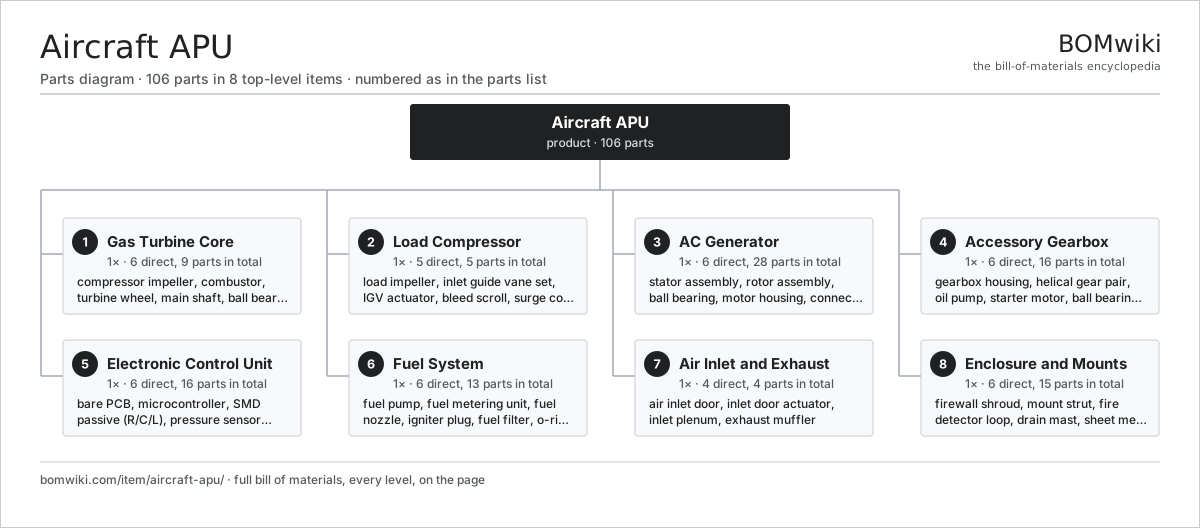
| # | Part | Qty | What it does |
|---|---|---|---|
| 1 | Gas Turbine Core 6 parts | 1× | Single-spool centrifugal-flow turbine spinning near 49,000 rpm and producing about 330 kW of shaft power. |
| 2 | Load Compressor 5 parts | 1× | Shaft-driven centrifugal compressor delivering bleed air for cabin conditioning and main-engine starting. |
| 3 | AC Generator 6 parts | 1× | Gearbox-driven 90 kVA generator supplying 115 V 400 Hz aircraft power with the engines shut down. |
| 4 | Accessory Gearbox 6 parts | 1× | Reduction gear train dropping 49,000 rpm shaft speed to generator and pump speeds, doubling as the oil system hub. |
| 5 | Electronic Control Unit 6 parts | 1× | Full-authority controller running start sequence, governed speed and protective shutdowns without crew attention. |
| 6 | Fuel System 6 parts | 1× | Pump, metering unit and atomisers feeding about 120 kg/h of Jet A-1 from the aircraft tanks. |
| 7 | Air Inlet and Exhaust 4 parts | 1× | Inlet door, plenum and muffled exhaust managing airflow into and out of the tailcone installation. |
| 8 | Enclosure and Mounts 6 parts | 1× | Firewalled tailcone compartment isolating the APU as a designated fire zone with its own detection. |
3D model
No 3D model yet. Have a CAD file of this? Add a 3D model. STL renders right on this page; STEP, FreeCAD, and OpenSCAD sources are welcome too (openly licensed, like all 3D models on BOMwiki).
Build & assembly graph
expand / collapse · shared sub-assemblies converge · links to related products · est. labourTap an assembly to expand/collapse · tap a part to open it · use “Open page” for any node · drag to pan, scroll to zoom.
Bill of materials for Aircraft APU
8 top-level lines · 60 rows shown · 106 parts total · indented to 3 levels| # | Item / sub-assembly | Part no. | Qty/assy | Ext. qty | Parts | Type |
|---|---|---|---|---|---|---|
| 1 | Gas Turbine Core 6 parts | aircraft-apu-turbine-core | 1× | 1 | 9 | assembly |
| 1.1 | Compressor Impeller | aircraft-apu-impeller | 1× | 1 | · | part |
| 1.2 | Combustor | aircraft-apu-combustor | 1× | 1 | · | part |
| 1.3 | Turbine Wheel | aircraft-apu-turbine-wheel | 2× | 2 | · | part |
| 1.4 | Main Shaft | aircraft-apu-main-shaft | 1× | 1 | · | part |
| 1.5 | Ball Bearing | ball-bearing | 2× | 2 | · | part |
| 1.6 | Oil Seal | oil-seal | 2× | 2 | · | part |
| 2 | Load Compressor 5 parts | aircraft-apu-load-compressor | 1× | 1 | 5 | assembly |
| 2.1 | Load Impeller | aircraft-apu-load-impeller | 1× | 1 | · | part |
| 2.2 | Inlet Guide Vane Set | aircraft-apu-igv-set | 1× | 1 | · | part |
| 2.3 | IGV Actuator | aircraft-apu-igv-actuator | 1× | 1 | · | part |
| 2.4 | Bleed Scroll | aircraft-apu-bleed-scroll | 1× | 1 | · | part |
| 2.5 | Surge Control Valve | aircraft-apu-surge-valve | 1× | 1 | · | part |
| 3 | AC Generator 6 parts | aircraft-apu-generator | 1× | 1 | 28 | assembly |
| 3.1 | Stator Assembly 3 parts | stator-assembly | 1× | 1 | 3 | assembly |
| 3.1.1 | Stator Core (laminations) | stator-core | 1× | 1 | · | part |
| 3.1.2 | Copper Winding | copper-winding | 1× | 1 | · | part |
| 3.1.3 | Slot Insulation | stator-insulation | 1× | 1 | · | part |
| 3.2 | Rotor Assembly 4 parts | rotor-assembly | 1× | 1 | 19 | assembly |
| 3.2.1 | Rotor Shaft | rotor-shaft | 1× | 1 | · | part |
| 3.2.2 | Rotor Core | rotor-core | 1× | 1 | · | part |
| 3.2.3 | Neodymium Magnet | neodymium-magnet | 16× | 16 | · | part |
| 3.2.4 | Ball Bearing | ball-bearing | 1× | 1 | · | part |
| 3.3 | Ball Bearing | ball-bearing | 2× | 2 | · | part |
| 3.4 | Motor Housing | motor-housing | 1× | 1 | · | part |
| 3.5 | Connector | connector | 2× | 2 | · | part |
| 3.6 | Generator Control Unit | aircraft-apu-gen-regulator | 1× | 1 | · | part |
| 4 | Accessory Gearbox 6 parts | aircraft-apu-gearbox | 1× | 1 | 16 | assembly |
| 4.1 | Gearbox Housing | gearbox-housing | 1× | 1 | · | part |
| 4.2 | Helical Gear Pair | gear-pair | 3× | 3 | · | part |
| 4.3 | Oil Pump | aircraft-apu-oil-pump | 1× | 1 | · | part |
| 4.4 | Starter Motor | aircraft-apu-starter-motor | 1× | 1 | · | part |
| 4.5 | Ball Bearing | ball-bearing | 6× | 6 | · | part |
| 4.6 | Oil Seal | oil-seal | 4× | 4 | · | part |
| 5 | Electronic Control Unit 6 parts | aircraft-apu-ecu | 1× | 1 | 16 | assembly |
| 5.1 | Bare PCB | pcb-bare | 2× | 2 | · | part |
| 5.2 | Microcontroller | mcu | 2× | 2 | · | part |
| 5.3 | SMD Passive (R/C/L) | smd-passives | 1× | 1 | · | part |
| 5.4 | Pressure Sensor | pressure-sensor | 2× | 2 | · | part |
| 5.5 | Relay | relay | 3× | 3 | · | part |
| 5.6 | Connector | connector | 6× | 6 | · | part |
| 6 | Fuel System 6 parts | aircraft-apu-fuel-system | 1× | 1 | 13 | assembly |
| 6.1 | Fuel Pump | aircraft-apu-fuel-pump | 1× | 1 | · | part |
| 6.2 | Fuel Metering Unit | aircraft-apu-fuel-metering-unit | 1× | 1 | · | part |
| 6.3 | Fuel Nozzle | aircraft-apu-fuel-nozzle | 6× | 6 | · | part |
| 6.4 | Igniter Plug | aircraft-apu-igniter | 2× | 2 | · | part |
| 6.5 | Fuel Filter | aircraft-apu-fuel-filter | 1× | 1 | · | part |
| 6.6 | O-Ring Set | oring-set | 2× | 2 | · | part |
| 7 | Air Inlet and Exhaust 4 parts | aircraft-apu-air-system | 1× | 1 | 4 | assembly |
| 7.1 | Air Inlet Door | aircraft-apu-inlet-door | 1× | 1 | · | part |
| 7.2 | Inlet Door Actuator | aircraft-apu-door-actuator | 1× | 1 | · | part |
| 7.3 | Inlet Plenum | aircraft-apu-inlet-plenum | 1× | 1 | · | part |
| 7.4 | Exhaust Muffler | aircraft-apu-exhaust-muffler | 1× | 1 | · | part |
| 8 | Enclosure and Mounts 6 parts | aircraft-apu-enclosure | 1× | 1 | 15 | assembly |
| 8.1 | Firewall Shroud | aircraft-apu-firewall-shroud | 1× | 1 | · | part |
| 8.2 | Mount Strut | aircraft-apu-mount-strut | 3× | 3 | · | part |
| 8.3 | Fire Detector Loop | aircraft-apu-fire-detector | 2× | 2 | · | part |
| 8.4 | Drain Mast | aircraft-apu-drain-mast | 1× | 1 | · | part |
| 8.5 | Sheet Metal Panel | sheet-panel | 4× | 4 | · | part |
| 8.6 | Fastener Set | fastener-set | 4× | 4 | · | part |
Something wrong in this list? Report a problem with this BOM.
Related products
same domain, ranked by shared parts Flying Boat
4,224 parts · shares 14 with this page
Flying Boat
4,224 parts · shares 14 with this page
 Freighter Aircraft
6,717 parts · shares 14 with this page
Freighter Aircraft
6,717 parts · shares 14 with this page
 Turboprop Airliner
3,298 parts · shares 14 with this page
Heavy-Lift Helicopter
1,794 parts · shares 13 with this page
Turboprop Airliner
3,298 parts · shares 14 with this page
Heavy-Lift Helicopter
1,794 parts · shares 13 with this page
 Tiltrotor Aircraft
2,528 parts · shares 13 with this page
Tiltrotor Aircraft
2,528 parts · shares 13 with this page
 Floatplane
813 parts · shares 13 with this page
Floatplane
813 parts · shares 13 with this page
Sourcing: possible vendors
Browse the supplier directory → Prices, MOQ, and lead times are algorithmic estimates, not quotes, and not claims about these companies. Company mappings are curated by keyword; est. price band $50k–$300M. How estimates work| Vendor | HQ | Specialty | MOQ | Lead time |
|---|---|---|---|---|
|
🇺🇸Boeing
boeing.com ↗
|
Arlington, US | Aerospace OEM | made to order | 40–80 wks |
|
🇫🇷Airbus
airbus.com ↗
|
Toulouse, FR | Aerospace OEM | made to order | 40–80 wks |
| lockheedmartin.com ↗ | Bethesda, US | Aerospace & defense | made to order | 40–80 wks |
|
🇧🇷Embraer
embraer.com ↗
|
São José dos Campos, BR | Aircraft OEM | made to order | 40–80 wks |
| txtav.com ↗ | Wichita, US | Aircraft OEM | made to order | 40–80 wks |
848-word article