Aircraft De-Icing Truck
ProductOverview
An aircraft de-icing truck sprays heated de-icing fluid onto aircraft surfaces before takeoff in winter conditions, preventing ice accumulation that would degrade aerodynamic performance and create safety hazards. Operating at major airports in cold climates, the de-icing truck combines high-capacity fluid storage, precision heating, and articulated spray delivery into a specialized ground-support vehicle.
The foundation is a heavy-duty commercial truck chassis: a 5.0–7.0 L turbocharged diesel producing 200–250 hp, paired with an eight-speed automatic transmission with retarder. The air-spring suspension with automatic level control maintains stable height across uneven airport taxiways and ramps, critical for proper boom positioning on aircraft of different sizes.
The core is a massive insulated tank (3000–5000 L capacity) made from stainless steel 304 with 150 mm polyurethane insulation. The tank contains either Type I (glycol-based, low viscosity) or Type IV (polysaccharide-based, high viscosity, longer hold-over time) de-icing fluid. Type I evaporates faster but provides shorter protection; Type IV adheres longer but is more viscous. Some trucks carry both fluids and mix them to balance protection time and coverage speed.
An immersion heater (30 kW, 480 V three-phase) maintains fluid temperature at 50–60°C. At this temperature, Type I fluid has viscosity ~3.5 cSt and flows smoothly through 200 mm nozzles at 200–300 L/min. Colder fluid (below 30°C) becomes sluggish and fails to cover aircraft quickly; hotter fluid (above 60°C) can damage paint and composite surfaces.
A centrifugal pump (200–300 L/min capacity) driven by a 30 kW electric motor delivers pressurized fluid to an articulated boom. The boom consists of telescoping aluminum arms reaching 6 m horizontally and 10 m vertically, articulated by hydraulic cylinders (50 mm bore vertical, 40 mm bore horizontal). The boom is rotatable 360° via a hydraulic swivel at its base, allowing the operator to spray all aircraft surfaces without repositioning the truck.
At the boom tip is a precision spray nozzle with interchangeable ceramic insert controlling spray pattern (cone angle 30°–90°). A 30° narrow cone delivers fluid to hard-to-reach wing surfaces; a 90° wide fan covers fuselage and tail surfaces rapidly. The nozzle has a stainless steel swivel coupling allowing ±45° directional tilt.
A proportioning system allows the operator to blend Type I and Type IV fluid from 0 (100% Type I) to 100 (100% Type IV). Two solenoid valves control the proportion, mixed in a proportioning valve that defaults to 50/50. This blending capability allows operators to adapt protection time to scheduled gate hold duration: if an aircraft will wait 15 minutes for takeoff, a high-Type-IV mix (80% Type IV) provides extended protection; if the aircraft pushes back immediately, 100% Type I provides fast runoff and clearance.
The operator sits in a climate-controlled cab with a control panel displaying tank pressure, fluid temperature, and flow rate. A proportional joystick controls boom position (vertical and horizontal); a momentary button triggers spray activation. An emergency stop button (red mushroom) cuts all hydraulic and electric power immediately in case of runaway nozzle or operator error.
How it works
An aircraft arrives at the gate during winter conditions and is scheduled for de-icing. The ground crew positions the de-icing truck alongside the aircraft (typically 5–10 m away) and the operator enters the control cab.
The operator starts the diesel engine and engages the 30 kW pump motor. The centrifugal pump draws fluid from the Heated Tank Assembly at ambient temperature; the immersion Heating Element has already warmed the bulk fluid to 55°C (if the truck was pre-positioned for dispatch). The Pressure Regulator maintains discharge pressure at 3 bar, and the Flow Meter displays flow rate (typically 250 L/min during heavy coverage).
The operator uses the Boom Control Joystick to position the boom tip near the aircraft's wing leading edge. The Vertical Lift Cylinder and Horizontal Extension Cylinder extend/retract under proportional control, reaching 10 m height and 6 m horizontal reach. Once positioned, the operator presses the Spray Trigger Button.
The spray solenoid opens, directing 55°C de-icing fluid through the Spray Nozzle Assembly. Depending on the Blend Control Dial setting, the Type I Solenoid Valve and Type IV Solenoid Valve proportions control the blend. If the operator has selected 80% Type IV, the fluid flowing to the nozzle is 80% high-viscosity polysaccharide (slow to evaporate, sticks to wing surfaces) and 20% low-viscosity glycol (fast-acting, clears vision).
The fluid leaves the nozzle at 250 L/min in a cone pattern (typically 60° fan spray for fuselage coverage, 30° narrow for wing leading edges). The operator sweeps the boom from wing root to wing tip, ensuring complete coverage of the upper surface, then rotates the boom 180° and covers the lower surface. The entire wing takes ~5 minutes to cover at this application rate.
The operator then repositions the boom to cover the fuselage, tail surfaces, and horizontal stabilizers. A typical narrow-body aircraft (Boeing 737, Airbus A320) requires 500–1000 L of de-icing fluid total, consuming 2–4 minutes of spray time. Large wide-body aircraft (Boeing 747, A380) require 1500–3000 L and 5–10 minutes.
Throughout application, the Pressure Gauge and Flow Display are monitored for anomalies. If pressure exceeds 5 bar (indicating nozzle blockage), the operator reduces pump speed or checks for debris. If flow drops below 150 L/min, the Check Valve may be stuck, requiring manual inspection.
The tank temperature is continuously displayed on the Temperature Gauge. If ambient is very cold and the truck has been idle, the Tank Thermostat signals the heater contactor to turn on the immersion heater, warming the bulk tank. Modern systems use indirect heating (heat exchanger) to warm outgoing fluid while preserving tank bulk temperature.
Once de-icing is complete, the spray button is released, the pump is shut down, and the boom is retracted to its stowed position (lowered to minimize wind loading during ground movement). The truck repositions to the next aircraft or returns to the de-icing bay for refilling.
Operational constraints
Fluid consumption is substantial: a single aircraft can require 500–3000 L, and a busy airport during heavy snowfall may require 10,000–20,000 L per hour of de-icing operations. Resupply trucks deliver fresh fluid to the main storage facility, where de-icing trucks refill. Fluid that has absorbed water or contains debris must be filtered and dried before reuse; most airports operate fluid reclamation centers.
Temperature control is critical: Type I fluid below 0°C becomes gel-like and will not spray; Type IV below −5°C crystallizes. Heated tanks must be pre-positioned for dispatch hours before peak de-icing activity begins. Conversely, fluid hotter than 65°C can cause paint damage and composite delamination, so Tank Thermostat safety limits are enforced strictly.
Holdover time is the duration between de-icing and takeoff during which the fluid prevents re-icing. Type I provides 5–10 minutes holdover in moderate snow; Type IV provides 20–60 minutes depending on ambient temperature and precipitation rate. If aircraft taxi delays exceed holdover time, they must return to the de-icing bay for re-treatment.
Boom reach limits aircraft size: the 10 m height reaches upper fuselage and tail surfaces of most narrow-body jets, but wide-body aircraft with tall tail fins (A380, Boeing 747) may require extension poles or repositioning the truck. Similarly, the 6 m horizontal reach limits application to aircraft at the gate; distant parking positions require multiple trucks or extended wait times.
Operator training is essential: improper boom control can strike aircraft fuselage or windows, causing thousands of dollars in damage. Operators must complete specialized ground-handling certification and pass competency tests on this equipment.
Environmental and regulatory aspects
De-icing fluid runoff is an environmental concern: Type I (ethylene glycol) and Type IV (propylene glycol or polysaccharides) are biodegradable but consume oxygen during decomposition. Major airports capture runoff in holding ponds or treatment facilities before discharge. Some facilities recirculate and filter de-icing fluid for reuse, reducing consumption by 30–50%.
Regulatory limits on water-side propylene glycol concentration are typically 500 ppm; airports must monitor runoff to ensure compliance. Spills require immediate containment and reporting to environmental agencies.
Aircraft de-icing is a safety-critical operation: inadequate coverage can leave ice on control surfaces, compromising aircraft handling. Quality assurance protocols require visual inspection and sometimes hot-water rinse verification before takeoff approval.
Market variants
Large airports operate fleets of 5–20 de-icing trucks, managed by ground-handling companies (Swissport, Menzies, Servisair). High-volume airports (Frankfurt, Denver, Minneapolis) operate continuously during winter months, rotating trucks through refill/maintenance cycles.
Specialized variants include:
- Low-level de-icing trucks: Boom height 6–8 m, designed for regional airports serving smaller aircraft.
- Dual-fluid trucks: Separate tanks for Type I and Type IV, allowing operator to switch without refilling.
- Heated hose systems: Wrapped hoses prevent fluid cooling during delivery from storage to tank.
- Monitoring systems: Telemetry logging fluid usage, application time, and aircraft type for operational analysis and training.
Some airports operate de-icing facilities with stationary platforms (aircraft drive over or park next to a fixed spray rig), reducing equipment costs but offering less flexibility than mobile trucks.
Aircraft De-Icing Truck parts and their functions
8 top-level parts · 100 parts in total · full bill of materials below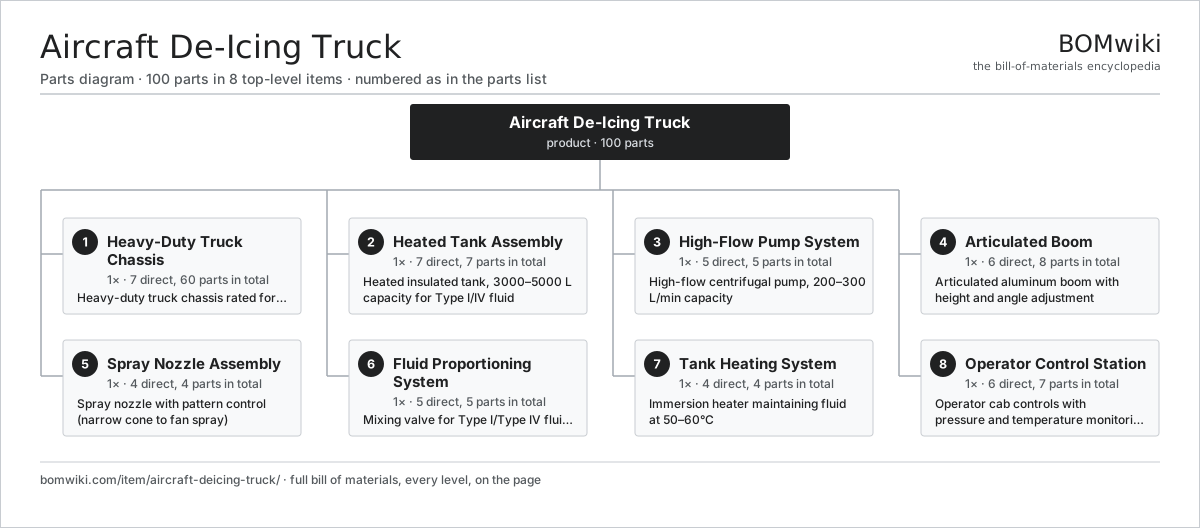
| # | Part | Qty | What it does |
|---|---|---|---|
| 1 | Heavy-Duty Truck Chassis 7 parts | 1× | Heavy-duty truck chassis rated for 8000 kg payload |
| 2 | Heated Tank Assembly 7 parts | 1× | Heated insulated tank, 3000–5000 L capacity for Type I/IV fluid |
| 3 | High-Flow Pump System 5 parts | 1× | High-flow centrifugal pump, 200–300 L/min capacity |
| 4 | Articulated Boom 6 parts | 1× | Articulated aluminum boom with height and angle adjustment |
| 5 | Spray Nozzle Assembly 4 parts | 1× | Spray nozzle with pattern control (narrow cone to fan spray) |
| 6 | Fluid Proportioning System 5 parts | 1× | Mixing valve for Type I/Type IV fluid ratio control |
| 7 | Tank Heating System 4 parts | 1× | Immersion heater maintaining fluid at 50–60°C |
| 8 | Operator Control Station 6 parts | 1× | Operator cab controls with pressure and temperature monitoring |
3D model
No 3D model yet. Have a CAD file of this? Add a 3D model. STL renders right on this page; STEP, FreeCAD, and OpenSCAD sources are welcome too (openly licensed, like all 3D models on BOMwiki).
Build & assembly graph
expand / collapse · shared sub-assemblies converge · links to related products · est. labourTap an assembly to expand/collapse · tap a part to open it · use “Open page” for any node · drag to pan, scroll to zoom.
Bill of materials for Aircraft De-Icing Truck
8 top-level lines · 57 rows shown · 100 parts total · indented to 3 levels| # | Item / sub-assembly | Part no. | Qty/assy | Ext. qty | Parts | Type |
|---|---|---|---|---|---|---|
| 1 | Heavy-Duty Truck Chassis 7 parts | aircraft-deicing-truck-chassis | 1× | 1 | 60 | assembly |
| 1.1 | Diesel Engine | aircraft-deicing-truck-engine | 1× | 1 | · | part |
| 1.2 | Automatic Transmission | aircraft-deicing-truck-transmission | 1× | 1 | · | part |
| 1.3 | Chassis Frame | aircraft-deicing-truck-frame | 1× | 1 | · | part |
| 1.4 | Air Suspension | aircraft-deicing-truck-suspension | 1× | 1 | · | part |
| 1.5 | Brake System | aircraft-deicing-truck-brakes | 1× | 1 | · | part |
| 1.6 | Power Steering | aircraft-deicing-truck-steering | 1× | 1 | · | part |
| 1.7 | Wheel Assembly 5 parts | wheel-assembly | 6× | 6 | 9 | assembly |
| 1.7.1 | Alloy Wheel | alloy-wheel | 1× | 6 | · | part |
| 1.7.2 | Tire | tire | 1× | 6 | · | part |
| 1.7.3 | TPMS Sensor | tpms-sensor | 1× | 6 | · | part |
| 1.7.4 | Lug Nut | lug-nut | 5× | 30 | · | part |
| 1.7.5 | Valve Stem | valve-stem | 1× | 6 | · | part |
| 2 | Heated Tank Assembly 7 parts | aircraft-deicing-truck-tank | 1× | 1 | 7 | assembly |
| 2.1 | Tank Container | aircraft-deicing-truck-tank-shell | 1× | 1 | · | part |
| 2.2 | Baffles | aircraft-deicing-truck-baffle | 1× | 1 | · | part |
| 2.3 | Tank Filler | aircraft-deicing-truck-filler | 1× | 1 | · | part |
| 2.4 | Drain Valve | aircraft-deicing-truck-drain-valve | 1× | 1 | · | part |
| 2.5 | Heating Element | aircraft-deicing-truck-heating-element | 1× | 1 | · | part |
| 2.6 | Pressure Sensor | pressure-sensor | 1× | 1 | · | part |
| 2.7 | Thermal Sensor | aircraft-deicing-truck-thermal-sensor | 1× | 1 | · | part |
| 3 | High-Flow Pump System 5 parts | aircraft-deicing-truck-pump | 1× | 1 | 5 | assembly |
| 3.1 | Pump Drive Motor | aircraft-deicing-truck-pump-motor | 1× | 1 | · | part |
| 3.2 | Centrifugal Pump | aircraft-deicing-truck-centrifugal-pump | 1× | 1 | · | part |
| 3.3 | Pressure Regulator | aircraft-deicing-truck-pressure-regulator | 1× | 1 | · | part |
| 3.4 | Flow Meter | aircraft-deicing-truck-flow-meter | 1× | 1 | · | part |
| 3.5 | Check Valve | aircraft-deicing-truck-check-valve | 1× | 1 | · | part |
| 4 | Articulated Boom 6 parts | aircraft-deicing-truck-boom | 1× | 1 | 8 | assembly |
| 4.1 | Boom Base Joint | aircraft-deicing-truck-boom-base | 1× | 1 | · | part |
| 4.2 | Boom Arm Section | aircraft-deicing-truck-boom-arm | 2× | 2 | · | part |
| 4.3 | Vertical Lift Cylinder | aircraft-deicing-truck-boom-cylinder-vertical | 2× | 2 | · | part |
| 4.4 | Horizontal Extension Cylinder | aircraft-deicing-truck-boom-cylinder-horizontal | 1× | 1 | · | part |
| 4.5 | Boom Hydraulic Hose | aircraft-deicing-truck-boom-hose | 1× | 1 | · | part |
| 4.6 | Pressure Sensor | pressure-sensor | 1× | 1 | · | part |
| 5 | Spray Nozzle Assembly 4 parts | aircraft-deicing-truck-nozzle | 1× | 1 | 4 | assembly |
| 5.1 | Nozzle Body | aircraft-deicing-truck-nozzle-body | 1× | 1 | · | part |
| 5.2 | Nozzle Insert | aircraft-deicing-truck-nozzle-insert | 1× | 1 | · | part |
| 5.3 | Nozzle Swivel | aircraft-deicing-truck-nozzle-swivel | 1× | 1 | · | part |
| 5.4 | Nozzle Strainer | aircraft-deicing-truck-nozzle-strainer | 1× | 1 | · | part |
| 6 | Fluid Proportioning System 5 parts | aircraft-deicing-truck-proportioning | 1× | 1 | 5 | assembly |
| 6.1 | Proportioning Valve | aircraft-deicing-truck-proportioning-valve | 1× | 1 | · | part |
| 6.2 | Type I Fluid Supply | aircraft-deicing-truck-type-I-line | 1× | 1 | · | part |
| 6.3 | Type I Solenoid Valve | aircraft-deicing-truck-solenoid-I | 1× | 1 | · | part |
| 6.4 | Type IV Solenoid Valve | aircraft-deicing-truck-solenoid-IV | 1× | 1 | · | part |
| 6.5 | Pressure Regulator | aircraft-deicing-truck-pressure-regulator | 1× | 1 | · | part |
| 7 | Tank Heating System 4 parts | aircraft-deicing-truck-heater | 1× | 1 | 4 | assembly |
| 7.1 | Heating Element | aircraft-deicing-truck-heating-element | 1× | 1 | · | part |
| 7.2 | Tank Thermostat | aircraft-deicing-truck-thermostat | 1× | 1 | · | part |
| 7.3 | Heater Contactor | aircraft-deicing-truck-contactor | 1× | 1 | · | part |
| 7.4 | Temperature Gauge | aircraft-deicing-truck-temperature-gauge | 1× | 1 | · | part |
| 8 | Operator Control Station 6 parts | aircraft-deicing-truck-controls | 1× | 1 | 7 | assembly |
| 8.1 | Pressure Gauge | aircraft-deicing-truck-pressure-gauge | 2× | 2 | · | part |
| 8.2 | Flow Display | aircraft-deicing-truck-flow-display | 1× | 1 | · | part |
| 8.3 | Boom Control Joystick | aircraft-deicing-truck-boom-joystick | 1× | 1 | · | part |
| 8.4 | Spray Trigger Button | aircraft-deicing-truck-spray-button | 1× | 1 | · | part |
| 8.5 | Blend Control Dial | aircraft-deicing-truck-proportioning-dial | 1× | 1 | · | part |
| 8.6 | Emergency Stop Button | aircraft-deicing-truck-emergency-stop | 1× | 1 | · | part |
Something wrong in this list? Report a problem with this BOM.
Related products
same domain, ranked by shared parts


Sourcing: possible vendors
Browse the supplier directory → Prices, MOQ, and lead times are algorithmic estimates, not quotes, and not claims about these companies. Company mappings are curated by keyword; est. price band $30k–$1.5M. How estimates work| Vendor | HQ | Specialty | MOQ | Lead time |
|---|---|---|---|---|
| oshkoshaerotech.com ↗ | Orlando, US | Airport ground support | made to order | 16–30 wks |
| tld-group.com ↗ | Paris, FR | Ground support equipment | made to order | 16–30 wks |
| textrongse.txtsv.com ↗ | Augusta, US | Ground support equipment | made to order | 16–30 wks |
| vestergaardcompany.com ↗ | Skanderborg, DK | De-icers & GSE | made to order | 16–30 wks |
| mallaghangse.com ↗ | Dungannon, GB | Ground support equipment | made to order | 16–30 wks |
1,602-word article