Airport Catering Truck
ProductOverview
An airport catering truck brings meals and beverages to aircraft parked at the gate. The truck carries pre-loaded meal carts in a refrigerated box body, drives to the aircraft, raises a scissor-lift deck to align with the aircraft cabin door (~2.5 m high for a narrow-body), and the ground crew transfers hot and cold meal carts into the galley. The whole operation (unload old carts, load new ones) takes 10–15 minutes; multiple trucks service a single aircraft simultaneously.
The design is engineered for speed and reliability. A scissor lift is robust, needs no complex pinch-point guarding, and reaches operating height (2–4 m) in 30–60 seconds. The refrigeration system maintains meal temperatures during 1–4 hour operations cycles. Stabilizer feet prevent tip-over when the lifted load moves laterally on the deck.
Scissor-lift mechanism
The Scissor Lift Frame is the core. Four steel arms cross diagonally (like an X pattern), articulated at central pins. As twin hydraulic cylinders extend vertically, they push the arm pairs apart, forcing the crossed pattern to elongate and the top deck to rise. The kinematic advantage is low (mechanical disadvantage, actually) but the geometry is robust: no single point of failure causes sudden collapse, and the mechanism is self-locking near full extension.
Height range is typically 1.5–4 m from ground to deck surface. Most narrow-body aircraft (737, A320) have cabin floors 2.4–2.7 m high; most wide-body aircraft (777, A350) are 2.7–3.0 m high. The operator raises the deck until it aligns with the aircraft door sill, then stabilizer feet are deployed.
Stabilization and safety
Once the lift is raised, the truck is unstable: the load is 2–4 m above the ground and slightly forward of the truck's wheelbase. A pair of hydraulic or pneumatic outrigger legs are deployed laterally from the truck frame, pressing rubber-faced pads against the tarmac. Load sensors confirm ground contact and measure pressure, preventing tip-over if the load shifts.
A mechanical height-lock pin inserted when the deck reaches its set height provides a fail-safe: if the hydraulic pressure is lost (pump failure or line rupture), the lift does not collapse; the pin bears the load.
Box body and refrigeration
The Box Body below the lift deck is an insulated compartment (8–15 m³) holding additional meal components. Walls are aluminum or fiberglass with 100–150 mm polyurethane foam insulation. The Refrigeration System is a roof-mounted packaged unit: hermetic compressor, condenser fan, and interior evaporator maintaining 2–7°C.
The compressor is driven via an auxiliary PTO from the truck engine, or via a small electric motor. Most modern units are PTO-driven at idle RPM during hot-holds (100–2000 L per day of cooling); continuous engine run costs fuel, but it decouples refrigeration from ground power. Some airports supply 400 VAC three-phase pedestal power at the gate, allowing trucks to plug in and shut down the engine for refrigeration during the 45–60 minute turnaround.
Refrigeration capacity is modest: 3–7 kW is enough to maintain temperature in a 10 m³ insulated box during a 1–4 hour operation cycle, assuming no door-opening. Each catering cycle involves multiple door opens (loading carts, removing old carts), so the compressor cycles on/off frequently. A digital thermostat modulates the compressor or expands the evaporator flow via a thermostatic valve.
Lift hydraulics
The Lift Hydraulics system is simple: a 5–10 cc/rev pump powered via the auxiliary PTO delivers 20–50 L/min at 150–210 bar. A proportional solenoid valve in the cabin allows the operator to modulate lift speed by opening the valve gradually. Up-speed is typically 10–30 cm/s; down-speed is slightly slower for load control.
A relief valve at 180–210 bar protects the system. If the deck is overloaded (more than 4 t on a truck rated 2–4 t), pressure rises and the relief opens, dumping flow to tank and halting the lift. The operator sees the pressure rise and knows not to continue.
Electrical system and controls
The electrical system is 24 V (two 12 V batteries in series). An alternator powered by the auxiliary PTO keeps the batteries charged during engine operation. The lift control is a proportional lever in the cabin or a hand-held remote pendant. A warning light on the control panel indicates overload or refrigeration setpoint drift.
Some newer trucks add wireless remote control, allowing a ground handler to raise or lower the lift without entering the cab. This speeds turnaround, especially on turbo ramps with multiple trucks servicing the same aircraft.
Ramp system
A ground ramp hinged at the box body sill allows loading meal carts from ground level without lifting them over the body perimeter. The aluminum ramp folds down via gravity and is held by a heavy-duty hinge with an integrated damper preventing free-fall. The safety chain retains the ramp if the hinge pin is accidentally removed.
Ground crews push meal carts up the ramp into the box body; the low gradient (~15°) makes this easy for a single handler pushing a 200–300 kg loaded cart.
Operational details
A typical catering truck carries 8–12 loaded meal carts (hot and cold) per cycle. During turnaround, the truck pulls up to the aircraft at the gate. The hydraulic outriggers are deployed and locked. The scissor lift raises the deck to door-sill height (30–60 seconds). The galley attendant (aircraft crew) opens the door, and the ground handler begins transferring carts: pulling old meal carts from the aircraft galley and pushing new carts in. Simultaneously, a second catering truck may be servicing the opposite side of the aircraft.
The transfer takes 10–15 minutes for a narrow-body, 20–30 minutes for a wide-body. Once complete, the ground handler withdraws, carts are chocked in the truck bed, the lift descends, outriggers retract, and the truck departs to the catering facility.
Thermostat setpoint is critical: too cold (−2°C) and ice cream desserts freeze solid; too warm (8°C) and perishables spoil. Most trucks are set to 3–5°C as a compromise.
Failure modes and maintenance
Common failure points:
- Scissor weld cracks: fatigue at the pivot pins over 100,000+ lift cycles. Cracks usually propagate slowly; ultrasonic testing every 2–3 years is recommended.
- Hydraulic seal wear: the lift cylinders operate in a corrosive salt-air airport environment. Seals degrade after 3–5 years; rod seals leak oil onto the deck and increase friction.
- Refrigeration compressor: hermetic compressors are sealed; if a seal fails, the system loses refrigerant within hours. Replacement cost is USD 3,000–6,000. Most operators maintain spare sealed cartridge compressor units for field swap.
- Stabilizer foot corrosion: the outrigger pads oxidize from salt water spray. Painting every 2 years is standard maintenance.
- Proportional solenoid coil failure: the solenoid controlling flow wears after 50,000+ cycles; replacement is USD 1,000–2,000.
Scheduled maintenance is annual: complete system inspection, hydraulic fluid and filter change, refrigerant charge top-up, compressor vibration check, and structural weld UT inspection. Downtime for a major overhaul (compressor replacement, seal kit) is 1–2 weeks.
Economics
A new catering truck costs USD 150,000–250,000 depending on lift capacity and refrigeration spec. Operating cost is roughly USD 30–50 per flight cycle (fuel, labour, maintenance). Most airports operate a fleet of 20–50 catering trucks, sized for peak turnaround loads (10 wide-body aircraft simultaneously in service). Truck life is 10–15 years before structural degradation (corroded frame, cracked welds) warrants retirement.
Rental fleets exist in major hub airports, with day/weekly/monthly rates available for airlines operating seasonal routes or ad-hoc charter operations.
Airport Catering Truck parts and their functions
9 top-level parts · 115 parts in total · full bill of materials below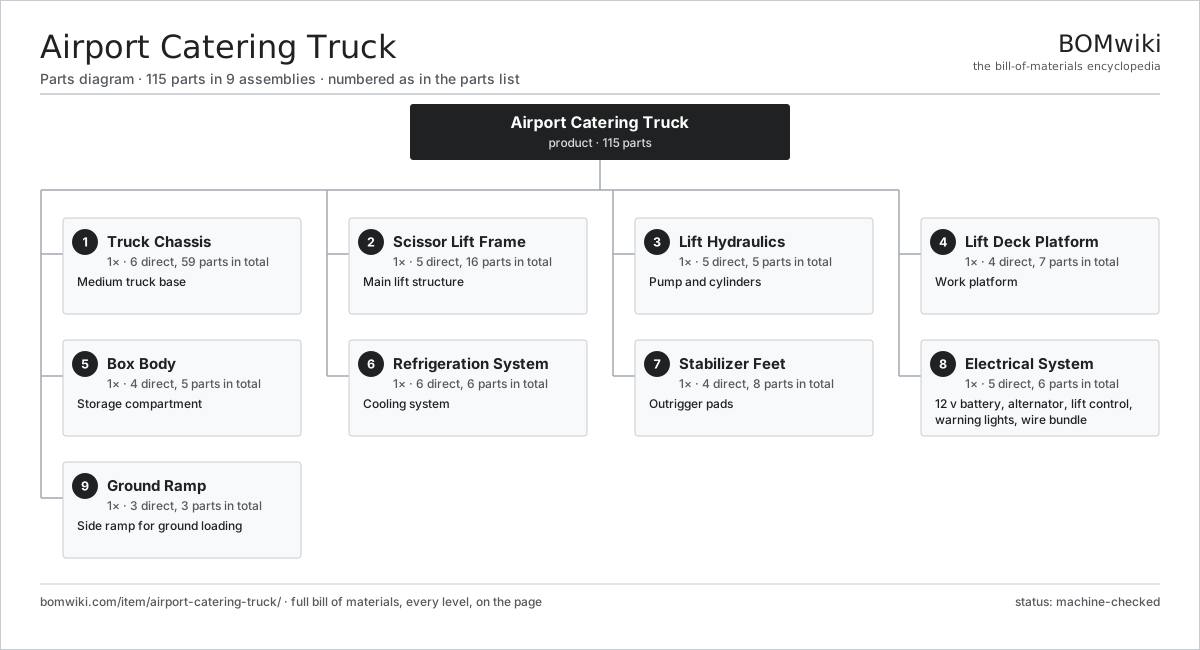
| # | Part | Qty | What it does |
|---|---|---|---|
| 1 | Truck Chassis 6 parts | 1× | Medium truck base |
| 2 | Scissor Lift Frame 5 parts | 1× | Main lift structure |
| 3 | Lift Hydraulics 5 parts | 1× | Pump and cylinders |
| 4 | Lift Deck Platform 4 parts | 1× | Work platform |
| 5 | Box Body 4 parts | 1× | Storage compartment |
| 6 | Refrigeration System 6 parts | 1× | Cooling system |
| 7 | Stabilizer Feet 4 parts | 1× | Outrigger pads |
| 8 | Electrical System 5 parts | 1× | 24 V dual-battery system powering the lift controls, refrigeration thermostat, and indicator lights. |
| 9 | Ground Ramp 3 parts | 1× | Side ramp for ground loading |
3D model
No 3D model yet. Have a CAD file of this? Add a 3D model — STL renders right on this page; STEP, FreeCAD, and OpenSCAD sources are welcome too (openly licensed, like all 3D models on BOMwiki).
Build & assembly graph
expand / collapse · shared sub-assemblies converge · links to related products · est. labourTap an assembly to expand/collapse · tap a part to open it · use “Open page” for any node · drag to pan, scroll to zoom.
Bill of materials for Airport Catering Truck
9 top-level lines · 56 rows shown · 115 parts total · indented to 3 levels| # | Item / sub-assembly | Part no. | Qty/assy | Ext. qty | Parts | Type |
|---|---|---|---|---|---|---|
| 1 | Truck Chassis 6 parts | airport-catering-truck-chassis | 1× | 1 | 59 | assembly |
| 1.1 | Frame Rails | airport-catering-truck-frame-rails | 1× | 1 | · | part |
| 1.2 | Diesel Engine | airport-catering-truck-diesel-engine | 1× | 1 | · | part |
| 1.3 | Transmission | airport-catering-truck-transmission | 1× | 1 | · | part |
| 1.4 | Axle Assembly | airport-catering-truck-axles | 1× | 1 | · | part |
| 1.5 | Wheel Assembly 5 parts | wheel-assembly | 6× | 6 | 9 | assembly |
| 1.5.1 | Alloy Wheel | alloy-wheel | 1× | 6 | · | part |
| 1.5.2 | Tire | tire | 1× | 6 | · | part |
| 1.5.3 | TPMS Sensor | tpms-sensor | 1× | 6 | · | part |
| 1.5.4 | Lug Nut | lug-nut | 5× | 30 | · | part |
| 1.5.5 | Valve Stem | valve-stem | 1× | 6 | · | part |
| 1.6 | Cab | airport-catering-truck-cab | 1× | 1 | · | part |
| 2 | Scissor Lift Frame 5 parts | airport-catering-truck-scissor-lift-frame | 1× | 1 | 16 | assembly |
| 2.1 | Outer Frame | airport-catering-truck-outer-frame | 1× | 1 | · | part |
| 2.2 | Scissor Arm | airport-catering-truck-scissor-arms | 4× | 4 | · | part |
| 2.3 | Pivot Pin | airport-catering-truck-pivot-pins | 8× | 8 | · | part |
| 2.4 | Lift Cylinder | airport-catering-truck-lift-cylinders | 2× | 2 | · | part |
| 2.5 | Height Lock Pin | airport-catering-truck-height-lock-pin | 1× | 1 | · | part |
| 3 | Lift Hydraulics 5 parts | airport-catering-truck-lift-hydraulics | 1× | 1 | 5 | assembly |
| 3.1 | Hydraulic Pump | airport-catering-truck-hydraulic-pump | 1× | 1 | · | part |
| 3.2 | Hydraulic Motor | airport-catering-truck-hydraulic-motor | 1× | 1 | · | part |
| 3.3 | Control Valve | airport-catering-truck-control-valve | 1× | 1 | · | part |
| 3.4 | Relief Valve | airport-catering-truck-relief-valve | 1× | 1 | · | part |
| 3.5 | Hydraulic Hose | airport-catering-truck-hydraulic-hose | 1× | 1 | · | part |
| 4 | Lift Deck Platform 4 parts | airport-catering-truck-lift-deck | 1× | 1 | 7 | assembly |
| 4.1 | Platform Surface | airport-catering-truck-platform-surface | 1× | 1 | · | part |
| 4.2 | Deck Guide | airport-catering-truck-deck-guides | 4× | 4 | · | part |
| 4.3 | Leveling Sensor | airport-catering-truck-leveling-sensor | 1× | 1 | · | part |
| 4.4 | Safety Railing | airport-catering-truck-safety-railing | 1× | 1 | · | part |
| 5 | Box Body 4 parts | airport-catering-truck-box-body | 1× | 1 | 5 | assembly |
| 5.1 | Body Panels | airport-catering-truck-body-panels | 1× | 1 | · | part |
| 5.2 | Body Insulation | airport-catering-truck-body-insulation | 1× | 1 | · | part |
| 5.3 | Cargo Door | airport-catering-truck-cargo-door | 2× | 2 | · | part |
| 5.4 | Interior Shelving | airport-catering-truck-interior-shelving | 1× | 1 | · | part |
| 6 | Refrigeration System 6 parts | airport-catering-truck-refrigeration-unit | 1× | 1 | 6 | assembly |
| 6.1 | Refrigeration Compressor | airport-catering-truck-compressor | 1× | 1 | · | part |
| 6.2 | Condenser | airport-catering-truck-condenser | 1× | 1 | · | part |
| 6.3 | Evaporator | airport-catering-truck-evaporator | 1× | 1 | · | part |
| 6.4 | Expansion Valve | airport-catering-truck-thermostatic-expansion-valve | 1× | 1 | · | part |
| 6.5 | Refrigerant | airport-catering-truck-refrigerant | 1× | 1 | · | part |
| 6.6 | Temperature Controller | airport-catering-truck-temperature-controller | 1× | 1 | · | part |
| 7 | Stabilizer Feet 4 parts | airport-catering-truck-stabilizer-feet | 1× | 1 | 8 | assembly |
| 7.1 | Stabilizer Leg | airport-catering-truck-stabilizer-leg | 2× | 2 | · | part |
| 7.2 | Foot Pad | airport-catering-truck-foot-pad | 2× | 2 | · | part |
| 7.3 | Stabilizer Cylinder | airport-catering-truck-stabilizer-cylinder | 2× | 2 | · | part |
| 7.4 | Pressure Sensor | pressure-sensor | 2× | 2 | · | part |
| 8 | Electrical System 5 parts | airport-catering-truck-electrical-system | 1× | 1 | 6 | assembly |
| 8.1 | 12 V Battery | lv-battery | 2× | 2 | · | part |
| 8.2 | Alternator | airport-catering-truck-alternator | 1× | 1 | · | part |
| 8.3 | Lift Control | airport-catering-truck-lift-control-panel | 1× | 1 | · | part |
| 8.4 | Warning Lights | airport-catering-truck-warning-light | 1× | 1 | · | part |
| 8.5 | Wire Bundle | wire-bundle | 1× | 1 | · | part |
| 9 | Ground Ramp 3 parts | airport-catering-truck-ramp-system | 1× | 1 | 3 | assembly |
| 9.1 | Ramp Panel | airport-catering-truck-ramp-panel | 1× | 1 | · | part |
| 9.2 | Ramp Hinge | airport-catering-truck-ramp-hinge | 1× | 1 | · | part |
| 9.3 | Ramp Safety Chain | airport-catering-truck-ramp-safety-chain | 1× | 1 | · | part |
Related products
same domain, ranked by shared parts Airport Pushback Tractor
250 parts · shares 2 with this page
Airport Pushback Tractor
250 parts · shares 2 with this page
 Jet Bridge
62 parts · shares 2 with this page
Jet Bridge
62 parts · shares 2 with this page
 Runway Sweeper Blower
88 parts · shares 1 with this page
Runway Sweeper Blower
88 parts · shares 1 with this page
 Aircraft De-Icing Truck
100 parts · shares 1 with this page
Aircraft De-Icing Truck
100 parts · shares 1 with this page
 Lavatory Service Truck
82 parts · shares 1 with this page
Lavatory Service Truck
82 parts · shares 1 with this page
 Passenger Boarding Stairs
104 parts · shares 1 with this page
Passenger Boarding Stairs
104 parts · shares 1 with this page
Sourcing: possible vendors
Prices, MOQ, and lead times are algorithmic estimates, not quotes, and not claims about these companies. Company mappings are curated by keyword; est. price band $30k–$1.5M. How estimates work| Vendor | HQ | Specialty | MOQ | Lead time |
|---|---|---|---|---|
| oshkoshaerotech.com ↗ | Orlando, US | Airport ground support | made to order | 16–30 wks |
| tld-group.com ↗ | Paris, FR | Ground support equipment | made to order | 16–30 wks |
| textrongse.txtsv.com ↗ | Augusta, US | Ground support equipment | made to order | 16–30 wks |
| vestergaardcompany.com ↗ | Skanderborg, DK | De-icers & GSE | made to order | 16–30 wks |
| mallaghangse.com ↗ | Dungannon, GB | Ground support equipment | made to order | 16–30 wks |
1,410-word article