Airport Refueling Truck
ProductOverview
An airport fuel truck is a specialized tanker designed to transfer jet fuel or aviation gasoline from a central depot to parked aircraft. The truck carries 10,000–20,000 L of fuel internally, drives to the aircraft stand, connects via a retractable hose to the aircraft fuel inlet, and pumps at controlled pressure and flow while filtering, metering, and monitoring the delivery. The design is utterly focused on safety: fuel transfer is a high-risk operation (explosion hazard, electrostatic discharge, fuel spill), so every component is redundant, monitored, and fail-safe.
Tank and fuel storage
The Main Fuel Tank is the core. A large aluminium-alloy or steel tank (10,000–20,000 L capacity) is mounted low on the truck bed to keep the centre of gravity down. Internal baffles divide the tank into compartments, minimizing sloshing during acceleration and braking and allowing storage of multiple fuel grades simultaneously (e.g., Jet A-1 in one chamber, AvGas 100LL in another).
Aluminium alloy is preferred over steel for jet fuel storage because jet fuel contains no corrosive water by design; steel tanks require regular washout to prevent microbial corrosion. The tank is rated for 1.5× working pressure (typically 10 bar) to survive pressure surges from the pump. A flame-arrestor vent on top allows air in as fuel is withdrawn; the arrestor prevents external flame from entering if a spark occurs during the return of the truck to the depot.
The Level Gauge is mechanical (a glass tube with a float) or electronic (capacitive probe). Modern trucks send tank level wirelessly to the dispatch office, triggering a request for top-up from the central tank farm. Storage conditions matter: the truck is parked in designated holding areas away from passenger terminals, with grounding cable attached between truck and terminal riser to prevent static buildup during extended waits.
Pump and flow control
The Pump Module is engine-driven via the transmission PTO. A centrifugal pump (100–400 L/min at 3–5 bar) draws fuel from the tank's submerged suction line and delivers it through the filtration system. The pump has no displacement control; excess flow beyond what the aircraft can accept is dumped back to the tank via a bypass relief valve.
A turbine flowmeter or positive-displacement meter accumulates the total volume delivered, displayed on the operator console. The meter is typically geared (pulse-per-litre) into a mechanical or electronic totalizer, allowing the operator to stop at an exact fuel load. Accuracy is ±0.5% to meet airline billing standards.
The deadman control system is the operator's valve. A hand-held nozzle with a dead-man trigger contains a proportional solenoid valve: when the operator squeezes the trigger, the valve opens proportionally; fuel flows at controlled pressure. The instant the operator releases the trigger, the valve closes and flow stops. This fail-safe design prevents runaway fuel flow if the operator loses consciousness or the hose ruptures.
Filtration
The multi-stage filtration is non-negotiable. Jet fuel is surprisingly intolerant of contamination: particles >10 microns can clog fuel nozzles in the engine; water droplets cause corrosion and ice formation at high altitude. A typical truck has three stages:
- Pre-filter (100 micron): removes rust, scale, and sand.
- Main filter (10 micron): the workhorse, replaced every 500–1000 refueling operations.
- Final polishing filter (3 micron): ensures delivered fuel meets ISO 4406 code 15/13/10.
A differential pressure gauge on each stage shows when cartridges are saturated. A clogged filter increases backpressure, slowing flow to the aircraft. Modern trucks have electronic sensors triggering a console alarm when filter change is due.
Water removal is not the truck's responsibility (that happens at the fuel farm before truck loading), but accumulated water in the truck tank is pumped out every 50 operating hours via a bottom drain.
Hose reel and coupling
The Hose Reel Assembly holds 100–200 m of fuel-grade hose (50–75 mm inner diameter), wound on a motorized spool. An electric or hydraulic motor automatically retracts the hose after refueling, keeping the truck organized. The hose is conductive (rubber impregnated with carbon), meeting DNV and API standards for static dissipation during fuel flow.
At the aircraft end, the hose terminates in a breakaway quick-disconnect coupling: if the aircraft moves during refueling (an emergency), the hose is pulled tight and the coupling separates on both sides, stopping fuel flow instantly and closing internal check valves to prevent spill. This is the most critical safety device on the truck.
A rotating swivel between the truck and hose prevents twisting as the hose unreels, extending hose life.
Grounding and static dissipation
Aviation fuel is a flammable liquid with a flash point around −18°C. During transfer, fuel friction in the hose and aircraft fuel tank generates static charge. If the charge accumulates without a path to ground, a spark can ignite vapour above the fuel surface. The Grounding System mitigates this risk.
Before connecting the hose, the operator clamps a bonding cable to the aircraft fuselage and a clamp to the truck chassis. A handheld resistance tester verifies continuity (<1 ohm typical) between truck and aircraft. Once bonded, any charge that builds up during fuel transfer flows safely to ground rather than accumulating as a spark hazard.
The fuel hose itself is conductive, further dissipating charge. Despite these precautions, the aviation industry maintains a strict protocol: no smoking, no engine running (except the fuel truck itself), no movement of the aircraft during refueling.
Operator console and displays
The Operator Console is a weatherproof cabinet mounted on the truck's exterior. The main display shows tank level, flow rate (L/min), and total volume delivered. A fuel-type selector (buttons or dial) allows the operator to log which grade was transferred, feeding inventory and billing systems in the airport operations centre.
A pressure gauge shows real-time discharge pressure (typically 2–5 bar during normal operation). If pressure exceeds 6–7 bar, a relief valve opens and the excess flow returns to the tank; this protects the aircraft fuel inlet from overpressure. Most modern trucks have electronic pressure transducers and wireless telemetry, reporting to the ramp control office in real-time.
Safety and operational hazards
Fuel trucks are high-consequence assets. Failure modes:
- Pump cavitation: if the tank runs empty during refueling, the pump loses prime and fuel aeration occurs. Recovery requires priming the pump, adding 5–10 minutes. Modern trucks have low-level sensors that trigger alarms and shut down the pump at a safe threshold.
- Breakaway coupling failure: if the coupling mechanism jams or seals degrade, a pull-away might not separate cleanly. Some hose is likely to remain attached to the aircraft, creating a spill. Regular maintenance and proof testing (every 6 months) are mandatory.
- Filtration bypass: if a filter cartridge tears internally, unfiltered fuel bypasses to the aircraft. Many operators now use transparent filter bowls to visually inspect for catastrophic failure signs (colour change, sediment).
- Electrostatic discharge: in dry climates or at high altitude, static charge can build despite bonding. Modern trucks have added fuel additives (static dissipator additives) that improve conductivity, reducing charge accumulation.
- Hose degradation: fuel hoses degrade from UV exposure, ozone, and thermal cycling. Rubber tubes typically last 7–10 years; some operators retire hoses at 5 years as a safety margin.
Regulatory inspection is strict. In most countries, fuel trucks are inspected annually by certified technicians; any defects are grounds for grounding the vehicle. Operators maintain detailed maintenance logs.
Economics and operations
An airport fuel truck costs USD 300,000–500,000 new. Operating cost is roughly USD 50–80 per refueling (fuel, labour, maintenance). Most airports operate a fleet of 5–20 trucks, sized to handle peak arrivals and departures. During peak hours (dawn push), trucks are deployed continuously. During off-peak, they're staged at a central ready-pad, engine running, awaiting a refueling call.
Truck life is 15–20 years if well-maintained. Many are rebuilt or resold to smaller airports or private aviation services after their primary airline service. Final scrapping requires environmental remediation (tank cleaning) due to residual fuel and water contamination.
Airport Refueling Truck parts and their functions
8 top-level parts · 128 parts in total · full bill of materials below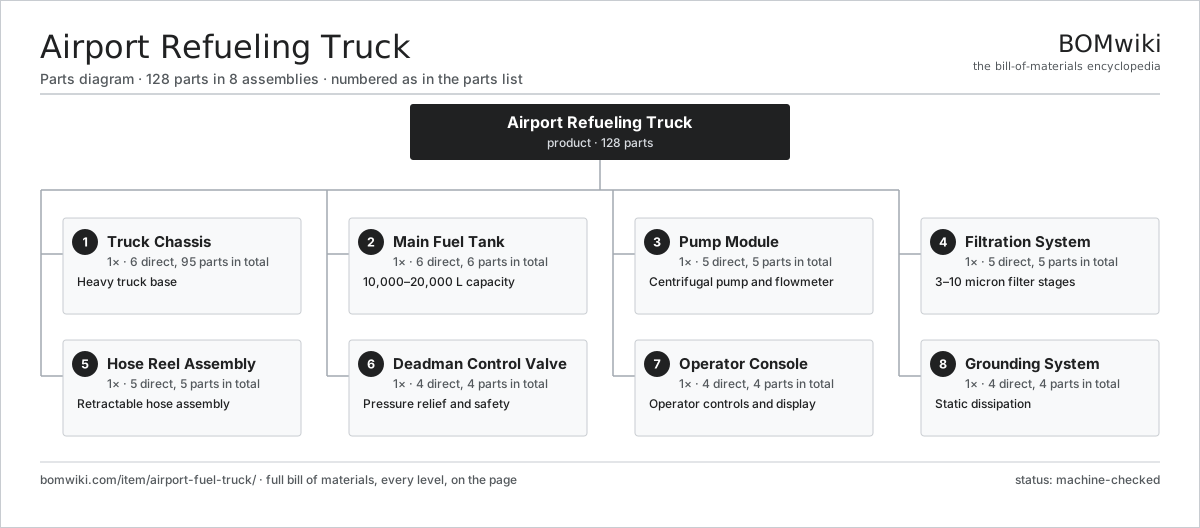
| # | Part | Qty | What it does |
|---|---|---|---|
| 1 | Truck Chassis 6 parts | 1× | Heavy truck base |
| 2 | Main Fuel Tank 6 parts | 1× | 10,000–20,000 L capacity |
| 3 | Pump Module 5 parts | 1× | Centrifugal pump and flowmeter |
| 4 | Filtration System 5 parts | 1× | 3–10 micron filter stages |
| 5 | Hose Reel Assembly 5 parts | 1× | Retractable hose assembly |
| 6 | Deadman Control Valve 4 parts | 1× | Pressure relief and safety |
| 7 | Operator Console 4 parts | 1× | Operator controls and display |
| 8 | Grounding System 4 parts | 1× | Static dissipation |
3D model
No 3D model yet. Have a CAD file of this? Add a 3D model — STL renders right on this page; STEP, FreeCAD, and OpenSCAD sources are welcome too (openly licensed, like all 3D models on BOMwiki).
Build & assembly graph
expand / collapse · shared sub-assemblies converge · links to related products · est. labourTap an assembly to expand/collapse · tap a part to open it · use “Open page” for any node · drag to pan, scroll to zoom.
Bill of materials for Airport Refueling Truck
8 top-level lines · 52 rows shown · 128 parts total · indented to 3 levels| # | Item / sub-assembly | Part no. | Qty/assy | Ext. qty | Parts | Type |
|---|---|---|---|---|---|---|
| 1 | Truck Chassis 6 parts | airport-fuel-truck-chassis | 1× | 1 | 95 | assembly |
| 1.1 | Truck Frame | airport-fuel-truck-frame | 1× | 1 | · | part |
| 1.2 | Diesel Engine | airport-fuel-truck-diesel-engine | 1× | 1 | · | part |
| 1.3 | Transmission | airport-fuel-truck-transmission | 1× | 1 | · | part |
| 1.4 | Axle Assembly | airport-fuel-truck-axles | 1× | 1 | · | part |
| 1.5 | Wheel Assembly 5 parts | wheel-assembly | 10× | 10 | 9 | assembly |
| 1.5.1 | Alloy Wheel | alloy-wheel | 1× | 10 | · | part |
| 1.5.2 | Tire | tire | 1× | 10 | · | part |
| 1.5.3 | TPMS Sensor | tpms-sensor | 1× | 10 | · | part |
| 1.5.4 | Lug Nut | lug-nut | 5× | 50 | · | part |
| 1.5.5 | Valve Stem | valve-stem | 1× | 10 | · | part |
| 1.6 | Cab | airport-fuel-truck-cab | 1× | 1 | · | part |
| 2 | Main Fuel Tank 6 parts | airport-fuel-truck-main-tank | 1× | 1 | 6 | assembly |
| 2.1 | Tank Shell | airport-fuel-truck-tank-shell | 1× | 1 | · | part |
| 2.2 | Tank Baffle | airport-fuel-truck-tank-baffle | 1× | 1 | · | part |
| 2.3 | Tank Outlet | airport-fuel-truck-tank-outlet | 1× | 1 | · | part |
| 2.4 | Tank Filler | airport-fuel-truck-tank-inlet | 1× | 1 | · | part |
| 2.5 | Tank Vent | airport-fuel-truck-tank-vent | 1× | 1 | · | part |
| 2.6 | Level Gauge | airport-fuel-truck-tank-level-gauge | 1× | 1 | · | part |
| 3 | Pump Module 5 parts | airport-fuel-truck-pump-module | 1× | 1 | 5 | assembly |
| 3.1 | Centrifugal Pump | airport-fuel-truck-centrifugal-pump | 1× | 1 | · | part |
| 3.2 | Pump Drive Coupling | airport-fuel-truck-pump-motor-coupling | 1× | 1 | · | part |
| 3.3 | Flow Meter | airport-fuel-truck-flowmeter | 1× | 1 | · | part |
| 3.4 | Check Valve | airport-fuel-truck-check-valve | 1× | 1 | · | part |
| 3.5 | Bypass Valve | airport-fuel-truck-bypass-valve | 1× | 1 | · | part |
| 4 | Filtration System 5 parts | airport-fuel-truck-filtration-system | 1× | 1 | 5 | assembly |
| 4.1 | Pre-Filter Stage | airport-fuel-truck-prefilter-stage | 1× | 1 | · | part |
| 4.2 | Main Filter Stage | airport-fuel-truck-main-filter-stage | 1× | 1 | · | part |
| 4.3 | Final Filter Stage | airport-fuel-truck-final-filter-stage | 1× | 1 | · | part |
| 4.4 | Filter Bypass Valve | airport-fuel-truck-filter-bypass-valve | 1× | 1 | · | part |
| 4.5 | Differential Gauge | airport-fuel-truck-differential-gauge | 1× | 1 | · | part |
| 5 | Hose Reel Assembly 5 parts | airport-fuel-truck-hose-reel | 1× | 1 | 5 | assembly |
| 5.1 | Reel Drum | airport-fuel-truck-reel-drum | 1× | 1 | · | part |
| 5.2 | Reel Motor | airport-fuel-truck-reel-motor | 1× | 1 | · | part |
| 5.3 | Fuel Hose | airport-fuel-truck-hose-bundle | 1× | 1 | · | part |
| 5.4 | Swivel Joint | airport-fuel-truck-swivel-joint | 1× | 1 | · | part |
| 5.5 | Breakaway Coupling | airport-fuel-truck-breakaway-coupling | 1× | 1 | · | part |
| 6 | Deadman Control Valve 4 parts | airport-fuel-truck-deadman-valve | 1× | 1 | 4 | assembly |
| 6.1 | Deadman Handle | airport-fuel-truck-deadman-handle | 1× | 1 | · | part |
| 6.2 | Solenoid Valve | airport-fuel-truck-solenoid-valve | 1× | 1 | · | part |
| 6.3 | Pressure Transducer | airport-fuel-truck-pressure-transducer | 1× | 1 | · | part |
| 6.4 | Relief Valve | airport-fuel-truck-relief-valve | 1× | 1 | · | part |
| 7 | Operator Console 4 parts | airport-fuel-truck-driver-console | 1× | 1 | 4 | assembly |
| 7.1 | Display Panel | airport-fuel-truck-console-display | 1× | 1 | · | part |
| 7.2 | Fuel Type Selector | airport-fuel-truck-fuel-type-selector | 1× | 1 | · | part |
| 7.3 | Totalizer Reset | airport-fuel-truck-totalizer-reset | 1× | 1 | · | part |
| 7.4 | Pressure Display | airport-fuel-truck-pressure-display | 1× | 1 | · | part |
| 8 | Grounding System 4 parts | airport-fuel-truck-grounding-system | 1× | 1 | 4 | assembly |
| 8.1 | Ground Cable | airport-fuel-truck-ground-cable | 1× | 1 | · | part |
| 8.2 | Truck Ground Clamp | airport-fuel-truck-truck-ground-clamp | 1× | 1 | · | part |
| 8.3 | Aircraft Ground Clamp | airport-fuel-truck-aircraft-ground-clamp | 1× | 1 | · | part |
| 8.4 | Bonding Checker | airport-fuel-truck-bonding-check | 1× | 1 | · | part |
Sourcing: possible vendors
Prices, MOQ, and lead times are algorithmic estimates, not quotes, and not claims about these companies. Company mappings are curated by keyword; est. price band $30k–$1.5M. How estimates work| Vendor | HQ | Specialty | MOQ | Lead time |
|---|---|---|---|---|
| oshkoshaerotech.com ↗ | Orlando, US | Airport ground support | made to order | 16–30 wks |
| tld-group.com ↗ | Paris, FR | Ground support equipment | made to order | 16–30 wks |
| textrongse.txtsv.com ↗ | Augusta, US | Ground support equipment | made to order | 16–30 wks |
| vestergaardcompany.com ↗ | Skanderborg, DK | De-icers & GSE | made to order | 16–30 wks |
| mallaghangse.com ↗ | Dungannon, GB | Ground support equipment | made to order | 16–30 wks |
1,496-word article