Algae Turf Scrubber
ProductOverview
An Algae Turf Scrubber is a nutrient-removal system that cultivates a high-density biofilm of rapidly growing algae on an illuminated screen, harvesting the biomass before it decomposes and returns nutrients to the tank. Unlike passive Sump Filtration System refugia that export nutrients indirectly, the algae scrubber is an active nutrient pump: the Growth Screen is continuously fed with nutrient-rich tank water, the High-Output LED Array drives photosynthesis, and harvesting removes the biomass (and the nitrogen and phosphorus it contains) entirely from the system. This makes algae scrubbers exceptionally effective for reducing nitrate and phosphate in tanks with high bioload, particularly fish-heavy systems or commercial hatcheries where passive refugium nutrient export is insufficient.
The core design is elegant: a thin water sheet (1–3 cm) gravity-flows across a mesh screen immediately beneath intense LEDs. Algae (primarily fast-growing diatoms, green microalgae, and filamentous species) colonize the mesh within 3–7 days. The high light intensity (5–10 W/cm²) accelerates photosynthesis; the thin water layer ensures all algal cells are near the screen surface where light penetrates fully. Algae absorbs dissolved nitrate (NO₃⁻) and phosphate (PO₄³⁻) from the tank water at rates proportional to growth. Every 3–7 days, harvesting removes the biomass, exporting the sequestered nutrients out of the system.
Biofilm Growth and Nutrient Uptake
The Growth Screen, a plastic or stainless mesh with 1–3 mm apertures, becomes a foundation for rapid algal colonization. Within hours of operation, microscopic spores and cells from tank water begin settling on the mesh. Within 1–3 days, a visible thin film develops; by day 5–7, the screen is covered with a dense, slimy green or brown biofilm 0.5–3 mm thick.
The dominant species depends on water chemistry, but typically include:
- Diatoms (fast-growing, high nutrient uptake, brown color initially)
- Chlorophyta (green algae, rapid, often emerald green)
- Filamentous forms (Ulva, Chaetomorpha-like species, fiber-like texture)
The high High-Output LED Array intensity (5–10 W/cm², equivalent to 500–1000 µmol/m²/s photosynthetic photon flux density, far brighter than natural reef sunlight) drives maximal photosynthetic rates. Combined with unlimited nutrient supply from the flowing tank water and the thin water film allowing all algal cells direct light access, growth rates exceed 2–5 grams per day of wet biomass.
Nutrient uptake is stoichiometric: approximately 100 g of algal biomass removes 5–10 g of nitrate and 0.5–1 g of phosphate from tank water. A screen harvesting 3 g/day removes 150–300 mg nitrate and 15–30 mg phosphate daily, equivalent to the output of a moderately stocked 100–200 liter reef tank.
Water Distribution and Sheet Flow
The Water Distribution System system is critical. Tank water (or sump overflow) enters the Header Tank, an elevated small reservoir above the screen. From the header, the Distribution Manifold (a perforated pipe or drip header) delivers water across the entire screen width. The Drip Nozzles (individual drip emitters) are tuned to provide a uniform thin sheet of water trickling down the screen at approximately 1–3 cm depth.
The Water Circulation Pump recirculates water from the Drain Sump and Collection back to the header, closing the loop. Flow rate is modest (200–1000 LPH) to maintain the thin sheet; excessive flow converts the sheet into a jet, which does not provide uniform algal contact.
Water residence time on the screen is 1–5 minutes, sufficient for algal uptake of the limiting nutrient (usually phosphate, which is absorbed rapidly) and CO₂ dissolution (if pH is high, the thin sheet improves gas exchange compared to bulk tank water). Draining water is collected in the Drain Sump and Collection and returns to the main tank or sump via the Return Drain Valve.
LED Intensity and Spectrum
The High-Output LED Array is the most expensive and power-hungry component. Intensity of 5–10 W/cm² at the screen surface requires high-quality LEDs (typically Cree, Luxeon, or equivalent high-bin chips) and robust heatsinking. The Aluminum Heatsink is often anodized aluminum with 100–200 fins/inch, and may include active cooling (small fan) for systems exceeding 200 W LED power.
Spectrum options vary:
- Full-spectrum white (5000–6500 K): Mimics daylight, supports all algae species equally, simplest to implement
- Red + Blue custom (660 nm red + 440 nm blue): Optimizes photosynthesis for specific algae, slightly more efficient but requires careful tuning to avoid algae imbalance
- Warm white (3000–4000 K): Favors slower diatom growth, used where fine-tuning is necessary
The Timer and Control Module governs photoperiod, typically 12–16 hours/day. Longer photoperiods increase daily harvest but consume more power; shorter periods slow growth. Reverse photoperiod (opposite main tank lights) provides continuous nutrient export throughout the 24-hour cycle.
Harvesting and Algae Removal
Every 3–7 days, the algae screen must be harvested to prevent overgrowth (which shades the lower mesh, reducing efficiency) and to realize the nutrient export benefit. Manual harvesting involves:
- Scraping: A soft brush or hand-held scraper gently removes the biofilm from the Growth Screen
- Rinsing: The scraped biomass is rinsed over the Harvest Strainer (a coarse strainer), which separates algae from drainage water
- Dewatering: The collected algae is squeezed or pressed to remove excess water
- Disposal or reuse: The wet biomass can be discarded, composted, fed to herbivorous fish or invertebrates, or dried for later use
Daily harvest of 3–5 g wet biomass is typical for a 1 m² screen under 250 W LED. Over one week, 20–30 g per day of harvest removes significant nutrient loads. For a 200-liter reef generating 0.5 g nitrogen/day, a scrubber harvesting 4 g/day removes 200–400 mg nitrogen weekly, easily preventing nitrate accumulation.
Screen Maintenance
The Growth Screen gradually accumulates sediment and dead algae in the mesh openings, reducing permeability. Every 2–4 weeks, the screen should be soaked in fresh water or dilute bleach (1:10 household bleach) to dissolve calcium deposits and biofilm, then thoroughly rinsed. Some operators replace the screen every 6–12 months rather than clean it.
Clogged screens increase back-pressure and reduce water sheet uniformity. If flow becomes restricted, the Pump Motor stalls or cavitates, reducing circulation and nutrient uptake.
Integration with Reef Systems
Algae scrubbers are most effective in high-bioload systems: fish-centric tanks, commercial breeding operations, or heavily fed reef systems. In lightly stocked or coral-dominant aquariums, passive refugia are often sufficient and require less power.
The Return Drain Valve returns processed water to the main tank, so the scrubber is a pure nutrient export device, no additional equipment is needed. However, some operators integrate the scrubber with a Sump Filtration System, using the scrubber as a third filtration stage after mechanical and biological zones.
Troubleshooting
Common issues include:
- Algae not growing or sparse biofilm: LED light may be insufficient (verify 5+ W/cm² at screen surface). Check photoperiod is ≥12 hours. Ensure water is flowing uniformly across entire screen width.
- Excessive algae growth or red/brown slime: Over-nutrition or poor harvesting schedule. Increase harvest frequency to every 2–3 days. Check for phosphate accumulation; if high, scrubber may not be nutrient-limited (algae growth is light-limited instead).
- Water sheet dripping unevenly: Distribution manifold or nozzles clogged with mineral deposits. Soak in dilute vinegar to dissolve calcite, then flush thoroughly.
- LED panel overheating or dimming: Heatsink fouled with dust or salt spray. Clean heatsink fins with compressed air. Verify cooling fan (if present) is running and not blocked.
- Screen clogs and flow slows: Screen permeability degrading. Clean screen with bleach soak or replace entirely.
Algae Turf Scrubber parts and their functions
7 top-level parts · 20 parts in total · full bill of materials below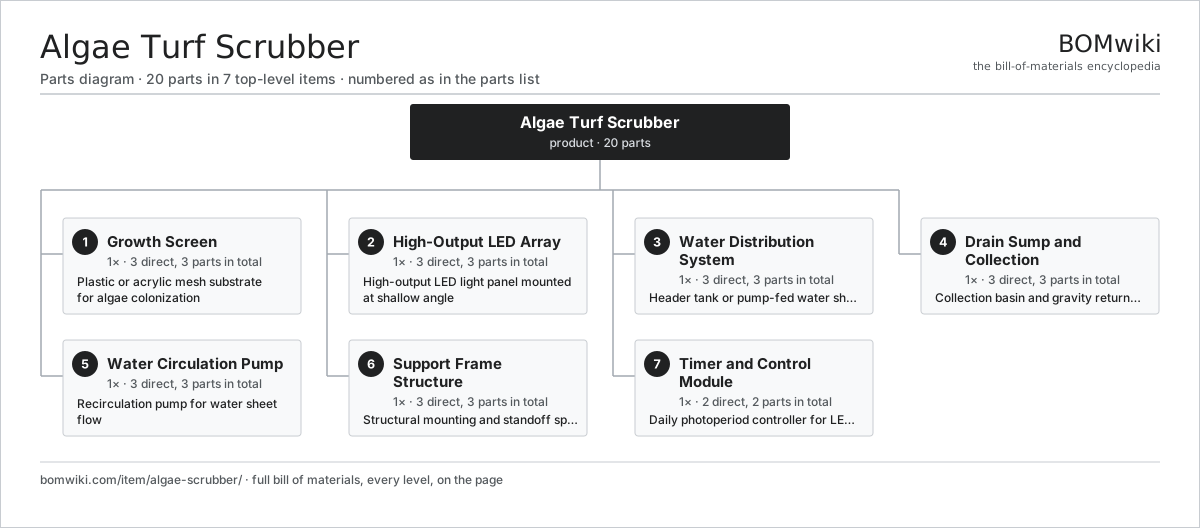
| # | Part | Qty | What it does |
|---|---|---|---|
| 1 | Growth Screen 3 parts | 1× | Plastic or acrylic mesh substrate for algae colonization |
| 2 | High-Output LED Array 3 parts | 1× | High-output LED light panel mounted at shallow angle |
| 3 | Water Distribution System 3 parts | 1× | Header tank or pump-fed water sheet dripping across screen |
| 4 | Drain Sump and Collection 3 parts | 1× | Collection basin and gravity return to tank |
| 5 | Water Circulation Pump 3 parts | 1× | Recirculation pump for water sheet flow |
| 6 | Support Frame Structure 3 parts | 1× | Structural mounting and standoff spacing |
| 7 | Timer and Control Module 2 parts | 1× | Daily photoperiod controller for LED light |
3D model
No 3D model yet. Have a CAD file of this? Add a 3D model. STL renders right on this page; STEP, FreeCAD, and OpenSCAD sources are welcome too (openly licensed, like all 3D models on BOMwiki).
Build & assembly graph
expand / collapse · shared sub-assemblies converge · links to related products · est. labourTap an assembly to expand/collapse · tap a part to open it · use “Open page” for any node · drag to pan, scroll to zoom.
Bill of materials for Algae Turf Scrubber
7 top-level lines · 27 rows shown · 20 parts total · indented to 3 levels| # | Item / sub-assembly | Part no. | Qty/assy | Ext. qty | Parts | Type |
|---|---|---|---|---|---|---|
| 1 | Growth Screen 3 parts | algae-scrubber-growth-screen | 1× | 1 | 3 | assembly |
| 1.1 | Mesh Substrate | algae-scrubber-screen-mesh | 1× | 1 | · | part |
| 1.2 | Screen Frame | algae-scrubber-screen-frame | 1× | 1 | · | part |
| 1.3 | Screen Spacers | algae-scrubber-screen-spacing | 1× | 1 | · | part |
| 2 | High-Output LED Array 3 parts | algae-scrubber-led-array | 1× | 1 | 3 | assembly |
| 2.1 | LED Chip Array | algae-scrubber-led-chip | 1× | 1 | · | part |
| 2.2 | Aluminum Heatsink | algae-scrubber-heatsink | 1× | 1 | · | part |
| 2.3 | LED Driver Board | algae-scrubber-led-driver | 1× | 1 | · | part |
| 3 | Water Distribution System 3 parts | algae-scrubber-water-distribution | 1× | 1 | 3 | assembly |
| 3.1 | Header Tank | algae-scrubber-header-tank | 1× | 1 | · | part |
| 3.2 | Distribution Manifold | algae-scrubber-distribution-manifold | 1× | 1 | · | part |
| 3.3 | Drip Nozzles | algae-scrubber-distribution-nozzles | 1× | 1 | · | part |
| 4 | Drain Sump and Collection 3 parts | algae-scrubber-drain-sump | 1× | 1 | 3 | assembly |
| 4.1 | Sump Basin | algae-scrubber-sump-body | 1× | 1 | · | part |
| 4.2 | Harvest Strainer | algae-scrubber-harvest-screen | 1× | 1 | · | part |
| 4.3 | Return Drain Valve | algae-scrubber-drain-valve | 1× | 1 | · | part |
| 5 | Water Circulation Pump 3 parts | algae-scrubber-water-pump | 1× | 1 | 3 | assembly |
| 5.1 | Pump Motor | algae-scrubber-pump-motor | 1× | 1 | · | part |
| 5.2 | Pump Impeller | algae-scrubber-pump-impeller | 1× | 1 | · | part |
| 5.3 | Pump Volute | algae-scrubber-pump-housing | 1× | 1 | · | part |
| 6 | Support Frame Structure 3 parts | algae-scrubber-support-frame | 1× | 1 | 3 | assembly |
| 6.1 | Frame Extrusion | algae-scrubber-frame-extrusion | 1× | 1 | · | part |
| 6.2 | Corner Brackets | algae-scrubber-corner-brackets | 1× | 1 | · | part |
| 6.3 | Vibration Isolators | algae-scrubber-vibration-isolators | 1× | 1 | · | part |
| 7 | Timer and Control Module 2 parts | algae-scrubber-timer-control | 1× | 1 | 2 | assembly |
| 7.1 | Photoperiod Timer | algae-scrubber-timer-unit | 1× | 1 | · | part |
| 7.2 | Optional LED Dimmer | algae-scrubber-pwm-dimmer | 1× | 1 | · | part |
Something wrong in this list? Report a problem with this BOM.
Sourcing: possible vendors
Browse the supplier directory → Prices, MOQ, and lead times are algorithmic estimates, not quotes, and not claims about these companies. Company mappings are curated by keyword; est. price band $2k–$500M. How estimates work| Vendor | HQ | Specialty | MOQ | Lead time |
|---|---|---|---|---|
| hd.com ↗ | Ulsan, KR | Shipbuilder | made to order | 52–104 wks |
| fincantieri.com ↗ | Trieste, IT | Shipbuilder | made to order | 52–104 wks |
| damen.com ↗ | Gorinchem, NL | Shipbuilder | made to order | 52–104 wks |
| brunswick.com ↗ | Mettawa, US | Marine & boats | made to order | 52–104 wks |
|
🇨🇳CSSC
cssc.net.cn ↗
|
Shanghai, CN | Shipbuilding conglomerate | made to order | 52–104 wks |
1,296-word article