Amphibious Tour Vehicle
ProductOverview
Amphibious tour vehicles enable sightseeing in urban waterways, harbors, and rivers while retaining road mobility for traffic navigation. The vehicle is a hybrid between a land truck and a boat, a sealed hull displaces water to maintain buoyancy, while road axles and drivetrain provide land propulsion. On water, the engine drives a jet pump or propeller; on land, the wheels take over.
Target markets: tourist destinations (Boston Duck Tours, San Antonio River Walk, Las Vegas), urban waterway exploration, and adventure tourism in mountainous regions with both road and water access.
Capital cost: $150,000–300,000 per vehicle; operating cost: $0.50–0.75/mile. A vehicle operating 200 days/year at 4–6 hours/day serving 30 passengers at $20–40 per ticket generates $240,000–480,000 annual revenue, supporting operating costs of ~$100,000–150,000/year and yielding profit of $90,000–330,000/year per vehicle.
Hull and Flotation
The Amphibious Hull Structure is the critical component. A sealed hull made of aluminum (lightweight, rust-resistant but expensive) or fiberglass (durable, easily repaired) must displace water weight equal to the vehicle plus passengers to maintain positive buoyancy.
Buoyancy calculation:
- Vehicle weight: ~20,000 lbs.
- Passengers (30 at 170 lbs avg): 5,100 lbs.
- Fuel, water, equipment: 1,000 lbs.
- Total displacement needed: 26,100 lbs = ~3,900 cubic feet of water.
- For a 25-foot-long, 8-foot-wide vehicle, hull volume ≈ 1,500 cu ft. Additional flotation required: 2,400 cu ft from foam or air tanks.
Flotation systems:
- Closed-cell foam: Glued to interior hull walls (permanent, unsinkable by design).
- Air tanks: Pressurized compartments providing buoyancy (removable for inspection).
- Sealed compartments: Welded chambers within hull structure.
A well-designed amphibious vehicle maintains 50–100% reserve buoyancy (floats even if hull is half-filled with water), providing safety margin against gradual leaks or bilge pump failure.
Common hull failures:
- Seam leaks: Welds or fiberglass seams degrade, causing slow water ingress. Detected by bilge pump running continuously or bilge level rising.
- Seal degradation: Hatches, drain plug seals, and through-hull fittings fail with age. Annual replacement recommended.
- Corrosion (aluminum): Saltwater or brackish water corrodes aluminum over 5–10 years. Mitigation: annual fresh-water rinse after seawater operation, protective coatings.
Marine Propulsion
Two propulsion options are common:
Jet pump: Impeller-based system that draws water through intake, accelerates it through a nozzle. Advantages:
- No exposed propeller (safer around swimmers, obstacles, driftwood).
- Better low-speed maneuverability (can rotate thrust vector nozzle for lateral movement).
- Shallow-water capable (no shaft draft limitation).
Disadvantages:
- Higher fuel consumption (less efficient than propeller).
- Noise (higher RPM impeller).
- Ice/debris clogging intake.
Propeller drive: Traditional propeller on submerged shaft. Advantages:
- More efficient (lower fuel consumption).
- Quieter operation.
- Lower cost.
Disadvantages:
- Exposed propeller (injury hazard, entanglement with weeds/rope).
- Draft limitation (cannot operate in water < 3 feet, depending on shaft length).
- Reverse operation requires gear change (slower than jet pump reversing).
Most modern amphibious tour vehicles use jet pumps for safety and shallow-water operation.
Bilge System and Water Management
The Bilge Pumping and Water Management is the lifeline of water operations. Any leak, seepage, or rain allows water to accumulate in the bilge (lowest point of the hull). If bilge water exceeds a critical level, the vehicle becomes top-heavy and tips.
Redundant pumping:
- Electric bilge pump (500+ GPM): Activated automatically by Float Switch when water rises to ~4 inches in bilge. Powered by 12 or 24 VDC battery.
- Engine-driven backup pump: Belt-driven from engine, runs whenever engine is running, ensuring continuous bilge evacuation even if electric pump fails.
- Manual pump option: Emergency hand pump allows crew to manually remove water if both powered pumps fail (low-capacity but essential backup).
Bilge alarm: An audible and visual alarm sounds if water level rises above the float switch setpoint, alerting the operator to a bilge pump failure. Immediate action required: reduce speed, return to shore, or activate manual pump.
Discharge path: Bilge water is expelled through a through-hull fitting via hose routed below the waterline (prevents backflow when stopped). Once at shore, bilge can be drained via the hull drain plugs or emergency dump valve.
Post-water-operation maintenance:
- Open bilge drain plugs (bottom of vehicle); allow to drain for 30+ minutes.
- Rinse hull interior with fresh water (if seawater operation) to prevent salt crystallization.
- Inspect bilge for debris, plant matter, or suspicious water.
- Test electric bilge pump (manually activate float switch, verify pump operates and discharges water).
- Check engine-driven pump belt for wear.
Neglecting bilge maintenance is the most common cause of amphibious vehicle sinking.
Land Drivetrain and Amphibious Transition
The Road Drivetrain and Suspension provides land propulsion via wheel drive. A 4-wheel-drive system with locking differentials (front and rear) ensures grip on soft ground, mud, or ramps.
Power routing:
- From engine: Transmission → Transfer case.
- Transfer case splits power: ~50% to front axle wheels, ~50% to rear axle wheels, with some power available to marine drive (jet pump impeller or propeller shaft).
- On land: Marine drive is disengaged (clutch or gearbox); wheels drive.
- In water: Wheels are disengaged; marine drive (jet pump or propeller) takes 100% power from engine.
Transition challenges:
- Launch ramp: Vehicle must drive down a slope into water (steering control transitions from wheels to rudder gradually as wheels lose traction).
- Angle of attack: If launch ramp is too steep, vehicle may nosedive (swamped by water over the bow). Safe ramp angle: < 15 degrees.
- Exit from water: Vehicle must climb out onto a ramp with steering transitioning from rudder back to wheels. Power and traction are critical; underpowered vehicles can become stuck.
Traction tires: Large, aggressive all-terrain tires (mud terrain or rock crawling compounds) provide grip on wet ramps and soft ground. Cost: $200–400/tire, wear quickly, requiring replacement annually or every 20,000 miles.
Steering and Directional Control
Dual steering is complex:
Land steering: Conventional wheel steering via power steering pump, operated by the driver's wheel.
Water steering: A submerged rudder (fin-shaped blade) mounted at the stern (rear) is rotated by a hydraulic cylinder. The driver's steering wheel input is mechanically or hydraulically integrated:
- Mechanical integration: Steering column directly drives both wheel steering shaft (for land) and rudder actuator (for water) via shared linkages.
- Hydraulic integration: Steering input modulates a hydraulic valve, which proportionally directs flow to both wheel steering and rudder actuator.
Coordination challenge: On land, steering is responsive and direct (road-speed steering). In water, steering is sluggish (water resistance, inertia). A skilled operator transitions smoothly between land and water steering modes as the vehicle enters and exits water.
Turning radius: A typical amphibious vehicle has a 25–35 foot turning radius on land (tight) but a 50–100 foot turning radius in water (loose), due to lower maneuverability and rudder drag.
Passenger Seating and Safety
The Passenger Seating and Safety comprises open-air bench seats for 20–30 passengers. Design considerations:
- Non-slip decking: Wet floor after water operations is extremely slippery; non-slip coating or textured deck plates prevent falls.
- Safety railings: Perimeter stainless steel railings prevent passengers from tumbling overboard, especially important on choppy water.
- Handholds: Overhead grab bars and vertical rails provide stability during acceleration, braking, and turns.
- Sun canopy (optional): Retractable or fixed awning provides shade on sunny tours, enhancing passenger comfort on long rides.
Life jacket requirements (USCG regulations):
- One USCG-approved Type III or higher PFD per person on board (passengers + crew).
- PFDs must be on person, not stowed (major violation).
- Crew must conduct safety briefing before water departure: location of PFDs, proper wear, and emergency procedures.
Electrical System and Battery Redundancy
Water operations place high demands on the electrical system:
- Starting: Engine starter draws 500+ amps at cold start; must have robust battery capacity.
- Bilge pumps: Electric pump draws 50–100 amps while running (can cycle frequently if leak is present).
- Lights and navigation: Running lights, interior lights, radio draw 10–20 amps continuous.
- Engine charging: Alternator (100+ amp output) must keep up with battery demand.
Dual battery system (critical redundancy):
- Primary battery: Main 12 or 24 VDC battery powering engine start and all systems.
- Secondary battery: Backup battery dedicated to bilge pump activation (float switch triggers secondary battery circuit independent of primary).
- Battery isolator: Automatic switch ensures secondary battery is fully charged before water operation, but isolates primary battery drain from secondary in case of primary failure.
Without redundant batteries, a single dead battery prevents starting, leaving the vehicle stranded. Redundancy is not optional for amphibious operations.
Operational Workflow (Typical Tour)
Pre-departure (15 min):
- Vehicle inspection: Check hull for visible cracks, inspect waterline seams.
- Bilge check: Drain plugs opened from previous operation. Fresh water rinse (if seawater prior). Bilge pump tested manually.
- Life jackets: Distributed to all passengers, proper fit checked.
- Battery check: Voltmeter confirms 12+ or 24+ VDC.
- Fuel check: Verify adequate fuel for tour duration + reserve.
Water departure (5 min):
- Load passengers and distribute weight evenly.
- Engine started, idled 1–2 minutes to warm up.
- Crew verifies all passengers are seated and belted (if applicable).
- Vehicle driven to launch ramp at slow speed.
Launch and water operation (60–90 min):
- Vehicle descends launch ramp, gradually entering water.
- At ~2/3 submerged, rudder becomes effective; wheel steering is reduced, rudder steering takes over.
- Once fully afloat and clear of obstacles, driver accelerates to cruising speed (8–12 knots).
- Tour proceeds: narrated sightseeing, points of interest, photos.
- Operator continuously monitors bilge (manual check every 15 min, or automated alarm if rising water detected).
Exiting water and return (5–10 min):
- Vehicle approaches exit ramp at shallow angle to avoid nosedive.
- As wheels contact ramp, wheel steering resumes control; rudder becomes less effective.
- Vehicle climbs ramp and drives back to dock at slow speed (mud/sand/wet ramp is slippery).
Post-operation (30 min):
- Passengers disembark.
- Bilge drain plugs opened; water drains for 30+ minutes.
- Hull rinsed with fresh water (especially if seawater tour).
- Bilge inspected for leaks or damage; bilge pump cycle monitored.
- Vehicle parked and secured.
Maintenance and Corrosion Management
Amphibious vehicles face aggressive corrosion from saltwater or brackish water:
Annual maintenance:
- Complete bilge inspection and seal replacement (gaskets degrade from water exposure).
- Fresh-water pressure wash of entire hull interior and exterior.
- Zincs or sacrificial anodes replacement (if aluminum hull in saltwater, galvanic protection required).
- Hose inspection and replacement (rubber hoses degrade faster in saltwater environment).
- Rudder bearing and actuator service (rust and corrosion).
Monthly maintenance (during operating season):
- Post-water-operation bilge drain and inspection (documented).
- Bilge pump functional test.
- Battery voltage check.
- Hose and fitting inspection for weeping leaks.
Lifespan impact: Proper maintenance extends amphibious vehicle lifespan to 15–20 years. Neglected corrosion and bilge maintenance reduces lifespan to 5–10 years.
Cost of Ownership
Capital: $150,000–300,000 per vehicle (heavily modified, specialized engineering).
Operating cost (annual, 200 operating days):
- Fuel: $8,000–12,000 (fuel consumption 5–8 gal/hour, mixed land/water ops).
- Maintenance and repairs: $5,000–8,000 (corrosion, seal replacement, bilge service).
- Staffing: $50,000–80,000 (driver/operator and guide).
- Insurance (marine + vehicle): $3,000–5,000.
- Depreciation: $10,000–15,000.
- Total: $76,000–120,000 per year.
Revenue: At $20–40 per passenger, 30 passengers per tour, 4–6 tours per day (200 operating days) = 30 × 30 × 5 × 200 = 900,000 passenger-days revenue. At $30 average ticket price = $27,000,000 potential revenue (unrealistic at 100% occupancy). More realistic: 50% occupancy (15 passengers) × 3 tours/day × 200 days = 9,000 passengers/year × $30 = $270,000 revenue. Against $100,000 operating cost, net profit is $170,000/year per vehicle.
This high profit margin makes amphibious tour operations lucrative in high-demand tourist destinations.
Amphibious Tour Vehicle parts and their functions
8 top-level parts · 79 parts in total · full bill of materials below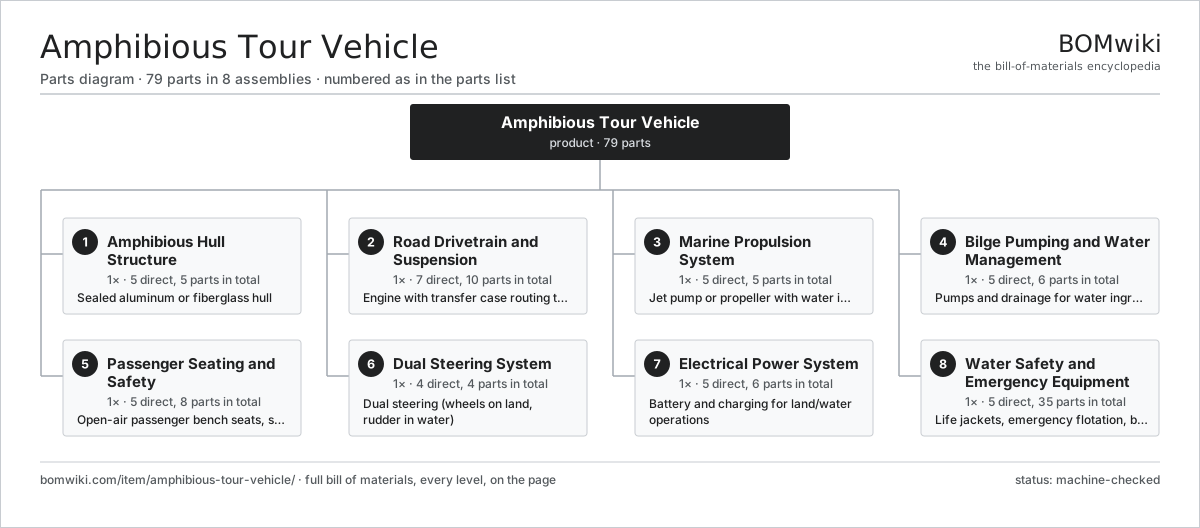
| # | Part | Qty | What it does |
|---|---|---|---|
| 1 | Amphibious Hull Structure 5 parts | 1× | Sealed aluminum or fiberglass hull |
| 2 | Road Drivetrain and Suspension 7 parts | 1× | Engine with transfer case routing to wheels and propeller |
| 3 | Marine Propulsion System 5 parts | 1× | Jet pump or propeller with water intake/discharge |
| 4 | Bilge Pumping and Water Management 5 parts | 1× | Pumps and drainage for water ingress management |
| 5 | Passenger Seating and Safety 5 parts | 1× | Open-air passenger bench seats, safety railings |
| 6 | Dual Steering System 4 parts | 1× | Dual steering (wheels on land, rudder in water) |
| 7 | Electrical Power System 5 parts | 1× | Battery and charging for land/water operations |
| 8 | Water Safety and Emergency Equipment 5 parts | 1× | Life jackets, emergency flotation, bilge alarms |
3D model
No 3D model yet. Have a CAD file of this? Add a 3D model — STL renders right on this page; STEP, FreeCAD, and OpenSCAD sources are welcome too (openly licensed, like all 3D models on BOMwiki).
Build & assembly graph
expand / collapse · shared sub-assemblies converge · links to related products · est. labourTap an assembly to expand/collapse · tap a part to open it · use “Open page” for any node · drag to pan, scroll to zoom.
Bill of materials for Amphibious Tour Vehicle
8 top-level lines · 49 rows shown · 79 parts total · indented to 3 levels| # | Item / sub-assembly | Part no. | Qty/assy | Ext. qty | Parts | Type |
|---|---|---|---|---|---|---|
| 1 | Amphibious Hull Structure 5 parts | amphibious-tour-vehicle-hull | 1× | 1 | 5 | assembly |
| 1.1 | Hull Shell | amphibious-tour-vehicle-hull-shell | 1× | 1 | · | part |
| 1.2 | Flotation | amphibious-tour-vehicle-internal-flotation | 1× | 1 | · | part |
| 1.3 | Hull Sealing | amphibious-tour-vehicle-hull-sealing | 1× | 1 | · | part |
| 1.4 | Water Intake | amphibious-tour-vehicle-water-intake | 1× | 1 | · | part |
| 1.5 | Drain Plug | amphibious-tour-vehicle-drain-plugs | 1× | 1 | · | part |
| 2 | Road Drivetrain and Suspension 7 parts | amphibious-tour-vehicle-road-drivetrain | 1× | 1 | 10 | assembly |
| 2.1 | Engine | amphibious-tour-vehicle-engine | 1× | 1 | · | part |
| 2.2 | Transmission | amphibious-tour-vehicle-transmission | 1× | 1 | · | part |
| 2.3 | Transfer Case | amphibious-tour-vehicle-transfer-case | 1× | 1 | · | part |
| 2.4 | Front Axle | amphibious-tour-vehicle-front-axle | 1× | 1 | · | part |
| 2.5 | Rear Axle | amphibious-tour-vehicle-rear-axle | 1× | 1 | · | part |
| 2.6 | Suspension | amphibious-tour-vehicle-suspension-springs | 1× | 1 | · | part |
| 2.7 | Wheels and Tires | amphibious-tour-vehicle-wheels-tires | 4× | 4 | · | part |
| 3 | Marine Propulsion System 5 parts | amphibious-tour-vehicle-marine-drive | 1× | 1 | 5 | assembly |
| 3.1 | Jet Pump | amphibious-tour-vehicle-jet-pump | 1× | 1 | · | part |
| 3.2 | Propeller Drive | amphibious-tour-vehicle-propeller-drive | 1× | 1 | · | part |
| 3.3 | Intake Grill | amphibious-tour-vehicle-intake-grill | 1× | 1 | · | part |
| 3.4 | Discharge Nozzle | amphibious-tour-vehicle-discharge-nozzle | 1× | 1 | · | part |
| 3.5 | Reverse Mechanism | amphibious-tour-vehicle-reverse-mechanism | 1× | 1 | · | part |
| 4 | Bilge Pumping and Water Management 5 parts | amphibious-tour-vehicle-bilge-system | 1× | 1 | 6 | assembly |
| 4.1 | Electric Bilge Pump | amphibious-tour-vehicle-electric-bilge-pump | 2× | 2 | · | part |
| 4.2 | Engine Bilge Pump | amphibious-tour-vehicle-engine-bilge-pump | 1× | 1 | · | part |
| 4.3 | Float Switch | amphibious-tour-vehicle-float-switch | 1× | 1 | · | part |
| 4.4 | Bilge Discharge | amphibious-tour-vehicle-bilge-discharge | 1× | 1 | · | part |
| 4.5 | Strainer Basket | amphibious-tour-vehicle-strainer-basket | 1× | 1 | · | part |
| 5 | Passenger Seating and Safety 5 parts | amphibious-tour-vehicle-seating | 1× | 1 | 8 | assembly |
| 5.1 | Bench Seat | amphibious-tour-vehicle-bench-seat | 4× | 4 | · | part |
| 5.2 | Safety Rail | amphibious-tour-vehicle-safety-rail | 1× | 1 | · | part |
| 5.3 | Decking | amphibious-tour-vehicle-non-slip-decking | 1× | 1 | · | part |
| 5.4 | Sun Canopy | amphibious-tour-vehicle-sun-canopy | 1× | 1 | · | part |
| 5.5 | Handrail | amphibious-tour-vehicle-handrails | 1× | 1 | · | part |
| 6 | Dual Steering System 4 parts | amphibious-tour-vehicle-steering-control | 1× | 1 | 4 | assembly |
| 6.1 | Wheel Steering | amphibious-tour-vehicle-wheel-steering | 1× | 1 | · | part |
| 6.2 | Rudder | amphibious-tour-vehicle-hydraulic-rudder | 1× | 1 | · | part |
| 6.3 | Steering Linkage | amphibious-tour-vehicle-steering-linkage | 1× | 1 | · | part |
| 6.4 | Rudder Actuator | amphibious-tour-vehicle-rudder-actuator | 1× | 1 | · | part |
| 7 | Electrical Power System 5 parts | amphibious-tour-vehicle-electrical-system | 1× | 1 | 6 | assembly |
| 7.1 | Battery | amphibious-tour-vehicle-main-battery | 2× | 2 | · | part |
| 7.2 | Alternator | amphibious-tour-vehicle-alternator | 1× | 1 | · | part |
| 7.3 | Battery Isolator | amphibious-tour-vehicle-battery-isolator | 1× | 1 | · | part |
| 7.4 | Breaker | amphibious-tour-vehicle-bilge-pump-breaker | 1× | 1 | · | part |
| 7.5 | Navigation Lights | amphibious-tour-vehicle-navigation-lights | 1× | 1 | · | part |
| 8 | Water Safety and Emergency Equipment 5 parts | amphibious-tour-vehicle-safety-equipment | 1× | 1 | 35 | assembly |
| 8.1 | Life Jacket | amphibious-tour-vehicle-life-jackets | 30× | 30 | · | part |
| 8.2 | Lifebuoy | amphibious-tour-vehicle-lifebuoy | 2× | 2 | · | part |
| 8.3 | First Aid Kit | amphibious-tour-vehicle-first-aid-kit | 1× | 1 | · | part |
| 8.4 | Bilge Alarm | amphibious-tour-vehicle-bilge-alarm | 1× | 1 | · | part |
| 8.5 | Flare Kit | amphibious-tour-vehicle-emergency-flare-kit | 1× | 1 | · | part |
Sourcing: possible vendors
Prices, MOQ, and lead times are algorithmic estimates, not quotes, and not claims about these companies. Company mappings are curated by keyword; est. price band $8k–$90k. How estimates work| Vendor | HQ | Specialty | MOQ | Lead time |
|---|---|---|---|---|
|
🇯🇵Toyota
global.toyota ↗
|
Toyota City, JP | Automaker | made to order | 16–28 wks |
| volkswagen-group.com ↗ | Wolfsburg, DE | Automaker | made to order | 16–28 wks |
| gm.com ↗ | Detroit, US | Automaker | made to order | 16–28 wks |
| hyundai.com ↗ | Seoul, KR | Automaker | made to order | 16–28 wks |
|
🇨🇳BYD
byd.com ↗
|
Shenzhen, CN | EV & battery manufacturer | made to order | 16–28 wks |
1,985-word article