Ampoule Filling-Sealing Machine
ProductOverview
An ampoule sealing machine fills open-top glass ampoules with pharmaceutical liquids and seals them by applying a flame to the glass neck until it fuses closed. Unlike vials, which use screw caps, ampoules are hermetically sealed by melting the glass itself. The resulting seal is absolute, no rubber, no threads, and suitable for long-term storage (shelf life 5–10 years or longer for aqueous solutions) and extreme environments (spacecraft, high-altitude, sterile rooms).
The process requires precision: the fill volume must be exact (ampoules cannot be recapped), the seal must be complete (no microbial ingress), and the flame must not crack the glass (thermal shock). Throughput is modest, 20–60 ampoules/minute vs. 100–200 for vial lines, due to the heat management and cooling requirements.
Ampoules are primarily used for injectable drugs, vaccines, and high-value biologics where long-term stability is paramount. A typical batch is 500–5000 ampoules; process time including loading, filling, sealing, cooling, inspection, and unloading is 30–90 minutes.
How it works
The sealing cycle consists of five stages:
Ampoule Loading: Empty open-top glass ampoules (thin-walled, ~0.5 mm glass) are gravity-fed into a vibratory bowl, which orients them upright. A pneumatic gate meters ampoules into a rotating carousel (turret) with 12–24 indexed positions. Each ampoule sits upright in a spring-loaded V-clamp, preventing tipping or rotation.
Filling: When the carousel pauses at the fill station, a peristaltic pump begins delivering liquid. A stainless steel needle descends into the upright ampoule. The pump rotates, metering 0.2–15 mL liquid depending on product size. After the set time (typically 3–5 seconds), the pump stops and the needle retracts. Fill accuracy is critical; under-filled ampoules reduce drug content, over-filled ampoules risk product leakage when sealed.
Sealing: The carousel indexes to the burn station. A multi-flame burner (typically 2–4 small flames) approaches the ampoule neck from the side. Gas (propane or natural gas) flows through precision nozzles; a piezo igniter lights the flame. The burner holds steady for 2–4 seconds, heating the glass neck to 800–1000°C. At this temperature, the borosilicate glass softens and begins to fuse. The operator or machine controller rotates the ampoule (if the carousel includes a rotation axis) to distribute heat evenly around the neck.
Sealing Completion: As the heated neck reaches ~950°C, the glass becomes fluid. Surface tension and capillary action draw the molten glass inward, creating an airtight seal. The burner pulls away; the neck cools rapidly. The sealed portion is visually transparent glass, no air pockets, no cracks, with a bead of material around the fused zone.
Cooling & Inspection: A pressurized air jet (6 bar compressed air) or water mist spray blasts the sealed ampoule head, cooling it from 1000°C to 50–60°C in 5–10 seconds. Rapid cooling prevents thermal shock cracking (which would occur if the neck cools unevenly). After cooling, an inspection station (vision camera or capacitive sensor) checks the seal quality. A successful seal shows a continuous glass bead around the ampoule neck and no visible gaps. Defective ampoules (cracked seals, open gaps) are diverted to waste.
Key Subsystems
Carousel Indexing
The carousel must maintain precise dwell at the fill and seal stations. A stepper or servo motor with encoder feedback enables position-locked indexing. Dwell time at fill is typically 3–5 seconds; dwell at seal is 2–4 seconds. If indexing occurs prematurely, the fill pump may still be running when the carousel moves, causing spillage. If dwell is excessive, throughput suffers.
The spring-loaded V-clamps in each carousel pocket must hold the ampoule firmly vertical without excessive stress. Undersized springs allow ampoule tipping; oversized springs crack the thin-walled ampoule. Clamp pressure is typically 2–5 N.
Fill Needle & Pump
Ampoule fill needles are shorter and finer than vial needles due to the narrow ampoule neck (typically 2–4 mm internal diameter). Fill needles are 25–27 gauge (0.4–0.5 mm), requiring low backpressure (<0.5 bar) to prevent splashing.
Peristaltic pumps are preferred for ampoule filling because the tubing deformation is gentle and repeatable. Pump stroke typically ranges 0.1–10 mL, with stepper motor control allowing precise metering. A one-way check valve prevents backflow when the needle is inside the ampoule; if backflow occurred, the ampoule would empty as the needle retracts.
Flame System
The burner is a multi-flame design: a pilot flame (small, always burning) ignites and stabilizes the main flame. Gas flow is controlled by proportional solenoids, allowing the operator to tune flame height (10–50 mm typical) and intensity. Flame temperature is monitored via a thermocouple; feedback control adjusts gas pressure to maintain setpoint.
Propane or natural gas fuels the burner. Propane offers higher combustion energy and faster heating; natural gas is cheaper but requires larger orifices and longer burn times. A pressure regulator maintains gas supply at 0.5–2 bar.
Cooling Strategy
Post-seal cooling is critical. If the sealed neck cools too slowly (ambient air), thermal stresses accumulate, and the seal may crack. Rapid cooling via compressed air (5–10 seconds) prevents cracking. The air jet is directed at the sealed zone at an angle to avoid splattering residual liquid from the ampoule rim.
Some high-speed machines employ water mist cooling (ultrasonic nozzles spray micro-droplets), which is faster but introduces the risk of water contamination if not carefully controlled.
Inspection & Rejection
Visual inspection via high-speed camera is the most reliable method. The camera captures a top-down image of the sealed ampoule head; image analysis software detects visible gaps, cracks, or asymmetrical seals. Gaps >100 microns are flagged as defective.
Capacitive sensors offer a non-contact alternative: the sealed (conductive glass) ampoule head shows high capacitance; an open gap shows low capacitance. However, capacitive sensors cannot detect internal voids or micro-cracks, so vision inspection is still preferred for critical applications.
Rejected ampoules are diverted by a pneumatic solenoid valve to a waste collection bin.
Operating Considerations
Ampoule Type & Quality
Ampoules are manufactured from borosilicate (Type I) or soda-lime (Type III) glass. Type I is preferred for pharmaceuticals: coefficient of thermal expansion is ~3 ppm/°C, reducing cracking risk during seal heating. Type III ampoules have higher CTE (~8 ppm/°C) and are prone to thermal shock.
Ampoule wall thickness affects heating time. Thin-walled ampoules (0.4 mm) seal faster (~2 seconds); thick-walled (~0.8 mm) require longer heating (~4 seconds) to reach glass transition temperature.
Seal Quality Standards
A successful seal is visually indistinguishable from the bulk glass, no bubbles, no cracks, no visible fused line. The sealed zone should form a convex bulge (bead) around the ampoule neck circumference. Uneven seals (one side darker or cracked) indicate uneven heating or thermal shock.
Seal integrity is typically verified by helium leak testing on a sample of each batch. The ampoule is placed in a chamber with helium; if the seal is open, helium diffuses into the ampoule interior, detected by mass spectrometry. Detection limit is <10^-10 mbar·L/s.
Formulation Compatibility
Borosilicate glass reacts with strong alkalis; formulations with pH >8 may etch the ampoule wall. Phenolic or antioxidant excipients can absorb into glass over time. Most parenteral solutions (pH 4–8, aqueous) are compatible with Type I borosilicate ampoules.
Batch Cycle Time
A typical 1000-ampoule batch requires:
- Hopper loading and orientation: 5 minutes
- Fill + seal cycles: 17–50 minutes (at 20–60 ampoules/min)
- Cooldown and inspection: 5 minutes
- Unloading and cleanup: 10 minutes
- Total: 40–75 minutes per batch
Troubleshooting
Seal cracks immediately after cooling: Cause: thermal shock due to rapid cooling or uneven flame heating. Solutions: reduce cooling air pressure, apply water mist instead of compressed air, extend cooling time.
Under-filled ampoules: Cause: pump stroke too short, fill time insufficient, or liquid level in supply tank low. Solutions: increase pump displacement, extend dwell time at fill station, refill supply tank.
Leaking seals (detected via helium test): Cause: insufficient seal temperature (glass not fully fused) or contamination (dust, moisture). Solutions: increase burner temperature by 50–100°C, reduce fill volume slightly (lower internal pressure), ensure supply tank is dry.
Ampoule tipping in carousel: Cause: spring clamp force insufficient or carousel tilt misaligned. Solutions: increase clamp preload, verify carousel pocket alignment with dial indicator.
Flame won't ignite: Cause: insufficient gas pressure or piezo igniter fouled with carbon. Solutions: verify gas supply pressure >0.5 bar, clean igniter electrode with fine-grit sandpaper.
Maintenance
The piezo igniter requires annual cleaning due to carbon deposits from burner combustion. Burner nozzles should be inspected every 500 cycles; deposits may constrict flame.
Peristaltic pump tubing stretches over time; replacement every 500–1000 operating hours maintains fill accuracy. Thermocouple elements degrade after prolonged exposure to 1000°C; replacement every 12–24 months ensures temperature control accuracy.
The vibratory feeder motor bearings should be greased every 1000 hours; the piez igniter electrode requires cleaning or replacement if ignition becomes unreliable.
See Also
- Filling-Sealing Carousel – Indexing and positioning system
- Fill Needle & Pump – Pump and metering control
- Flame Sealing System – Gas flame temperature and pressure
- Cooling & Handling – Post-seal cooling and thermal management
- Seal Quality Inspection – Vision and seal integrity verification
Ampoule Filling-Sealing Machine parts and their functions
8 top-level parts · 53 parts in total · full bill of materials below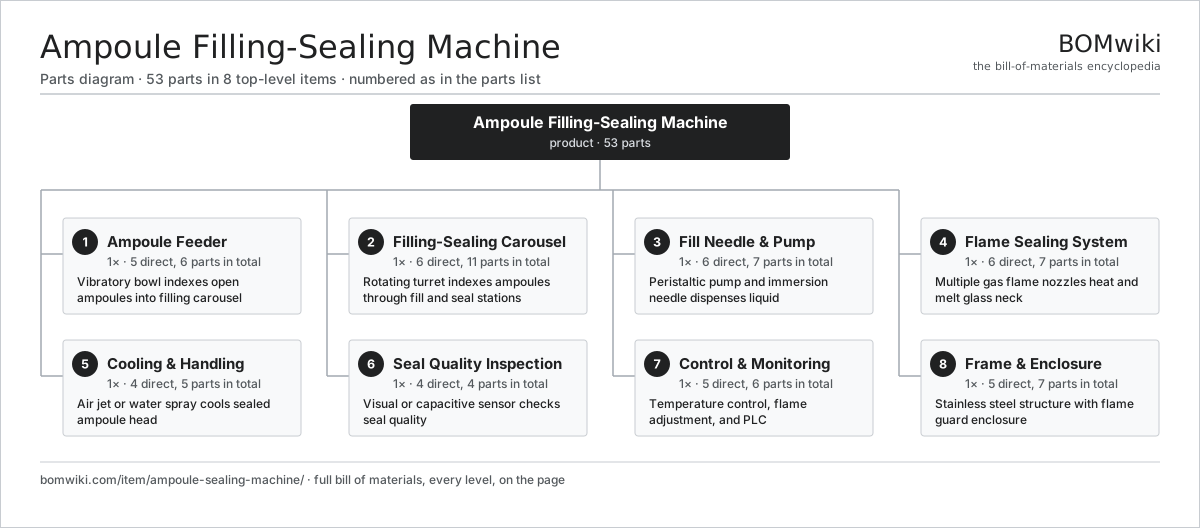
| # | Part | Qty | What it does |
|---|---|---|---|
| 1 | Ampoule Feeder 5 parts | 1× | Vibratory bowl indexes open ampoules into filling carousel |
| 2 | Filling-Sealing Carousel 6 parts | 1× | Rotating turret indexes ampoules through fill and seal stations |
| 3 | Fill Needle & Pump 6 parts | 1× | Peristaltic pump and immersion needle dispenses liquid |
| 4 | Flame Sealing System 6 parts | 1× | Multiple gas flame nozzles heat and melt glass neck |
| 5 | Cooling & Handling 4 parts | 1× | Air jet or water spray cools sealed ampoule head |
| 6 | Seal Quality Inspection 4 parts | 1× | Visual or capacitive sensor checks seal quality |
| 7 | Control & Monitoring 5 parts | 1× | Temperature control, flame adjustment, and PLC |
| 8 | Frame & Enclosure 5 parts | 1× | Stainless steel structure with flame guard enclosure |
3D model
No 3D model yet. Have a CAD file of this? Add a 3D model. STL renders right on this page; STEP, FreeCAD, and OpenSCAD sources are welcome too (openly licensed, like all 3D models on BOMwiki).
Build & assembly graph
expand / collapse · shared sub-assemblies converge · links to related products · est. labourTap an assembly to expand/collapse · tap a part to open it · use “Open page” for any node · drag to pan, scroll to zoom.
Bill of materials for Ampoule Filling-Sealing Machine
8 top-level lines · 49 rows shown · 53 parts total · indented to 3 levels| # | Item / sub-assembly | Part no. | Qty/assy | Ext. qty | Parts | Type |
|---|---|---|---|---|---|---|
| 1 | Ampoule Feeder 5 parts | ampoule-sealing-feeder | 1× | 1 | 6 | assembly |
| 1.1 | Hopper Bowl | ampoule-sealing-hopper-bowl | 1× | 1 | · | part |
| 1.2 | Vibration Motor | ampoule-sealing-feeder-motor | 1× | 1 | · | part |
| 1.3 | Orientation Track | ampoule-sealing-track | 1× | 1 | · | part |
| 1.4 | Exit Gate Valve | ampoule-sealing-exit-gate | 1× | 1 | · | part |
| 1.5 | Fastener Set | fastener-set | 2× | 2 | · | part |
| 2 | Filling-Sealing Carousel 6 parts | ampoule-sealing-carousel | 1× | 1 | 11 | assembly |
| 2.1 | Turret Hub | ampoule-sealing-turret-hub | 1× | 1 | · | part |
| 2.2 | Station Clamps | ampoule-sealing-turret-station-holders | 1× | 1 | · | part |
| 2.3 | Turret Indexing Motor | ampoule-sealing-turret-motor | 1× | 1 | · | part |
| 2.4 | Turret Position Encoder | ampoule-sealing-turret-encoder | 1× | 1 | · | part |
| 2.5 | Ball Bearing | ball-bearing | 4× | 4 | · | part |
| 2.6 | Fastener Set | fastener-set | 3× | 3 | · | part |
| 3 | Fill Needle & Pump 6 parts | ampoule-sealing-fill-needle | 1× | 1 | 7 | assembly |
| 3.1 | Peristaltic Pump | ampoule-sealing-pump | 1× | 1 | · | part |
| 3.2 | Pump Drive Motor | ampoule-sealing-pump-motor | 1× | 1 | · | part |
| 3.3 | Fill Needle | ampoule-sealing-needle | 1× | 1 | · | part |
| 3.4 | Needle Lifting Actuator | ampoule-sealing-needle-position | 1× | 1 | · | part |
| 3.5 | Pump Check Valve | ampoule-sealing-check-valve | 1× | 1 | · | part |
| 3.6 | Fastener Set | fastener-set | 2× | 2 | · | part |
| 4 | Flame Sealing System 6 parts | ampoule-sealing-flame-burner | 1× | 1 | 7 | assembly |
| 4.1 | Burner Block | ampoule-sealing-burner-head | 1× | 1 | · | part |
| 4.2 | Gas Supply System | ampoule-sealing-gas-supply | 1× | 1 | · | part |
| 4.3 | Flame Ignition Module | ampoule-sealing-ignition | 1× | 1 | · | part |
| 4.4 | Flame Intensity Control | ampoule-sealing-flame-height | 1× | 1 | · | part |
| 4.5 | Burner Positioning Actuator | ampoule-sealing-burner-position | 1× | 1 | · | part |
| 4.6 | Fastener Set | fastener-set | 2× | 2 | · | part |
| 5 | Cooling & Handling 4 parts | ampoule-sealing-cooling | 1× | 1 | 5 | assembly |
| 5.1 | Air Cooling Jet | ampoule-sealing-air-cooldown | 1× | 1 | · | part |
| 5.2 | Water Mist Spray (Optional) | ampoule-sealing-mist-cooler | 1× | 1 | · | part |
| 5.3 | Transfer Arm | ampoule-sealing-robotic-arm | 1× | 1 | · | part |
| 5.4 | Fastener Set | fastener-set | 2× | 2 | · | part |
| 6 | Seal Quality Inspection 4 parts | ampoule-sealing-inspection | 1× | 1 | 4 | assembly |
| 6.1 | Vision Inspection Camera | ampoule-sealing-vision-camera | 1× | 1 | · | part |
| 6.2 | Capacitive Seal Sensor | ampoule-sealing-capacitive-sensor | 1× | 1 | · | part |
| 6.3 | Reject Diverter Valve | ampoule-sealing-reject-gate | 1× | 1 | · | part |
| 6.4 | Fastener Set | fastener-set | 1× | 1 | · | part |
| 7 | Control & Monitoring 5 parts | ampoule-sealing-electrical | 1× | 1 | 6 | assembly |
| 7.1 | Control PLC with HMI | ampoule-sealing-plc | 1× | 1 | · | part |
| 7.2 | Flame Temperature Sensor | ampoule-sealing-temperature-sensor | 1× | 1 | · | part |
| 7.3 | Gas Pressure Monitor | ampoule-sealing-gas-pressure-sensor | 1× | 1 | · | part |
| 7.4 | Vision Processing Computer | ampoule-sealing-vision-processor | 1× | 1 | · | part |
| 7.5 | Fastener Set | fastener-set | 2× | 2 | · | part |
| 8 | Frame & Enclosure 5 parts | ampoule-sealing-frame | 1× | 1 | 7 | assembly |
| 8.1 | Base Frame | ampoule-sealing-base-frame | 1× | 1 | · | part |
| 8.2 | Flame Safety Guard | ampoule-sealing-flame-guard | 1× | 1 | · | part |
| 8.3 | Interlocked Access Door | ampoule-sealing-access-door | 1× | 1 | · | part |
| 8.4 | Thermal Insulation Jacket | ampoule-sealing-heat-insulation | 1× | 1 | · | part |
| 8.5 | Fastener Set | fastener-set | 3× | 3 | · | part |
Something wrong in this list? Report a problem with this BOM.
Related products
same domain, ranked by shared parts All-Electric Injection Molding Machine
851 parts · shares 1 with this page
AOI Machine
38 parts · shares 1 with this page
Automated Paint Spray Line
2,003 parts · shares 1 with this page
Banbury Internal Mixer
64 parts · shares 1 with this page
All-Electric Injection Molding Machine
851 parts · shares 1 with this page
AOI Machine
38 parts · shares 1 with this page
Automated Paint Spray Line
2,003 parts · shares 1 with this page
Banbury Internal Mixer
64 parts · shares 1 with this page
Sourcing: possible vendors
Browse the supplier directory → Prices, MOQ, and lead times are algorithmic estimates, not quotes, and not claims about these companies. Company mappings are curated by keyword; est. price band $5k–$2M. How estimates work| Vendor | HQ | Specialty | MOQ | Lead time |
|---|---|---|---|---|
| atlascopco.com ↗ | Stockholm, SE | Compressors & industrial | 10 units | 12–20 wks |
|
🇦🇹Andritz
andritz.com ↗
|
Graz, AT | Process plants & machinery | 10 units | 12–20 wks |
| buhlergroup.com ↗ | Uzwil, CH | Food & materials processing | 10 units | 12–20 wks |
| gea.com ↗ | Düsseldorf, DE | Process technology | 10 units | 12–20 wks |
| mhi.com ↗ | Tokyo, JP | Heavy machinery | 10 units | 12–20 wks |
1,554-word article