Ankle-Foot Orthosis (AFO)
ProductOverview
An ankle-foot orthosis (AFO) is one of the most commonly prescribed lower-limb orthoses, designed to control ankle motion and support the foot during walking and standing. The primary clinical indication is foot drop, the inability to dorsiflex (lift) the toes during swing phase, typically caused by stroke, peripheral nerve injury (common peroneal nerve palsy), cerebral palsy, or spinal cord injury. When the foot cannot lift passively, it catches on the ground during swing, causing the gait to look "steppage" (exaggerated hip flexion to compensate). An AFO prevents this by holding the ankle in neutral or slight dorsiflexion, allowing the foot to clear the ground during swing and restoring a more natural, symmetric gait.
The Ankle-Foot Orthosis (AFO) achieves this through a combination of a rigid Foot Support Plate supporting the foot arch, a custom Custom Calf Shell wrapping around the lower leg, and a connecting Ankle Control Strut that controls ankle motion. The strut can be rigid (preventing all ankle motion) or spring-loaded (assisting dorsiflexion), depending on patient motor control and functional goals.
Types and Design Variants
AFOs are classified by their ankle control mechanism:
Solid AFO (SAFO): The ankle strut is completely rigid, preventing all plantarflexion and dorsiflexion. The foot plate and calf shell are welded or glued together. SolidAFOs are the most common and are prescribed for patients with severe foot drop, weakness, or spasticity.
Articulated AFO: A Ankle Joint Hinge (hinged joint) allows controlled plantarflexion and dorsiflexion. The hinge may be:
- Free-motion: Unrestricted ankle movement (rarely used; mostly for static support).
- Dorsiflexion-assist: Spring-loaded or mechanical assist providing upward force on the foot.
- Plantarflexion-stop: Allowing plantarflexion but blocking dorsiflexion (for spasticity management).
Dynamic AFO (spring-assist): The Strut Material (typically carbon fiber or spring steel with 15–20 N/mm stiffness) acts as a leaf spring, actively pushing the foot into dorsiflexion during swing phase while allowing controlled plantarflexion during loading response. This variant requires less muscular effort and improves energy efficiency for active, high-functioning patients.
Foot Plate Design and Arch Support
The Foot Support Plate is the foundation of the AFO. It extends from the Heel Cup Insert (a shallow posterior recess that centers the heel and prevents inversion) through the Arch Support Ridge (a raised medial contour supporting the longitudinal arch) to the metatarsal head area. The plate is custom-molded to the individual patient's foot contours using a replica of their foot or 3D scan, ensuring intimate contact and load distribution.
The foot plate serves four functions:
- Arch support: Prevents flatfoot deformity and lateral ankle instability, critical for patients with spasticity or weakness.
- Plantarflexor lengthening: The slight dorsiflexion angle built into the plate (usually 5–10°) maintains the length of plantarflexor muscles (gastrocnemius, soleus), reducing contracture risk over months.
- Ground reaction support: The rigid plate redirects ground reaction forces from the metatarsal heads upward to the shank, reducing ankle strain.
- Proprioceptive feedback: A well-fitted plate provides tactile input helping the nervous system sense foot position during gait.
Foot plate thickness (3–4 mm) is a balance between stiffness and weight; too thin and the plate flexes under load, reducing effectiveness; too thick and the AFO becomes bulky and uncomfortable. Materials range from basic injection-molded polypropylene (lightweight, affordable, but less durable) to carbon-fiber composite (stiffer, longer-lasting, more expensive).
Calf Shell and Proximal Control
The Custom Calf Shell wraps around the lower leg from the ankle to just below the fibular head, providing proximal control and preventing inversion/eversion torque. The Calf Shell Blank is vacuum-formed in a custom mold over the patient's leg, ensuring a snug fit that minimizes slipping during swing and distributes pressure evenly to prevent skin irritation.
The Calf Trimline is carefully shaped: the superior trimline typically sits just below the fibular head to allow unrestricted knee flexion; the lateral trimline is rounded to prevent chafing. Too high a trimline restricts knee motion; too low and the AFO slips during swing.
For patients with inversion/eversion instability (common after stroke), an optional Optional Lateral Stiffener (a fiberglass or carbon strut bonded to the lateral calf shell) resists inversion torque, stabilizing the ankle complex.
Strut Design and Ankle Control
The Ankle Control Strut is the mechanical heart of the AFO, transferring forces between foot and calf. The strut can be:
Rigid (solid AFO): Aluminum or fiberglass tube, immovably fixed to foot plate and calf shell, typically set at 3–5° dorsiflexion. This prevents all ankle motion and is the safest design for weak or spastic patients.
Spring-assist: The Strut Material (carbon-fiber-reinforced epoxy) is designed with a subtle S-curve or with reduced cross-section, allowing 10–15° of compliance. The Strut Compliance Tuning (typically 15–25 N/mm) is tuned so that the patient's calf muscles can plantarflex the foot (lowering heel to floor) without excessive effort, while the spring actively assists dorsiflexion during swing.
Articulated with mechanical limits: A ball-and-socket or pin hinge at the ankle joint, with stops limiting dorsiflexion to 10–15° and plantarflexion to neutral (0°). This design provides some ankle motion while preventing excessive plantarflexion (and foot slap) during loading response.
The Ankle Joint Hinge type is critical in gait retraining: a solid AFO may force the patient to adopt a "circumduction" gait pattern (swinging the prosthesis outward instead of straightening the hip) to gain ground clearance; an articulated AFO with dorsiflexion assist allows a more natural stepping pattern.
Closure and Fit System
The Closure and Attachment Straps uses one to three Anterior Closure Strap straps with hook-and-loop fasteners, allowing the patient to don and doff the AFO and to adjust tension daily. Swelling (edema) is common in patients with stroke or immobility; the straps must be re-tightened to maintain support and prevent slipping.
The anterior strap typically threads over the dorsum of the foot (across the shoelaces) and is anchored to the lateral calf shell. An optional Calf Circumferential Strap at mid-calf level prevents superior migration. Well-designed straps should be 3–5 cm wide (distributing pressure over a larger area) and made of non-stretching canvas or elastic.
Padding and Skin Protection
The Padding and Liner System is essential for comfort during extended wear (8–12 hours/day). The Foam Padding Material (3–5 mm closed-cell polyurethane, Shore A 15–25) is glued to inner shell surfaces, distributing pressure. The Liner Fabric (breathable polyester mesh) covers the padding, wicking moisture and reducing microbial growth. Patients who wear AFOs for >6 hours/day should have removable or washable liners, and should inspect skin daily for pressure marks or breakdown.
Footwear Compatibility
One practical challenge in AFO use is footwear. The AFO adds 0.5–1 cm to the medial side of the foot and changes the calf circumference, typically requiring shoes 0.5–2 sizes larger. Some AFOs are designed to fit inside certain athletic shoe models; others protrude visibly and require loose-fitting or custom orthopedic shoes. Patient counseling on footwear selection is an important part of fitting.
Gait Outcomes and Clinical Efficacy
Well-fitted and compliant AFO use improves functional outcomes significantly:
- Walking speed: 10–30% improvement in walking velocity compared to ambulation without AFO.
- Symmetry: Reduced gait asymmetry (step length difference between sound and affected legs).
- Safety: Reduced fall risk due to improved ground clearance and ankle stability.
- Energy cost: Dynamic AFOs reduce metabolic cost of walking by 5–10% compared to solid AFOs or no orthosis.
- Endurance: Many patients can walk longer distances with AFO support.
However, benefits depend on patient compliance and motor control. A patient with severe cognitive impairment may struggle with donning/doffing; a patient with intact cognition and some plantarflexor strength can achieve near-normal gait with a dynamic AFO.
Long-Term Management
AFOs typically last 2–4 years before requiring replacement due to material fatigue (thermoplastic shell becoming brittle), padding compression, or strap wear. Annual check-ups assess fit and allow strap replacement or minor shell repairs. If the patient's underlying condition improves (e.g., stroke recovery with return of plantarflexor strength), AFO prescription may be discontinued, though this occurs in only 10–15% of stroke survivors.
For patients with progressive conditions (spinal cord injury, advancing MS), the AFO prescription may need to evolve: as weakness increases, a solid AFO may replace an articulated design, or an articulated AFO may need re-tuning to stiffer spring stiffness.
Ankle-Foot Orthosis (AFO) parts and their functions
5 top-level parts · 16 parts in total · full bill of materials below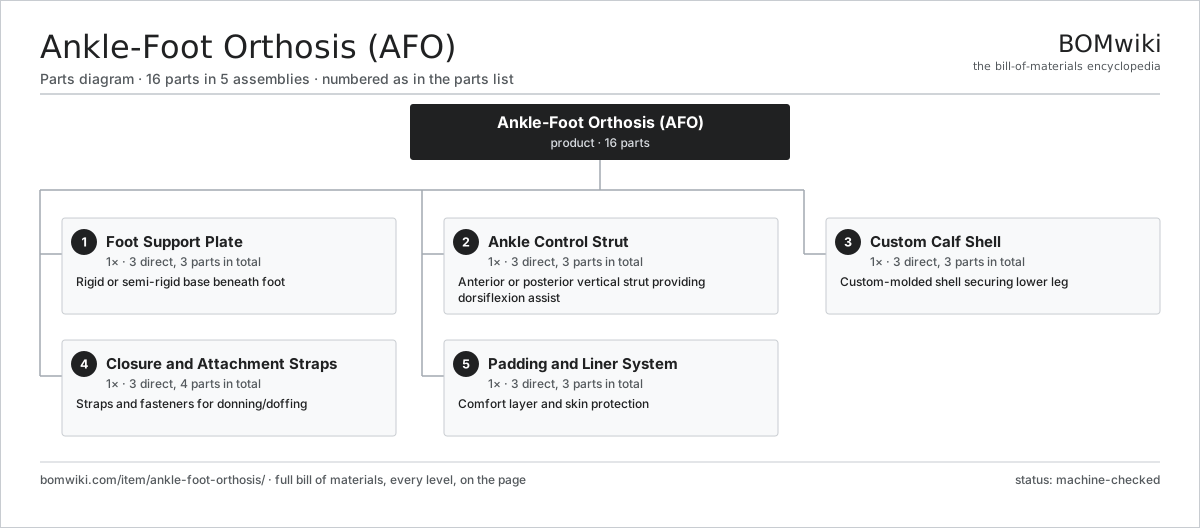
| # | Part | Qty | What it does |
|---|---|---|---|
| 1 | Foot Support Plate 3 parts | 1× | Rigid or semi-rigid base beneath foot |
| 2 | Ankle Control Strut 3 parts | 1× | Anterior or posterior vertical strut providing dorsiflexion assist |
| 3 | Custom Calf Shell 3 parts | 1× | Custom-molded shell securing lower leg |
| 4 | Closure and Attachment Straps 3 parts | 1× | Straps and fasteners for donning/doffing |
| 5 | Padding and Liner System 3 parts | 1× | Comfort layer and skin protection |
3D model
No 3D model yet. Have a CAD file of this? Add a 3D model — STL renders right on this page; STEP, FreeCAD, and OpenSCAD sources are welcome too (openly licensed, like all 3D models on BOMwiki).
Build & assembly graph
expand / collapse · shared sub-assemblies converge · links to related products · est. labourTap an assembly to expand/collapse · tap a part to open it · use “Open page” for any node · drag to pan, scroll to zoom.
Bill of materials for Ankle-Foot Orthosis (AFO)
5 top-level lines · 20 rows shown · 16 parts total · indented to 3 levels| # | Item / sub-assembly | Part no. | Qty/assy | Ext. qty | Parts | Type |
|---|---|---|---|---|---|---|
| 1 | Foot Support Plate 3 parts | ankle-foot-orthosis-foot-plate | 1× | 1 | 3 | assembly |
| 1.1 | Foot Plate Base Material | ankle-foot-orthosis-plate-blank | 1× | 1 | · | part |
| 1.2 | Heel Cup Insert | ankle-foot-orthosis-heel-cup | 1× | 1 | · | part |
| 1.3 | Arch Support Ridge | ankle-foot-orthosis-arch-support | 1× | 1 | · | part |
| 2 | Ankle Control Strut 3 parts | ankle-foot-orthosis-strut-assembly | 1× | 1 | 3 | assembly |
| 2.1 | Strut Material | ankle-foot-orthosis-strut-material | 1× | 1 | · | part |
| 2.2 | Strut Compliance Tuning | ankle-foot-orthosis-strut-stiffness | 1× | 1 | · | part |
| 2.3 | Ankle Joint Hinge | ankle-foot-orthosis-strut-termination | 1× | 1 | · | part |
| 3 | Custom Calf Shell 3 parts | ankle-foot-orthosis-calf-shell | 1× | 1 | 3 | assembly |
| 3.1 | Calf Shell Blank | ankle-foot-orthosis-calf-blank | 1× | 1 | · | part |
| 3.2 | Calf Trimline | ankle-foot-orthosis-calf-trim-edge | 1× | 1 | · | part |
| 3.3 | Optional Lateral Stiffener | ankle-foot-orthosis-calf-stiffener | 1× | 1 | · | part |
| 4 | Closure and Attachment Straps 3 parts | ankle-foot-orthosis-closure-system | 1× | 1 | 4 | assembly |
| 4.1 | Anterior Closure Strap | ankle-foot-orthosis-anterior-strap | 1× | 1 | · | part |
| 4.2 | Calf Circumferential Strap | ankle-foot-orthosis-calf-strap | 1× | 1 | · | part |
| 4.3 | Hook-and-Loop Fasteners | ankle-foot-orthosis-velcro-tabs | 2× | 2 | · | part |
| 5 | Padding and Liner System 3 parts | ankle-foot-orthosis-liner-padding | 1× | 1 | 3 | assembly |
| 5.1 | Foam Padding Material | ankle-foot-orthosis-foam-padding | 1× | 1 | · | part |
| 5.2 | Liner Fabric | ankle-foot-orthosis-fabric-liner | 1× | 1 | · | part |
| 5.3 | Adhesive for Liner | ankle-foot-orthosis-padding-adhesive | 1× | 1 | · | part |
Sourcing: possible vendors
Prices, MOQ, and lead times are algorithmic estimates, not quotes, and not claims about these companies. Company mappings are curated by keyword; est. price band $500–$3M. How estimates work| Vendor | HQ | Specialty | MOQ | Lead time |
|---|---|---|---|---|
| gehealthcare.com ↗ | Chicago, US | Medical imaging & devices | 100 units | 12–20 wks |
| siemens-healthineers.com ↗ | Erlangen, DE | Medical systems | 100 units | 12–20 wks |
|
🇳🇱Philips
philips.com ↗
|
Amsterdam, NL | Health technology | 100 units | 12–20 wks |
| medtronic.com ↗ | Minneapolis, US | Medical devices | 100 units | 12–20 wks |
|
🇨🇳Mindray
mindray.com ↗
|
Shenzhen, CN | Medical devices | 100 units | 12–20 wks |
1,460-word article