Glass Annealing Lehr
ProductOverview
A glass annealing lehr is a long, insulated heating chamber designed to slowly cool freshly made glass articles, relieving the internal stress that develops during blowing, molding, or casting. Without annealing, glass items cool rapidly and unevenly: the outer surface shrinks while the interior remains hot, creating locked-in tensile stress. This stress can cause spontaneous cracking hours or days after the piece is made.
The lehr solves this by moving hot glass through three zones: a soak zone maintaining high temperature, an annealing zone cooling slowly through the critical range, and a cooling zone bringing the glass to room temperature gradually. The Chamber is divided into these zones with independent Heating Elements. A Conveyor System carries glass through on rollers, or stationary shelves hold glass for batch annealing.
Electronic Controls manage the temperature ramp: typically 3–5 °F per minute through the critical annealing zone (450–550 °F for soda-lime glass, lower for borosilicate). The correct annealing schedule is crucial, too fast and cracks develop; too slow and production throughput suffers.
Lehrs range from small tabletop units (10–20 inch chamber) for studio glass artists, to large industrial conveyors 20+ feet long for production glassware, light bulbs, and bottling. The largest lehrs consume 5–10 kW of power and produce thousands of pieces per day.
The Three Zones: Function and Temperature Profile
The Chamber is divided into three zones, each with its own Heating Elements:
Soak Zone: Glass enters at high temperature (800–1100 °F depending on the glass composition and thickness). The Zone 1 Elements maintains this temperature, ensuring the interior of thick pieces warms fully and reaches thermal equilibrium. The dwell time is 30 minutes to 2 hours depending on piece thickness. A thick beer bottle might need 1–2 hours in the soak zone; a thin decorative vase might need only 15 minutes.
Annealing Zone: The critical zone where cooling is controlled. The Zone 2 Elements reduces temperature slowly, typically 3–5 °F per minute, passing through the annealing point (about 480 °F for soda-lime glass). At this temperature, the glass is stiff enough that further cooling does not lock in stress. A slower ramp (1–2 °F per minute) is used for very thick pieces or for lead crystal, which is more sensitive to stress. The Ramp Timer automates this rate, controlling power to the zone heater.
Cooling Zone: Below the annealing point, stress risk diminishes, so the cooling rate can increase. The Zone 3 Elements holds temperature at 200–300 °F, then power is reduced to allow faster descent to room temperature. The Exhaust System vents excess heat.
A typical annealing cycle for a 0.5-inch thick glass vase might look like:
- Soak: 800 °F for 45 minutes
- Annealing: Cool 800 °F to 480 °F at 4 °F/min (80 minutes)
- Cooling: 480 °F to 200 °F at 10 °F/min (28 minutes)
- Room: 200 °F to ambient naturally overnight
The Pyrometer Assembly with three thermocouples monitors the actual temperatures in each zone, displayed on the Display.
Conveyor vs. Batch Systems
Conveyor Models: A motorized Conveyor System with steel rollers or a mesh belt runs continuously, moving glass articles through the zones at adjustable speed (10–60 feet per hour). The Drive Motor is typically 0.25–0.5 hp, running slowly to save energy. Conveyor models suit production facilities making similar items repeatedly. A glass-container factory might load bottles onto the inlet every few seconds, allowing them to traverse the lehr over several hours.
Batch/Shelf Models: Stationary shelves inside the chamber hold articles for several hours while the oven cycles through the annealing profile. Load is lower per batch, but no power is spent moving goods, ideal for art glass studios or small production runs where throughput is less critical.
Heating and Thermal Insulation
The heating elements are nichrome or ceramic-sheathed electric coils mounted on ceramic insulators, spaced to avoid direct contact with the chamber walls. They are arranged for even temperature distribution: multiple elements per zone rather than a single hot spot. Power is applied via solid-state relays controlled by the Controller, which reads the thermocouples and adjusts power continuously to maintain setpoint.
The Insulation Blanket (typically 4–6 inches of ceramic fiber) wraps the exterior, reducing radiant heat loss to 5–10% of total energy consumption. Without insulation, heat loss would be 40–50%, driving energy costs and making temperature control difficult. The zone dividers are also insulated, preventing heat transfer between zones.
Controls and Programming
The Controls are the lehr's brain. Modern lehrs use a PID controller that:
- Reads thermocouple temperatures continuously
- Adjusts power to heating elements to track a ramp (°F per hour)
- Allows independent setpoints for each zone
- Includes a timer programming the cooling rate through the annealing zone
The operator sets three setpoints (soak, anneal, cool) and two ramp rates (soak-to-anneal, anneal-to-cool). The controller does the rest. Some large industrial lehrs have a memory store for 10–20 different annealing profiles, selectable by button, allowing the same machine to handle different glass types and thicknesses.
Older lehrs (pre-1980) use mechanical thermostats and analog timers; they work but require frequent adjustment. Electronic control is far more precise and repeatable.
Door and Material Handling
The Door Assembly at the lehr entrance allows loading hot glass into the Chamber. The Door Frame and Door Block form an insulated seal; the ceramic fiber gasket minimizes air leakage.
Glass is typically loaded at 1000–1100 °F directly from the glossblowing-furnace or forming process. The hot article is placed on the conveyor or shelf. An optional interlock prevents the door from opening while the conveyor is running, preventing safety hazards.
The Exhaust System with ducting and a damper vents moisture and excess heat. Some lehrs include an optional fan assisting draft if the lehr's location does not allow natural chimney draft.
Materials and Failure Modes
The walls are high-alumina ceramic brick (rated 2000+ °F), far hotter than the maximum operating temperature (1200 °F), ensuring years of service. The Ceiling sees the most thermal cycling and may require replacement every 5–10 years as brick gradually spalls from repeated heating and cooling.
The conveyor rollers are the primary wear item in continuous-operation models. Steel rollers oxidize and wear, requiring replacement every 2–5 years depending on usage and the abrasiveness of the glass items. Some modern lehrs use ceramic or carbide-coated rollers, extending life to 10+ years.
The elements have a finite life, typically 5–10 years, depending on switching frequency and temperature cycling. Once an element fails (open circuit), that zone loses power and the lehr cannot control temperature; replacement is necessary.
Stress Relief and Glass Behavior
The lehr's annealing schedule is not arbitrary; it must match the glass composition:
- Soda-lime glass (most common): Annealing point ~480 °F, cooled at 3–5 °F/min through this range.
- Borosilicate glass: Annealing point ~890 °F (much higher), requires slower cooling rates and higher soak temperatures. Rapid cooling of borosilicate causes severe cracking.
- Lead crystal: Annealing point ~520 °F, but very sensitive to stress; requires the slowest cooling rates, often 1–2 °F/min.
- Fused silica: Annealing point ~900 °F, most demanding; thick fused-silica optics can take 24+ hours to anneal properly.
Studio glass artists often place small annealed pieces in a secondary slow-cool cycle overnight at low temperature (200–300 °F) to ensure complete stress relief.
Production and Workflow
In a production facility, glass exits the forming station (blowing, molding, or casting) at 1000–1200 °F and is immediately placed on the lehr conveyor. It travels through the three zones over several hours, exiting cooled to near room temperature. The conveyor speed is set so that a piece spends the correct time in each zone; faster conveyor means fewer pieces can be "in process" but higher throughput per hour.
A modern container-glass plant might have three or four parallel lehrs, each handling 50–100 pieces per hour, producing 200–400 annealed items daily. Art glass studios often use a single small batch lehr, annealing pieces overnight and removing them the next morning stress-free.
Glass Annealing Lehr parts and their functions
8 top-level parts · 49 parts in total · full bill of materials below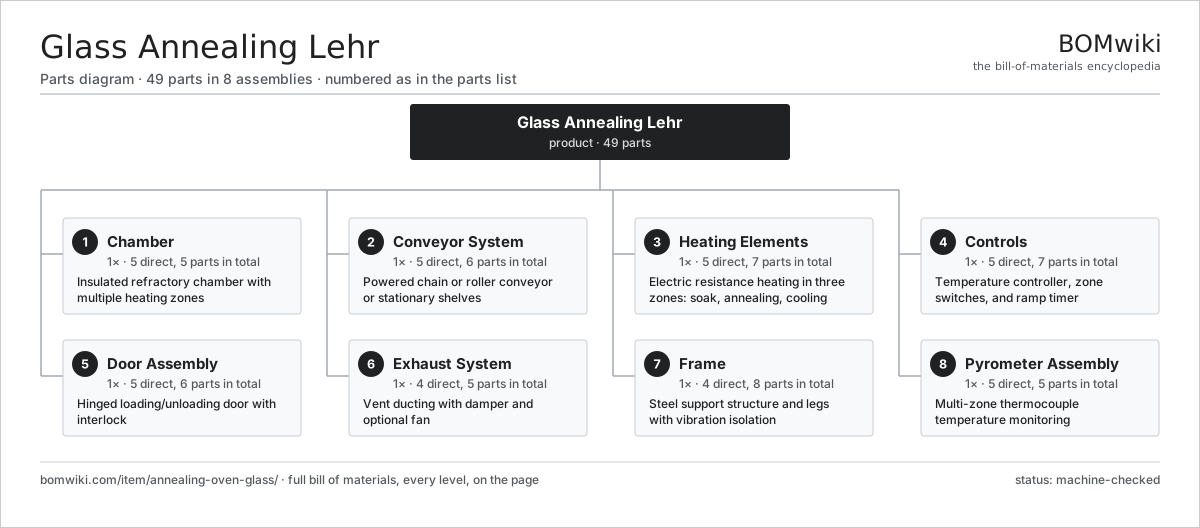
| # | Part | Qty | What it does |
|---|---|---|---|
| 1 | Chamber 5 parts | 1× | Insulated refractory chamber with multiple heating zones |
| 2 | Conveyor System 5 parts | 1× | Powered chain or roller conveyor or stationary shelves |
| 3 | Heating Elements 5 parts | 1× | Electric resistance heating in three zones: soak, annealing, cooling |
| 4 | Controls 5 parts | 1× | Temperature controller, zone switches, and ramp timer |
| 5 | Door Assembly 5 parts | 1× | Hinged loading/unloading door with interlock |
| 6 | Exhaust System 4 parts | 1× | Vent ducting with damper and optional fan |
| 7 | Frame 4 parts | 1× | Steel support structure and legs with vibration isolation |
| 8 | Pyrometer Assembly 5 parts | 1× | Multi-zone thermocouple temperature monitoring |
3D model
No 3D model yet. Have a CAD file of this? Add a 3D model — STL renders right on this page; STEP, FreeCAD, and OpenSCAD sources are welcome too (openly licensed, like all 3D models on BOMwiki).
Build & assembly graph
expand / collapse · shared sub-assemblies converge · links to related products · est. labourTap an assembly to expand/collapse · tap a part to open it · use “Open page” for any node · drag to pan, scroll to zoom.
Bill of materials for Glass Annealing Lehr
8 top-level lines · 46 rows shown · 49 parts total · indented to 3 levels| # | Item / sub-assembly | Part no. | Qty/assy | Ext. qty | Parts | Type |
|---|---|---|---|---|---|---|
| 1 | Chamber 5 parts | annealing-oven-glass-chamber | 1× | 1 | 5 | assembly |
| 1.1 | Inner Walls | annealing-oven-glass-inner-walls | 1× | 1 | · | part |
| 1.2 | Ceiling | annealing-oven-glass-ceiling | 1× | 1 | · | part |
| 1.3 | Floor | annealing-oven-glass-floor | 1× | 1 | · | part |
| 1.4 | Insulation Blanket | annealing-oven-glass-insulation-blanket | 1× | 1 | · | part |
| 1.5 | Chamber Liners | annealing-oven-glass-chamber-liners | 1× | 1 | · | part |
| 2 | Conveyor System 5 parts | annealing-oven-glass-conveyor | 1× | 1 | 6 | assembly |
| 2.1 | Drive Motor | annealing-oven-glass-drive-motor | 1× | 1 | · | part |
| 2.2 | Chain Drive | annealing-oven-glass-chain-drive | 1× | 1 | · | part |
| 2.3 | Conveyor Frame | annealing-oven-glass-conveyor-frame | 1× | 1 | · | part |
| 2.4 | Conveyor Support | annealing-oven-glass-conveyor-support | 2× | 2 | · | part |
| 2.5 | Speed Control | annealing-oven-glass-speed-control | 1× | 1 | · | part |
| 3 | Heating Elements 5 parts | annealing-oven-glass-heating-elements | 1× | 1 | 7 | assembly |
| 3.1 | Zone 1 Elements | annealing-oven-glass-element-zone-1 | 1× | 1 | · | part |
| 3.2 | Zone 2 Elements | annealing-oven-glass-element-zone-2 | 1× | 1 | · | part |
| 3.3 | Zone 3 Elements | annealing-oven-glass-element-zone-3 | 1× | 1 | · | part |
| 3.4 | Element Support | annealing-oven-glass-element-support | 3× | 3 | · | part |
| 3.5 | Electrical Bus | annealing-oven-glass-electrical-bus | 1× | 1 | · | part |
| 4 | Controls 5 parts | annealing-oven-glass-controls | 1× | 1 | 7 | assembly |
| 4.1 | Controller | annealing-oven-glass-controller | 1× | 1 | · | part |
| 4.2 | Relay Bank | annealing-oven-glass-relay-bank | 1× | 1 | · | part |
| 4.3 | Setpoint Dial | annealing-oven-glass-setpoint-dial | 3× | 3 | · | part |
| 4.4 | Ramp Timer | annealing-oven-glass-ramp-timer | 1× | 1 | · | part |
| 4.5 | Display | annealing-oven-glass-display | 1× | 1 | · | part |
| 5 | Door Assembly 5 parts | annealing-oven-glass-door-assembly | 1× | 1 | 6 | assembly |
| 5.1 | Door Frame | annealing-oven-glass-door-frame | 1× | 1 | · | part |
| 5.2 | Door Block | annealing-oven-glass-door-block | 1× | 1 | · | part |
| 5.3 | Door Hinge | annealing-oven-glass-door-hinge | 2× | 2 | · | part |
| 5.4 | Door Latch | annealing-oven-glass-door-latch | 1× | 1 | · | part |
| 5.5 | Door Gasket | annealing-oven-glass-door-gasket | 1× | 1 | · | part |
| 6 | Exhaust System 4 parts | annealing-oven-glass-exhaust-system | 1× | 1 | 5 | assembly |
| 6.1 | Vent Duct | annealing-oven-glass-vent-duct | 2× | 2 | · | part |
| 6.2 | Damper Valve | annealing-oven-glass-damper-valve | 1× | 1 | · | part |
| 6.3 | Exhaust Fan | annealing-oven-glass-exhaust-fan | 1× | 1 | · | part |
| 6.4 | Chimney Section | annealing-oven-glass-chimney-section | 1× | 1 | · | part |
| 7 | Frame 4 parts | annealing-oven-glass-frame | 1× | 1 | 8 | assembly |
| 7.1 | Main Frame | annealing-oven-glass-main-frame | 1× | 1 | · | part |
| 7.2 | Vibration Mounts | annealing-oven-glass-vibration-mounts | 4× | 4 | · | part |
| 7.3 | Shelf Support | annealing-oven-glass-shelf-support | 2× | 2 | · | part |
| 7.4 | Fastener Set | fastener-set | 1× | 1 | · | part |
| 8 | Pyrometer Assembly 5 parts | annealing-oven-glass-pyrometer | 1× | 1 | 5 | assembly |
| 8.1 | Zone 1 Thermocouple | annealing-oven-glass-thermocouple-1 | 1× | 1 | · | part |
| 8.2 | Zone 2 Thermocouple | annealing-oven-glass-thermocouple-2 | 1× | 1 | · | part |
| 8.3 | Zone 3 Thermocouple | annealing-oven-glass-thermocouple-3 | 1× | 1 | · | part |
| 8.4 | Extension Wire | annealing-oven-glass-extension-wire | 1× | 1 | · | part |
| 8.5 | Connector Block | annealing-oven-glass-connector-block | 1× | 1 | · | part |
Sourcing: possible vendors
Prices, MOQ, and lead times are algorithmic estimates, not quotes, and not claims about these companies. Company mappings are curated by keyword; est. price band $5k–$2M. How estimates work| Vendor | HQ | Specialty | MOQ | Lead time |
|---|---|---|---|---|
| atlascopco.com ↗ | Stockholm, SE | Compressors & industrial | 10 units | 12–20 wks |
|
🇦🇹Andritz
andritz.com ↗
|
Graz, AT | Process plants & machinery | 10 units | 12–20 wks |
| buhlergroup.com ↗ | Uzwil, CH | Food & materials processing | 10 units | 12–20 wks |
| gea.com ↗ | Düsseldorf, DE | Process technology | 10 units | 12–20 wks |
| mhi.com ↗ | Tokyo, JP | Heavy machinery | 10 units | 12–20 wks |
1,532-word article