Anodizing Line
ProductOverview
Anodizing is an electrochemical process that converts aluminum surface into a hard, corrosion-resistant aluminum oxide layer. Unlike paint or plating (which are applied coatings), anodized oxide grows directly from and into the aluminum substrate, becoming an integral part of the material. The anodizing line is a series of immersion tanks where parts progress through degreasing, electrochemical oxidation, and water rinsing stages. The process relies on DC electrical current (500 A at 20 V) to drive a controlled electrochemical dissolution-and-redeposition cycle in sulfuric acid electrolyte, producing densely packed aluminum oxide (Al₂O₃) crystals hardened by hot-water sealing. Anodized parts exhibit superior wear resistance, corrosion resistance (especially in salt-spray environments), aesthetic color options (dyes can be absorbed into the porous oxide layer), and dimensional stability compared to unprotected aluminum.
The anodizing line begins with the Degreasing Tank, which removes organic contaminants (oils, machining fluid, fingerprints) from aluminum surfaces. The Degrease Vessel is a 200 L stainless steel tank held at 50–65°C by an Immersion Heater electric heater. An alkaline surfactant (soap) is injected by a Chemical Dispenser peristaltic pump at 0.1–0.5% by volume. An Circulation Pump centrifugal pump circulates the solution and provides spray agitation. Parts are immersed for 5–10 minutes; the alkaline environment saponifies oils and suspends particulate. After degreasing, parts are rinsed in tap water and moved to the anodizing tank.
The Anodic Tank Assembly is the heart of the process. A large stainless steel Anodic Tank Vessel (400 L capacity, 6 mm walls, acid-resistant) contains 15–20% sulfuric acid (H₂SO₄) by weight. The Lead Cathode Bar, a pure lead bar 50 mm diameter, is suspended parallel to the aluminum parts being anodized. The parts are held in the Aluminum Racking System, which serves as the anode electrical conductor.
When DC current flows (via the DC Rectifier Supply), the aluminum parts become anodic (positive). The electrochemical reaction is:
- At the anode: 2Al + 3H₂O → Al₂O₃ + 6H⁺ + 6e⁻
- At the cathode: 2H⁺ + 2e⁻ → H₂↑ (hydrogen gas released)
This occurs at the aluminum surface only. Aluminum is oxidized (dissolved into oxide form), and the oxide layer grows into the aluminum substrate rather than on top of it. The process is self-limiting to a degree: as the oxide layer thickens, resistance increases and oxide growth slows. By controlling current density (mA/cm²) and time, the operator controls final oxide thickness. Type II anodizing (general purpose) produces 5–25 µm thickness over 20–45 minutes. Type III anodizing (hard coat) produces 25–50 µm over 60+ minutes, yielding hardness 400–600 HV suitable for wear surfaces.
Temperature control is critical. Anodizing is highly exothermic; the electrochemical oxidation releases heat. If temperature rises above 30°C, the oxide becomes softer and porosity increases. The Cooling System maintains tank temperature at 15–25°C. An Chiller Unit 8 kW refrigerated unit cools water, which passes through an Heat Exchanger plate-frame exchanger submerged in the acid tank. A Cooling Water Pump vane pump circulates the cooling water at 40 L/min. A Thermostat Control Valve proportional valve mixes cooled and warm return water to maintain precise setpoint.
The DC Rectifier Supply DC power supply delivers constant 500 A at 12–20 V depending on load. A Power Transformer 600 V 3-phase primary steps down to 25 V secondary. A Rectifier Bridge 3-phase full-wave rectifier converts AC to DC (600 A capacity). A Smoothing Inductor 200 mH choke and capacitor bank smooth ripple to <5%. An anodizing-line-ammeter 0–600 A panel meter displays process current; an Voltmeter 0–30 V meter displays operating voltage. The operator sets desired current density by adjusting the rectifier output; current density determines oxide growth rate and final thickness.
Acid concentration is a critical parameter. The electrolyte must maintain 15–20% H₂SO₄. As the process consumes water (water is converted to Al₂O₃ and H₂), acid concentration drifts upward. An anodizing-line-acid-circulation-sensor hydrometer or density probe monitors concentration; when it drifts above 20%, the operator dilutes the tank with deionized water. An Acid Circulation System pump and filter keep the acid clean by continuously circulating through a 20 micron cartridge filter.
After anodizing, parts must be immediately rinsed to remove acid residue. The Rinse Station (two tanks in series) spray-washes parts with deionized (DI) water. Each Rinse Tank Vessel is a shallow stainless basin; Spray Nozzle adjustable cone nozzles spray from overhead. An Rinse Pump 30 L/min pump circulates DI water. A Drain Strainer 100 micron basket filter protects the drain. Parts are rinsed for 2–3 minutes in each tank to ensure complete acid removal.
Hydrogen gas generation during anodizing creates safety and environmental concerns. The Fume Hood & Extraction system captures hydrogen gas and acid mist. A Hood Canopy stainless steel enclosure (sloped for drainage) surrounds all tanks. An Extraction Fan centrifugal blower (5000 CFM, 500 Pa pressure) draws air through the hood. A Mist Filter coalescent cartridge (5 micron efficiency) separates acid droplets and aerosols from the air stream before atmospheric release. The cleaned air exits to roof via Ductwork stainless ducting with rain hood.
Finally, parts are typically hot-water sealed to close the porous oxide layer and improve corrosion resistance. A seal tank (not shown in this BOM) contains 95°C deionized water; immersion for 10–30 minutes allows water to hydrolyze the outermost oxide pores, converting Al₂O₃ to Al(OH)₃, which seals the layer and increases hardness to 500–700 HV.
In industry, anodized aluminum dominates aerospace, automotive, and architectural applications. Engine components, landing gear, airframe structure all use Type II and Type III anodizing. Automotive pistons and cylinder blocks use hard anodizing (Type III) for wear resistance. Architectural aluminum extrusions (windows, curtain walls) are Type II anodized with integral dyes for color and aesthetics. Marine equipment tolerates anodizing's corrosion resistance far better than bare aluminum in salt-spray environments.
How it works
- Aluminum parts (previously machined or fabricated) are loaded into the Aluminum Racking System aluminum rack. The rack holds multiple parts and provides electrical contact points via Contact Rod aluminum rods.
- Racks are submerged in the Degreasing Tank. The Immersion Heater maintains temperature at 50–65°C. The Chemical Dispenser doses alkaline surfactant into the 200 L solution. The Circulation Pump agitates for 5–10 minutes, removing oils and dirt.
- Racks are lifted out and rinsed in tap water (manually or via automatic conveyor). Parts are then submerged in the primary Anodic Tank Assembly containing 15–20% H₂SO₄ acid at 15–25°C (cooled by the Cooling System chiller and Heat Exchanger).
- The DC Rectifier Supply DC power supply is energized. Current flows from the rectifier positive terminal to the Aluminum Racking System (anode). Current flows through the aluminum parts, through the acidic electrolyte, to the Lead Cathode Bar (negative terminal), and back through the return cable to the rectifier.
- At the anode (aluminum part surface), oxidation occurs: aluminum atoms are oxidized and form Al₂O₃. At the cathode (lead bar), hydrogen gas is evolved. The operator adjusts the rectifier to maintain a constant current (e.g., 500 A for a 10 m² surface area load), corresponding to a desired current density (e.g., 50 mA/cm²).
- As anodizing progresses, the oxide layer grows inward into the aluminum substrate. The layer becomes increasingly resistive (electrical resistance rises), causing voltage to increase while current is held constant. The operator monitors anodizing-line-ammeter and Voltmeter to track progress.
- Anodizing duration depends on desired thickness. Type II coating (15–25 µm) takes 30–45 minutes. Type III hard coat (40–50 µm) takes 60–90 minutes. The operator removes racks when time expires.
- The Acid Circulation System pump continuously filters and recirculates the electrolyte to maintain cleanliness. An Acid Concentration Sensor hydrometer is checked daily; if concentration drifts above 20%, the tank is diluted with DI water.
- Temperature is continuously monitored and maintained at 15–25°C. The Cooling System chiller maintains 15°C supply water; the Thermostat Control Valve proportional valve blends cooled water with the tank return, maintaining setpoint.
- Hydrogen gas and acid mist are captured by the Hood Canopy enclosure and drawn out via the Extraction Fan blower. The Mist Filter coalescent cartridge removes acid aerosols before release.
- After anodizing is complete, racks are lifted and the oxide surface is immediately rinsed in the first Rinse Station. The Spray Nozzle overhead sprays DI water for 2–3 minutes. Parts are then rinsed in the second rinse tank (same spray pattern).
- Parts exit the rinsing stage and are often moved to a hot-water seal tank (95°C DI water, 10–30 min soak) to close the porous oxide layer and improve hardness and corrosion resistance. This sealing step is optional but recommended for critical applications.
- Parts are dried (naturally or forced air) and inspected for thickness (eddy-current gauge), color uniformity, and hardness (microhardness indentation test if required).
Anodizing Line parts and their functions
7 top-level parts · 50 parts in total · full bill of materials below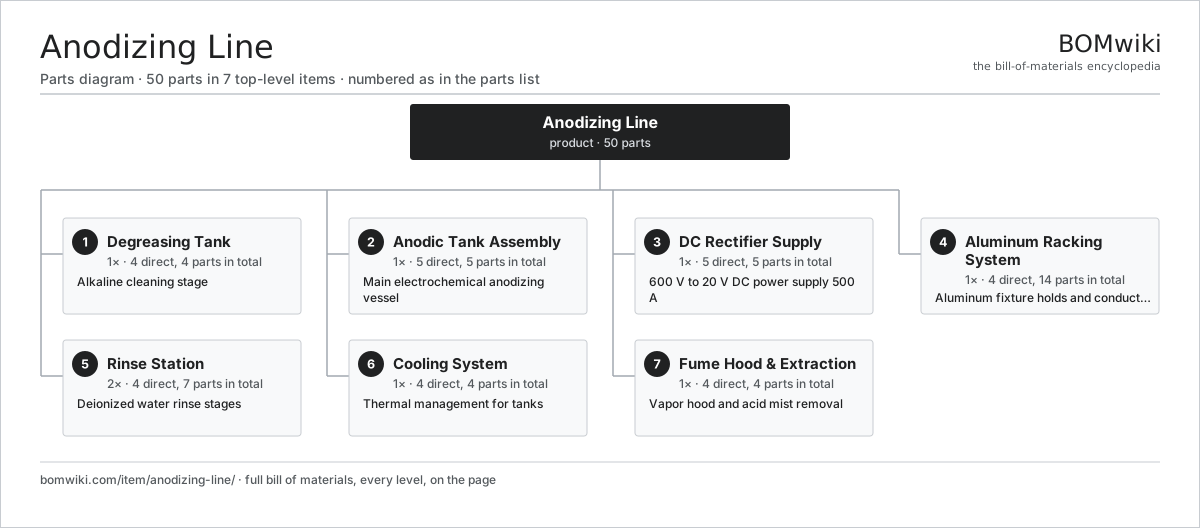
| # | Part | Qty | What it does |
|---|---|---|---|
| 1 | Degreasing Tank 4 parts | 1× | Alkaline cleaning stage |
| 2 | Anodic Tank Assembly 5 parts | 1× | Main electrochemical anodizing vessel |
| 3 | DC Rectifier Supply 5 parts | 1× | 600 V to 20 V DC power supply 500 A |
| 4 | Aluminum Racking System 4 parts | 1× | Aluminum fixture holds and conducts current |
| 5 | Rinse Station 4 parts | 2× | Deionized water rinse stages |
| 6 | Cooling System 4 parts | 1× | Thermal management for tanks |
| 7 | Fume Hood & Extraction 4 parts | 1× | Vapor hood and acid mist removal |
3D model
No 3D model yet. Have a CAD file of this? Add a 3D model. STL renders right on this page; STEP, FreeCAD, and OpenSCAD sources are welcome too (openly licensed, like all 3D models on BOMwiki).
Build & assembly graph
expand / collapse · shared sub-assemblies converge · links to related products · est. labourTap an assembly to expand/collapse · tap a part to open it · use “Open page” for any node · drag to pan, scroll to zoom.
Bill of materials for Anodizing Line
7 top-level lines · 37 rows shown · 50 parts total · indented to 3 levels| # | Item / sub-assembly | Part no. | Qty/assy | Ext. qty | Parts | Type |
|---|---|---|---|---|---|---|
| 1 | Degreasing Tank 4 parts | anodizing-line-degreasing-tank | 1× | 1 | 4 | assembly |
| 1.1 | Degrease Vessel | anodizing-line-degrease-vessel | 1× | 1 | · | part |
| 1.2 | Immersion Heater | anodizing-line-immersion-heater | 1× | 1 | · | part |
| 1.3 | Circulation Pump | anodizing-line-circulation-pump | 1× | 1 | · | part |
| 1.4 | Chemical Dispenser | anodizing-line-chemical-dispenser | 1× | 1 | · | part |
| 2 | Anodic Tank Assembly 5 parts | anodizing-line-anodic-tank | 1× | 1 | 5 | assembly |
| 2.1 | Anodic Tank Vessel | anodizing-line-tank-vessel | 1× | 1 | · | part |
| 2.2 | Lead Cathode Bar | anodizing-line-lead-cathode | 1× | 1 | · | part |
| 2.3 | Acid Circulation System | anodizing-line-acid-circulation | 1× | 1 | · | part |
| 2.4 | Temperature Control Valves | anodizing-line-temperature-control | 1× | 1 | · | part |
| 2.5 | Acid Concentration Sensor | anodizing-line-acid-concentration-sensor | 1× | 1 | · | part |
| 3 | DC Rectifier Supply 5 parts | anodizing-line-rectifier | 1× | 1 | 5 | assembly |
| 3.1 | Power Transformer | anodizing-line-transformer | 1× | 1 | · | part |
| 3.2 | Rectifier Bridge | anodizing-line-bridge-rectifier | 1× | 1 | · | part |
| 3.3 | Smoothing Inductor | anodizing-line-smoothing-inductor | 1× | 1 | · | part |
| 3.4 | Ammeter | anodizing-line-current-meter | 1× | 1 | · | part |
| 3.5 | Voltmeter | anodizing-line-voltage-meter | 1× | 1 | · | part |
| 4 | Aluminum Racking System 4 parts | anodizing-line-racking-system | 1× | 1 | 14 | assembly |
| 4.1 | Rack Frame | anodizing-line-rack-frame | 1× | 1 | · | part |
| 4.2 | Contact Rod | anodizing-line-rod-contacts | 2× | 2 | · | part |
| 4.3 | Insulated Handle | anodizing-line-insulated-handle | 1× | 1 | · | part |
| 4.4 | Contact Pad | anodizing-line-contact-pads | 10× | 10 | · | part |
| 5 | Rinse Station 4 parts | anodizing-line-rinse-station | 2× | 2 | 7 | assembly |
| 5.1 | Rinse Tank Vessel | anodizing-line-rinse-tank | 1× | 2 | · | part |
| 5.2 | Spray Nozzle | anodizing-line-spray-nozzle | 4× | 8 | · | part |
| 5.3 | Rinse Pump | anodizing-line-rinse-pump | 1× | 2 | · | part |
| 5.4 | Drain Strainer | anodizing-line-drain-strainer | 1× | 2 | · | part |
| 6 | Cooling System 4 parts | anodizing-line-cooling-system | 1× | 1 | 4 | assembly |
| 6.1 | Chiller Unit | anodizing-line-chiller | 1× | 1 | · | part |
| 6.2 | Cooling Water Pump | anodizing-line-pump-cooler | 1× | 1 | · | part |
| 6.3 | Heat Exchanger | anodizing-line-heat-exchanger | 1× | 1 | · | part |
| 6.4 | Thermostat Control Valve | anodizing-line-thermostat | 1× | 1 | · | part |
| 7 | Fume Hood & Extraction 4 parts | anodizing-line-fume-extraction | 1× | 1 | 4 | assembly |
| 7.1 | Hood Canopy | anodizing-line-hood-canopy | 1× | 1 | · | part |
| 7.2 | Mist Filter | anodizing-line-mist-filter | 1× | 1 | · | part |
| 7.3 | Extraction Fan | anodizing-line-extraction-fan | 1× | 1 | · | part |
| 7.4 | Ductwork | anodizing-line-ductwork | 1× | 1 | · | part |
Something wrong in this list? Report a problem with this BOM.
Sourcing: possible vendors
Browse the supplier directory → Prices, MOQ, and lead times are algorithmic estimates, not quotes, and not claims about these companies. Company mappings are curated by keyword; est. price band $5k–$2M. How estimates work| Vendor | HQ | Specialty | MOQ | Lead time |
|---|---|---|---|---|
| atlascopco.com ↗ | Stockholm, SE | Compressors & industrial | 10 units | 12–20 wks |
|
🇦🇹Andritz
andritz.com ↗
|
Graz, AT | Process plants & machinery | 10 units | 12–20 wks |
| buhlergroup.com ↗ | Uzwil, CH | Food & materials processing | 10 units | 12–20 wks |
| gea.com ↗ | Düsseldorf, DE | Process technology | 10 units | 12–20 wks |
| mhi.com ↗ | Tokyo, JP | Heavy machinery | 10 units | 12–20 wks |
1,590-word article