Antenna Analyzer
ProductOverview
An antenna analyzer is a portable RF instrument designed to measure the electromagnetic properties of antennas and transmission lines in the field. Rather than relying on external network analyzers or laboratory test benches, field engineers use antenna analyzers to verify antenna resonance, bandwidth, and matching conditions on-site. The device combines a swept RF signal source, a broadband directional coupler, and a real-time measurement processor to compute standing wave ratio (SWR), return loss, and complex impedance values across a frequency range from 100 kHz to 200 MHz.
The analyzer is essential in radio frequency engineering disciplines including antenna design, mobile tower commissioning, emergency communications setup, and amateur radio work. A well-matched antenna presents an SWR close to 1:1 (50 Ω reference), minimizing power loss and preventing amplifier damage. By sweeping frequency and displaying impedance in real time, engineers identify resonance peaks and bandwidth edges without moving between instruments.
Historically, antenna analyzers descended from standing-wave indicators (SWI) coupled with reflection measurements. Modern instruments integrate DDS signal generation, logarithmic detectors, microprocessor control, and calibration algorithms into a single handheld unit weighing under 500 grams.
How it Works
The RF frontend generates a low-power swept signal from 100 kHz to 200 MHz using a DDS oscillator, driving the test antenna through a directional hybrid coupler. The coupler samples both the forward power (incident wave) and the reflected power (return wave) from the antenna under test. Both signals feed logarithmic power detectors that convert RF amplitude into analog voltages proportional to forward and reflected power.
These voltage outputs route through an instrumentation amplifier stage to a 16-bit ADC, which samples both channels at 10 kHz. The embedded microprocessor computes SWR as the ratio sqrt((Pref + ε) / (Pfwd − ε)) in real time, where ε is a small epsilon to avoid division by zero at high SWR. Return loss is computed as 20 log10(sqrt(Pref / Pfwd)). The complex impedance Z = 50(1 + Γ) / (1 − Γ) is derived from the reflection coefficient magnitude and phase estimate.
A color LCD display presents the impedance as a resistance-reactance (R-X) plot across the swept frequency range, with SWR curve overlay. The rotary encoder allows the operator to zoom, pan, and set markers to identify resonant frequencies and bandwidth edges. The calibration assembly permits user adjustment against open-circuit, short-circuit, and 50 Ω reference standards to correct for connector losses and coupling uncertainties.
Power derives from eight AA lithium primary cells arranged in two 4-cell series strings in parallel with a charging circuit, yielding 12V nominal with 8–10 hours of continuous operation. Separate buck and boost DC-DC converters derive the 5V logic rail and 12V RF bias rail. USB charging allows field recharging without replacing batteries.
Measurement Accuracy and Limitations
The measurement uncertainty is dominated by directional coupler directivity (>30 dB at 50 MHz), meaning the coupler's finite directivity (cross-talk between forward and reflected arms) limits return loss resolution to approximately 30 dB. Calibration against reference standards reduces systematic error to ±0.1 SWR in the 1:1 to 3:1 practical range; higher SWR values incur greater uncertainty as the reflected signal approaches the forward signal in magnitude.
Coaxial cable length and routing within the instrument introduce impedance discontinuities ("component parasitics") that must be calibrated out via open, short, and load corrections. The time-domain reflectometry (TDR) mode on some analyzers visualizes these impedance steps along the transmission line, useful for identifying discrete faults like connector corrosion or cable damage.
Applications and Field Use
In mobile telecommunications, antenna analyzers verify the performance of base station antennas after installation, detecting tuning drift from wind load, ice accumulation, or thermal stress. Emergency response teams deploy analyzers to quickly assemble field communication systems and confirm frequency allocation compliance. Amateur radio operators use them to optimize wire antenna designs and diagnose standing-wave problems. Antenna design engineers employ them as part of the design iteration loop, measuring prototypes in an anechoic chamber or over a ground plane.
The sweep speed (0.5 to 10 seconds) trades measurement resolution for field usability; slower sweeps reveal finer impedance detail but reduce responsiveness when manually adjusting antenna components. Real-time impedance traces on the LCD guide live tuning of variable capacitor antenna elements or transmission line stub trimmers.
Antenna Analyzer parts and their functions
7 top-level parts · 40 parts in total · full bill of materials below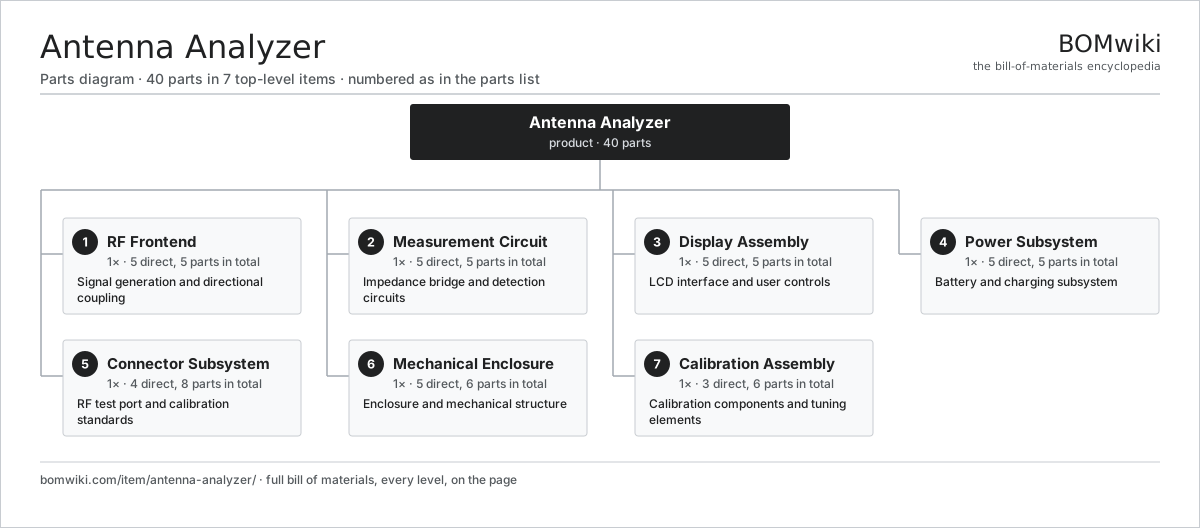
| # | Part | Qty | What it does |
|---|---|---|---|
| 1 | RF Frontend 5 parts | 1× | Signal generation and directional coupling |
| 2 | Measurement Circuit 5 parts | 1× | Impedance bridge and detection circuits |
| 3 | Display Assembly 5 parts | 1× | LCD interface and user controls |
| 4 | Power Subsystem 5 parts | 1× | Battery and charging subsystem |
| 5 | Connector Subsystem 4 parts | 1× | RF test port and calibration standards |
| 6 | Mechanical Enclosure 5 parts | 1× | Enclosure and mechanical structure |
| 7 | Calibration Assembly 3 parts | 1× | Calibration components and tuning elements |
3D model
No 3D model yet. Have a CAD file of this? Add a 3D model. STL renders right on this page; STEP, FreeCAD, and OpenSCAD sources are welcome too (openly licensed, like all 3D models on BOMwiki).
Build & assembly graph
expand / collapse · shared sub-assemblies converge · links to related products · est. labourTap an assembly to expand/collapse · tap a part to open it · use “Open page” for any node · drag to pan, scroll to zoom.
Bill of materials for Antenna Analyzer
7 top-level lines · 39 rows shown · 40 parts total · indented to 3 levels| # | Item / sub-assembly | Part no. | Qty/assy | Ext. qty | Parts | Type |
|---|---|---|---|---|---|---|
| 1 | RF Frontend 5 parts | antenna-analyzer-rf-frontend | 1× | 1 | 5 | assembly |
| 1.1 | DDS Oscillator | antenna-analyzer-oscillator | 1× | 1 | · | part |
| 1.2 | Hybrid Coupler | antenna-analyzer-coupler | 1× | 1 | · | part |
| 1.3 | Buffer Amplifier | antenna-analyzer-amplifier | 1× | 1 | · | part |
| 1.4 | Variable Attenuator | antenna-analyzer-attenuator | 1× | 1 | · | part |
| 1.5 | Low-Pass Filter | antenna-analyzer-filter | 1× | 1 | · | part |
| 2 | Measurement Circuit 5 parts | antenna-analyzer-measurement | 1× | 1 | 5 | assembly |
| 2.1 | Forward Detector | antenna-analyzer-detector-forward | 1× | 1 | · | part |
| 2.2 | Reflected Detector | antenna-analyzer-detector-reflected | 1× | 1 | · | part |
| 2.3 | 16-Bit ADC | antenna-analyzer-adc | 1× | 1 | · | part |
| 2.4 | Instrumentation Amp | antenna-analyzer-opamp-card | 1× | 1 | · | part |
| 2.5 | Voltage Reference | antenna-analyzer-reference | 1× | 1 | · | part |
| 3 | Display Assembly 5 parts | antenna-analyzer-display | 1× | 1 | 5 | assembly |
| 3.1 | LCD Panel | lcd-panel | 1× | 1 | · | part |
| 3.2 | Rotary Encoder | antenna-analyzer-encoder | 1× | 1 | · | part |
| 3.3 | Button Set | antenna-analyzer-buttons | 1× | 1 | · | part |
| 3.4 | Bare PCB | pcb-bare | 1× | 1 | · | part |
| 3.5 | Display Ribbon Cable | antenna-analyzer-cable-display | 1× | 1 | · | part |
| 4 | Power Subsystem 5 parts | antenna-analyzer-power | 1× | 1 | 5 | assembly |
| 4.1 | Lithium Battery Pack | antenna-analyzer-battery-pack | 1× | 1 | · | part |
| 4.2 | Charging Controller | antenna-analyzer-charger-ic | 1× | 1 | · | part |
| 4.3 | 5V Regulator | antenna-analyzer-dcdc-5v | 1× | 1 | · | part |
| 4.4 | 12V Boost Converter | antenna-analyzer-dcdc-12v | 1× | 1 | · | part |
| 4.5 | Power Input Jack | antenna-analyzer-connector-power | 1× | 1 | · | part |
| 5 | Connector Subsystem 4 parts | antenna-analyzer-connectors | 1× | 1 | 8 | assembly |
| 5.1 | Main SMA Port | antenna-analyzer-sma-main | 1× | 1 | · | part |
| 5.2 | Reference SMA Connectors | antenna-analyzer-sma-ref | 2× | 2 | · | part |
| 5.3 | Connector Shield | antenna-analyzer-connector-guard | 1× | 1 | · | part |
| 5.4 | PCB Standoff | antenna-analyzer-standoff | 4× | 4 | · | part |
| 6 | Mechanical Enclosure 5 parts | antenna-analyzer-housing | 1× | 1 | 6 | assembly |
| 6.1 | Top Housing | antenna-analyzer-case-top | 1× | 1 | · | part |
| 6.2 | Bottom Housing | antenna-analyzer-case-bottom | 1× | 1 | · | part |
| 6.3 | RF Shield Partition | antenna-analyzer-shield | 2× | 2 | · | part |
| 6.4 | Carrying Handle | antenna-analyzer-handle | 1× | 1 | · | part |
| 6.5 | Fastener Set | fastener-set | 1× | 1 | · | part |
| 7 | Calibration Assembly 3 parts | antenna-analyzer-calibration | 1× | 1 | 6 | assembly |
| 7.1 | Trim Capacitor | antenna-analyzer-trimmer-cap | 3× | 3 | · | part |
| 7.2 | Trim Inductor | antenna-analyzer-trimmer-ind | 2× | 2 | · | part |
| 7.3 | Precision 50Ω Load | antenna-analyzer-standard-50 | 1× | 1 | · | part |
Something wrong in this list? Report a problem with this BOM.
Related products
same domain, ranked by shared parts Analytical Balance
54 parts · shares 1 with this page
Analytical Balance
54 parts · shares 1 with this page
 Arbitrary Waveform Generator
45 parts · shares 1 with this page
Arbitrary Waveform Generator
45 parts · shares 1 with this page
 Atomic Absorption Spectrometer
648 parts · shares 1 with this page
Autoclave Sterilizer
282 parts · shares 1 with this page
Atomic Absorption Spectrometer
648 parts · shares 1 with this page
Autoclave Sterilizer
282 parts · shares 1 with this page
 Automated Cell Counter
54 parts · shares 1 with this page
Automated Colony Counter
322 parts · shares 1 with this page
Automated Cell Counter
54 parts · shares 1 with this page
Automated Colony Counter
322 parts · shares 1 with this page
Sourcing: possible vendors
Browse the supplier directory → Prices, MOQ, and lead times are algorithmic estimates, not quotes, and not claims about these companies. Company mappings are curated by keyword; est. price band $1k–$500k. How estimates work| Vendor | HQ | Specialty | MOQ | Lead time |
|---|---|---|---|---|
| thermofisher.com ↗ | Waltham, US | Lab instruments | 100 units | 10–18 wks |
|
🇺🇸Agilent
agilent.com ↗
|
Santa Clara, US | Analytical instruments | 100 units | 10–18 wks |
|
🇺🇸Bruker
bruker.com ↗
|
Billerica, US | Scientific instruments | 100 units | 10–18 wks |
|
🇯🇵Shimadzu
shimadzu.com ↗
|
Kyoto, JP | Analytical instruments | 100 units | 10–18 wks |
|
🇺🇸Waters
waters.com ↗
|
Milford, US | Chromatography & MS | 100 units | 10–18 wks |
717-word article