Anti-Gravity Treadmill
ProductOverview
An anti-gravity treadmill unloads a walker or runner by air pressure rather than harnesses. The user wears neoprene Pressure Shorts, steps onto a treadmill enclosed by a flexible Pressure Bag, and zips themselves into a waist-height Cockpit Ring. A blower then raises the chamber a few kilopascals above ambient. Because pressure acts on the cross-sectional area of the body at the waist seal, the net upward force is simply pressure × area, about 1 kPa over a typical 0.05 m² waist section yields ~50 N of lift, and the control system trims pressure until the user feels anywhere from 100% down to 20% of body weight, adjustable in 1% steps.
The principle, differential air pressure (DAP) unweighting, came out of NASA research, originally inverted, using negative pressure to add load for astronauts, and was commercialized for rehabilitation by AlterG in 2005. Unlike harness systems, DAP lifts through the whole lower body uniformly, so gait kinematics stay close to normal even at deep unweighting, which is why the machines are standard in sports-medicine clinics for post-surgical running progressions and stress-fracture returns.
Pressure chamber
The chamber is the urethane-coated Pressure Bag clamped to the treadmill perimeter below and the rigid cockpit ring above. Clear Viewing Window panels let a clinician watch the legs; gait observation is half the clinical value. The user interface to the chamber is the Shorts Seal Interface: the shorts carry a fabric Sealing Skirt whose Airtight Zipper half mates with the ring, while a compliant Waist Gasket limits leakage at the torso. The seal does not need to be hermetic, the blower runs continuously and the system tolerates steady leakage, it only needs leakage to be stable enough for the pressure loop to hold setpoint. A mechanical Pressure Relief Valve caps chamber pressure independently of software.
Air supply and control loop
A centrifugal Blower Motor in the Blower Housing feeds the chamber through a Supply Duct, drawing through an Intake Air Filter and Intake Muffler. Coarse pressure comes from blower speed; fast trim comes from the servo Pressure Control Valve bleeding excess air, which responds in tens of milliseconds as the runner's bounce changes chamber volume. Feedback comes from Pressure Sensor taps compensated by the Chamber Temperature Sensor.
Calibration makes the percentage display honest. At session start the user stands still while Deck Load Cell gauges under the deck weigh them at ambient pressure; the Sensor Interface Board then maps chamber pressure to measured deck force across a brief pressure sweep. From then on, commanding "60% body weight" means the controller holds the pressure that the calibration showed produces 60% of the measured weight on the deck.
Treadmill base and frame
Inside the bag is a largely conventional deck: the Treadmill Drive Motor turns the crowned Front Drive Roller through a Drive Belt, dragging the Running Belt over a waxed phenolic Deck Board. Speeds reach 20 km/h with incline to 15%, because unweighted athletes run fast. The Support Frame carries the cockpit on telescoping Cockpit Lift Column posts, the ring must sit at the iliac crest, so column height is set per user before zipping in, with Handrail grips for entry and balance.
Console and safety
The operator sets body-weight percentage, speed, and incline on a touchscreen (LCD Panel plus Touch Digitizer driven by a Compute SoC Module); the Console Control Board sequences blower, valve, and belt drive and enforces interlocks, the belt will not start until the chamber is sealed and calibrated. The Emergency Stop stops the belt and dumps pressure in one action. Because the user is zipped to the machine, fall consequences differ from a normal treadmill: the inflated chamber itself catches a stumbling user, which is part of why DAP treadmills are cleared for very early post-operative gait work.
Service notes
The consumable list is short: shorts and zippers (the highest-wear items, replaced like gloves), bag inspection for pinholes, intake filters, belt wax, and annual load-cell recalibration. The blower and treadmill motor are standard rotating-machinery service. A dedicated 220–240 V circuit is required; clinics typically budget the machine at 160–280 kg installed over a 2 × 0.9 m footprint.
Anti-Gravity Treadmill parts and their functions
9 top-level parts · 96 parts in total · full bill of materials below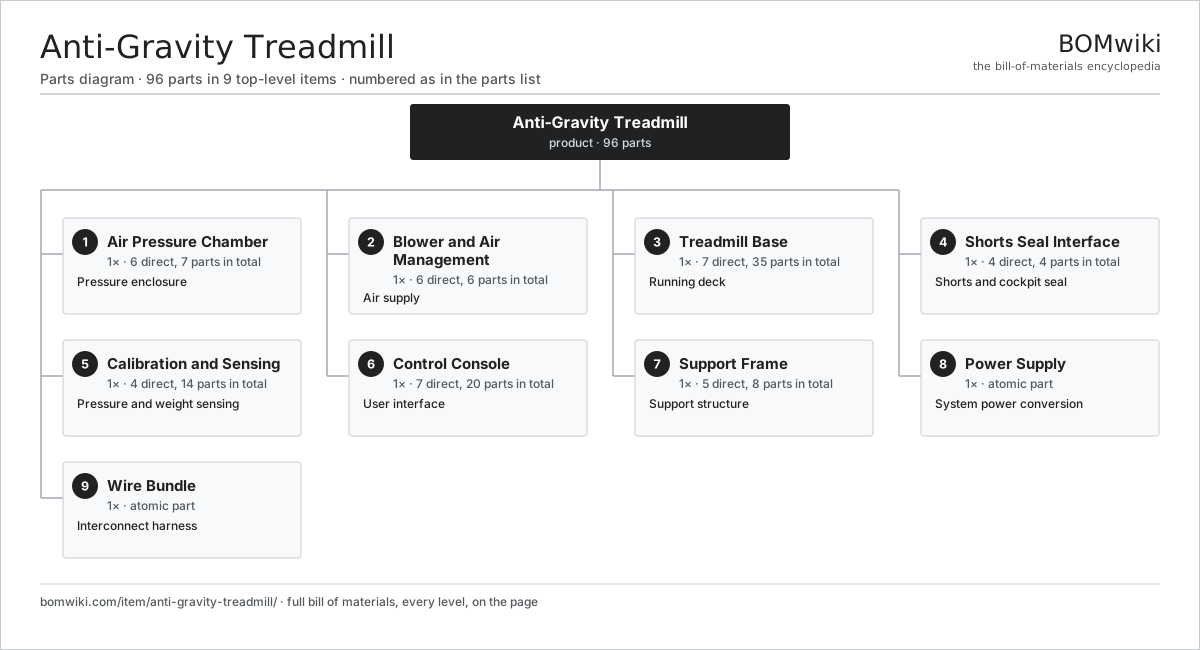
| # | Part | Qty | What it does |
|---|---|---|---|
| 1 | Air Pressure Chamber 6 parts | 1× | Pressure enclosure |
| 2 | Blower and Air Management 6 parts | 1× | Air supply |
| 3 | Treadmill Base 7 parts | 1× | Running deck |
| 4 | Shorts Seal Interface 4 parts | 1× | Shorts and cockpit seal |
| 5 | Calibration and Sensing 4 parts | 1× | Pressure and weight sensing |
| 6 | Control Console 7 parts | 1× | User interface |
| 7 | Support Frame 5 parts | 1× | Support structure |
| 8 | Power Supply | 1× | System power conversion |
| 9 | Wire Bundle | 1× | Interconnect harness |
3D model
No 3D model yet. Have a CAD file of this? Add a 3D model. STL renders right on this page; STEP, FreeCAD, and OpenSCAD sources are welcome too (openly licensed, like all 3D models on BOMwiki).
Build & assembly graph
expand / collapse · shared sub-assemblies converge · links to related products · est. labourTap an assembly to expand/collapse · tap a part to open it · use “Open page” for any node · drag to pan, scroll to zoom.
Bill of materials for Anti-Gravity Treadmill
9 top-level lines · 62 rows shown · 96 parts total · indented to 3 levels| # | Item / sub-assembly | Part no. | Qty/assy | Ext. qty | Parts | Type |
|---|---|---|---|---|---|---|
| 1 | Air Pressure Chamber 6 parts | anti-gravity-treadmill-chamber | 1× | 1 | 7 | assembly |
| 1.1 | Pressure Bag | anti-gravity-treadmill-bag | 1× | 1 | · | part |
| 1.2 | Cockpit Ring | anti-gravity-treadmill-cockpit-ring | 1× | 1 | · | part |
| 1.3 | Viewing Window | anti-gravity-treadmill-window | 2× | 2 | · | part |
| 1.4 | Airtight Zipper | anti-gravity-treadmill-zipper | 1× | 1 | · | part |
| 1.5 | Pressure Relief Valve | anti-gravity-treadmill-relief-valve | 1× | 1 | · | part |
| 1.6 | O-Ring Set | oring-set | 1× | 1 | · | part |
| 2 | Blower and Air Management 6 parts | anti-gravity-treadmill-blower-system | 1× | 1 | 6 | assembly |
| 2.1 | Blower Motor | blower-motor | 1× | 1 | · | part |
| 2.2 | Blower Housing | anti-gravity-treadmill-blower-housing | 1× | 1 | · | part |
| 2.3 | Pressure Control Valve | anti-gravity-treadmill-control-valve | 1× | 1 | · | part |
| 2.4 | Supply Duct | anti-gravity-treadmill-duct | 1× | 1 | · | part |
| 2.5 | Intake Air Filter | anti-gravity-treadmill-air-filter | 1× | 1 | · | part |
| 2.6 | Intake Muffler | anti-gravity-treadmill-muffler | 1× | 1 | · | part |
| 3 | Treadmill Base 7 parts | anti-gravity-treadmill-treadmill-base | 1× | 1 | 35 | assembly |
| 3.1 | Treadmill Drive Motor 5 parts | anti-gravity-treadmill-drive-motor | 1× | 1 | 26 | assembly |
| 3.1.1 | Stator Assembly 3 parts + deeper › | stator-assembly | 1× | 1 | 3 | assembly |
| 3.1.2 | Rotor Assembly 4 parts + deeper › | rotor-assembly | 1× | 1 | 19 | assembly |
| 3.1.3 | Motor Housing | motor-housing | 1× | 1 | · | part |
| 3.1.4 | Ball Bearing | ball-bearing | 2× | 2 | · | part |
| 3.1.5 | Encoder | encoder | 1× | 1 | · | part |
| 3.2 | Running Belt | anti-gravity-treadmill-running-belt | 1× | 1 | · | part |
| 3.3 | Deck Board | anti-gravity-treadmill-deck | 1× | 1 | · | part |
| 3.4 | Front Drive Roller | anti-gravity-treadmill-front-roller | 1× | 1 | · | part |
| 3.5 | Rear Idler Roller | anti-gravity-treadmill-rear-roller | 1× | 1 | · | part |
| 3.6 | Drive Belt | drive-belt | 1× | 1 | · | part |
| 3.7 | Ball Bearing | ball-bearing | 4× | 4 | · | part |
| 4 | Shorts Seal Interface 4 parts | anti-gravity-treadmill-seal-interface | 1× | 1 | 4 | assembly |
| 4.1 | Pressure Shorts | anti-gravity-treadmill-shorts | 1× | 1 | · | part |
| 4.2 | Sealing Skirt | anti-gravity-treadmill-skirt | 1× | 1 | · | part |
| 4.3 | Waist Gasket | anti-gravity-treadmill-waist-gasket | 1× | 1 | · | part |
| 4.4 | Cockpit Size Adapter | anti-gravity-treadmill-size-adapter | 1× | 1 | · | part |
| 5 | Calibration and Sensing 4 parts | anti-gravity-treadmill-calibration | 1× | 1 | 14 | assembly |
| 5.1 | Pressure Sensor | pressure-sensor | 2× | 2 | · | part |
| 5.2 | Deck Load Cell | anti-gravity-treadmill-load-cell | 4× | 4 | · | part |
| 5.3 | Sensor Interface Board 4 parts | anti-gravity-treadmill-sensor-board | 1× | 1 | 7 | assembly |
| 5.3.1 | Bare PCB | pcb-bare | 1× | 1 | · | part |
| 5.3.2 | Microcontroller | mcu | 1× | 1 | · | part |
| 5.3.3 | SMD Passive (R/C/L) | smd-passives | 1× | 1 | · | part |
| 5.3.4 | Connector | connector | 4× | 4 | · | part |
| 5.4 | Chamber Temperature Sensor | anti-gravity-treadmill-temp-sensor | 1× | 1 | · | part |
| 6 | Control Console 7 parts | anti-gravity-treadmill-controls | 1× | 1 | 20 | assembly |
| 6.1 | LCD Panel | lcd-panel | 1× | 1 | · | part |
| 6.2 | Touch Digitizer | touch-digitizer | 1× | 1 | · | part |
| 6.3 | Compute SoC Module | soc-module | 1× | 1 | · | part |
| 6.4 | Console Control Board 5 parts | anti-gravity-treadmill-console-pcb | 1× | 1 | 9 | assembly |
| 6.4.1 | Bare PCB | pcb-bare | 1× | 1 | · | part |
| 6.4.2 | Microcontroller | mcu | 1× | 1 | · | part |
| 6.4.3 | Power MOSFET | mosfet | 4× | 4 | · | part |
| 6.4.4 | Relay | relay | 2× | 2 | · | part |
| 6.4.5 | SMD Passive (R/C/L) | smd-passives | 1× | 1 | · | part |
| 6.5 | Emergency Stop | anti-gravity-treadmill-estop | 1× | 1 | · | part |
| 6.6 | Speaker | speaker | 1× | 1 | · | part |
| 6.7 | Connector | connector | 6× | 6 | · | part |
| 7 | Support Frame 5 parts | anti-gravity-treadmill-frame | 1× | 1 | 8 | assembly |
| 7.1 | Frame Side Rail | anti-gravity-treadmill-side-rail | 2× | 2 | · | part |
| 7.2 | Cockpit Lift Column | anti-gravity-treadmill-lift-column | 2× | 2 | · | part |
| 7.3 | Handrail | anti-gravity-treadmill-handrail | 2× | 2 | · | part |
| 7.4 | Body Shroud | anti-gravity-treadmill-shroud | 1× | 1 | · | part |
| 7.5 | Fastener Set | fastener-set | 1× | 1 | · | part |
| 8 | Power Supply | power-supply | 1× | 1 | · | part |
| 9 | Wire Bundle | wire-bundle | 1× | 1 | · | part |
Something wrong in this list? Report a problem with this BOM.
Related products
same domain, ranked by shared parts Baseball Pitching Machine
144 parts · shares 19 with this page
Baseball Pitching Machine
144 parts · shares 19 with this page
 Treadmill
122 parts · shares 19 with this page
Stair Climber
128 parts · shares 17 with this page
Treadmill
122 parts · shares 19 with this page
Stair Climber
128 parts · shares 17 with this page
 Vibration Plate
77 parts · shares 17 with this page
Vibration Plate
77 parts · shares 17 with this page
 Exercise Bike
93 parts · shares 16 with this page
Percussion Massage Gun
71 parts · shares 16 with this page
Exercise Bike
93 parts · shares 16 with this page
Percussion Massage Gun
71 parts · shares 16 with this page
Sourcing: possible vendors
Browse the supplier directory → Prices, MOQ, and lead times are algorithmic estimates, not quotes, and not claims about these companies. Company mappings are curated by keyword; est. price band $100–$10k. How estimates work| Vendor | HQ | Specialty | MOQ | Lead time |
|---|---|---|---|---|
| lifefitness.com ↗ | Rosemont, US | Fitness equipment | 200 units | 8–14 wks |
| technogym.com ↗ | Cesena, IT | Fitness equipment | 200 units | 8–14 wks |
|
🇺🇸Peloton
onepeloton.com ↗
|
New York, US | Connected fitness | 200 units | 8–14 wks |
| johnsonhealthtech.com ↗ | Taichung, TW | Fitness (Matrix) | 200 units | 8–14 wks |
|
🇺🇸Precor
precor.com ↗
|
Woodinville, US | Fitness equipment | 200 units | 8–14 wks |
760-word article