Aquarium Ozonizer
ProductOverview
An Aquarium Ozonizer is a chemical oxidation system that generates ozone gas (O₃) via electrical corona discharge and injects it into seawater to destroy dissolved organic compounds, pathogenic microorganisms, and discoloration. Ozone is a highly reactive allotrope of oxygen that oxidizes organic molecules at the molecular level, breaking C=C bonds and denaturing proteins. In marine aquariums, ozone serves three primary functions: (1) elimination of dissolved organics that cause yellowing water and reduce water clarity; (2) disinfection of bacteria, dinoflagellates, and parasites; and (3) enhancement of biological filtration efficiency by reducing bioload. Unlike chemical additives, ozone leaves no residue, excess molecules decompose back to O₂ within 20–40 minutes.
The core technology is the Corona Discharge Cell, which applies 8–15 kilovolts of alternating current across a narrow air gap, ionizing molecular oxygen into ozone. The Air Drying Cartridge removes moisture from input air, preventing electrode oxidation and preserving electrical efficiency. The ORP Sensor and Relay Module continuously monitors the tank's oxidation-reduction potential (ORP) and automatically switches the ozonizer off when the setpoint is reached, preventing overdose, a critical safety feature, since excessive ozone stresses fish and damages coral tissue.
Ozone-treated aquariums show measurable improvements in water clarity within 24–48 hours of initial dosing. However, ozonizers are best suited for high-bioload systems (heavily stocked fish tanks or large commercial installations); heavily planted or coral-dominant aquariums typically derive limited benefit and risk ozone stress.
How it Works
Compressed air from an aquarium blower or air pump enters the Air Drying Cartridge, where Desiccant Cartridge (silica gel and molecular sieve) absorbs water vapor. Dry air then flows to the Corona Discharge Cell, where the High-Voltage Transformer boosts line voltage to 8–15 kV. This high voltage ionizes oxygen molecules across the electrode gap, splitting some O₂ molecules into individual oxygen atoms (O), which rapidly recombine into ozone: 3O₂ → 2O₃.
The ozone-enriched air exits the discharge cell via Ozone Gas Tubing and bubbles through the Ozone Reaction Chamber, where the Ozone Diffuser breaks the gas stream into fine bubbles, maximizing contact with seawater. Ozone immediately begins oxidizing dissolved organics: yellowing compounds (tannins, lignins) decompose, dissolved proteins denature, and bacterial cell membranes rupture. The contact time is typically 2–5 minutes; the treated water then drains back to the main tank via the Chamber Outlet Valve.
Simultaneously, the ORP Probe measures the tank's oxidation-reduction potential, a direct indicator of the quantity of oxidizing agents present. As ozone is consumed, ORP falls. Once ORP climbs to the user-set threshold (typically 350–450 mV for reef aquariums), the Control Relay Module triggers an electromagnetic relay that cuts AC power to the High-Voltage Transformer, stopping ozone production. This closed-loop feedback prevents overdosing and eliminates the guesswork of manual on/off timing.
Ozone Chemistry in Seawater
Ozone's half-life in seawater is 20–40 minutes at 25 °C, much shorter than in fresh water due to salt's catalytic effect. Excess ozone not consumed in the reaction chamber escapes as waste gas; some installations include an activated carbon Chamber Outlet Valve scrubber at the exhaust to eliminate gaseous ozone before it vents to the atmosphere (ozone at >0.1 ppm is harmful to humans and sensitive aquatic life).
The oxidation process produces various byproducts. Bromide ions in seawater can react with ozone to form hypobromic acid and hypobromite ions, which are oxidizing agents in their own right; some aquarists regard this as beneficial additional disinfection, while others argue it introduces unnecessary complexity. Ozone also oxidizes iodine and other micronutrients; reef systems relying on naturally occurring iodine levels may require supplementation.
Safety and Control
The ORP Sensor and Relay Module is essential to safe operation. Without it, operators must manually monitor ORP and switch the ozone generator on and off, a tedious and error-prone process that risks chronic ozone stress. The relay-based controller automates this, making ozone use feasible in aquariums too large to monitor continuously.
The high-voltage High-Voltage Transformer poses electrocution risk; the Enclosure and Cooling provides electrical isolation. Most professional ozonizers include mechanical interlocks that cut power when the unit is opened. Users should never attempt repair without training; the transformer stores electrical energy even after mains power is disconnected.
Maintenance and Consumables
The Desiccant Cartridge is a consumable that degrades over 3–6 months in saltwater environments (moisture load is higher than in freshwater). Signs of saturation include reduced ozone output and increased humidity in the Case Body. Replacement cartridges cost $15–40 and take 5 minutes to swap.
The Ozone Diffuser develops biofilm buildup over time, reducing bubble dispersion efficiency. Monthly soaking in dilute bleach solution (1:10 household bleach to water) and thorough rinsing restores porosity. The ORP Probe requires occasional cleaning with distilled water and calibration against known ORP standards (typically ORP 225 mV buffer solution) every 3–6 months to maintain accuracy.
Applications and Limitations
Heavily stocked fish tanks with high bioload (e.g., goldfish, koi, or cichlid systems) benefit dramatically from ozone, as the oxidation rate of uneaten food and feces dramatically exceeds biological filtration. Similarly, public aquariums and commercial breeding facilities routinely use ozonizers to maintain water clarity under high stocking density.
Reef aquariums (emphasis on coral growth) rarely benefit from ozone. Corals are sensitive to oxidative stress; an ORP exceeding 400 mV can cause bleaching or polyp retraction. Additionally, reef systems typically maintain lower stocking densities and rely on biological filtration and regular water changes, making chemical oxidation unnecessary.
Aquarium Ozonizer parts and their functions
7 top-level parts · 19 parts in total · full bill of materials below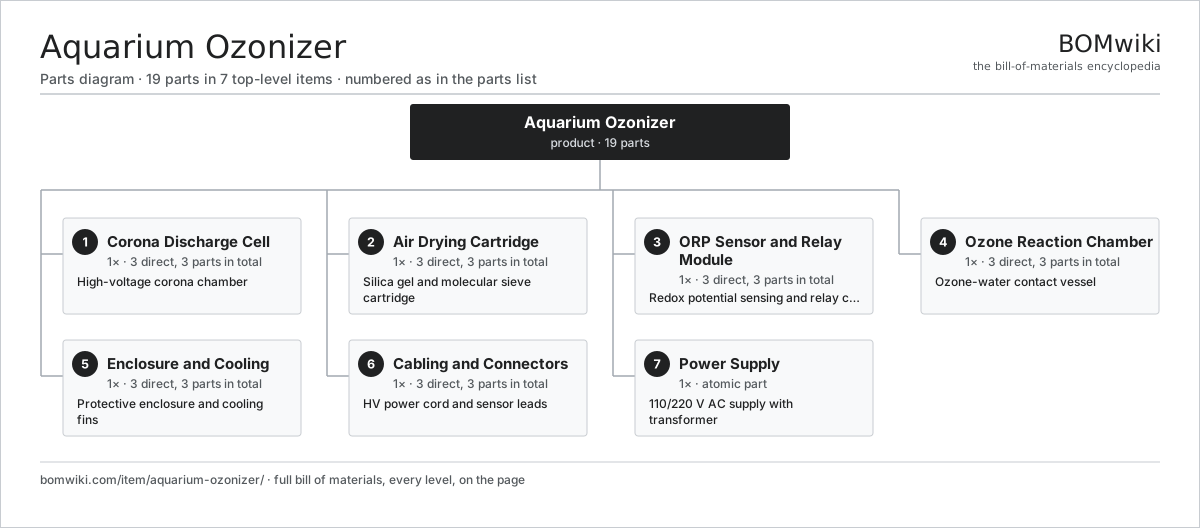
| # | Part | Qty | What it does |
|---|---|---|---|
| 1 | Corona Discharge Cell 3 parts | 1× | High-voltage corona chamber |
| 2 | Air Drying Cartridge 3 parts | 1× | Silica gel and molecular sieve cartridge |
| 3 | ORP Sensor and Relay Module 3 parts | 1× | Redox potential sensing and relay control |
| 4 | Ozone Reaction Chamber 3 parts | 1× | Ozone-water contact vessel |
| 5 | Enclosure and Cooling 3 parts | 1× | Protective enclosure and cooling fins |
| 6 | Cabling and Connectors 3 parts | 1× | HV power cord and sensor leads |
| 7 | Power Supply | 1× | 110/220 V AC supply with transformer |
3D model
No 3D model yet. Have a CAD file of this? Add a 3D model. STL renders right on this page; STEP, FreeCAD, and OpenSCAD sources are welcome too (openly licensed, like all 3D models on BOMwiki).
Build & assembly graph
expand / collapse · shared sub-assemblies converge · links to related products · est. labourTap an assembly to expand/collapse · tap a part to open it · use “Open page” for any node · drag to pan, scroll to zoom.
Bill of materials for Aquarium Ozonizer
7 top-level lines · 25 rows shown · 19 parts total · indented to 3 levels| # | Item / sub-assembly | Part no. | Qty/assy | Ext. qty | Parts | Type |
|---|---|---|---|---|---|---|
| 1 | Corona Discharge Cell 3 parts | aquarium-ozonizer-discharge-cell | 1× | 1 | 3 | assembly |
| 1.1 | Electrode Pair | aquarium-ozonizer-electrode-pair | 1× | 1 | · | part |
| 1.2 | High-Voltage Transformer | aquarium-ozonizer-hv-transformer | 1× | 1 | · | part |
| 1.3 | Arc Limiter Resistor | aquarium-ozonizer-arc-limiter | 1× | 1 | · | part |
| 2 | Air Drying Cartridge 3 parts | aquarium-ozonizer-air-dryer | 1× | 1 | 3 | assembly |
| 2.1 | Desiccant Cartridge | aquarium-ozonizer-desiccant-cartridge | 1× | 1 | · | part |
| 2.2 | Dryer Housing | aquarium-ozonizer-dryer-housing | 1× | 1 | · | part |
| 2.3 | Dryer Inlet Port | aquarium-ozonizer-dryer-inlet | 1× | 1 | · | part |
| 3 | ORP Sensor and Relay Module 3 parts | aquarium-ozonizer-orp-controller | 1× | 1 | 3 | assembly |
| 3.1 | ORP Probe | aquarium-ozonizer-orp-probe | 1× | 1 | · | part |
| 3.2 | Reference Electrode | aquarium-ozonizer-reference-electrode | 1× | 1 | · | part |
| 3.3 | Control Relay Module | aquarium-ozonizer-relay-board | 1× | 1 | · | part |
| 4 | Ozone Reaction Chamber 3 parts | aquarium-ozonizer-reaction-chamber | 1× | 1 | 3 | assembly |
| 4.1 | Chamber Body | aquarium-ozonizer-chamber-body | 1× | 1 | · | part |
| 4.2 | Ozone Diffuser | aquarium-ozonizer-diffuser-stone | 1× | 1 | · | part |
| 4.3 | Chamber Outlet Valve | aquarium-ozonizer-outlet-valve | 1× | 1 | · | part |
| 5 | Enclosure and Cooling 3 parts | aquarium-ozonizer-housing | 1× | 1 | 3 | assembly |
| 5.1 | Case Body | aquarium-ozonizer-case-body | 1× | 1 | · | part |
| 5.2 | Cooling Fins | aquarium-ozonizer-cooling-fins | 1× | 1 | · | part |
| 5.3 | Power Inlet Connector | aquarium-ozonizer-power-inlet | 1× | 1 | · | part |
| 6 | Cabling and Connectors 3 parts | aquarium-ozonizer-cable-assembly | 1× | 1 | 3 | assembly |
| 6.1 | Power Cord | aquarium-ozonizer-power-cable | 1× | 1 | · | part |
| 6.2 | Sensor Cable | aquarium-ozonizer-sensor-leads | 1× | 1 | · | part |
| 6.3 | Ozone Gas Tubing | aquarium-ozonizer-gas-tube | 1× | 1 | · | part |
| 7 | Power Supply | power-supply | 1× | 1 | · | part |
Something wrong in this list? Report a problem with this BOM.
Related products
same domain, ranked by shared parts Anchor Handling Tug
1,196 parts · shares 1 with this page
Aquarium Auto Feeder
18 parts · shares 1 with this page
Anchor Handling Tug
1,196 parts · shares 1 with this page
Aquarium Auto Feeder
18 parts · shares 1 with this page
 Aquarium Chiller
22 parts · shares 1 with this page
Aquarium Wave Maker
22 parts · shares 1 with this page
Auto Top-Off System
20 parts · shares 1 with this page
Aviary Misting System
83 parts · shares 1 with this page
Aquarium Chiller
22 parts · shares 1 with this page
Aquarium Wave Maker
22 parts · shares 1 with this page
Auto Top-Off System
20 parts · shares 1 with this page
Aviary Misting System
83 parts · shares 1 with this page
Sourcing: possible vendors
Browse the supplier directory → Prices, MOQ, and lead times are algorithmic estimates, not quotes, and not claims about these companies. Company mappings are curated by keyword; est. price band $2k–$500M. How estimates work| Vendor | HQ | Specialty | MOQ | Lead time |
|---|---|---|---|---|
| hd.com ↗ | Ulsan, KR | Shipbuilder | made to order | 52–104 wks |
| fincantieri.com ↗ | Trieste, IT | Shipbuilder | made to order | 52–104 wks |
| damen.com ↗ | Gorinchem, NL | Shipbuilder | made to order | 52–104 wks |
| brunswick.com ↗ | Mettawa, US | Marine & boats | made to order | 52–104 wks |
|
🇨🇳CSSC
cssc.net.cn ↗
|
Shanghai, CN | Shipbuilding conglomerate | made to order | 52–104 wks |
943-word article