Auto Shredder Residue Separator
ProductOverview
Automobile shredder residue (ASR), commonly known as "fluff," is the non-metallic and fine-metal leftover remaining after primary ferrous and aluminum removal in an automobile shredder. Fluff typically comprises 18–25% of the original vehicle weight: foam cushioning, rubber seals and hoses, plastic trim, glass, textiles, wood filler, soil, and fragments of steel or copper that escaped primary magnetic separation.
An ASR separator is an integrated multi-stage system designed to recover residual metals (ferrous and nonferrous) from fluff and sort the remaining organic material for downstream processing, land-fill, refuse-derived fuel, or incineration with energy recovery. Modern ASR systems achieve 85–95% metal recovery efficiency, making economically feasible the processing of fluff that older facilities simply landfilled.
The key stages are air classification (separating light organics from heavy metals), magnetic extraction (removing ferrous fragments), density sorting, and eddy-current recovery (extracting remaining aluminum and copper). Each stage increases product purity and reduces contamination in downstream buyers' material.
How it works
Fresh fluff from the shredder primary discharge is conveyed to the ASR plant on a main feed conveyor (6–8 feet wide). Material is metered into the air classification chamber via a rotary feeder at controlled rates (10–20 tons/hour).
Inside the tall conical classifier chamber, an upward air stream (3000–6000 cfm, adjustable) from a high-capacity blower is tuned to a critical settling velocity. Heavy materials (ferrous fragments, glass, copper bits, stones) have high settling rates and fall to the bottom outlet; light materials (foam, insulation, cloth, plastic, rubber shreds) are entrained by the air and exit the top outlet.
The heavy fraction discharges onto a magnetic conveyor belt. As material travels through a permanent or electromagnet head pulley, ferrous fragments (nails, stamped steel, wire) are magnetically attracted and pulled into a dedicated ferrous collection chute. The non-ferrous-heavy material (glass, stones, aluminum chunks, copper bits) continues to the secondary density sorting table.
The density table is an inclined vibrating mesh deck oscillating at 50–60 Hz. Material stratifies by weight: heavy glass and stones settle faster and roll downslope; lighter material and remaining rubber particles are more buoyant and move slower. Two separate outlets capture these fractions, allowing recovery of pure glass for recyclers and light rubber for pyrolysis or fuel processing.
The light fraction from the air classifier is routed to an eddy-current recovery stage. This stage operates identically to a standalone eddy-current separator, using a high-speed magnetic rotor to repel aluminum and copper fragments away from foam, rubber, and plastic residue. The separated nonferrous fragments are collected; the remaining light organics proceed to final disposition (landfill, fuel, or composting).
Throughout all stages, fine dust and light particles are continuously drawn via negative pressure into the dust collection system. A powerful fan (15–25 hp) creates 4000–8000 cfm flow through a primary cyclone (capturing coarse fines) and baghouse filter (removing particles <10 microns). Recovered fine dust may include valuable copper powder, fine aluminum, and plastic fines worth resale.
The entire process is orchestrated by a PLC control system. The operator adjusts classifier air flow via VFD to fine-tune the density cutoff between light and heavy fractions; slower conveyor speeds can be set to increase residence time on the density table, improving separation fidelity. All settings are displayed on an HMI touchscreen along with real-time diagnostics and alarm messages.
Material Recovery Economics
Typical ASR composition entering the plant:
- Ferrous metals: 25–35% by weight
- Nonferrous metals (Al, Cu): 5–10%
- Glass: 3–8%
- Rubber: 8–15%
- Plastic: 10–20%
- Foam and organics: 15–25%
- Soil, sand, fines: 5–15%
Recovered ferrous is sold as low-grade scrap or briquetted. Nonferrous (aluminum especially) achieves 90–98% purity and is sold directly to smelters. Glass and rubber fractions often require additional processing or have limited markets. Operating margin depends on metal prices, local disposal costs, and feed rates; modern plants operate profitably at throughputs of 10+ tons/hour.
Classifier Tuning and Efficiency
The air classifier is the critical separation stage. Blower speed controls the cut density, typically set so that 95%+ of ferrous fragments enter the heavy outlet, while 95%+ of foam exits the light outlet. Denser materials like rubber (1.0–1.2 g/cc) and plastic (1.0–1.4 g/cc) are intermediate; classifier angle, residence time, and air velocity all affect their routing.
For ultra-high purity ferrous output, a secondary magnetic drum or intensity magnet may be installed after the primary magnetic conveyor, recovering additional ferrous from mixed heavy-fraction material.
Environmental and Regulatory
ASR processing is capital-intensive and land-use-intensive. Regulatory trends in Europe (EU End-of-Life Vehicles Directive) and North America mandate that at least 85–95% of vehicle mass be recycled or recovered; ASR plants are essential for meeting these targets.
Noise control is critical: the classifier blower is the primary noise source (85–92 dB). Sound-absorbing shrouds or enclosed buildings are typically required. Dust suppression via the baghouse must meet Clean Air Act particulate limits (<10 mg/m³ outlet).
ASR residue (the 55–70% organic fraction exiting the system) is typically combusted in waste-to-energy plants, diverted to landfill, or sent to mechanical biological treatment (MBT) facilities. Some newer processes attempt pyrolysis of the organic fraction to produce fuels, but economics remain marginal at scale.
Integration with Shredder Operations
Most modern auto-recycling facilities integrate the ASR plant directly downstream of the primary shredder. Material flows continuously; operators monitor metal purity and throughput via the HMI. Feeding rate from the shredder is throttled to prevent overload and jamming.
Seasonal variation is important: summer fluff (dried foam and insulation) separates more efficiently; winter fluff (wet from rain or snow) clogs classifiers and eddy separators. Many facilities reduce throughput in wet seasons or install additional drying stages upstream.
Auto Shredder Residue Separator parts and their functions
8 top-level parts · 43 parts in total · full bill of materials below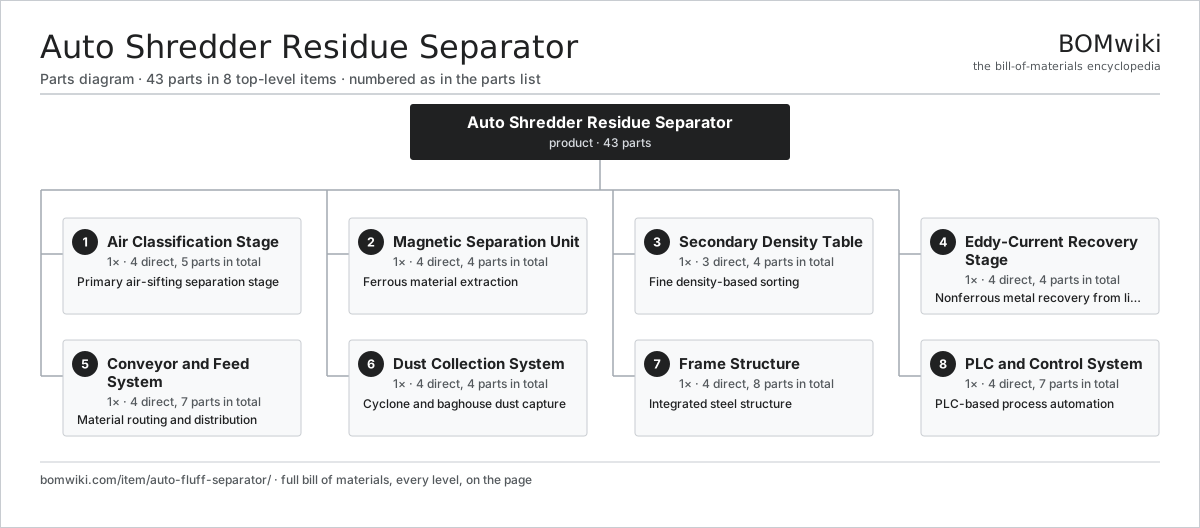
| # | Part | Qty | What it does |
|---|---|---|---|
| 1 | Air Classification Stage 4 parts | 1× | Primary air-sifting separation stage |
| 2 | Magnetic Separation Unit 4 parts | 1× | Ferrous material extraction |
| 3 | Secondary Density Table 3 parts | 1× | Fine density-based sorting |
| 4 | Eddy-Current Recovery Stage 4 parts | 1× | Nonferrous metal recovery from light fraction |
| 5 | Conveyor and Feed System 4 parts | 1× | Material routing and distribution |
| 6 | Dust Collection System 4 parts | 1× | Cyclone and baghouse dust capture |
| 7 | Frame Structure 4 parts | 1× | Integrated steel structure |
| 8 | PLC and Control System 4 parts | 1× | PLC-based process automation |
3D model
No 3D model yet. Have a CAD file of this? Add a 3D model. STL renders right on this page; STEP, FreeCAD, and OpenSCAD sources are welcome too (openly licensed, like all 3D models on BOMwiki).
Build & assembly graph
expand / collapse · shared sub-assemblies converge · links to related products · est. labourTap an assembly to expand/collapse · tap a part to open it · use “Open page” for any node · drag to pan, scroll to zoom.
Bill of materials for Auto Shredder Residue Separator
8 top-level lines · 39 rows shown · 43 parts total · indented to 3 levels| # | Item / sub-assembly | Part no. | Qty/assy | Ext. qty | Parts | Type |
|---|---|---|---|---|---|---|
| 1 | Air Classification Stage 4 parts | auto-fluff-separator-air-classifier | 1× | 1 | 5 | assembly |
| 1.1 | Classifier Chamber | auto-fluff-separator-classifier-chamber | 1× | 1 | · | part |
| 1.2 | Classifier Blower | auto-fluff-separator-classifier-blower | 1× | 1 | · | part |
| 1.3 | Classifier Inlet | auto-fluff-separator-classifier-inlet | 1× | 1 | · | part |
| 1.4 | Classifier Outlet | auto-fluff-separator-classifier-outlets | 2× | 2 | · | part |
| 2 | Magnetic Separation Unit 4 parts | auto-fluff-separator-magnet-section | 1× | 1 | 4 | assembly |
| 2.1 | Magnetic Conveyor Belt | auto-fluff-separator-magnet-conveyor | 1× | 1 | · | part |
| 2.2 | Magnet Head Pulley | auto-fluff-separator-magnet-head | 1× | 1 | · | part |
| 2.3 | Ferrous Collection Chute | auto-fluff-separator-magnet-chute | 1× | 1 | · | part |
| 2.4 | Magnet Conveyor Motor | auto-fluff-separator-magnet-drive | 1× | 1 | · | part |
| 3 | Secondary Density Table 3 parts | auto-fluff-separator-density-table | 1× | 1 | 4 | assembly |
| 3.1 | Density Table Deck | auto-fluff-separator-table-deck | 1× | 1 | · | part |
| 3.2 | Table Vibrator Motor | auto-fluff-separator-table-vibrator | 1× | 1 | · | part |
| 3.3 | Density Table Outlet | auto-fluff-separator-table-outlets | 2× | 2 | · | part |
| 4 | Eddy-Current Recovery Stage 4 parts | auto-fluff-separator-eddy-section | 1× | 1 | 4 | assembly |
| 4.1 | Eddy Rotor Assembly | auto-fluff-separator-eddy-rotor | 1× | 1 | · | part |
| 4.2 | Eddy Conveyor Belt | auto-fluff-separator-eddy-conveyor | 1× | 1 | · | part |
| 4.3 | Eddy Splitter Blade | auto-fluff-separator-eddy-splitter | 1× | 1 | · | part |
| 4.4 | Eddy Rotor Motor | auto-fluff-separator-eddy-motor | 1× | 1 | · | part |
| 5 | Conveyor and Feed System 4 parts | auto-fluff-separator-conveyor-system | 1× | 1 | 7 | assembly |
| 5.1 | Main Feed Conveyor | auto-fluff-separator-main-conveyor | 1× | 1 | · | part |
| 5.2 | Distribution Conveyor | auto-fluff-separator-distribution-conveyor | 1× | 1 | · | part |
| 5.3 | Conveyor Drive Motor | auto-fluff-separator-conveyor-motors | 2× | 2 | · | part |
| 5.4 | Routing Diverter Gate | auto-fluff-separator-routing-gates | 3× | 3 | · | part |
| 6 | Dust Collection System 4 parts | auto-fluff-separator-dust-system | 1× | 1 | 4 | assembly |
| 6.1 | Main Cyclone Separator | auto-fluff-separator-cyclone-main | 1× | 1 | · | part |
| 6.2 | Baghouse Filter Unit | auto-fluff-separator-baghouse | 1× | 1 | · | part |
| 6.3 | Dust System Blower | auto-fluff-separator-dust-blower | 1× | 1 | · | part |
| 6.4 | Fines Collection Hopper | auto-fluff-separator-dust-collection-hopper | 1× | 1 | · | part |
| 7 | Frame Structure 4 parts | auto-fluff-separator-frame | 1× | 1 | 8 | assembly |
| 7.1 | Main Frame Assembly | auto-fluff-separator-main-frame | 1× | 1 | · | part |
| 7.2 | Work Platform | auto-fluff-separator-platform-deck | 2× | 2 | · | part |
| 7.3 | Support Rail | auto-fluff-separator-support-rails | 4× | 4 | · | part |
| 7.4 | Fastener Set | fastener-set | 1× | 1 | · | part |
| 8 | PLC and Control System 4 parts | auto-fluff-separator-controls | 1× | 1 | 7 | assembly |
| 8.1 | PLC Unit | auto-fluff-separator-plc-unit | 1× | 1 | · | part |
| 8.2 | Variable-Frequency Drive | auto-fluff-separator-vfd-drives | 4× | 4 | · | part |
| 8.3 | Operator Control Panel | auto-fluff-separator-operator-panel | 1× | 1 | · | part |
| 8.4 | Safety Interlock System | auto-fluff-separator-safety-interlocks | 1× | 1 | · | part |
Something wrong in this list? Report a problem with this BOM.
Sourcing: possible vendors
Browse the supplier directory → Prices, MOQ, and lead times are algorithmic estimates, not quotes, and not claims about these companies. Company mappings are curated by keyword; est. price band $5k–$2M. How estimates work| Vendor | HQ | Specialty | MOQ | Lead time |
|---|---|---|---|---|
| atlascopco.com ↗ | Stockholm, SE | Compressors & industrial | 10 units | 12–20 wks |
|
🇦🇹Andritz
andritz.com ↗
|
Graz, AT | Process plants & machinery | 10 units | 12–20 wks |
| buhlergroup.com ↗ | Uzwil, CH | Food & materials processing | 10 units | 12–20 wks |
| gea.com ↗ | Düsseldorf, DE | Process technology | 10 units | 12–20 wks |
| mhi.com ↗ | Tokyo, JP | Heavy machinery | 10 units | 12–20 wks |
1,090-word article