Auto Rickshaw
ProductOverview
The auto rickshaw is a three-wheeled passenger vehicle common in South and Southeast Asia, designed for urban and semi-urban transport. The design combines a simple tubular steel chassis with either a single-cylinder petrol engine or an electric hub motor, handlebar steering, and an open canopy providing weather protection without full enclosure. Two passenger wheels are mounted on a rigid rear axle, with a single steered wheel in front, creating inherent stability and the ability to navigate narrow lanes. The vehicle seats a driver and four to five passengers on bench seating, making it economical for last-mile transport. Modern electric versions offer reduced operating costs and zero local emissions.
The tricycle configuration provides inherent advantages: the geometry allows extreme simplicity in steering (no complex rack-and-pinion), the rear axle is sturdy and easy to fabricate, and the overall footprint is compact. Suspension uses leaf springs for both front and rear, allowing the chassis to articulate over rough roads without a complex independent system. Braking relies on mechanical drum brakes actuated by hand or foot controls, keeping the complexity and cost low.
How it works
Steering and Propulsion
The operator holds a curved handlebar mounted to the chassis. The handlebar connects via tie-rods to the front wheel knuckles, allowing direct steering input with no intermediate gearbox or power-assist. In petrol models, a single-cylinder air-cooled engine (typically 150 cc) sits low in the frame and drives a continuously variable transmission (CVT) that smooths throttle response. The CVT output goes to a final reduction gear pair and then a driveshaft that connects to the rear axle. Electric models replace the engine with a hub motor (3 kW) mounted directly on the rear axle, eliminating the CVT and driveshaft.
Throttle control in petrol models is via a twist-grip on the handlebar; electric models use a digital controller sensing motor current. The operator engages a foot or hand brake lever, which tightens cables attached to the brake drums on all three wheels, creating friction-based deceleration.
Suspension and Stability
Front suspension uses a leaf spring pack, a common design in vehicles built to minimize cost. Rear suspension similarly employs stacked flat steel leaves, allowing the chassis to flex and absorb impact from uneven pavement. Friction dampers (or in newer designs, hydraulic shocks) control oscillation. The wide rear track (1400 mm) and close front wheel (1200 mm) give the vehicle a stable, yaw-resistant stance on corners, though high-speed corners will still cause lean.
Braking and Safety
All three wheels have mechanical drum brakes. The front brake is typically controlled by the right hand grip or a foot pedal, while the rear brake (both wheels) is controlled separately. Drum brakes are self-energizing when spinning forward, meaning that once engaged, friction force increases with rotational speed, useful for emergency stops but requiring careful modulation to avoid wheel lockup on poor surfaces. The open canopy provides overhead weather protection but leaves passengers exposed to side impacts; rollover bars are sometimes added for extra safety in markets with stricter regulations.
Chassis and Body
The frame is a welded tubular steel structure, typically using 25 mm diameter tubing with 2 mm wall thickness. This approach minimizes material use while maintaining torsional stiffness. The canopy is a bolt-on structure with its own tubular frame, covered with UV-treated canvas that can be rolled up in warm weather or fully deployed for rain protection. Seating is bench-style, allowing flexible passenger count.
Electrical System
Petrol models use a magneto alternator that generates AC current for the ignition system; a small 12 V lead-acid battery provides starter power (in kick-start-only models, the battery is omitted). Electric models carry a 48 V battery pack (often arranged as four series-connected 12 V cells), with a controller managing motor current and regenerative braking. Lighting is basic LED units for headlight and side indicators, powered directly from the alternator or battery.
Market and Evolution
Auto rickshaws have remained largely unchanged in design since their 1950s origins, because the fundamental geometry is hard to improve without significant cost. Most bodies are still hand-fabricated, leading to wide variation in construction and finish. Recent trends include electrification (India now offers subsidies for electric autos), sealed cabin designs for comfort and safety, and automatic transmission integration in petrol models. Some manufacturers are experimenting with tubular or monocoque bodies to reduce weight and improve rigidity.
The vehicle remains the dominant mode of motorized transport for short distances in cities across India, Bangladesh, Thailand, and the Philippines, filling a niche between bicycles and cars. Regulatory changes requiring safety features (rollover protection, seat belts, emission controls) are gradually pushing design evolution, but the tricycle layout and simplicity will likely persist for cost-sensitive markets.
Auto Rickshaw parts and their functions
8 top-level parts · 175 parts in total · full bill of materials below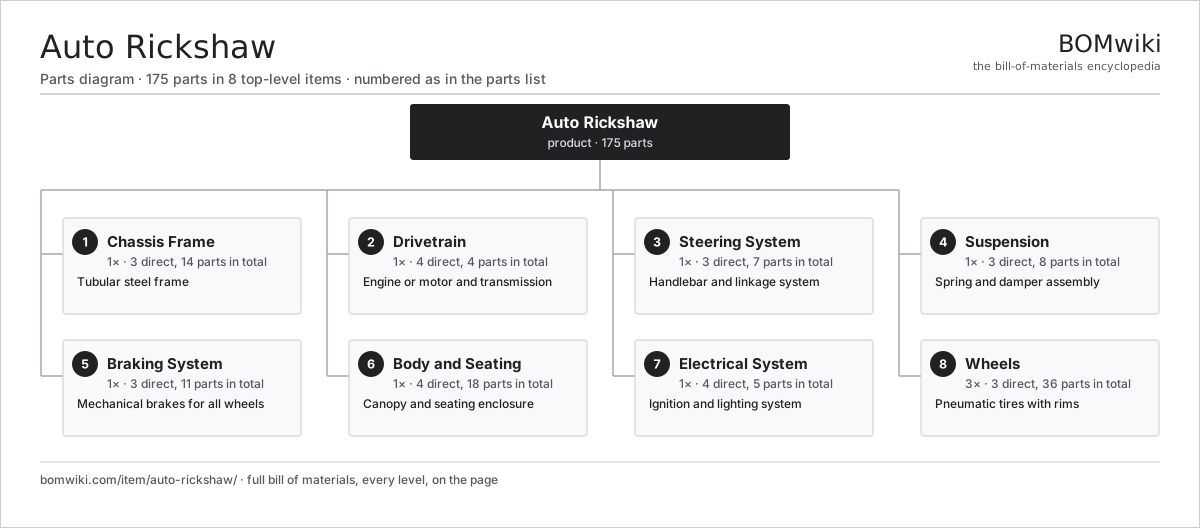
| # | Part | Qty | What it does |
|---|---|---|---|
| 1 | Chassis Frame 3 parts | 1× | Tubular steel frame |
| 2 | Drivetrain 4 parts | 1× | Engine or motor and transmission |
| 3 | Steering System 3 parts | 1× | Handlebar and linkage system |
| 4 | Suspension 3 parts | 1× | Spring and damper assembly |
| 5 | Braking System 3 parts | 1× | Mechanical brakes for all wheels |
| 6 | Body and Seating 4 parts | 1× | Canopy and seating enclosure |
| 7 | Electrical System 4 parts | 1× | Ignition and lighting system |
| 8 | Wheels 3 parts | 3× | Pneumatic tires with rims |
3D model
No 3D model yet. Have a CAD file of this? Add a 3D model. STL renders right on this page; STEP, FreeCAD, and OpenSCAD sources are welcome too (openly licensed, like all 3D models on BOMwiki).
Build & assembly graph
expand / collapse · shared sub-assemblies converge · links to related products · est. labourTap an assembly to expand/collapse · tap a part to open it · use “Open page” for any node · drag to pan, scroll to zoom.
Bill of materials for Auto Rickshaw
8 top-level lines · 45 rows shown · 175 parts total · indented to 3 levels| # | Item / sub-assembly | Part no. | Qty/assy | Ext. qty | Parts | Type |
|---|---|---|---|---|---|---|
| 1 | Chassis Frame 3 parts | auto-rickshaw-chassis | 1× | 1 | 14 | assembly |
| 1.1 | Main Tube | auto-rickshaw-main-tube | 4× | 4 | · | part |
| 1.2 | Fastener Set | fastener-set | 8× | 8 | · | part |
| 1.3 | Sheet Metal Panel | sheet-panel | 2× | 2 | · | part |
| 2 | Drivetrain 4 parts | auto-rickshaw-drivetrain | 1× | 1 | 4 | assembly |
| 2.1 | Engine Unit | auto-rickshaw-engine | 1× | 1 | · | part |
| 2.2 | CVT Transmission | auto-rickshaw-cvt | 1× | 1 | · | part |
| 2.3 | Driveshaft | auto-rickshaw-driveshaft | 1× | 1 | · | part |
| 2.4 | Helical Gear Pair | gear-pair | 1× | 1 | · | part |
| 3 | Steering System 3 parts | auto-rickshaw-steering | 1× | 1 | 7 | assembly |
| 3.1 | Handlebar | auto-rickshaw-handlebar | 1× | 1 | · | part |
| 3.2 | Tie Rod | auto-rickshaw-tie-rod | 2× | 2 | · | part |
| 3.3 | Fastener Set | fastener-set | 4× | 4 | · | part |
| 4 | Suspension 3 parts | auto-rickshaw-suspension | 1× | 1 | 8 | assembly |
| 4.1 | Leaf Spring Pack | auto-rickshaw-leaf-spring | 2× | 2 | · | part |
| 4.2 | Spring Shackle | auto-rickshaw-shackle | 4× | 4 | · | part |
| 4.3 | Coil Spring | coil-spring | 2× | 2 | · | part |
| 5 | Braking System 3 parts | auto-rickshaw-braking | 1× | 1 | 11 | assembly |
| 5.1 | Brake Drum | auto-rickshaw-brake-drum | 3× | 3 | · | part |
| 5.2 | Brake Shoe | auto-rickshaw-brake-shoe | 6× | 6 | · | part |
| 5.3 | Brake Cable | auto-rickshaw-brake-cable | 2× | 2 | · | part |
| 6 | Body and Seating 4 parts | auto-rickshaw-body | 1× | 1 | 18 | assembly |
| 6.1 | Canopy Frame | auto-rickshaw-canopy-frame | 1× | 1 | · | part |
| 6.2 | Canopy Canvas | auto-rickshaw-canopy-canvas | 1× | 1 | · | part |
| 6.3 | Seat Assembly 5 parts | seat-assembly | 2× | 2 | 7 | assembly |
| 6.3.1 | Seat Frame | seat-frame | 1× | 2 | · | part |
| 6.3.2 | Seat Foam | seat-foam | 2× | 4 | · | part |
| 6.3.3 | Seat Cover | seat-cover | 1× | 2 | · | part |
| 6.3.4 | Seat Motor | seat-motor | 2× | 4 | · | part |
| 6.3.5 | Seat Heater Mat | seat-heater | 1× | 2 | · | part |
| 6.4 | Safety Railing | auto-rickshaw-railing | 2× | 2 | · | part |
| 7 | Electrical System 4 parts | auto-rickshaw-electrical | 1× | 1 | 5 | assembly |
| 7.1 | Alternator | auto-rickshaw-alternator | 1× | 1 | · | part |
| 7.2 | Battery | auto-rickshaw-battery | 1× | 1 | · | part |
| 7.3 | Wiring Harness | auto-rickshaw-wiring-harness | 1× | 1 | · | part |
| 7.4 | LED Headlight | led-headlight | 2× | 2 | · | part |
| 8 | Wheels 3 parts | auto-rickshaw-wheels | 3× | 3 | 36 | assembly |
| 8.1 | Wheel Assembly 5 parts | wheel-assembly | 3× | 9 | 9 | assembly |
| 8.1.1 | Alloy Wheel | alloy-wheel | 1× | 9 | · | part |
| 8.1.2 | Tire | tire | 1× | 9 | · | part |
| 8.1.3 | TPMS Sensor | tpms-sensor | 1× | 9 | · | part |
| 8.1.4 | Lug Nut | lug-nut | 5× | 45 | · | part |
| 8.1.5 | Valve Stem | valve-stem | 1× | 9 | · | part |
| 8.2 | Wheel Hub | auto-rickshaw-hub | 3× | 9 | · | part |
| 8.3 | Ball Bearing | ball-bearing | 6× | 18 | · | part |
Something wrong in this list? Report a problem with this BOM.
Related products
same domain, ranked by shared parts Food Truck
197 parts · shares 15 with this page
Food Truck
197 parts · shares 15 with this page
 Hearse
184 parts · shares 15 with this page
Hearse
184 parts · shares 15 with this page
 Electric Golf Cart
144 parts · shares 14 with this page
Electric Golf Cart
144 parts · shares 14 with this page
 Funeral Coach
539 parts · shares 14 with this page
Funeral Coach
539 parts · shares 14 with this page
 Gasoline Car
1,190 parts · shares 14 with this page
Gasoline Car
1,190 parts · shares 14 with this page
 Hatchback Car
18,053 parts · shares 14 with this page
Hatchback Car
18,053 parts · shares 14 with this page
Sourcing: possible vendors
Browse the supplier directory → Prices, MOQ, and lead times are algorithmic estimates, not quotes, and not claims about these companies. Company mappings are curated by keyword; est. price band $8k–$90k. How estimates work| Vendor | HQ | Specialty | MOQ | Lead time |
|---|---|---|---|---|
|
🇯🇵Toyota
global.toyota ↗
|
Toyota City, JP | Automaker | made to order | 16–28 wks |
| volkswagen-group.com ↗ | Wolfsburg, DE | Automaker | made to order | 16–28 wks |
| gm.com ↗ | Detroit, US | Automaker | made to order | 16–28 wks |
| hyundai.com ↗ | Seoul, KR | Automaker | made to order | 16–28 wks |
|
🇨🇳BYD
byd.com ↗
|
Shenzhen, CN | EV & battery manufacturer | made to order | 16–28 wks |
798-word article