Autoharp
ProductOverview
The autoharp is a zither-family instrument enabling simple chording with one hand while the other hand strikes strings. Its defining feature is the chord bar system: pressing a labeled button (typically marked with chord names like "C," "G," or "D") engages a mechanical damper bar that silences all strings except those needed for that chord. This allows a player with no music reading skills to play complete, harmonically correct chords. When a chord button is active, strumming or plucking the full string bank produces only the desired chord tones.
The autoharp was patented in 1881 by Karl Kroeber in Karlsruhe, Germany. Its design combined elements of the traditional zither with a mechanical damping system. Electric versions appeared in the 1950s–1970s, adding a rotating plectrum wheel and motor drive for continuous rhythmic strumming. The autoharp became popular in folk, country, and popular music as an accessible harmony instrument.
Modern autoharps fall into two categories: traditional (hand-strummed), where the player manually strikes the strings, and electric (motorized), where a foot pedal controls the speed of an automated plectrum wheel.
How it works
The autoharp consists of a large, flat wooden body similar to a zither, with 36–49 steel strings strung parallel across its surface. Each string is tuned to a specific pitch within a repeating chromatic scale. The tuning system uses bronze tuning pins (similar to a piano) at one end to control pitch.
Damping mechanism: The chord bar system is the mechanical heart. Beneath the strings runs a series of felt-lined damper bars, one associated with each chord button. When a button is pressed (e.g., "C major"), springs and linkage rods push the corresponding damper bar upward, pressing felt pads against specific strings. These strings are muted (damped); the remaining strings are free to vibrate.
A typical C major damper might silence 25–30 of the 36 strings, leaving 6–11 strings that form the C major chord (C, E, G notes in multiple octaves). When the player strums or plucks across all strings, only the undamped strings sound, producing a pure C major harmony.
Traditional hand-strummed: The player holds the autoharp vertically on the lap and strums with fingernails, a guitar pick, or a special brush across the strings, while the left hand presses chord buttons.
Electric motorized: A AC synchronous motor rotates a plectrum wheel at adjustable speed (0–150 RPM). The wheel is mounted above the strings with felt or leather plectra attached; as it rotates, the plectra repeatedly strike the string bank. A foot pedal controls motor speed, allowing the player to vary rhythm and intensity. This hands-free continuous strumming made electric autoharps popular in Appalachian and folk contexts, where the player could focus entirely on chord changes.
The bridge and string guide distribute tension and control string spacing. The spruce soundboard amplifies vibration; the internal bracing provides structural rigidity and tuning.
Chord configurations
Different autoharp models offer varying chord sets. A 36-string diatonic model might include: C major, C minor, G major, G minor, D major, D minor, A major, A minor, E major, E minor, B minor, and F major, enough for most folk and country repertoire. A 49-string chromatic model includes additional enharmonic chords (C# major, D# minor, etc.) for contemporary and jazz music.
Each chord button is positioned and weighted precisely so that its damper bar contacts the correct string subset. Misalignment even by 2–3 mm causes adjacent strings to be damped incorrectly. Builders must mechanically validate each damper after assembly.
Performance and repertoire
Autoharps are primary instruments in Appalachian folk music, where electric models with motorized plectrum wheels dominated from the 1960s–1980s. The steady strumming and accessible chord control made them ideal for traditional fiddle, banjo, and vocal ensembles.
Folk and country recording: Autoharps are featured on countless 1960s–1970s folk and country albums (particularly in bluegrass). Artists like Pete Seeger and Joan Baez used autoharps in live performance.
Contemporary uses: Electric autoharps have largely been replaced by acoustic guitar and modern rhythm instruments, but they remain in folk traditions and are experiencing modest revival in world music and experimental contexts.
Tuning challenges: All 36–49 strings must stay in tune together. Environmental changes (temperature, humidity) cause differential expansion and tuning drift. Traditional players often perform a full re-tuning before recording sessions or major performances.
Autoharps are relatively affordable ($300–$2,000 depending on new vs. vintage and hand-built quality), making them accessible entry instruments for harmony accompaniment. However, diminished cultural presence has reduced manufacturing; most modern autoharps are vintage instruments from the 1960s–1980s being restored and re-marketed.
Autoharp parts and their functions
7 top-level parts · 238 parts in total · full bill of materials below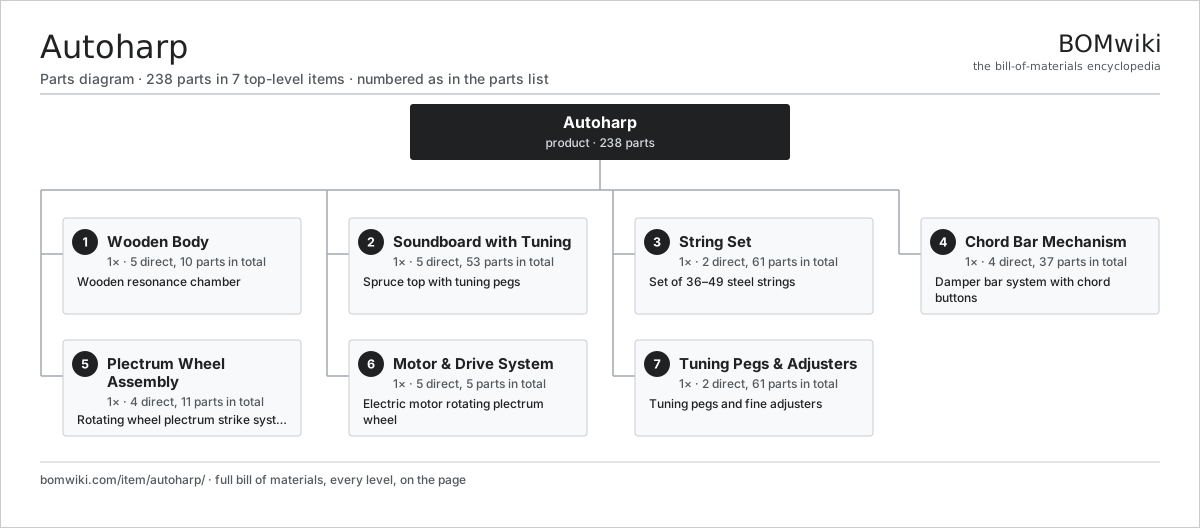
| # | Part | Qty | What it does |
|---|---|---|---|
| 1 | Wooden Body 5 parts | 1× | Wooden resonance chamber |
| 2 | Soundboard with Tuning 5 parts | 1× | Spruce top with tuning pegs |
| 3 | String Set 2 parts | 1× | Set of 36–49 steel strings |
| 4 | Chord Bar Mechanism 4 parts | 1× | Damper bar system with chord buttons |
| 5 | Plectrum Wheel Assembly 4 parts | 1× | Rotating wheel plectrum strike system |
| 6 | Motor & Drive System 5 parts | 1× | Electric motor rotating plectrum wheel |
| 7 | Tuning Pegs & Adjusters 2 parts | 1× | Tuning pegs and fine adjusters |
3D model
No 3D model yet. Have a CAD file of this? Add a 3D model. STL renders right on this page; STEP, FreeCAD, and OpenSCAD sources are welcome too (openly licensed, like all 3D models on BOMwiki).
Build & assembly graph
expand / collapse · shared sub-assemblies converge · links to related products · est. labourTap an assembly to expand/collapse · tap a part to open it · use “Open page” for any node · drag to pan, scroll to zoom.
Bill of materials for Autoharp
7 top-level lines · 34 rows shown · 238 parts total · indented to 3 levels| # | Item / sub-assembly | Part no. | Qty/assy | Ext. qty | Parts | Type |
|---|---|---|---|---|---|---|
| 1 | Wooden Body 5 parts | autoharp-body | 1× | 1 | 10 | assembly |
| 1.1 | Soundboard Top | autoharp-body-top | 1× | 1 | · | part |
| 1.2 | Back Panel | autoharp-body-bottom | 1× | 1 | · | part |
| 1.3 | Side Rail | autoharp-body-sides | 4× | 4 | · | part |
| 1.4 | Internal Brace | autoharp-body-bracing | 3× | 3 | · | part |
| 1.5 | Fastener Set | fastener-set | 1× | 1 | · | part |
| 2 | Soundboard with Tuning 5 parts | autoharp-soundboard | 1× | 1 | 53 | assembly |
| 2.1 | Soundboard Panel | autoharp-soundboard-panel | 1× | 1 | · | part |
| 2.2 | Tuning Block | autoharp-tuning-pin-block | 1× | 1 | · | part |
| 2.3 | Tuning Pin | autoharp-tuning-pin-set | 49× | 49 | · | part |
| 2.4 | Bridge | autoharp-bridge | 1× | 1 | · | part |
| 2.5 | String Guide Nut | autoharp-string-guide | 1× | 1 | · | part |
| 3 | String Set 2 parts | autoharp-strings | 1× | 1 | 61 | assembly |
| 3.1 | String Course | autoharp-string-course | 12× | 12 | · | part |
| 3.2 | String Peg | autoharp-string-peg | 49× | 49 | · | part |
| 4 | Chord Bar Mechanism 4 parts | autoharp-chord-bar-mechanism | 1× | 1 | 37 | assembly |
| 4.1 | Chord Button | autoharp-chord-button | 12× | 12 | · | part |
| 4.2 | Damper Bar | autoharp-damper-bar | 1× | 1 | · | part |
| 4.3 | Damper Spring | autoharp-damper-spring | 12× | 12 | · | part |
| 4.4 | Linkage Rod | autoharp-linkage-rod | 12× | 12 | · | part |
| 5 | Plectrum Wheel Assembly 4 parts | autoharp-plectrum-mechanism | 1× | 1 | 11 | assembly |
| 5.1 | Wheel Hub | autoharp-wheel-hub | 1× | 1 | · | part |
| 5.2 | Plectrum | autoharp-plectrum-set | 8× | 8 | · | part |
| 5.3 | Wheel Frame | autoharp-wheel-frame | 1× | 1 | · | part |
| 5.4 | Plectrum Guide | autoharp-plectrum-guide | 1× | 1 | · | part |
| 6 | Motor & Drive System 5 parts | autoharp-motor-drive | 1× | 1 | 5 | assembly |
| 6.1 | AC Motor | autoharp-motor-ac | 1× | 1 | · | part |
| 6.2 | Motor Pulley | autoharp-pulley-motor | 1× | 1 | · | part |
| 6.3 | Wheel Pulley | autoharp-pulley-wheel | 1× | 1 | · | part |
| 6.4 | Drive Belt | autoharp-belt | 1× | 1 | · | part |
| 6.5 | Speed Control | autoharp-speed-control | 1× | 1 | · | part |
| 7 | Tuning Pegs & Adjusters 2 parts | autoharp-tuning-system | 1× | 1 | 61 | assembly |
| 7.1 | Tuning Pin | autoharp-tuning-pin-set | 49× | 49 | · | part |
| 7.2 | Fine Tuner Screw | autoharp-fine-tuner-screw | 12× | 12 | · | part |
Something wrong in this list? Report a problem with this BOM.
Sourcing: possible vendors
Browse the supplier directory → Prices, MOQ, and lead times are algorithmic estimates, not quotes, and not claims about these companies. Company mappings are curated by keyword; est. price band $50–$5k. How estimates work| Vendor | HQ | Specialty | MOQ | Lead time |
|---|---|---|---|---|
| yamaha.com ↗ | Hamamatsu, JP | Audio & instruments | 200 units | 8–14 wks |
|
🇺🇸Fender
fender.com ↗
|
Los Angeles, US | Guitars & amps | 200 units | 8–14 wks |
|
🇺🇸Gibson
gibson.com ↗
|
Nashville, US | Guitars | 200 units | 8–14 wks |
|
🇯🇵Roland
roland.com ↗
|
Hamamatsu, JP | Electronic instruments | 200 units | 8–14 wks |
| steinway.com ↗ | New York, US | Pianos | 200 units | 8–14 wks |
832-word article