Automated Book Return
ProductOverview
An automated book return system is a self-service device enabling patrons to return library materials outside standard hours. Unlike manual returns desks, these systems operate 24/7, reading RFID tags automatically to confirm check-in status and updating the library's Integrated Library System (ILS) without staff intervention. Libraries deploy them in lobbies, parking lots, or external walls, dramatically reducing after-hours traffic and enabling extended access.
The system combines a patron-friendly intake slot, internal RFID reading station, motorized bin management, and network connectivity to provide a fully autonomous returns workflow.
How It Works
A patron deposits books through the Book Return Slot at any time. The Internal Transport Conveyor transports items into the RFID Check-In Reader, where the RFID reader captures each item's EPC (Electronic Product Code) and automatically initiates check-in via the PLC Controller & Logic.
The PLC Controller & Logic PLC queries the ILS, updating the item status to "checked in" and recording the transaction timestamp. If the return is accepted (no fines, valid patron account), the item is allowed to settle into the collection bin below. If rejected (e.g., damaged barcode, invalid account), the controller logs an exception for staff review.
Once the internal bin reaches capacity (typically 50–150 items), the Motorized Bin Lift Assembly raises the full bin, signaling staff that collection is needed. A heavy-duty bin swap is performed, and the empty bin is lowered back into position.
The Power & Backup includes a supercapacitor UPS providing 60 seconds of backup, allowing active transactions to complete and be logged even during brief power outages. The Non-Volatile Memory stores transaction logs, syncing with the ILS when network restores.
Intake & Anti-Jam Design
The return slot opening is intentionally narrow (200 mm × 300 mm) to accept books but prevent insertion of oversized objects or backpacks. The Anti-Jam Roller anti-jam rollers prevent diagonal insertion that could jam the conveyor. If a book becomes stuck, the Conveyor Drive Motor reverses automatically, ejecting the item.
Most systems have a "drop height" of 30–50 cm to slow books and reduce impact damage to the system. Books fall onto the Internal Transport Conveyor, which moves them at 0.2–0.3 m/s into the read zone.
RFID Check-In at Scale
The Fixed RFID Read Pad is a fixed 20 cm × 20 cm pad tuned to 865–928 MHz. As each book passes over it, the RFID Reader Module captures the EPC and validates it against the ILS.
Read accuracy is typically 98–99%. If a tag is unreadable (damaged, missing, or deactivated), the system logs the exception and either:
- Routes the item to a quarantine bin for manual inspection
- Accepts it anyway and flags it as unconfirmed for staff review
Deactivated tags (items previously checked out elsewhere) are recognized and re-activated during return, restoring security gate function for future use.
Bin Management & Collection Workflow
Items slide down into a collection bin mounted on the Motorized Bin Lift Assembly. Each bin has a capacity of 50–150 items depending on book size distribution (paperbacks hold more than hardcovers or oversized books).
The PLC Controller & Logic monitors bin weight via a Pressure Sensor-based load cell (or item count from conveyor encoder). When capacity is reached, the Position Sensor upper position sensor confirms the lift is at maximum height, and the system logs a "bin full" event.
Staff receive notification (email, SMS, or dashboard alert), retrieve the full bin, and swap it with an empty one. The entire swap takes 2–3 minutes; during this downtime, the slot is functional but items queue internally (most systems hold 20–50 additional items in temporary staging).
Weatherproofing for Outdoor Deployment
Systems intended for outdoor 24/7 operation, such as in parking lots or public plazas, must meet IP65 standards (dust-tight, water-resistant). The Weatherproof Enclosure enclosure uses powder-coated steel or weather-resistant composite with sealed connectors.
The Enclosure Gasket gaskets and drain holes prevent water ingress. For freezing climates, the Insulation & Heating heating element (24 VDC, 100W) maintains internal temperature above 0°C, preventing conveyor belt stiffening and motor failure.
Paper-based returns can absorb moisture in high-humidity regions; some outdoor systems include a shallow drying tray and fan circulation.
Network & Offline Operation
The PLC Controller & Logic connects via Ethernet to the library ILS, syncing transactions in real time. Network latency is typically 100–500 ms, allowing fast check-in confirmation.
If the network fails, the system switches to offline mode:
- Transactions are logged to Non-Volatile Memory
- Items are accepted without ILS confirmation
- UPS backup preserves session data for up to 60 seconds
- Once network restores, pending transactions are replayed and synced
This graceful degradation ensures patrons can always return items, even during network outages.
Maintenance & Failure Recovery
Conveyor belts require monthly inspection for wear and tension. The Conveyor Drive Motor brushless design eliminates carbon dust accumulation. Thermal cameras installed on some systems monitor for overheating (excessive item backlog causing motor strain).
Bin lift mechanisms are sealed and low-maintenance; the ball screw requires annual lubrication. Most systems have manual override crank handles allowing staff to raise/lower the bin lift without power in emergencies.
Integration with Library Workflows
Returned items bypass the manual check-in desk entirely, freeing staff from routine transaction processing. Many libraries use this efficiency gain to expand after-hours building access, offering extended study space and self-directed browsing while returns are still processed.
High-capacity systems (400 items/hour throughput) can replace a dedicated returns desk at peak times, though most libraries keep manual desks for edge cases: damaged items, holdover disputes, and media requiring visual inspection.
Automated Book Return parts and their functions
8 top-level parts · 35 parts in total · full bill of materials below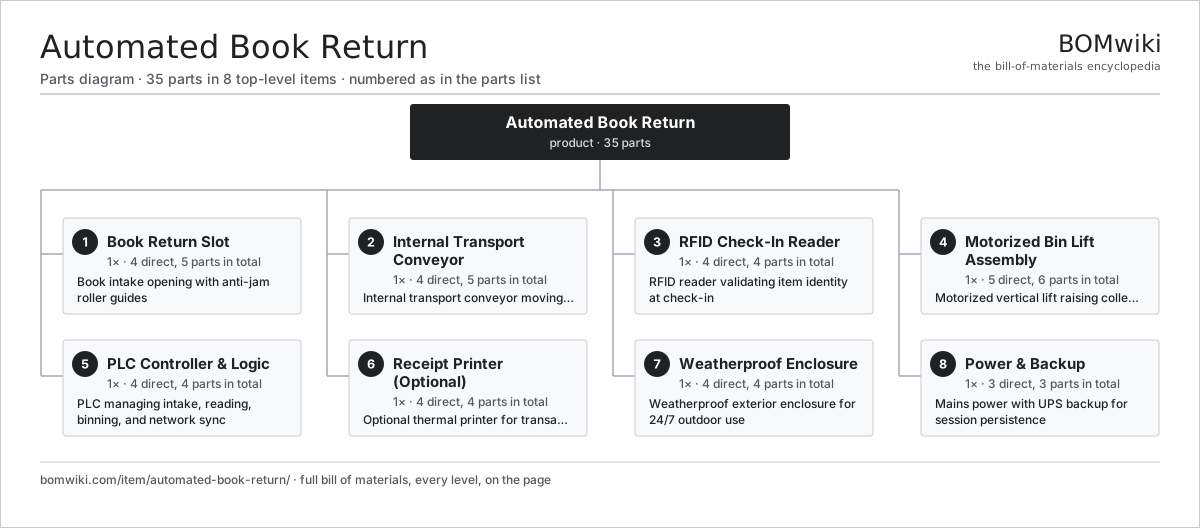
| # | Part | Qty | What it does |
|---|---|---|---|
| 1 | Book Return Slot 4 parts | 1× | Book intake opening with anti-jam roller guides |
| 2 | Internal Transport Conveyor 4 parts | 1× | Internal transport conveyor moving items to read zone |
| 3 | RFID Check-In Reader 4 parts | 1× | RFID reader validating item identity at check-in |
| 4 | Motorized Bin Lift Assembly 5 parts | 1× | Motorized vertical lift raising collection bin when full |
| 5 | PLC Controller & Logic 4 parts | 1× | PLC managing intake, reading, binning, and network sync |
| 6 | Receipt Printer (Optional) 4 parts | 1× | Optional thermal printer for transaction receipts |
| 7 | Weatherproof Enclosure 4 parts | 1× | Weatherproof exterior enclosure for 24/7 outdoor use |
| 8 | Power & Backup 3 parts | 1× | Mains power with UPS backup for session persistence |
3D model
No 3D model yet. Have a CAD file of this? Add a 3D model. STL renders right on this page; STEP, FreeCAD, and OpenSCAD sources are welcome too (openly licensed, like all 3D models on BOMwiki).
Build & assembly graph
expand / collapse · shared sub-assemblies converge · links to related products · est. labourTap an assembly to expand/collapse · tap a part to open it · use “Open page” for any node · drag to pan, scroll to zoom.
Bill of materials for Automated Book Return
8 top-level lines · 40 rows shown · 35 parts total · indented to 3 levels| # | Item / sub-assembly | Part no. | Qty/assy | Ext. qty | Parts | Type |
|---|---|---|---|---|---|---|
| 1 | Book Return Slot 4 parts | automated-book-return-return-slot | 1× | 1 | 5 | assembly |
| 1.1 | Return Slot Door | automated-book-return-slot-door | 1× | 1 | · | part |
| 1.2 | Return Slot Frame | automated-book-return-slot-frame | 1× | 1 | · | part |
| 1.3 | Anti-Jam Roller | automated-book-return-roller-guide | 2× | 2 | · | part |
| 1.4 | Connector | connector | 1× | 1 | · | part |
| 2 | Internal Transport Conveyor 4 parts | automated-book-return-conveyor | 1× | 1 | 5 | assembly |
| 2.1 | Conveyor Drive Motor | automated-book-return-motor | 1× | 1 | · | part |
| 2.2 | Conveyor Belt | automated-book-return-belt | 1× | 1 | · | part |
| 2.3 | Conveyor Roller | automated-book-return-roller | 2× | 2 | · | part |
| 2.4 | Encoder | encoder | 1× | 1 | · | part |
| 3 | RFID Check-In Reader 4 parts | automated-book-return-reader-station | 1× | 1 | 4 | assembly |
| 3.1 | Fixed RFID Read Pad | automated-book-return-reader-antenna | 1× | 1 | · | part |
| 3.2 | RFID Reader Module | automated-book-return-reader-ic | 1× | 1 | · | part |
| 3.3 | Reader Control Board | automated-book-return-reader-pcb | 1× | 1 | · | part |
| 3.4 | SMD Passive (R/C/L) | smd-passives | 1× | 1 | · | part |
| 4 | Motorized Bin Lift Assembly 5 parts | automated-book-return-bin-lift | 1× | 1 | 6 | assembly |
| 4.1 | Bin Lift Motor | automated-book-return-lift-motor | 1× | 1 | · | part |
| 4.2 | Ball Screw Actuator | automated-book-return-screw-jack | 1× | 1 | · | part |
| 4.3 | Lift Platform | automated-book-return-bin-platform | 1× | 1 | · | part |
| 4.4 | Position Sensor | automated-book-return-limit-switch | 2× | 2 | · | part |
| 4.5 | Encoder | encoder | 1× | 1 | · | part |
| 5 | PLC Controller & Logic 4 parts | automated-book-return-controller | 1× | 1 | 4 | assembly |
| 5.1 | Programmable Logic Controller | automated-book-return-plc | 1× | 1 | · | part |
| 5.2 | I/O Multiplexer Card | automated-book-return-io-card | 1× | 1 | · | part |
| 5.3 | Non-Volatile Memory | automated-book-return-nvram | 1× | 1 | · | part |
| 5.4 | Bare PCB | pcb-bare | 1× | 1 | · | part |
| 6 | Receipt Printer (Optional) 4 parts | automated-book-return-receipt-printer | 1× | 1 | 4 | assembly |
| 6.1 | Thermal Print Head | library-self-checkout-thermal-head | 1× | 1 | · | part |
| 6.2 | Paper Feed Stepper Motor | library-self-checkout-printer-motor | 1× | 1 | · | part |
| 6.3 | Paper Guide Assembly | library-self-checkout-paper-guide | 1× | 1 | · | part |
| 6.4 | Printer Control PCB | library-self-checkout-printer-pcb | 1× | 1 | · | part |
| 7 | Weatherproof Enclosure 4 parts | automated-book-return-housing | 1× | 1 | 4 | assembly |
| 7.1 | Weatherproof Cabinet | automated-book-return-cabinet | 1× | 1 | · | part |
| 7.2 | Enclosure Gasket | automated-book-return-door-seal | 1× | 1 | · | part |
| 7.3 | Insulation & Heating | automated-book-return-thermal-pad | 1× | 1 | · | part |
| 7.4 | Fastener Set | fastener-set | 1× | 1 | · | part |
| 8 | Power & Backup 3 parts | automated-book-return-power-system | 1× | 1 | 3 | assembly |
| 8.1 | Power Supply Module | automated-book-return-power-supply | 1× | 1 | · | part |
| 8.2 | UPS Supercapacitor Bank | automated-book-return-ups-cap | 1× | 1 | · | part |
| 8.3 | Surge Suppressor | automated-book-return-surge-protect | 1× | 1 | · | part |
Something wrong in this list? Report a problem with this BOM.
Related products
same domain, ranked by shared parts Library Self-Checkout
37 parts · shares 4 with this page
Banknote Fitness Sorter
89 parts · shares 2 with this page
Library Self-Checkout
37 parts · shares 4 with this page
Banknote Fitness Sorter
89 parts · shares 2 with this page
 Cash Deposit Machine
64 parts · shares 2 with this page
Coin Counting Kiosk
63 parts · shares 2 with this page
Cash Deposit Machine
64 parts · shares 2 with this page
Coin Counting Kiosk
63 parts · shares 2 with this page
 Guillotine Paper Cutter
261 parts · shares 2 with this page
Library RFID Gate
46 parts · shares 2 with this page
Guillotine Paper Cutter
261 parts · shares 2 with this page
Library RFID Gate
46 parts · shares 2 with this page
Sourcing: possible vendors
Browse the supplier directory → Prices, MOQ, and lead times are algorithmic estimates, not quotes, and not claims about these companies. Company mappings are curated by keyword; est. price band $50–$15k. How estimates work| Vendor | HQ | Specialty | MOQ | Lead time |
|---|---|---|---|---|
|
🇯🇵Canon
canon.com ↗
|
Tokyo, JP | Imaging & optics | 500 units | 8–12 wks |
|
🇯🇵Ricoh
ricoh.com ↗
|
Tokyo, JP | Office imaging | 500 units | 8–12 wks |
|
🇺🇸Xerox
xerox.com ↗
|
Norwalk, US | Printers & copiers | 500 units | 8–12 wks |
|
🇯🇵Epson
epson.com ↗
|
Suwa, JP | Printers & projectors | 500 units | 8–12 wks |
|
🇯🇵Brother
brother.com ↗
|
Nagoya, JP | Printers & sewing | 500 units | 8–12 wks |
979-word article