Automated Fiber Placement
ProductOverview
Automated Fiber Placement (AFP) is a computer-controlled robotic composite layup process that precisely deposits prepreg tape (25–150 mm wide, 0.1–0.3 mm thick) onto flat or curved surfaces, with in-situ compaction and optional heating. The Robot Arm or Gantry (6–9 axis industrial robot) positions the Fiber Placement Head (tape dispenser and compaction tool) to place individual tows at commanded angles and locations, building up multi-directional laminates.
AFP is the dominant method for primary aerospace structures: Airbus A350 fuselage, Boeing 787 wings, Bombardier Global jets. Compared to hand layup (slow, labor-intensive, inconsistent), AFP is 2–10× faster and achieves superior fiber placement accuracy (±2 mm vs. ±5–10 mm). Compared to tape laying (ATL, which applies wider tapes), AFP handles tighter radius curves and complex fiber steering patterns, improving structural efficiency.
The process combines the precision of automated systems with the flexibility of continuous-fiber composites, enabling fiber orientation optimization per local stress state (tailored composites), reducing weight by 10–20% vs. conventional layup.
Robot Arm & Positioning
The Robot Arm or Gantry is a standard industrial robot (KUKA, ABB, Fanuc, Yaskawa) with 6–9 axes:
- Base axes 1–3: Shoulder, elbow, wrist rotation (3-axis movement in space).
- Wrist axes 4–6: Roll, pitch, yaw (tool orientation).
- Optional axes 7–9: Auxiliary joints (finger, dual-head support, or external linear axis).
Each Robot Joint includes an Servo Drive AC servo motor with harmonic gear reducer and encoder feedback. The Robot Controller processes motion commands from CAM software, interpolating smooth paths and maintaining servo loop stability.
Workspace: A 6-axis, 2.0 m reach robot can access most of a fuselage barrel (3–4 m diameter). Large parts require multiple robots or a gantry system (linear XYZ rails + smaller robot).
Fiber Delivery & Creel
The Fiber Delivery & Creel system holds prepreg tape spools (25–150 mm wide, stored at −18°C to preserve tack). The Spool Carousel automatically indexes spools, feeding tape through a guide path to the Fiber Placement Head.
Tape characteristics:
- Width: 25 mm for tight curves, 100+ mm for flat sections (narrower tape = tighter radius capability).
- Areal weight: Typically 300–600 g/m² (equivalent to 1–3 plies of woven fabric).
- Tack: Sticky at room temperature (15–25°C), allowing tape to adhere to part without additional adhesive. Tack degrades after 5–7 days, requiring tape refreshment or oven reheat.
The Tension Brake applies constant load (0.5–2 kg per tape, via Tension Brake brake on each spool) ensuring controlled unwinding. Excessive tension wrinkles tape; insufficient tension causes slack and misplacement.
The Tape Splicer automatically joins tape ends when one spool is exhausted, enabling continuous long production runs (kilometers of tow) without manual intervention.
Placement Head & Compaction
The Fiber Placement Head is the critical tool, mounted on the robot wrist via Tool Changer System quick-couple. It consists of:
- Tape Guide Nozzle: Precision nozzle (2–12 mm wide, adjustable per tape width) positioning the tape on the part surface.
- Heat Element: 500–1500 W infrared lamp or cartridge heater softening the prepreg (increasing tack, improving consolidation).
- Compaction Roller: Heated rubber or silicone roller (50–500 kN contact force) pressing tape down, removing air, and transferring heat.
Compaction process:
- As the robot moves at 5–20 m/min tow advance speed, the Fiber Placement Head traces the desired path on the part.
- The Heat Element heats the prepreg (and part surface) to 60–120°C, reducing viscosity and improving resin flow.
- The Compaction Roller presses down with 100–500 kN force over a small contact area (10–50 cm²), achieving local pressures 2–10 MPa.
- This pressure consolidates the tape: resin flows into fiber interstices, displaces air, and bonds to the previous ply and underlying substrate.
- Void content is reduced to <2% (vs. 3–5% for uncompacted hand layup).
Fiber Steering & Path Planning
The Motion Planning & Software CAM software converts part geometry and laminate design into tow placement paths, optimizing fiber orientation per local stress requirements.
Key capabilities:
- Variable fiber angle: Each tow can have a different fiber angle (0°–360° range). A fuselage hoop layer may be 0° (circumferential), while a region with bending loads might steer to ±30° (local optimization).
- Curved paths: The software computes paths following part geometry (geodesic curves on curved surfaces), minimizing steering and maintaining fiber alignment.
- Gap minimization: The placement head is positioned and angled to maintain near-zero gap between adjacent tows (typical ±1 mm, vs. 3–5 mm for manual placement).
- Collision avoidance: The Collision Detection checks all robot poses, ensuring no interference with part, fixtures, or itself.
Tow steering:
- For a fuselage barrel with a local wing attachment, fiber angles might transition smoothly from 0° (hoop at fuselage) to +45° (load path toward attachment) over ~0.5 m axial distance.
- AFP tow steering reduces weight by 5–15% (vs. constant-angle layup) because fiber closely follows local stress directions.
Heating & Tack Control
In-situ heating via the In-Situ Heating (Optional) (infrared lamp or heated roller) is optional but valuable:
Benefits:
- Tack improvement: Cold prepreg tape (−18°C fresh) has minimal tack on a cold part; heating to 60–100°C restores tack, improving tape adhesion and reducing slippage.
- Resin flow: Slight temperature rise reduces resin viscosity, allowing consolidation with lower mechanical force.
- Continuous layup: Without heating, tape on a cold part may slip or pucker; heating enables faster placement on complex geometries.
Trade-offs:
- Additional capital cost (heating element + power supply ~$20–50k).
- Thermal management complexity (preventing overheating, which causes resin bleed-off and excessive cure acceleration).
- Energy consumption (~5–10 kW during placement).
Most AFP systems operating on prepreg use moderate heating (60–90°C) for optimal consolidation speed and tape adhesion.
Part Support & Positioning
The Part Support & Fixtures must hold the part rigid and at repeatable orientation throughout placement:
Flat parts (wing skins, fuselage panels): Vacuum table Vacuum Table (porous aluminum with pump) holds the part, achieving excellent grip without tooling.
Complex curved parts (fuselage barrels, radomes): Custom fixture Part Fixture (often a mandrel or mold) supports the part; multiple fixtures may be needed for full part.
Large parts: An optional Rotary Table rotates the part to allow robot access from all angles, maximizing placement coverage and minimizing robot reach requirements.
Quality Control & Monitoring
The Tow Monitor sensor system monitors:
- Tow width: Optical or capacitive sensor ensuring tape width is correct (±1 mm).
- Tow tension: Load cell on Fiber Delivery & Creel detecting tension excursions (loose or over-tight tape).
- Fiber breakage: Sudden tension drop signals tape rupture; system halts and alerts operator.
The System Monitor real-time display tracks:
- Meters of tow laid (progress).
- Tow gaps and overlaps (defects).
- Temperature and force during compaction (quality metrics).
- Robot position and joint status.
Post-layup inspection includes:
- Visual: Edge lighting to detect gaps, wrinkles, or foreign objects between plies.
- Ultrasonic: Through-transmission or pulse-echo scanning detecting voids, delaminations, wrinkles.
- Thermography: Thermal imager after quick heating, revealing density variations (voids appear as darker).
Typical AFP Layup Scenario
Airbus A350 fuselage barrel section, 3 m long × 2.5 m diameter, carbon/epoxy:
Design (preparation): Composite engineer defines 30 plies, with ply 1–10 at 0° (hoop, burst strength), plies 11–20 at ±45° (shear and torsion), plies 21–30 at 90° (axial bending). Some plies steer locally near frame cutouts (±15°–±30°).
CAM generation (2–4 hours): CAM software imports barrel geometry (STEP model), computes optimal tow paths for each ply, minimizes gaps and overlaps, exports robot G-code (millions of motion commands).
Part setup (30 min): Barrel mandrel positioned in AFP work cell. Vacuum table activated (if used). Robot home position verified.
Ply 1 (0°, hoop, ~10 tows at 125 mm width): Robot executes circumferential paths, laying down 10 parallel tows. Placement speed 10 m/min, circumference ~8 m per tow → 4.8 minutes for entire ply. Compaction force 200 kN, heating 80°C.
Plies 2–30 (repeat): Each ply takes 4–8 minutes depending on fiber angle and steering complexity. Total layup time: ~2–3 hours.
Quality check (30 min): Visual inspection for gaps/wrinkles, ultrasonic scan at critical regions.
Postcure (oven, 4–8 hours): Part cured in autoclave at 180°C, 700 kPa pressure per epoxy schedule. Resin cross-links fully, properties stabilize.
Total build-to-cure: ~8–10 hours per barrel. With multiple barrels in queue and parallel AFP systems, production rate ~6–12 barrels per week per facility.
Advantages Over Hand & ATL
| Aspect | Hand Layup | Tape Layer (ATL) | AFP |
|---|---|---|---|
| Tape width | N/A (prepreg ply) | 150–300 mm | 25–150 mm |
| Fiber angle range | Limited (±45° or ±90°) | Limited (±45°, 0°, 90°) | Unlimited (0–360°) |
| Curve handling | Excellent (manual) | Poor (wide tape bridges gaps) | Excellent (narrow tape conforms) |
| Steering efficiency | No (constant angle) | No (constant angle) | Yes (fiber follows stress) |
| Placement speed | 1–2 m/min | 10–30 m/min | 5–20 m/min |
| Labor | High (2–3 people per ply) | Low (1 operator) | Low (1 operator) |
| Void content | 5–8% | 2–4% | <2% (with heating) |
| Fiber waste | 10–15% trim | <5% | <2% |
| Capital cost | ~$100k | ~$500k–1M | ~$1M–3M |
Verdict: AFP is superior for complex, fiber-steered, primary aerospace structures. Hand layup remains cost-competitive for small-batch, simple geometries. ATL fills the middle ground for large flat/cylindrical sections with minimal steering.
Limitations & Challenges
- Capital cost: $1–3M for a complete AFP system (robot, placement head, control, integration). Accessible only to Tier-1 suppliers and major OEMs.
- Programming complexity: Generating collision-free, optimized tow paths requires expert CAM engineers and can take weeks for complex parts.
- Fiber steering artifacts: Sharp angle transitions can create wrinkles; smooth steering transitions required (adding complexity).
- Tow breakage: Prepreg tape under tension can snap, halting production. Operator must splice tape and restart (15–30 min downtime).
- Curve radius limits: Very tight curves (radius <50 mm) with thick tape (100+ mm) may cause wrinkling or fiber buckling; narrow tape (25 mm) required.
Modern research focuses on on-demand consolidation (heating only at compaction point, reducing overall energy) and AI-driven path optimization (real-time adaptation to part geometry or defects).
Industry Adoption
Leading adopters: Boeing (787, MAX), Airbus (A350, A220), Bombardier (Global jets), Embraer (E2 jets), Lockheed (F-35 fuselage). Secondary applications: Wind turbine blades (large flat skins), racing yacht hulls, high-end automotive (carbon monocoques).
Estimated AFP capacity worldwide: ~50–100 systems deployed (vs. thousands of hand layup stations). Cost of entry and technical skill remain barriers, but as composite designs embrace fiber steering, AFP adoption will expand.
Automated Fiber Placement parts and their functions
8 top-level parts · 46 parts in total · full bill of materials below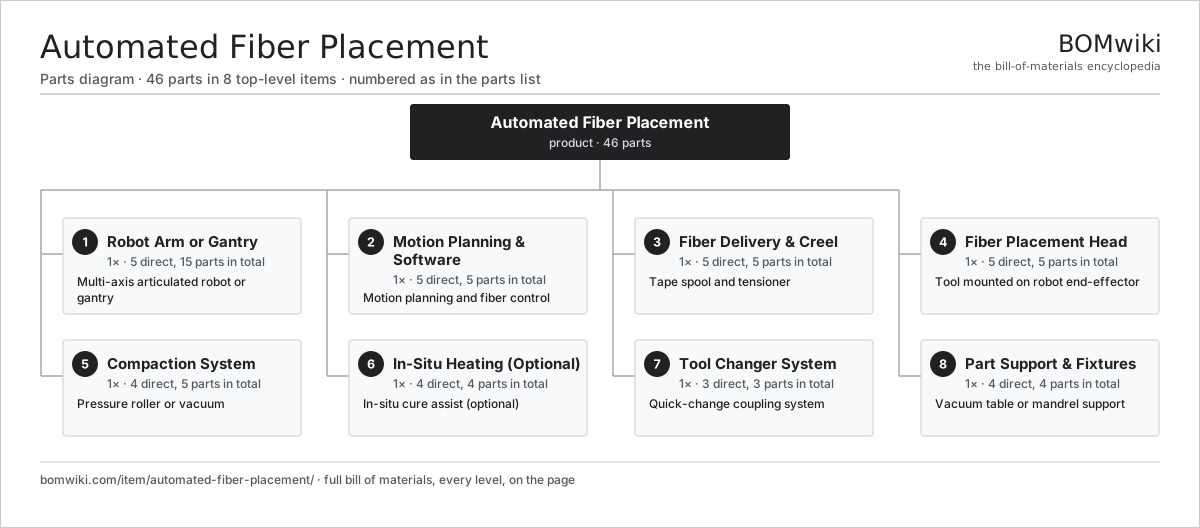
| # | Part | Qty | What it does |
|---|---|---|---|
| 1 | Robot Arm or Gantry 5 parts | 1× | Multi-axis articulated robot or gantry |
| 2 | Motion Planning & Software 5 parts | 1× | Motion planning and fiber control |
| 3 | Fiber Delivery & Creel 5 parts | 1× | Tape spool and tensioner |
| 4 | Fiber Placement Head 5 parts | 1× | Tool mounted on robot end-effector |
| 5 | Compaction System 4 parts | 1× | Pressure roller or vacuum |
| 6 | In-Situ Heating (Optional) 4 parts | 1× | In-situ cure assist (optional) |
| 7 | Tool Changer System 3 parts | 1× | Quick-change coupling system |
| 8 | Part Support & Fixtures 4 parts | 1× | Vacuum table or mandrel support |
3D model
No 3D model yet. Have a CAD file of this? Add a 3D model. STL renders right on this page; STEP, FreeCAD, and OpenSCAD sources are welcome too (openly licensed, like all 3D models on BOMwiki).
Build & assembly graph
expand / collapse · shared sub-assemblies converge · links to related products · est. labourTap an assembly to expand/collapse · tap a part to open it · use “Open page” for any node · drag to pan, scroll to zoom.
Bill of materials for Automated Fiber Placement
8 top-level lines · 43 rows shown · 46 parts total · indented to 3 levels| # | Item / sub-assembly | Part no. | Qty/assy | Ext. qty | Parts | Type |
|---|---|---|---|---|---|---|
| 1 | Robot Arm or Gantry 5 parts | automated-fiber-placement-robot-arm | 1× | 1 | 15 | assembly |
| 1.1 | Robot Base | automated-fiber-placement-robot-base | 1× | 1 | · | part |
| 1.2 | Robot Joint | automated-fiber-placement-robot-joints | 6× | 6 | · | part |
| 1.3 | Wrist Assembly | automated-fiber-placement-robot-wrist | 1× | 1 | · | part |
| 1.4 | Robot Controller | automated-fiber-placement-robot-controller | 1× | 1 | · | part |
| 1.5 | Servo Drive | automated-fiber-placement-servo-drives | 6× | 6 | · | part |
| 2 | Motion Planning & Software 5 parts | automated-fiber-placement-control-system | 1× | 1 | 5 | assembly |
| 2.1 | CAD Interface | automated-fiber-placement-cad-import | 1× | 1 | · | part |
| 2.2 | Path Optimizer | automated-fiber-placement-path-optimizer | 1× | 1 | · | part |
| 2.3 | Collision Detection | automated-fiber-placement-collision-detector | 1× | 1 | · | part |
| 2.4 | Tow Monitor | automated-fiber-placement-fiber-gauge | 1× | 1 | · | part |
| 2.5 | System Monitor | automated-fiber-placement-status-monitor | 1× | 1 | · | part |
| 3 | Fiber Delivery & Creel 5 parts | automated-fiber-placement-fiber-delivery | 1× | 1 | 5 | assembly |
| 3.1 | Spool Carousel | automated-fiber-placement-spool-carousel | 1× | 1 | · | part |
| 3.2 | Tension Brake | automated-fiber-placement-tension-controller | 1× | 1 | · | part |
| 3.3 | Fiber Guide Path | automated-fiber-placement-fiber-guide | 1× | 1 | · | part |
| 3.4 | Tape Splicer | automated-fiber-placement-fiber-splicer | 1× | 1 | · | part |
| 3.5 | Tape Cooler | automated-fiber-placement-storage-cooler | 1× | 1 | · | part |
| 4 | Fiber Placement Head 5 parts | automated-fiber-placement-placement-head | 1× | 1 | 5 | assembly |
| 4.1 | Tape Guide Nozzle | automated-fiber-placement-tape-guide | 1× | 1 | · | part |
| 4.2 | Heat Element | automated-fiber-placement-heat-source | 1× | 1 | · | part |
| 4.3 | Compaction Roller | automated-fiber-placement-compaction-roller | 1× | 1 | · | part |
| 4.4 | Feed Motor | automated-fiber-placement-motor-feed | 1× | 1 | · | part |
| 4.5 | Tool Changer | automated-fiber-placement-tool-interface | 1× | 1 | · | part |
| 5 | Compaction System 4 parts | automated-fiber-placement-compaction-device | 1× | 1 | 5 | assembly |
| 5.1 | Roller Motor | automated-fiber-placement-compaction-roller-motor | 1× | 1 | · | part |
| 5.2 | Roller Bearing | automated-fiber-placement-roller-bearing | 2× | 2 | · | part |
| 5.3 | Thermal Controller | automated-fiber-placement-thermal-management | 1× | 1 | · | part |
| 5.4 | Force Feedback | automated-fiber-placement-force-control | 1× | 1 | · | part |
| 6 | In-Situ Heating (Optional) 4 parts | automated-fiber-placement-heating-element | 1× | 1 | 4 | assembly |
| 6.1 | IR Lamp | automated-fiber-placement-ir-lamp | 1× | 1 | · | part |
| 6.2 | Power Supply | automated-fiber-placement-lamp-power-supply | 1× | 1 | · | part |
| 6.3 | Temperature Sensor | automated-fiber-placement-temperature-sensor | 1× | 1 | · | part |
| 6.4 | Thermal Shroud | automated-fiber-placement-insulation-shroud | 1× | 1 | · | part |
| 7 | Tool Changer System 3 parts | automated-fiber-placement-tool-changer | 1× | 1 | 3 | assembly |
| 7.1 | Changer Base | automated-fiber-placement-changer-base | 1× | 1 | · | part |
| 7.2 | Tool Socket | automated-fiber-placement-changer-socket | 1× | 1 | · | part |
| 7.3 | Tool Pallet | automated-fiber-placement-changer-pallet | 1× | 1 | · | part |
| 8 | Part Support & Fixtures 4 parts | automated-fiber-placement-facility-integration | 1× | 1 | 4 | assembly |
| 8.1 | Vacuum Table | automated-fiber-placement-vacuum-table | 1× | 1 | · | part |
| 8.2 | Part Fixture | automated-fiber-placement-part-fixture | 1× | 1 | · | part |
| 8.3 | Positioning Stage | automated-fiber-placement-positioning-stage | 1× | 1 | · | part |
| 8.4 | Rotary Table | automated-fiber-placement-rotary-table | 1× | 1 | · | part |
Something wrong in this list? Report a problem with this BOM.
Sourcing: possible vendors
Browse the supplier directory → Prices, MOQ, and lead times are algorithmic estimates, not quotes, and not claims about these companies. Company mappings are curated by keyword; est. price band $5k–$2M. How estimates work| Vendor | HQ | Specialty | MOQ | Lead time |
|---|---|---|---|---|
| atlascopco.com ↗ | Stockholm, SE | Compressors & industrial | 10 units | 12–20 wks |
|
🇦🇹Andritz
andritz.com ↗
|
Graz, AT | Process plants & machinery | 10 units | 12–20 wks |
| buhlergroup.com ↗ | Uzwil, CH | Food & materials processing | 10 units | 12–20 wks |
| gea.com ↗ | Düsseldorf, DE | Process technology | 10 units | 12–20 wks |
| mhi.com ↗ | Tokyo, JP | Heavy machinery | 10 units | 12–20 wks |
1,844-word article