Automatic Calf Feeder
ProductOverview
An automatic calf feeder is a computerized milk-dispensing system that allows individual dairy calves to drink milk (whole milk or replacer) on a self-directed schedule, similar to natural dam-reared suckling behavior. The system uses RFID ear-tag identification to limit feeding to enrolled calves, monitors each animal's consumption patterns, and allows dairy farmers to deliver customized feeding programs by individual animal rather than feeding all calves identically.
The technology emerged in the 1990s (first commercial systems in Denmark and Germany) and has become standard on modern dairy operations, particularly in Europe. Adoption in North America has grown since 2010 as farmers recognize labor-savings and improved calf health outcomes.
Modern systems can manage 30–50 calves per station through multi-visit allowances (limiting calf to 4 visits/day, for example) and use data analytics to detect illness early (sudden appetite loss), improving survival rates from 95% (conventional bucket feeding) to 98%+ (automated feeding with health monitoring).
How it works
Milk Arrival & Storage: Fresh milk (whole milk from milking parlor, or mixed replacer powder) is delivered to the feeder's Milk Tank. The refrigerated tank maintains milk at 2–5°C to preserve quality and limit bacterial growth. Tank capacity of 200 liters allows 3–5 days of storage for a 40-calf group.
ID Verification: As a calf approaches the station, it passes under or touches the RFID Antenna. The antenna reads the ISO 11784-compliant electronic ear tag embedded in the calf's ear. The tag transmits the calf's unique ID number (10-digit code) to the RFID Reader Module.
Access Control: The Controller & Computer (an embedded computer) looks up the calf's ID in its database. The controller verifies:
- Is this calf enrolled in the feeder program?
- Has the calf reached its maximum daily visits (e.g., 4 visits/day)?
- Is the calf within its age-appropriate feeding window (prevents premature weaning calves from drinking)?
If all checks pass, the controller opens the Teat Valve, allowing the calf to access the teat. If checks fail (e.g., calf has already had 4 feedings today), the valve remains closed; the calf receives no milk and must wait for the next allowed visit window.
Milk Heating & Dispensing: Milk is drawn from the cold tank through the Peristaltic Pump (variable-speed DC motor). As milk flows through the Heating Unit, a thermostat-controlled electric heater or hot-water coil warms the milk to the optimal temperature (36–40°C), which matches the temperature of naturally expressed bovine colostrum and milk. The Temperature Sensor continuously monitors milk temperature; if it drops below 35°C, the heater activates; if it exceeds 41°C, heating is cut off.
Feeding & Metering: The calf begins suckling the Teat Rubber, a silicone teat that mimics natural nipple shape and texture. The peristaltic pump delivers milk at a rate of 1–2 LPM (depending on pump speed setting, which is configured by the farmer). The Pump Flow Meter measures actual milk delivered in real-time.
The calf can suckle for as long as it wishes (typically 5–15 minutes), but the feeder limits total volume per visit (e.g., 2–4 liters depending on age and program). Once the volume limit is reached, the Teat Valve closes, ending that feeding session. If the calf attempts to continue suckling, no additional milk is dispensed.
Consumption Logging: Each feeding session is recorded in the controller's data storage:
- Calf ID
- Time and date
- Milk volume dispensed
- Milk temperature
- Visit number (1st, 2nd, 3rd, 4th of the day)
Over time, the system builds a feeding pattern profile for each calf, allowing early detection of abnormal behavior (reduced appetite often indicates illness 1–2 days before clinical signs appear).
Automated Cleaning: After each feeding session, a Cleaning System automatically activates. Hot water and a food-safe sanitizer solution are circulated through all milk-contact tubing and the teat via solenoid-controlled bypass loops. This 3–5 minute wash cycle removes milk residue and reduces bacterial contamination. After washing, the system drains and opens all lines to air-dry. Modern systems achieve bacterial counts <10⁴ CFU/mL (acceptable for calf health; <10⁶ CFU/mL is mandatory in many jurisdictions).
Optional Remote Monitoring: If equipped with a Cellular Modem, feeding data is transmitted via 4G cellular network to a cloud-based farm management platform accessible on the farmer's smartphone or computer. The farmer can review individual calf consumption in real-time, receive health alerts (appetite drops >25% compared to baseline = investigate calf), and adjust feeding programs remotely.
Feeding Program Flexibility
A key advantage is customization per individual calf:
Age-Based Escalation:
- Days 3–7: 2 liters per visit, 4 visits/day (8 liters/day total). Early-stage calves may visit more frequently if hungry.
- Weeks 2–4: 2.5 liters per visit, 3 visits/day (7.5 liters/day). Calves self-regulate frequency.
- Weeks 5–8: 3 liters per visit, 2–3 visits/day (6–9 liters/day). Calves naturally reduce visits as they begin eating solid feed.
- Weeks 9–12: Gradual reduction toward weaning; 1–2 visits/day with decreasing volume.
Health-Based Adjustments:
- Calves recovering from illness can be programmed for extra visits or larger volumes without moving them to different housing.
- Weak calves can be enrolled with lower volume limits to encourage frequent visits (building strength and appetite).
Early Weaning Detection:
- System allows farmers to pre-program complete cessation of access (e.g., "no access after 12:00 PM Wednesday") to initiate weaning without human intervention.
- Calf still approaches station; learns it no longer provides milk; naturally transitions to hay/grain consumption.
Operational Workflow
Station Setup:
- Mix or source milk (whole milk from dairy parlor or powdered replacer).
- Fill feeder tank (typically daily or every other day).
- Verify tank temperature (thermostat should maintain 2–5°C).
- Verify sanitizer reservoir is filled (system uses ~50 mL per cleaning cycle; 200-cycle supply = 10 liters).
Calf Enrollment:
- New calf arrives (3–7 days old, after colostrum feeding).
- Electronic ear tag is applied to calf (ISO 11784 standard).
- Tag ID is entered into feeder controller via touchscreen.
- Feeding program (age, volume limits, daily visit allowance) is configured.
- Calf is released to pen with access to feeder station.
Ongoing Operation:
- Calves self-regulate visiting frequency (typically 3–4 visits/day for young calves, declining to 1–2 visits as they age).
- Farmer monitors consumption via touchscreen display or smartphone app; checks for outliers (unusually low consumption = potential illness).
- Daily tank refill is performed (typically 20–40 minutes of labor per tank).
End of Season or Weaning:
- Programming is adjusted to reduce access frequency (down to 1 visit/day) or volume.
- Over 3–5 days, calves naturally transition away from feeder as visits become infrequent.
- Calves are moved to group pens after weaning.
- Feeder is thoroughly cleaned and either stored or prepared for next season.
Health Advantages
Research (published in Journal of Dairy Science, 2015–2023) shows calves fed via automatic systems have:
Improved Health:
- 1–2% higher survival rate (illness detected earlier via appetite monitoring).
- 15–20% lower incidence of pneumonia (consistent milk temperature reduces stress).
- 10–15% lower incidence of diarrhea (automated cleaning ensures hygienic milk).
Better Growth:
- Average daily gain (ADG) 5–10% higher than conventionally fed calves.
- Skeletal growth measured via hip height increases ~2 cm over 12 weeks.
- Faster transition to solid feed (grain/hay) due to earlier appetite satiation signals.
Behavioral Improvements:
- Calves fed via teats (mimicking natural suckling) show less abnormal behavior (cross-suckling, object suckling).
- Reduced stress responses (lower cortisol levels measured in blood).
- Calves weaned via gradual reduction (natural appetite decline) transition smoother to post-weaning diet than abruptly weaned calves.
Integration with Dairy Operations
Conventional System:
- Calves bottle-fed 2–3 times/day by hand (~30 min labor per calf per season).
- Difficult to provide individual attention or detect illness early.
- Relies on caretaker observational skills (subjective).
Automated System:
- 20–40 calves per station; one worker manages 2–4 stations.
- Labor: ~2 hours/day (milk prep and tank refill) vs. 3–4 hours/day for bottle feeding.
- Objective health monitoring (appetite trends are quantified in software).
- Scalable: add more stations as herd grows without proportional labor increase.
Economic Model: Capital cost: $35,000–50,000 per station (including installation, training, software licenses). Operating cost: Milk/replacer, sanitizer, electricity, maintenance. Labor savings: 2–3 hours/day × 5 days/week × 50 weeks = 500–750 hours/year at $25/hour = $12,500–18,750/year. Payback: 2–3 years from labor savings alone; health improvements increase ROI further.
Common Issues & Troubleshooting
Tag Not Reading: RFID antenna malfunction or tag out of range.
- Verify antenna power (LED indicator on antenna should glow).
- Test tag by bringing it directly to antenna (within 5 cm); antenna should beep.
- If no beep, antenna or reader may have failed; replace module (~$800–1200).
Milk Leaking from Teat: Teat valve solenoid not closing fully or teat rubber has puncture.
- Verify solenoid energizing (listen for click when closed).
- If solenoid clicks but milk still drips, solenoid plunger is stuck; clean debris or replace valve ($300–500).
- Inspect teat rubber for cracks; replace if damaged ($50–100).
Calf Not Drinking: Teat not accessible or milk quality issue.
- Verify calf is enrolled in system and has remaining visit allowance (check controller log).
- Test teat manually: apply pressure with finger; milk should flow.
- Verify milk temperature is 36–40°C (too cold deters calves).
- If teat is accessible and warm but calf refuses, may be illness; isolate calf for observation.
Cleaning Cycle Not Starting: Solenoid valve failure or wash pump malfunction.
- Verify pump is running (listen for hum when cleaning cycle begins).
- If pump doesn't run, check 24 VDC supply to pump motor.
- If supply is present but pump silent, pump may have seized; replace (~$200–400).
High Bacterial Count in Milk Tank: Cooling element malfunction or contamination.
- Verify tank temperature is 2–5°C (thermostat display).
- If temperature is rising above 8°C, cooler compressor may have failed; service/replace (~$1000–2000).
- Drain and thoroughly clean tank; refill with fresh milk.
Calf Spillage Around Teat: Shield positioning or calf feeding technique.
- Verify Spill Shield is properly positioned (should catch 95% of drips).
- Adjust shield height if calf is unusually tall.
- Some spillage is normal (5–10% of milk); excessive spillage (>20%) suggests teat valve leakage (see "Milk Leaking" above).
Maintenance & Seasonal Care
Weekly:
- Check tank temperature (should maintain 2–5°C).
- Inspect teat rubber for cracks or deformation; replace if necessary.
- Verify sanitizer reservoir level; top up if below 50% capacity.
Monthly:
- Deep-clean milk tank (drain, scrub, rinse thoroughly with hot water).
- Inspect all hoses and connections for cracks or loose clamps.
- Test RFID antenna by waving multiple tags past it; read rate should be >99%.
Quarterly:
- Replace water filter in wash-water supply line (sediment reduces cleaning efficiency).
- Verify controller hard drive has sufficient free space (should maintain >10% free capacity).
- Backup data to external drive or cloud storage.
Annually (or 500–1000 operating hours):
- Replace peristaltic pump tubing (silicone stretches gradually; old tubing meters inconsistently).
- Inspectcompressor cooling coils for frost buildup or debris; clean with compressed air.
- Professional service technician should inspect solenoid valves, perform calibration, and update software.
Off-Season Storage:
- Drain milk tank completely; rinse with warm water and dry.
- Run multiple cleaning cycles with just hot water (no milk residue remains).
- Open all solenoid valve drain ports to allow moisture evaporation.
- Cover feeder with tarp to protect from dust.
- Disconnect 120 VAC power unless continuous cooling is required.
Future Enhancements
Emerging technologies in automated calf feeding:
AI-Based Health Monitoring: Machine learning algorithms analyze feeding behavior patterns; algorithm predicts illness 3–5 days before clinical symptoms with 85% accuracy (vs. current 1–2 day early detection via appetite change).
Precision Nutrition: Feeder integrates weighing scale; calf weight is measured at each visit; feeding volume automatically adjusts to deliver age and weight-appropriate milk amounts.
Wearable Biomarkers: Calf collar worn near neck detects temperature, activity level, respiration rate; combined with feeding data, provides comprehensive health picture.
Robotic Teat Cleaning: Mechanical brush cleans teat between feedings, reducing bacterial transfer between calves and improving hygiene further.
These technologies are in prototype or early commercial stages; widespread adoption expected 5–10 years.
Automatic Calf Feeder parts and their functions
8 top-level parts · 44 parts in total · full bill of materials below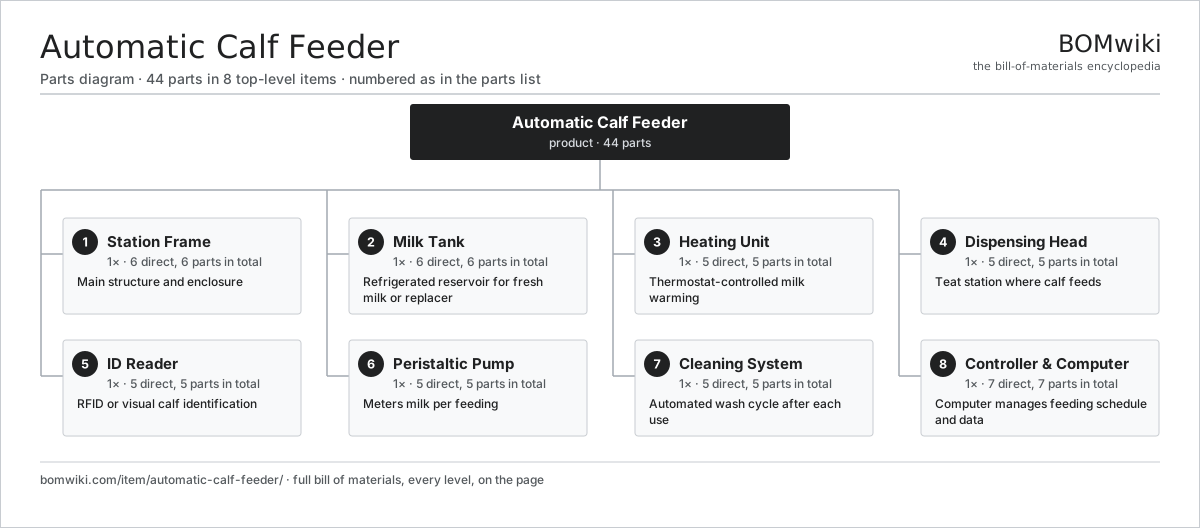
| # | Part | Qty | What it does |
|---|---|---|---|
| 1 | Station Frame 6 parts | 1× | Main structure and enclosure |
| 2 | Milk Tank 6 parts | 1× | Refrigerated reservoir for fresh milk or replacer |
| 3 | Heating Unit 5 parts | 1× | Thermostat-controlled milk warming |
| 4 | Dispensing Head 5 parts | 1× | Teat station where calf feeds |
| 5 | ID Reader 5 parts | 1× | RFID or visual calf identification |
| 6 | Peristaltic Pump 5 parts | 1× | Meters milk per feeding |
| 7 | Cleaning System 5 parts | 1× | Automated wash cycle after each use |
| 8 | Controller & Computer 7 parts | 1× | Computer manages feeding schedule and data |
3D model
No 3D model yet. Have a CAD file of this? Add a 3D model. STL renders right on this page; STEP, FreeCAD, and OpenSCAD sources are welcome too (openly licensed, like all 3D models on BOMwiki).
Build & assembly graph
expand / collapse · shared sub-assemblies converge · links to related products · est. labourTap an assembly to expand/collapse · tap a part to open it · use “Open page” for any node · drag to pan, scroll to zoom.
Bill of materials for Automatic Calf Feeder
8 top-level lines · 52 rows shown · 44 parts total · indented to 3 levels| # | Item / sub-assembly | Part no. | Qty/assy | Ext. qty | Parts | Type |
|---|---|---|---|---|---|---|
| 1 | Station Frame 6 parts | auto-calf-feeder-station-frame | 1× | 1 | 6 | assembly |
| 1.1 | Main Enclosure | auto-calf-feeder-main-enclosure | 1× | 1 | · | part |
| 1.2 | Internal Framework | auto-calf-feeder-internal-framework | 1× | 1 | · | part |
| 1.3 | Drainage Pan | auto-calf-feeder-drainage-pan | 1× | 1 | · | part |
| 1.4 | Floor Grate | auto-calf-feeder-floor-grate | 1× | 1 | · | part |
| 1.5 | Access Door | auto-calf-feeder-access-door | 1× | 1 | · | part |
| 1.6 | Fastener Set | fastener-set | 1× | 1 | · | part |
| 2 | Milk Tank 6 parts | auto-calf-feeder-milk-tank | 1× | 1 | 6 | assembly |
| 2.1 | Tank Shell | auto-calf-feeder-tank-shell | 1× | 1 | · | part |
| 2.2 | Tank Thermostat | auto-calf-feeder-tank-thermostat | 1× | 1 | · | part |
| 2.3 | Tank Cooling Element | auto-calf-feeder-tank-cooling-element | 1× | 1 | · | part |
| 2.4 | Tank Drain Valve | auto-calf-feeder-tank-drain-valve | 1× | 1 | · | part |
| 2.5 | Tank Fill Opening | auto-calf-feeder-tank-fill-opening | 1× | 1 | · | part |
| 2.6 | Fastener Set | fastener-set | 1× | 1 | · | part |
| 3 | Heating Unit 5 parts | auto-calf-feeder-heating-unit | 1× | 1 | 5 | assembly |
| 3.1 | Heating Element | auto-calf-feeder-heating-element | 1× | 1 | · | part |
| 3.2 | Heating Thermostat | auto-calf-feeder-heating-thermostat | 1× | 1 | · | part |
| 3.3 | Temperature Sensor | auto-calf-feeder-temperature-sensor | 1× | 1 | · | part |
| 3.4 | Heat Exchanger | auto-calf-feeder-heat-exchanger | 1× | 1 | · | part |
| 3.5 | Fastener Set | fastener-set | 1× | 1 | · | part |
| 4 | Dispensing Head 5 parts | auto-calf-feeder-dispensing-head | 1× | 1 | 5 | assembly |
| 4.1 | Teat Rubber | auto-calf-feeder-teat-rubber | 1× | 1 | · | part |
| 4.2 | Teat Valve | auto-calf-feeder-teat-valve | 1× | 1 | · | part |
| 4.3 | Teat Sensor | auto-calf-feeder-teat-sensor | 1× | 1 | · | part |
| 4.4 | Spill Shield | auto-calf-feeder-spill-shield | 1× | 1 | · | part |
| 4.5 | Fastener Set | fastener-set | 1× | 1 | · | part |
| 5 | ID Reader 5 parts | auto-calf-feeder-id-reader | 1× | 1 | 5 | assembly |
| 5.1 | RFID Antenna | auto-calf-feeder-rfid-antenna | 1× | 1 | · | part |
| 5.2 | RFID Reader Module | auto-calf-feeder-rfid-reader-module | 1× | 1 | · | part |
| 5.3 | Visual Camera | auto-calf-feeder-visual-camera | 1× | 1 | · | part |
| 5.4 | Manual Entry Keypad | auto-calf-feeder-manual-entry-keypad | 1× | 1 | · | part |
| 5.5 | Fastener Set | fastener-set | 1× | 1 | · | part |
| 6 | Peristaltic Pump 5 parts | auto-calf-feeder-peristaltic-pump | 1× | 1 | 5 | assembly |
| 6.1 | Pump Motor | auto-calf-feeder-pump-motor | 1× | 1 | · | part |
| 6.2 | Pump Head | auto-calf-feeder-pump-head | 1× | 1 | · | part |
| 6.3 | Pump Flow Meter | auto-calf-feeder-pump-flow-meter | 1× | 1 | · | part |
| 6.4 | Pump Check Valve | auto-calf-feeder-pump-check-valve | 1× | 1 | · | part |
| 6.5 | Fastener Set | fastener-set | 1× | 1 | · | part |
| 7 | Cleaning System 5 parts | auto-calf-feeder-cleaning-system | 1× | 1 | 5 | assembly |
| 7.1 | Wash Pump | auto-calf-feeder-wash-pump | 1× | 1 | · | part |
| 7.2 | Sanitizer Dispenser | auto-calf-feeder-sanitizer-dispenser | 1× | 1 | · | part |
| 7.3 | Wash Cycle Valve | auto-calf-feeder-wash-cycle-valve | 1× | 1 | · | part |
| 7.4 | Drain Solenoid | auto-calf-feeder-drain-solenoid | 1× | 1 | · | part |
| 7.5 | Fastener Set | fastener-set | 1× | 1 | · | part |
| 8 | Controller & Computer 7 parts | auto-calf-feeder-controller | 1× | 1 | 7 | assembly |
| 8.1 | PLC Module | auto-calf-feeder-plc-module | 1× | 1 | · | part |
| 8.2 | Touchscreen Display | auto-calf-feeder-touchscreen-display | 1× | 1 | · | part |
| 8.3 | Cellular Modem | auto-calf-feeder-cellular-modem | 1× | 1 | · | part |
| 8.4 | Data Storage | auto-calf-feeder-data-storage | 1× | 1 | · | part |
| 8.5 | Power Supply | auto-calf-feeder-power-supply | 1× | 1 | · | part |
| 8.6 | Battery Backup | auto-calf-feeder-battery-backup | 1× | 1 | · | part |
| 8.7 | Fastener Set | fastener-set | 1× | 1 | · | part |
Something wrong in this list? Report a problem with this BOM.
Sourcing: possible vendors
Browse the supplier directory → Prices, MOQ, and lead times are algorithmic estimates, not quotes, and not claims about these companies. Company mappings are curated by keyword; est. price band $5k–$800k. How estimates work| Vendor | HQ | Specialty | MOQ | Lead time |
|---|---|---|---|---|
| deere.com ↗ | Moline, US | Agriculture & turf | made to order | 14–24 wks |
| cnh.com ↗ | Basildon, GB | Agriculture (Case IH, New Holland) | made to order | 14–24 wks |
|
🇺🇸AGCO
agcocorp.com ↗
|
Duluth, US | Agriculture (Fendt, Massey Ferguson) | made to order | 14–24 wks |
|
🇩🇪Claas
claas.com ↗
|
Harsewinkel, DE | Harvesters & tractors | made to order | 14–24 wks |
|
🇯🇵Kubota
kubota.com ↗
|
Osaka, JP | Compact tractors & equipment | made to order | 14–24 wks |
2,094-word article