Automatic Chain Oiler
ProductOverview
An automatic chain oiler is an electronic system that dispenses lubrication oil onto the motorcycle chain while riding, replacing manual oiling or spray maintenance. The system continuously drips small amounts of oil at intervals proportional to engine speed or wheel speed, ensuring the chain stays lubricated without rider intervention. This reduces chain stretch, sprocket wear, and improves fuel efficiency by lowering rolling friction. Modern systems also prevent oil overspray, keeping the rear wheel and tire cleaner than manual lubrication.
Lubrication Fundamentals
Motorcycle chains operate under cyclic bending and tension loads, rotating around thousands of riveted pin-and-bushing joints. Each link moves through four positions per cycle:
- Tight side (under tension): Pulling the sprocket forward.
- Transition: Wrapping around the top of the rear sprocket.
- Slack side (returning): Slack enough to allow flexing.
- Wrap: Engaging the bottom sprocket.
Friction at the pin-bushing interface (inside the chain link) generates heat and wear. Without oil, a chain can wear out in 5,000–10,000 km. With manual oiling, lifespan extends to 20,000–30,000 km. With automatic oiling, chains can last 40,000–60,000 km or more.
The automatic oiler delivers just enough oil to keep the internal pin-bushing friction low without excess oil fling, which would soil the rear wheel and tire (and waste oil).
Pump Architecture
The Metering Pump is a solenoid-driven piston pump:
Actuation Sequence
Idle state: The Return Spring holds the Pump Piston in the extended position, with the pump chamber filled with oil from the Oil Reservoir Tank.
Solenoid pulse: The Electronic Controller MCU energizes the Solenoid Actuator coil (12 V, 2–5 W), generating a magnetic field that pulls the piston inward.
Compression: As the piston moves inward 5–10 mm, it compresses the oil in the chamber, raising internal pressure to 5–10 bar.
Check valve opening: When chamber pressure exceeds the cracking pressure (2–5 bar, set by a spring-loaded Injection Port Valve), the check valve opens, allowing pressurized oil to flow through the Delivery System toward the nozzle.
Delivery: A precise volume of oil (0.5–2 mL per solenoid pulse) is delivered to the chain in a single drip or fine stream.
Spring return: When the solenoid de-energizes, the spring pushes the piston back, refilling the chamber from the reservoir.
Pulse Rate Modulation
The Microcontroller modulates solenoid pulse frequency (0.5–5 Hz) based on engine RPM or wheel speed:
- Idle (1000 RPM): 0.5 Hz (1 pulse every 2 seconds).
- Cruising (5000 RPM): 2 Hz (1 pulse every 0.5 seconds).
- High speed (10,000 RPM): 5 Hz (1 pulse every 0.2 seconds).
This adaptive delivery ensures the chain receives more oil when stressed (high speed, high load) and less when at rest.
Electronic Control Loop
The automatic-chain-chain-oiler-controller is the decision-making unit:
Sensor Input
The Speed Sensor Input measures engine speed via one of three methods:
- Hall-effect pickup: Detects a magnet on the crankshaft or engine pulley; sends a square-wave frequency signal to the MCU. Clean, simple, reliable.
- Pulse coil: Wired to the bike's ignition system; detects one pulse per engine revolution. Common on carbureted bikes.
- CAN bus tap: For fuel-injected bikes, the controller listens to engine-management CAN messages to extract RPM directly.
The MCU samples input frequency every 100 ms and calculates current RPM using a low-pass filter to reject electrical noise.
Flow Adjustment
The Adjustment Potentiometer potentiometer is a 10 kΩ variable resistor that the rider adjusts via a knob or dial mounted on the motorcycle fairing or center console. This analog input sets a gain multiplier on the pulse frequency:
- Min (counterclockwise): Pulses disabled or reduced to 10% of calculated frequency.
- Mid: Standard frequency (100% of calculated, typically 0.5–5 Hz at normal speeds).
- Max (clockwise): Increased frequency (150–200% of calculated, for wet or harsh conditions).
Output Control
Once the MCU calculates target pulse frequency, it outputs a 12 V PWM (pulse-width modulation) or on-off signal to the Solenoid Driver solenoid driver. The relay or MOSFET switches the full 12 V DC supply to the solenoid coil at the commanded frequency.
Oil Delivery Path
Nozzle Positioning
The Drip Nozzle is mounted on a bracket near the chain, typically positioned at the bottom run of the chain (between engine sprocket and rear sprocket) or on the top run. The nozzle:
- Discharges oil vertically downward or at a 30–45° angle into the chain.
- Is positioned 20–50 mm away from the chain to avoid direct splashing.
- Has an orifice size of 0.5–1.5 mm diameter, creating a fine drip or small spray.
At typical pulse volumes (0.5–2 mL) and frequencies (1–5 Hz), the chain receives 0.3–10 mL/minute, which is distributed to internal pin-bushing surfaces by centrifugal force and gravity.
Hose Routing
The Delivery Hose (4–6 mm ID, 200–300 cm long) is routed along the frame, secured by Hose Clip stainless steel clips every 10–15 cm. Routing considerations:
- Avoid sharp bends (minimum 50 mm bend radius) to prevent kinking.
- Stay clear of hot engine surfaces (exhaust, cylinder head).
- Keep away from moving chains or belts (pulleys).
- Prevent the hose from rubbing on frame edges.
Vibration-induced fatigue is the primary hose failure mode; proper clipping and isolators extend hose life to 5+ years.
Reservoir & Filtration
The Oil Reservoir Tank (200–500 mL capacity) typically holds ISO VG 90 gear oil, SAE 80W90 motor oil, or automatic transmission fluid (ATF). The choice depends on climate and application:
- Synthetic PAO-based oil: Thinner, flows better at cold startup; better oxidation stability.
- Mineral gear oil: Cheaper, thicker, better for high-temperature environments.
- ATF: Multi-purpose, good flow, reduces pump cavitation risk.
The Intake Strainer (100–200 micron mesh) sits at the pump inlet, catching rust particles and debris from the reservoir. Over time, the filter clogs; periodic backflushing or replacement (every 1000–2000 km) maintains pump reliability.
Oil Supply Rate Calculation
Oil consumption on a motorcycle chain depends on speed, load, and weather:
- City riding (5,000 km/month, 30 km/h average): ~5 mL/day, refill every 10–20 days.
- Highway riding (10,000 km/month, 100 km/h average): ~10–15 mL/day, refill weekly.
- Track riding (high speeds, hard acceleration): ~20–30 mL/day, refill every 2–3 days.
A 200 mL tank is exhausted in roughly:
- City: 40 days
- Highway: 14 days
- Track: 7–10 days
Riders typically check and refill the reservoir weekly during regular maintenance.
Advantages & Limitations
Advantages
- Extended chain life: Proper lubrication reduces wear by 50–70%, extending interval from 30,000 km to 60,000 km.
- Reduced maintenance: Eliminates manual spraying, which is messy and incomplete.
- Cleaner bike: Excess oil doesn't fling onto the rear wheel and tire, reducing dirt accumulation.
- Better fuel efficiency: Lower chain friction reduces parasitic drag by 1–2%.
- Adaptive flow: Automatic adjustment based on riding speed means no manual intervention.
Limitations
- Requires electrical power: Must be integrated with the bike's 12 V system; battery-powered systems run 200–500 hours per charge.
- Complex troubleshooting: Oil buildup in the nozzle can cause clogging; diagnosis requires hose disassembly.
- Cost: Automatic systems cost USD 150–400; manual chain maintenance (spray every 500 km) is cheaper upfront.
- Reservoir refilling: Must monitor oil level and refill periodically (less convenient than carrying a spray can).
- Oil type constraints: Some systems require specific oil grades; incompatible oils can damage seals or clog the pump.
Clogging Prevention
The Drip Nozzle is the most failure-prone component. Clogging occurs when:
- Oil thickens at low temperature and doesn't flow.
- Dirt or oxidized oil particles accumulate in the 0.5–1.5 mm orifice.
- The pump pressure drops below the check-valve cracking pressure, trapping oil in the hose.
Prevention strategies:
- Use fresh oil and replace every season (oil oxidizes over time).
- Keep the Intake Strainer clean; backflush or replace every 1000 km.
- Run the pump weekly (even in off-season) to circulate oil and prevent stagnation.
- Position the nozzle such that oil drips by gravity even if pump pressure drops.
- Perform annual nozzle inspection and cleaning (soak in solvent if necessary).
Installation Considerations
Automatic oilers are typically installed as a kit on new motorcycles or retrofitted to older bikes:
- Drill a small hole in the frame for the speed sensor (or tap into the ignition system).
- Mount the Mounting Bracket to the frame near the chain, using M8 bolts and rubber isolators.
- Route the delivery hose along the frame, securing with clips every 10–15 cm.
- Position the nozzle 20–50 mm from the chain at the bottom or top run.
- Connect the controller wiring to the 12 V battery (fused circuit, 5 A minimum).
- Calibrate the speed sensor input and set the potentiometer to mid-range.
- Fill the reservoir and test the pump by grounding the solenoid signal wire (should hear a solenoid click and feel oil in the hose).
Installation takes 2–4 hours on average for an experienced mechanic.
Standards & Certification
Automatic chain oilers are not subject to ECE or ISO certification. However, manufacturers typically test for:
- IP67 waterproofing (controller enclosure must survive rain and chain wash).
- Vibration isolation (rubber mounts rated for 500–2000 Hz motorcycle vibration).
- Pressure relief (pump designed to handle backpressure if hose is pinched; relief valve opens at ~15 bar).
- Temperature range (-10°C to +80°C ambient operation).
Third-party reviews (motorcycle magazines, YouTube channels) often validate reliability and ease of use before purchase.
Automatic Chain Oiler parts and their functions
6 top-level parts · 21 parts in total · full bill of materials below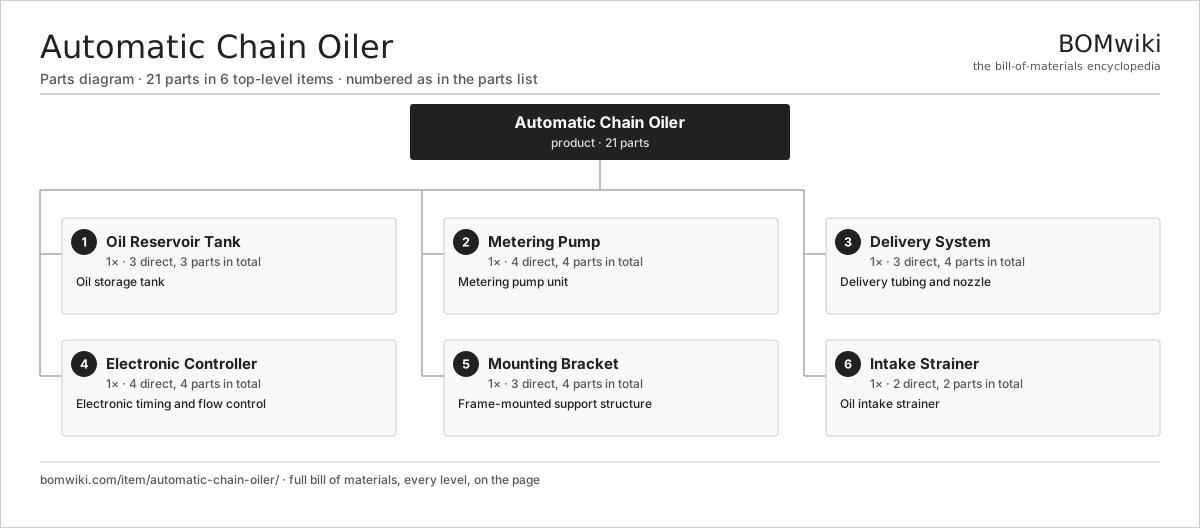
| # | Part | Qty | What it does |
|---|---|---|---|
| 1 | Oil Reservoir Tank 3 parts | 1× | Oil storage tank |
| 2 | Metering Pump 4 parts | 1× | Metering pump unit |
| 3 | Delivery System 3 parts | 1× | Delivery tubing and nozzle |
| 4 | Electronic Controller 4 parts | 1× | Electronic timing and flow control |
| 5 | Mounting Bracket 3 parts | 1× | Frame-mounted support structure |
| 6 | Intake Strainer 2 parts | 1× | Oil intake strainer |
3D model
No 3D model yet. Have a CAD file of this? Add a 3D model. STL renders right on this page; STEP, FreeCAD, and OpenSCAD sources are welcome too (openly licensed, like all 3D models on BOMwiki).
Build & assembly graph
expand / collapse · shared sub-assemblies converge · links to related products · est. labourTap an assembly to expand/collapse · tap a part to open it · use “Open page” for any node · drag to pan, scroll to zoom.
Bill of materials for Automatic Chain Oiler
6 top-level lines · 25 rows shown · 21 parts total · indented to 3 levels| # | Item / sub-assembly | Part no. | Qty/assy | Ext. qty | Parts | Type |
|---|---|---|---|---|---|---|
| 1 | Oil Reservoir Tank 3 parts | automatic-chain-oiler-reservoir | 1× | 1 | 3 | assembly |
| 1.1 | Tank Shell | automatic-chain-oiler-reservoir-body | 1× | 1 | · | part |
| 1.2 | Filler Cap | automatic-chain-oiler-reservoir-cap | 1× | 1 | · | part |
| 1.3 | Mounting Feet | automatic-chain-oiler-reservoir-mount | 1× | 1 | · | part |
| 2 | Metering Pump 4 parts | automatic-chain-oiler-pump | 1× | 1 | 4 | assembly |
| 2.1 | Pump Piston | automatic-chain-oiler-pump-piston | 1× | 1 | · | part |
| 2.2 | Injection Port Valve | automatic-chain-oiler-pump-valve | 1× | 1 | · | part |
| 2.3 | Return Spring | automatic-chain-oiler-pump-spring | 1× | 1 | · | part |
| 2.4 | Solenoid Actuator | automatic-chain-oiler-pump-solenoid | 1× | 1 | · | part |
| 3 | Delivery System 3 parts | automatic-chain-oiler-line | 1× | 1 | 4 | assembly |
| 3.1 | Delivery Hose | automatic-chain-oiler-line-tube | 1× | 1 | · | part |
| 3.2 | Drip Nozzle | automatic-chain-oiler-line-nozzle | 1× | 1 | · | part |
| 3.3 | Hose Clip | automatic-chain-oiler-line-clamp | 2× | 2 | · | part |
| 4 | Electronic Controller 4 parts | automatic-chain-oiler-controller | 1× | 1 | 4 | assembly |
| 4.1 | Microcontroller | automatic-chain-oiler-controller-mcu | 1× | 1 | · | part |
| 4.2 | Solenoid Driver | automatic-chain-oiler-controller-relay | 1× | 1 | · | part |
| 4.3 | Speed Sensor Input | automatic-chain-oiler-controller-sensor | 1× | 1 | · | part |
| 4.4 | Adjustment Potentiometer | automatic-chain-oiler-controller-pot | 1× | 1 | · | part |
| 5 | Mounting Bracket 3 parts | automatic-chain-oiler-bracket | 1× | 1 | 4 | assembly |
| 5.1 | Support Strut | automatic-chain-oiler-bracket-arm | 1× | 1 | · | part |
| 5.2 | Mounting Bolt | automatic-chain-oiler-bracket-fastener | 2× | 2 | · | part |
| 5.3 | Vibration Isolator | automatic-chain-oiler-bracket-spacer | 1× | 1 | · | part |
| 6 | Intake Strainer 2 parts | automatic-chain-oiler-filter | 1× | 1 | 2 | assembly |
| 6.1 | Filter Mesh | automatic-chain-oiler-filter-element | 1× | 1 | · | part |
| 6.2 | Filter Housing | automatic-chain-oiler-filter-housing | 1× | 1 | · | part |
Something wrong in this list? Report a problem with this BOM.
Sourcing: possible vendors
Browse the supplier directory → Prices, MOQ, and lead times are algorithmic estimates, not quotes, and not claims about these companies. Company mappings are curated by keyword; est. price band $300–$15k. How estimates work| Vendor | HQ | Specialty | MOQ | Lead time |
|---|---|---|---|---|
| global.honda ↗ | Tokyo, JP | Motorcycles & power products | made to order | 10–16 wks |
| yamaha-motor.com ↗ | Iwata, JP | Motorcycles & marine | made to order | 10–16 wks |
| heromotocorp.com ↗ | New Delhi, IN | Motorcycle & scooter maker | made to order | 10–16 wks |
| bajajauto.com ↗ | Pune, IN | Two- & three-wheeler maker | made to order | 10–16 wks |
| harley-davidson.com ↗ | Milwaukee, US | Motorcycles | made to order | 10–16 wks |
1,676-word article