Automatic Smoke Vent
ProductOverview
In a burning warehouse the killer is rarely the flame front; it is the smoke layer that descends from the roof and erases visibility within minutes. Automatic smoke vents attack that layer directly. Installed on the roofs of single-storey industrial and big-box buildings, typically one vent per 100 m² over high-hazard storage, they are double-door hatches that stay shut for years and then must open fully, unattended, within seconds of heat arrival. Open vents let the buoyant smoke plume escape vertically, holding the smoke layer above head height so occupants can find exits and firefighters can find the seat of the fire. NFPA 204 governs the engineering of vent area and spacing; UL 793 and FM 4430 govern the hardware itself.
The defining requirement is autonomy. A vent must work with the building power dead and the sprinklers steaming, so the baseline mechanism is wholly mechanical: stored spring energy released by a melting link.
How it works
In service the two leaves of the Vent Doors are held shut by Latch Hooks against the constant preload of four Gas Springs, the doors are always trying to open. The latch is restrained through the Release Lever by a Fusible Link, a eutectic-solder element rated 74 °C for most occupancies (100 °C where roof temperatures run hot). When the fire plume heats the link past its rating, the solder yields, the lever trips, and the gas springs throw both leaves through their arc in under five seconds, against up to 0.5 kPa of snow on the covers, which is why the springs look oversized for the door weight.
Each leaf swings just past vertical, where the Opening Limiter arrests it on a Damper Pad and the Hold-Open Arm locks it there. Locking open matters: a fire generates violent gusts, and a vent that blows shut mid-fire is worse than none because the smoke-control design assumed its area. The double-leaf format halves the swept volume of each door and presents a lower profile to wind from any direction than a single large flap.
Firefighters can also fire the vent manually from floor level via the Manual Pull Cable, standard practice when ventilating ahead of an interior attack. After a test or activation, the Reset Handle winches the doors back against their springs and re-latches them with a fresh link.
Electric actuation
Where the building has engineered smoke control, the vent adds the Electric Control Option package: a 24 V DC Release Actuator trips the same latch on command from the fire-alarm panel, Position Switches report open/closed state, and Relay contacts integrate with the smoke-control sequence. The fusible link remains in the chain as the fail-safe, the panel can open the vent early, but loss of the panel cannot prevent thermal release. One coordination point is deliberate: in sprinklered buildings, designers often specify a link temperature above the sprinkler rating so the sprinklers get first chance to control the fire before venting accelerates it; NFPA 204 addresses this sprinkler-vent interaction explicitly.
Construction
Each cover is a Cover Pan over an Insulation Core with an inner liner, gasketed to the curb by an EPDM Cover Gasket and carried on heavy Cover Hinges. Closed, the assembly is simply part of the roof: it must carry 1.4 kPa of snow and foot-traffic live load, resist 0.7 kPa of internal uplift, and not leak for decades. The Curb Frame raises the throat about 300 mm above the membrane, with Counterflashing receiving the roofing and Curb Insulation breaking the thermal bridge.
Because an opened or burned-out vent is a hole in the roof, OSHA treats the throat as a floor opening; the Fall-Protection Grille spans it with welded grating rated to arrest a falling worker, removable for service via Grille Clips. A Padlock Tab secures the vent against roof-side intrusion without touching the release chain.
Sizing and standards
Vent effectiveness is quoted as aerodynamic free area, geometric throat area derated by a discharge coefficient of roughly 0.6–0.7, measured per EN 12101-2 in Europe. NFPA 204 design balances vent area against inlet air: exhaust only works if makeup air can enter low in the building, so vent schedules pair with door and louver provisions. Typical practice over high-piled storage runs vent ratios near 1:50 to 1:100 of floor area with curtain boards subdividing the roof into smoke reservoirs. UL 793 listing requires the assembly to open under load, survive 30 days of vibration and corrosion conditioning, and still release at the link's rated temperature.
Automatic Smoke Vent parts and their functions
7 top-level parts · 60 parts in total · full bill of materials below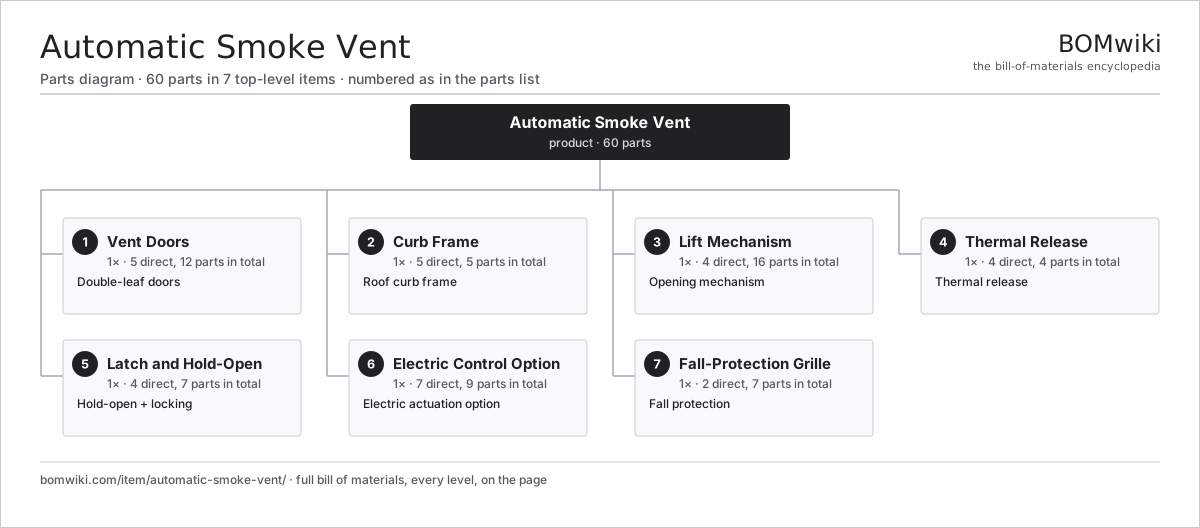
| # | Part | Qty | What it does |
|---|---|---|---|
| 1 | Vent Doors 5 parts | 1× | Double-leaf doors |
| 2 | Curb Frame 5 parts | 1× | Roof curb frame |
| 3 | Lift Mechanism 4 parts | 1× | Opening mechanism |
| 4 | Thermal Release 4 parts | 1× | Thermal release |
| 5 | Latch and Hold-Open 4 parts | 1× | Hold-open + locking |
| 6 | Electric Control Option 7 parts | 1× | Electric actuation option |
| 7 | Fall-Protection Grille 2 parts | 1× | Fall protection |
3D model
No 3D model yet. Have a CAD file of this? Add a 3D model. STL renders right on this page; STEP, FreeCAD, and OpenSCAD sources are welcome too (openly licensed, like all 3D models on BOMwiki).
Build & assembly graph
expand / collapse · shared sub-assemblies converge · links to related products · est. labourTap an assembly to expand/collapse · tap a part to open it · use “Open page” for any node · drag to pan, scroll to zoom.
Bill of materials for Automatic Smoke Vent
7 top-level lines · 38 rows shown · 60 parts total · indented to 3 levels| # | Item / sub-assembly | Part no. | Qty/assy | Ext. qty | Parts | Type |
|---|---|---|---|---|---|---|
| 1 | Vent Doors 5 parts | automatic-smoke-vent-covers | 1× | 1 | 12 | assembly |
| 1.1 | Cover Pan | automatic-smoke-vent-cover-pan | 2× | 2 | · | part |
| 1.2 | Insulation Core | automatic-smoke-vent-insulation-core | 2× | 2 | · | part |
| 1.3 | Sheet Metal Panel | sheet-panel | 2× | 2 | · | part |
| 1.4 | Cover Gasket | automatic-smoke-vent-cover-gasket | 2× | 2 | · | part |
| 1.5 | Cover Hinge | automatic-smoke-vent-hinge | 4× | 4 | · | part |
| 2 | Curb Frame 5 parts | automatic-smoke-vent-curb | 1× | 1 | 5 | assembly |
| 2.1 | Curb Wall | automatic-smoke-vent-curb-wall | 1× | 1 | · | part |
| 2.2 | Curb Insulation | automatic-smoke-vent-curb-insulation | 1× | 1 | · | part |
| 2.3 | Counterflashing | automatic-smoke-vent-counterflashing | 1× | 1 | · | part |
| 2.4 | Mounting Flange | automatic-smoke-vent-mounting-flange | 1× | 1 | · | part |
| 2.5 | Fastener Set | fastener-set | 1× | 1 | · | part |
| 3 | Lift Mechanism 4 parts | automatic-smoke-vent-lift | 1× | 1 | 16 | assembly |
| 3.1 | Gas Spring | automatic-smoke-vent-gas-spring | 4× | 4 | · | part |
| 3.2 | Spring Mount | automatic-smoke-vent-spring-mount | 8× | 8 | · | part |
| 3.3 | Opening Limiter | automatic-smoke-vent-opening-limiter | 2× | 2 | · | part |
| 3.4 | Damper Pad | automatic-smoke-vent-damper-pad | 2× | 2 | · | part |
| 4 | Thermal Release 4 parts | automatic-smoke-vent-release | 1× | 1 | 4 | assembly |
| 4.1 | Fusible Link | automatic-smoke-vent-fusible-link | 1× | 1 | · | part |
| 4.2 | Release Lever | automatic-smoke-vent-release-lever | 1× | 1 | · | part |
| 4.3 | Manual Pull Cable | automatic-smoke-vent-pull-cable | 1× | 1 | · | part |
| 4.4 | Reset Handle | automatic-smoke-vent-reset-handle | 1× | 1 | · | part |
| 5 | Latch and Hold-Open 4 parts | automatic-smoke-vent-latch | 1× | 1 | 7 | assembly |
| 5.1 | Latch Hook | automatic-smoke-vent-latch-hook | 2× | 2 | · | part |
| 5.2 | Hold-Open Arm | automatic-smoke-vent-hold-open-arm | 2× | 2 | · | part |
| 5.3 | Coil Spring | coil-spring | 2× | 2 | · | part |
| 5.4 | Padlock Tab | automatic-smoke-vent-padlock-tab | 1× | 1 | · | part |
| 6 | Electric Control Option 7 parts | automatic-smoke-vent-controls | 1× | 1 | 9 | assembly |
| 6.1 | Release Actuator | automatic-smoke-vent-actuator | 1× | 1 | · | part |
| 6.2 | Bare PCB | pcb-bare | 1× | 1 | · | part |
| 6.3 | Microcontroller | mcu | 1× | 1 | · | part |
| 6.4 | Relay | relay | 2× | 2 | · | part |
| 6.5 | SMD Passive (R/C/L) | smd-passives | 1× | 1 | · | part |
| 6.6 | Wire Bundle | wire-bundle | 1× | 1 | · | part |
| 6.7 | Position Switch | automatic-smoke-vent-position-switch | 2× | 2 | · | part |
| 7 | Fall-Protection Grille 2 parts | automatic-smoke-vent-grille | 1× | 1 | 7 | assembly |
| 7.1 | Grille Panel | automatic-smoke-vent-grille-panel | 1× | 1 | · | part |
| 7.2 | Grille Clip | automatic-smoke-vent-grille-clip | 6× | 6 | · | part |
Something wrong in this list? Report a problem with this BOM.
Related products
same domain, ranked by shared parts Smart Parcel Locker
278 parts · shares 4 with this page
Heavy Shoring Tower System
481 parts · shares 3 with this page
Smart Parcel Locker
278 parts · shares 4 with this page
Heavy Shoring Tower System
481 parts · shares 3 with this page
 Hollowcore Slab Extruder
547 parts · shares 3 with this page
Hollowcore Slab Extruder
547 parts · shares 3 with this page
 LED Scoreboard
161 parts · shares 3 with this page
LED Scoreboard
161 parts · shares 3 with this page
 Precast Concrete Mold
493 parts · shares 3 with this page
Precast Concrete Mold
493 parts · shares 3 with this page
 Access Control Panel
52 parts · shares 3 with this page
Access Control Panel
52 parts · shares 3 with this page
Sourcing: possible vendors
Browse the supplier directory → Prices, MOQ, and lead times are algorithmic estimates, not quotes, and not claims about these companies. Company mappings are curated by keyword; est. price band $50–$10k. How estimates work| Vendor | HQ | Specialty | MOQ | Lead time |
|---|---|---|---|---|
| assaabloy.com ↗ | Stockholm, SE | Locks & access | 1,000 units | 8–12 wks |
|
🇺🇸Allegion
allegion.com ↗
|
Dublin, US | Security products (Schlage) | 1,000 units | 8–12 wks |
| dormakaba.com ↗ | Rümlang, CH | Access & door systems | 1,000 units | 8–12 wks |
| honeywell.com ↗ | Charlotte, US | Building & safety tech | 1,000 units | 8–12 wks |
| hikvision.com ↗ | Hangzhou, CN | Surveillance & security | 1,000 units | 8–12 wks |
840-word article