Automatic Titrator
ProductOverview
The automatic titrator is a laboratory instrument that performs volumetric chemical analysis without manual burette reading or visual indicator judgement. It dispenses a titrant of known concentration into a sample and finds the point at which the reaction is complete, then calculates the analyte concentration from the dispensed volume. Automating the process improves precision over hand titration, removes operator bias in endpoint detection, and allows unattended series of samples. Common applications include acid–base, redox, precipitation, and complexometric titrations across water analysis, food, pharmaceuticals, and petrochemicals.
A titration follows the stoichiometry of a known reaction. If the titrant concentration and the volume consumed at the equivalence point are both known, the moles of analyte follow directly. The instrument's job is to add titrant accurately and to detect the equivalence point objectively, which it does electrochemically rather than by color change.
Construction
The dispensing core is the Burette Drive. A stepper motor turns a Dosing Piston in a borosilicate cylinder through a Rotary Valve Block that switches between filling from the reservoir and dispensing to the sample. Because the cylinder is divided into roughly ten thousand motor steps, a 10 mL unit resolves about one microliter per step. The reagent itself lives in the exchangeable Dosing Unit, whose Reagent ID Chip records titrant identity, concentration, and the date its titer was last verified, so the system can flag stale reagents and apply the correct standardization factor automatically.
Endpoint sensing relies on the Sensing Electrode. For acid–base work this is a combined glass electrode: the Glass Membrane develops a potential proportional to hydrogen-ion activity, measured against the Reference Element, an Ag/AgCl half-cell joined to the sample through a porous liquid junction. An integrated Temperature Probe feeds temperature compensation. The electrode signal is extremely high impedance, so it is carried on a Electrode Cable to the Electrometer Input input, an amplifier with input resistance above 10^12 Ω that reads the membrane potential without drawing current from it.
The Magnetic Stirrer keeps the sample homogeneous so the electrode sees the bulk solution rather than a local pocket of unreacted titrant. A Stirrer Motor spins drive magnets beneath the beaker that couple to a PTFE Stir Bar; viscous samples instead use the overhead Propeller Stirrer. The Titration Tower holds the electrode, dosing tip, and stirrer in fixed geometry over the beaker, and its Lift Motor raises the head for rinsing and beaker changes.
How it works
The Controller Board runs the titration as a closed loop. After the operator selects a method on the Display Module, the controller commands the Motor Driver to dispense a small increment of titrant, waits for the reading on the Electrometer Input to stabilize, records the volume–potential pair, and repeats. As the equivalence point approaches, the measured potential changes steeply for each microliter added; the controller detects this rising slope and reduces the increment size to map the inflection finely, a strategy known as dynamic or equivalence-point titration.
The equivalence point is the volume at which the first derivative of the potential-versus-volume curve is maximal, the inflection of the titration curve. The controller computes this derivative numerically and reports the volume at its peak, then combines it with the stored titrant concentration and sample weight to output the analyte content. Fixed-endpoint methods instead dose until a target potential or pH is reached, which is used for standards that specify titration to a defined pH.
Between samples the Dosing Tip design limits back-diffusion of titrant into the sample, and the Dosing Tubing and Rotary Valve Block are flushed during refill. The Housing is chemically resistant and incorporates a Drip Tray that routes spills away from the electronics, while the reagent bottle carries a drying tube so that titrants like sodium hydroxide do not absorb atmospheric carbon dioxide and drift in concentration.
Automatic Titrator parts and their functions
10 top-level parts · 65 parts in total · full bill of materials below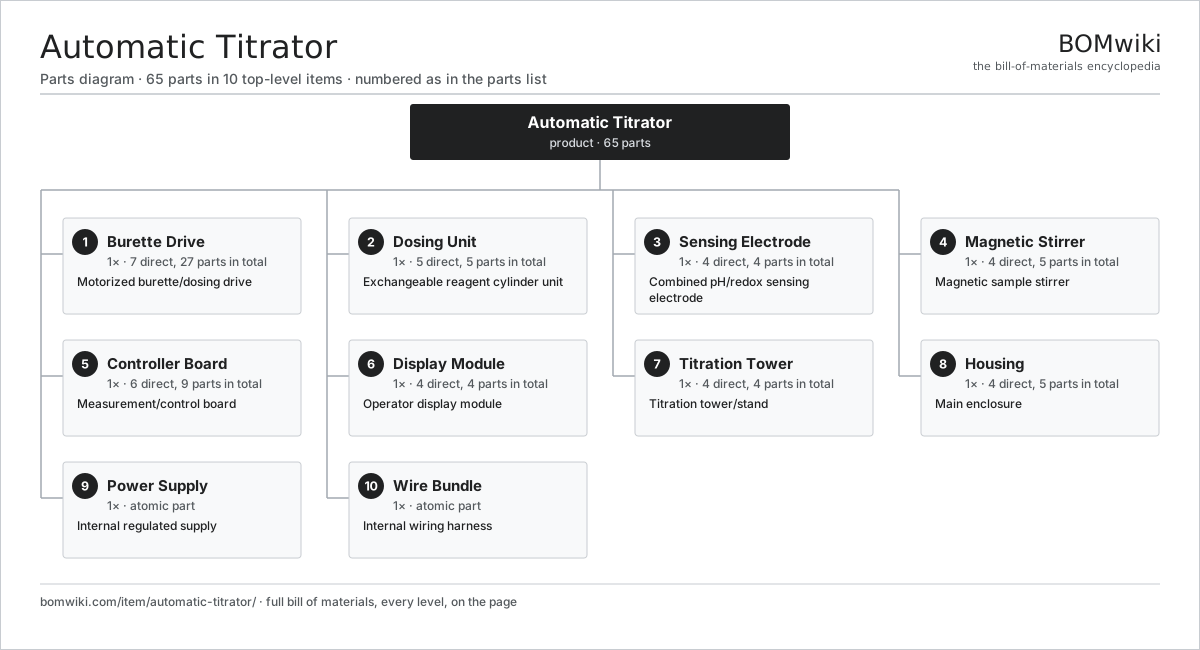
| # | Part | Qty | What it does |
|---|---|---|---|
| 1 | Burette Drive 7 parts | 1× | Motorized burette/dosing drive |
| 2 | Dosing Unit 5 parts | 1× | Exchangeable reagent cylinder unit |
| 3 | Sensing Electrode 4 parts | 1× | Combined pH/redox sensing electrode |
| 4 | Magnetic Stirrer 4 parts | 1× | Magnetic sample stirrer |
| 5 | Controller Board 6 parts | 1× | Measurement/control board |
| 6 | Display Module 4 parts | 1× | Operator display module |
| 7 | Titration Tower 4 parts | 1× | Titration tower/stand |
| 8 | Housing 4 parts | 1× | Main enclosure |
| 9 | Power Supply | 1× | Internal regulated supply |
| 10 | Wire Bundle | 1× | Internal wiring harness |
3D model
No 3D model yet. Have a CAD file of this? Add a 3D model. STL renders right on this page; STEP, FreeCAD, and OpenSCAD sources are welcome too (openly licensed, like all 3D models on BOMwiki).
Build & assembly graph
expand / collapse · shared sub-assemblies converge · links to related products · est. labourTap an assembly to expand/collapse · tap a part to open it · use “Open page” for any node · drag to pan, scroll to zoom.
Bill of materials for Automatic Titrator
10 top-level lines · 55 rows shown · 65 parts total · indented to 3 levels| # | Item / sub-assembly | Part no. | Qty/assy | Ext. qty | Parts | Type |
|---|---|---|---|---|---|---|
| 1 | Burette Drive 7 parts | automatic-titrator-burette-drive | 1× | 1 | 27 | assembly |
| 1.1 | Stator Assembly 3 parts | stator-assembly | 1× | 1 | 3 | assembly |
| 1.1.1 | Stator Core (laminations) | stator-core | 1× | 1 | · | part |
| 1.1.2 | Copper Winding | copper-winding | 1× | 1 | · | part |
| 1.1.3 | Slot Insulation | stator-insulation | 1× | 1 | · | part |
| 1.2 | Rotor Assembly 4 parts | rotor-assembly | 1× | 1 | 19 | assembly |
| 1.2.1 | Rotor Shaft | rotor-shaft | 1× | 1 | · | part |
| 1.2.2 | Rotor Core | rotor-core | 1× | 1 | · | part |
| 1.2.3 | Neodymium Magnet | neodymium-magnet | 16× | 16 | · | part |
| 1.2.4 | Ball Bearing | ball-bearing | 1× | 1 | · | part |
| 1.3 | Ball Screw | ball-screw | 1× | 1 | · | part |
| 1.4 | Dosing Piston | automatic-titrator-piston | 1× | 1 | · | part |
| 1.5 | Rotary Valve Block | automatic-titrator-valve-block | 1× | 1 | · | part |
| 1.6 | Encoder | encoder | 1× | 1 | · | part |
| 1.7 | Fastener Set | fastener-set | 1× | 1 | · | part |
| 2 | Dosing Unit 5 parts | automatic-titrator-dosing-unit | 1× | 1 | 5 | assembly |
| 2.1 | Reagent Bottle | automatic-titrator-reagent-bottle | 1× | 1 | · | part |
| 2.2 | Dosing Tubing | automatic-titrator-tubing | 1× | 1 | · | part |
| 2.3 | Dosing Tip | automatic-titrator-dosing-tip | 1× | 1 | · | part |
| 2.4 | Reagent ID Chip | automatic-titrator-id-chip | 1× | 1 | · | part |
| 2.5 | O-Ring Set | oring-set | 1× | 1 | · | part |
| 3 | Sensing Electrode 4 parts | automatic-titrator-electrode | 1× | 1 | 4 | assembly |
| 3.1 | Glass Membrane | automatic-titrator-glass-membrane | 1× | 1 | · | part |
| 3.2 | Reference Element | automatic-titrator-reference-element | 1× | 1 | · | part |
| 3.3 | Temperature Probe | automatic-titrator-temp-probe | 1× | 1 | · | part |
| 3.4 | Electrode Cable | automatic-titrator-electrode-cable | 1× | 1 | · | part |
| 4 | Magnetic Stirrer 4 parts | automatic-titrator-stirrer | 1× | 1 | 5 | assembly |
| 4.1 | Stirrer Motor | automatic-titrator-stirrer-motor | 1× | 1 | · | part |
| 4.2 | Neodymium Magnet | neodymium-magnet | 2× | 2 | · | part |
| 4.3 | Stir Bar | automatic-titrator-stir-bar | 1× | 1 | · | part |
| 4.4 | Propeller Stirrer | automatic-titrator-propeller | 1× | 1 | · | part |
| 5 | Controller Board 6 parts | automatic-titrator-controller | 1× | 1 | 9 | assembly |
| 5.1 | Bare PCB | pcb-bare | 1× | 1 | · | part |
| 5.2 | Microcontroller | mcu | 1× | 1 | · | part |
| 5.3 | Electrometer Input | automatic-titrator-electrometer | 1× | 1 | · | part |
| 5.4 | Motor Driver | automatic-titrator-motor-driver | 1× | 1 | · | part |
| 5.5 | SMD Passive (R/C/L) | smd-passives | 1× | 1 | · | part |
| 5.6 | Connector | connector | 4× | 4 | · | part |
| 6 | Display Module 4 parts | automatic-titrator-display | 1× | 1 | 4 | assembly |
| 6.1 | LCD Panel | lcd-panel | 1× | 1 | · | part |
| 6.2 | Touch Digitizer | touch-digitizer | 1× | 1 | · | part |
| 6.3 | Display Bezel | automatic-titrator-display-bezel | 1× | 1 | · | part |
| 6.4 | Connector | connector | 1× | 1 | · | part |
| 7 | Titration Tower 4 parts | automatic-titrator-tower | 1× | 1 | 4 | assembly |
| 7.1 | Tower Column | automatic-titrator-tower-column | 1× | 1 | · | part |
| 7.2 | Sensor Clamps | automatic-titrator-sensor-clamps | 1× | 1 | · | part |
| 7.3 | Lift Motor | automatic-titrator-lift-motor | 1× | 1 | · | part |
| 7.4 | Fastener Set | fastener-set | 1× | 1 | · | part |
| 8 | Housing 4 parts | automatic-titrator-housing | 1× | 1 | 5 | assembly |
| 8.1 | Front Panel | automatic-titrator-front-panel | 1× | 1 | · | part |
| 8.2 | Drip Tray | automatic-titrator-drip-tray | 1× | 1 | · | part |
| 8.3 | Sheet Metal Panel | sheet-panel | 2× | 2 | · | part |
| 8.4 | Fastener Set | fastener-set | 1× | 1 | · | part |
| 9 | Power Supply | power-supply | 1× | 1 | · | part |
| 10 | Wire Bundle | wire-bundle | 1× | 1 | · | part |
Something wrong in this list? Report a problem with this BOM.
Related products
same domain, ranked by shared parts Rockwell Hardness Tester
97 parts · shares 16 with this page
Rockwell Hardness Tester
97 parts · shares 16 with this page
 Flow Cytometer
110 parts · shares 16 with this page
Superconductor Materials Lab
1,846 parts · shares 16 with this page
Flow Cytometer
110 parts · shares 16 with this page
Superconductor Materials Lab
1,846 parts · shares 16 with this page
 Scanning Electron Microscope
1,000 parts · shares 16 with this page
Scanning Electron Microscope
1,000 parts · shares 16 with this page
 Atomic Absorption Spectrometer
648 parts · shares 15 with this page
Dissolution Tester
370 parts · shares 15 with this page
Atomic Absorption Spectrometer
648 parts · shares 15 with this page
Dissolution Tester
370 parts · shares 15 with this page
Sourcing: possible vendors
Browse the supplier directory → Prices, MOQ, and lead times are algorithmic estimates, not quotes, and not claims about these companies. Company mappings are curated by keyword; est. price band $1k–$500k. How estimates work| Vendor | HQ | Specialty | MOQ | Lead time |
|---|---|---|---|---|
| thermofisher.com ↗ | Waltham, US | Lab instruments | 100 units | 10–18 wks |
|
🇺🇸Agilent
agilent.com ↗
|
Santa Clara, US | Analytical instruments | 100 units | 10–18 wks |
|
🇺🇸Bruker
bruker.com ↗
|
Billerica, US | Scientific instruments | 100 units | 10–18 wks |
|
🇯🇵Shimadzu
shimadzu.com ↗
|
Kyoto, JP | Analytical instruments | 100 units | 10–18 wks |
|
🇺🇸Waters
waters.com ↗
|
Milford, US | Chromatography & MS | 100 units | 10–18 wks |
681-word article