Automatic Transmission
ProductOverview
An automatic transmission is a self-shifting gearbox that automatically selects and engages optimal gear ratios based on engine load, vehicle speed, and driving conditions, without requiring a driver-operated clutch pedal. The transmission enables a vehicle to accelerate smoothly from a standstill (where engine torque is highest but speed is zero), through city driving and highway cruising, without the driver needing to shift gears manually.
The core mechanism is the torque converter (a hydraulic fluid coupling replacing a mechanical clutch) paired with a planetary gearset (a compact arrangement of sun, planet, and ring gears enabling multiple ratios). A sophisticated hydraulic control system (valve body, solenoids, transmission control unit) orchestrates which gear ratio is engaged at any moment, modulating clutch and brake apply pressure to execute smooth transitions.
How It Works
The engine's crankshaft connects to the Torque Converter Assembly via a flexible plate (bolted to the flex plate, which is bolted to the crankshaft). The converter pump (a curved-blade turbine) is driven by the engine and accelerates transmission fluid outward centrifugally.
This pressurized fluid strikes the Converter Turbine (another curved-blade turbine), which absorbs momentum and begins rotating. The fluid then flows through the Converter Stator, a stationary guide-vane element that redirects the turbine discharge back toward the pump, redirecting flow to further accelerate the pump impeller. This stator action generates torque multiplication: at engine start (pump running, turbine stalled), the torque converter multiplies engine torque by 2–3x, creating enormous output torque for initial acceleration.
As vehicle speed rises and the turbine accelerates, the speed difference between pump and turbine narrows, and torque multiplication decreases. Eventually, at highway cruise, pump and turbine speeds nearly match, and the Converter Lockup Clutch engages, mechanically locking the converter and eliminating slip. This improves fuel economy by eliminating parasitic converter losses (~5–10% of power).
Once the converter delivers torque to the transmission input shaft, the Planetary Gearset Stack selects the active gear ratio. Planetary gearsets are elegantly compact: three elements (sun gear, planet carrier, ring gear) arranged concentrically allow multiple ratios by selectively locking or freeing elements via friction clutches and brakes.
A typical gear selection sequence for a 6-speed transmission:
- 1st gear: Drive clutch + low/reverse brake engaged; output reduces input speed 4:1.
- 2nd gear: Drive + intermediate brake; ratio 2.5:1.
- 3rd gear: Drive + overdrive (or 2nd planetary stage input); ratio 1.5:1.
- 4th gear: Two drive clutches lock planetary elements 1:1; direct drive.
- 5th gear: Overdrive clutch engaged, reducing input speed 0.8:1; output faster than input.
- 6th gear: Further overdrive; ratio 0.65:1; fuel-efficient cruising.
The Internal Oil Pump (driven by the converter pump shaft) continuously pressurizes transmission fluid (ATF) at 5–10 bar. This high-pressure fluid routes through the Valve Body Assembly, an extraordinarily complex manifold with hundreds of precision-drilled passages, spool valves, check valves, and shuttle valves.
The Valve Body Assembly logic is largely passive: spool-valve logic and check valves route pressure selectively based on:
- Manual shift lever position (Park, Reverse, Neutral, Drive)
- Throttle angle and engine load
- Vehicle speed
- Transmission fluid temperature
However, modern transmissions employ a Solenoid Control Array (4–12 proportional solenoids) controlled by the transmission control unit (TCU) via PWM commands. The TCU compares actual gear (via input/output speed sensors) to the desired gear and modulates solenoid current to adjust clutch apply pressure, executing smooth shifts in 50–200 ms.
Shift Quality and Comfort
A harsh shift (abrupt, jerky engagement) results from sudden clutch apply pressure. A soft shift spreads apply pressure over 100–200 ms, allowing the friction disk to slip slightly, dissipating energy gradually as heat instead of sudden mechanical shock.
The TCU tunes shift feel by modulating solenoid PWM: higher duty cycle = higher clutch pressure = faster shift, lower duty cycle = slower shift. Modern vehicles allow driver selectable modes (Comfort, Normal, Sport) that adjust shift timing and firmness.
Downshift (reducing gear ratio, e.g., 4th to 3rd) requires blip-matching: the TCU briefly revs the engine (commanding the throttle body to increase airflow) while disengaging the higher gear and engaging the lower one. This eliminates shock and wheelspin.
Transmission Fluid (ATF) Properties
ATF is not engine oil; it performs multiple functions:
- Hydraulic fluid (medium for control pressure)
- Coolant (absorbs heat generated by friction)
- Lubrication (for gears, bearings, pump)
- Coupling fluid (in the torque converter)
ATF must maintain viscosity over a wide temperature range (40°C to 140°C), resist oxidation and varnish formation, provide friction coefficients compatible with clutch disk linings, and not foam.
Typical ATF change intervals are 60,000–150,000 km or 5–10 years. Neglected ATF (dark color, burnt smell) loses anti-varnish additives, causing clutch plate glazing and poor friction, leading to slipping and overheating.
Modern Developments
8–10 speed automatics are now standard on new vehicles, enabling narrower gear spacing for smoother acceleration and better fuel economy. Each added gear ratio requires more clutch packs and solenoids, increasing complexity but improving efficiency.
Dual-clutch transmissions (DCTs) use two interleaved planetary sets with separate wet clutches for odd and even gears, enabling pre-selecting the next gear without interrupting torque flow, faster shifts and higher efficiency (up to 95%) versus 85–92% for conventional automatics.
Continuously variable transmissions (CVTs) use a belt-and-pulley system with infinite ratio adjustment between min/max limits, eliminating discrete shifts. CVTs excel at fuel economy but suffer from delayed response on acceleration and characteristic whining noise.
Hybrid transmissions in plug-in hybrids often use a single-speed reducer (fixed 9:1 ratio) because the electric motor torque adjusts continuously, eliminating the need for discrete gears. Pure electric vehicles universally use single-speed reduction (4:1 to 10:1) because electric motors deliver full torque from zero rpm.
Failure Modes
Transmission fluid breakdown (varnish, oxidation) is the most common cause of automatic transmission failure. Varnish coats internal passages, restricting fluid flow, and glazes clutch disk linings, reducing friction coefficient and causing slipping. Slipping generates excessive heat, accelerating fluid breakdown (vicious cycle).
Solenoid failure (electrical open, internal plunger seizure) prevents a clutch from engaging or disengaging, causing stuck shifts or loss of a gear ratio. Modern TCUs detect solenoid faults via electrical diagnostics and redundant solenoid circuits.
Planetary gear failure (teeth stripped or fractured) results from metal fatigue or excessive load (aggressive launches, repeated towing). Once a tooth breaks, metal fragments circulate in the fluid, damaging bearings and other gears.
Torque converter failure (internal seal rupture, impeller fatigue crack) leads to fluid loss, inadequate hydraulic pressure, and loss of power transmission to the gearbox.
Transmission overheating (fluid reaching 150°C+) damages clutch linings and seals, triggering limp-home mode and requiring urgent fluid cooler service or replacement.
Maintenance and Longevity
Regular fluid and filter changes are critical for longevity. Neglected transmissions fail at 80,000–120,000 km; well-maintained transmissions routinely exceed 200,000 km. Flushing the cooling circuit and verifying adequate cooler flow during service extends life significantly.
Smooth driving (gradual acceleration, avoiding jackrabbit starts and heavy towing on hot days) reduces fluid stress and extends interval life.
Modern TCU software adapts shift strategy over the life of the transmission, learning clutch wear and adjusting apply pressure to maintain shift quality. However, severely worn clutches eventually reach limits where even maximum pressure cannot engage smoothly, requiring transmission rebuild or replacement.
Automatic Transmission parts and their functions
8 top-level parts · 32 parts in total · full bill of materials below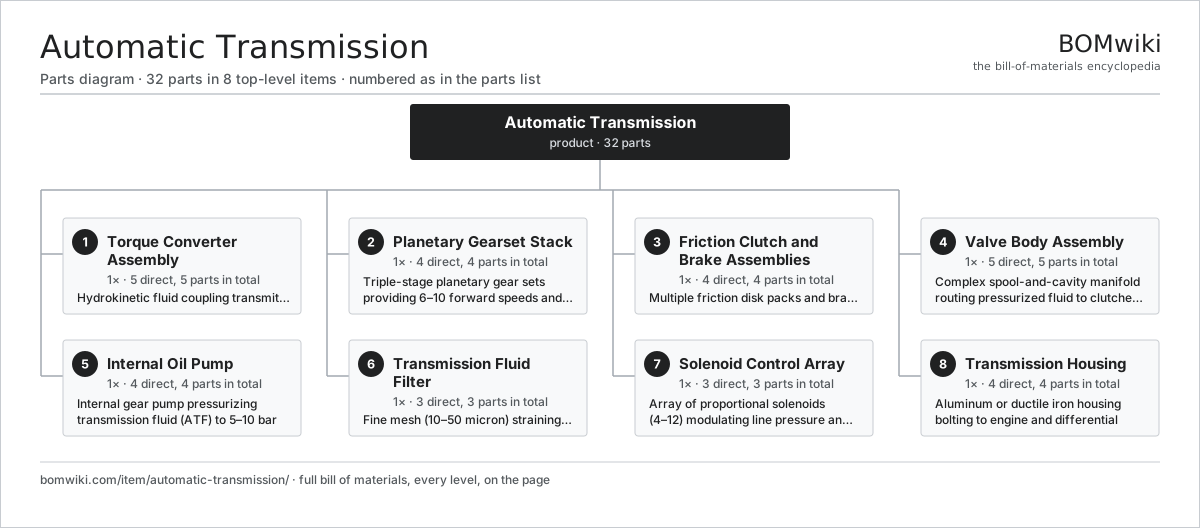
| # | Part | Qty | What it does |
|---|---|---|---|
| 1 | Torque Converter Assembly 5 parts | 1× | Hydrokinetic fluid coupling transmitting engine torque with slip and lockup clutch |
| 2 | Planetary Gearset Stack 4 parts | 1× | Triple-stage planetary gear sets providing 6–10 forward speeds and reverse |
| 3 | Friction Clutch and Brake Assemblies 4 parts | 1× | Multiple friction disk packs and brakes actuating planetary elements |
| 4 | Valve Body Assembly 5 parts | 1× | Complex spool-and-cavity manifold routing pressurized fluid to clutches and servos |
| 5 | Internal Oil Pump 4 parts | 1× | Internal gear pump pressurizing transmission fluid (ATF) to 5–10 bar |
| 6 | Transmission Fluid Filter 3 parts | 1× | Fine mesh (10–50 micron) straining ATF before clutch circuits |
| 7 | Solenoid Control Array 3 parts | 1× | Array of proportional solenoids (4–12) modulating line pressure and clutch apply |
| 8 | Transmission Housing 4 parts | 1× | Aluminum or ductile iron housing bolting to engine and differential |
3D model
No 3D model yet. Have a CAD file of this? Add a 3D model. STL renders right on this page; STEP, FreeCAD, and OpenSCAD sources are welcome too (openly licensed, like all 3D models on BOMwiki).
Build & assembly graph
expand / collapse · shared sub-assemblies converge · links to related products · est. labourTap an assembly to expand/collapse · tap a part to open it · use “Open page” for any node · drag to pan, scroll to zoom.
Bill of materials for Automatic Transmission
8 top-level lines · 40 rows shown · 32 parts total · indented to 3 levels| # | Item / sub-assembly | Part no. | Qty/assy | Ext. qty | Parts | Type |
|---|---|---|---|---|---|---|
| 1 | Torque Converter Assembly 5 parts | automatic-transmission-torque-converter | 1× | 1 | 5 | assembly |
| 1.1 | Converter Pump Impeller | automatic-transmission-converter-pump | 1× | 1 | · | part |
| 1.2 | Converter Turbine | automatic-transmission-converter-turbine | 1× | 1 | · | part |
| 1.3 | Converter Stator | automatic-transmission-converter-stator | 1× | 1 | · | part |
| 1.4 | Converter Housing Drum | automatic-transmission-converter-housing | 1× | 1 | · | part |
| 1.5 | Converter Lockup Clutch | automatic-transmission-lockup-clutch | 1× | 1 | · | part |
| 2 | Planetary Gearset Stack 4 parts | automatic-transmission-planetary-gearbox | 1× | 1 | 4 | assembly |
| 2.1 | Planetary Sun Gears | automatic-transmission-sun-gears | 1× | 1 | · | part |
| 2.2 | Planetary Planet Gears | automatic-transmission-planet-gears | 1× | 1 | · | part |
| 2.3 | Planetary Ring Gears | automatic-transmission-ring-gears | 1× | 1 | · | part |
| 2.4 | Planetary Carriers | automatic-transmission-planetary-carriers | 1× | 1 | · | part |
| 3 | Friction Clutch and Brake Assemblies 4 parts | automatic-transmission-clutch-packs | 1× | 1 | 4 | assembly |
| 3.1 | Clutch Steel Plates | automatic-transmission-friction-disk-steel | 1× | 1 | · | part |
| 3.2 | Friction-Lined Plates | automatic-transmission-friction-disk-lined | 1× | 1 | · | part |
| 3.3 | Clutch Apply Springs | automatic-transmission-clutch-spring-pack | 1× | 1 | · | part |
| 3.4 | Friction Brake Band | automatic-transmission-brake-band | 1× | 1 | · | part |
| 4 | Valve Body Assembly 5 parts | automatic-transmission-valve-body | 1× | 1 | 5 | assembly |
| 4.1 | Main Pressure Regulator Spool | automatic-transmission-main-pressure-regulator | 1× | 1 | · | part |
| 4.2 | Shift Proportional Solenoid | automatic-transmission-shift-solenoid | 1× | 1 | · | part |
| 4.3 | Valve Body Galleries | automatic-transmission-oil-galleries | 1× | 1 | · | part |
| 4.4 | Shuttle and Check Valves | automatic-transmission-shuttle-valves | 1× | 1 | · | part |
| 4.5 | Valve Calibration Springs | automatic-transmission-valve-springs | 1× | 1 | · | part |
| 5 | Internal Oil Pump 4 parts | automatic-transmission-transmission-oil-pump | 1× | 1 | 4 | assembly |
| 5.1 | Pump Drive Gears | automatic-transmission-pump-gears | 1× | 1 | · | part |
| 5.2 | Pump Case | automatic-transmission-pump-housing | 1× | 1 | · | part |
| 5.3 | Pump Inlet Screen | automatic-transmission-pump-inlet-screen | 1× | 1 | · | part |
| 5.4 | Pump Relief Valve | automatic-transmission-pump-relief-valve | 1× | 1 | · | part |
| 6 | Transmission Fluid Filter 3 parts | automatic-transmission-oil-filter | 1× | 1 | 3 | assembly |
| 6.1 | Filter Media | automatic-transmission-filter-element | 1× | 1 | · | part |
| 6.2 | Filter Bypass | automatic-transmission-filter-bypass-valve | 1× | 1 | · | part |
| 6.3 | Filter Canister | automatic-transmission-filter-housing | 1× | 1 | · | part |
| 7 | Solenoid Control Array 3 parts | automatic-transmission-solenoid-array | 1× | 1 | 3 | assembly |
| 7.1 | Proportional Solenoid Valve | automatic-transmission-proportional-solenoid | 1× | 1 | · | part |
| 7.2 | Solenoid Driver | automatic-transmission-solenoid-driver-circuit | 1× | 1 | · | part |
| 7.3 | TCU Interface | automatic-transmission-tcu-communication | 1× | 1 | · | part |
| 8 | Transmission Housing 4 parts | automatic-transmission-casing | 1× | 1 | 4 | assembly |
| 8.1 | Main Transmission Case | automatic-transmission-main-casting | 1× | 1 | · | part |
| 8.2 | Transmission Pan | automatic-transmission-pan | 1× | 1 | · | part |
| 8.3 | Engine Mount Flange | automatic-transmission-mounting-flange | 1× | 1 | · | part |
| 8.4 | Cooler Ports | automatic-transmission-cooler-connection | 1× | 1 | · | part |
Something wrong in this list? Report a problem with this BOM.
Sourcing: possible vendors
Browse the supplier directory → Prices, MOQ, and lead times are algorithmic estimates, not quotes, and not claims about these companies. Company mappings are curated by keyword; est. price band $8k–$90k. How estimates work| Vendor | HQ | Specialty | MOQ | Lead time |
|---|---|---|---|---|
|
🇯🇵Toyota
global.toyota ↗
|
Toyota City, JP | Automaker | made to order | 16–28 wks |
| volkswagen-group.com ↗ | Wolfsburg, DE | Automaker | made to order | 16–28 wks |
| gm.com ↗ | Detroit, US | Automaker | made to order | 16–28 wks |
| hyundai.com ↗ | Seoul, KR | Automaker | made to order | 16–28 wks |
|
🇨🇳BYD
byd.com ↗
|
Shenzhen, CN | EV & battery manufacturer | made to order | 16–28 wks |
1,243-word article