Aviation Obstruction Light
ProductOverview
Any structure tall enough to threaten air navigation, broadcast masts, wind turbines, cranes, chimneys, high buildings, must carry obstruction lights. In most jurisdictions the obligation begins around 45–60 m above ground (lower near airports), and the lights are a legal condition of the structure's permit: if a beacon goes dark, the owner must report the outage to the aviation authority, in the US as a NOTAM filed within minutes, and repair it within days.
The fixtures form a small family. Low-intensity L-810 markers burn steady red at 32 cd and dress the intermediate levels of a tall mast. Medium-intensity L-864 beacons flash red at 2,000 cd, 20–40 flashes per minute, and crown the structure. White strobes (L-865) cover daytime marking on structures that forgo paint. This article describes the red LED beacon, the most numerous type; one tall TV mast may carry a dozen of them.
How it works
The light originates in the LED Ring Board, a circular board of radially aimed Red LED Emitter dies whose 620–630 nm output falls inside the ICAO red chromaticity boundary without any filter, one reason LED beacons need a tenth of the power of the filtered incandescent units they replaced. The surrounding Fresnel Drum Lens does the photometric work: pilots only ever see the beacon from near the horizontal, so the drum lens compresses the vertical spread to a few degrees around the horizon, and the internal Reflector Cone folds upward-going light back into that band. The result is full 360° azimuth coverage with rated candela held across at least ±3° of elevation.
The Flasher Controller gives the beacon its character. Its Flasher PCB switches the LED string through Power MOSFET drivers in the configured pattern, set by the Mode Select Switch: steady burn for L-810 service, or timed flashes for L-864. On wind farms and multi-mast sites the GPS Sync Module module phase-locks every beacon's flash to UTC, so the whole farm pulses as one, a regulatory requirement in many countries because synchronized flashing reads far better to a pilot than random twinkling.
Day/night behaviour comes from the Photocell Assembly. Its Photodiode Sensor watches ambient sky light and steps the system between intensity modes at defined thresholds, with hysteresis so passing clouds do not toggle the beacon. On red-only installations the lights simply come on at dusk; on dual systems the controller swaps between white daytime strobes and red night beacons at the twilight threshold.
Surviving the tower top
The electrical environment at the top of a 300 m mast is hostile. The structure takes direct lightning strikes that induce kilovolt transients on every cable, so the Power Supply Unit unit puts a Surge Arrester ahead of its wide-input converter, and the body bonds to the down-conductor through the Grounding Lug. Broadcast sites add strong RF fields, handled by the EMI Filter and the all-metal Base Casting acting as a shield. Mechanically the fixture sees −55 to +55 °C, ice loading, salt fog, and constant vibration; the O-Ring Set and Lens Gasket seal it to IP66/67, while the Drain / Breather Vent membrane lets internal condensation escape. Even wildlife is designed for: the Bird Deterrent Spike crown keeps raptors from perching on and fouling the lens.
Monitoring
Because a dark beacon is a reportable hazard, supervision is built in rather than optional. The Monitoring Module module watches actual LED current through its Current-Sense Element element on every flash; a missed or low-current flash, a stuck photocell, or a supply failure drops the fail-safe relay on the Monitor PCB, opening the dry contact at the Alarm Terminal Block. That contact feeds the site SCADA, a tower-light dialler, or the wind-turbine controller, which raises the alarm to the operations centre. The relay is energised in the healthy state, so loss of power itself also signals a fault.
Installation and service
The beacon threads onto a 3/4–2 inch stub pipe via its Mounting Flange, is levelled so the beam sits on the horizon, and receives its cable through the Conduit Entry Gland. Where regulators allow, modern installations derate the LEDs and rely on their 100,000-hour life to stretch tower climbs, the dominant cost of ownership, to once every several years; the incandescent beacons they replaced needed a lamp change roughly every 8,000 hours, each one a climb. Aircraft-detection lighting systems (ADLS) increasingly switch the beacons on only when radar detects an aircraft nearby, leaving the sky dark the rest of the night, with the beacon's flasher and monitoring chain unchanged underneath.
Aviation Obstruction Light parts and their functions
9 top-level parts · 192 parts in total · full bill of materials below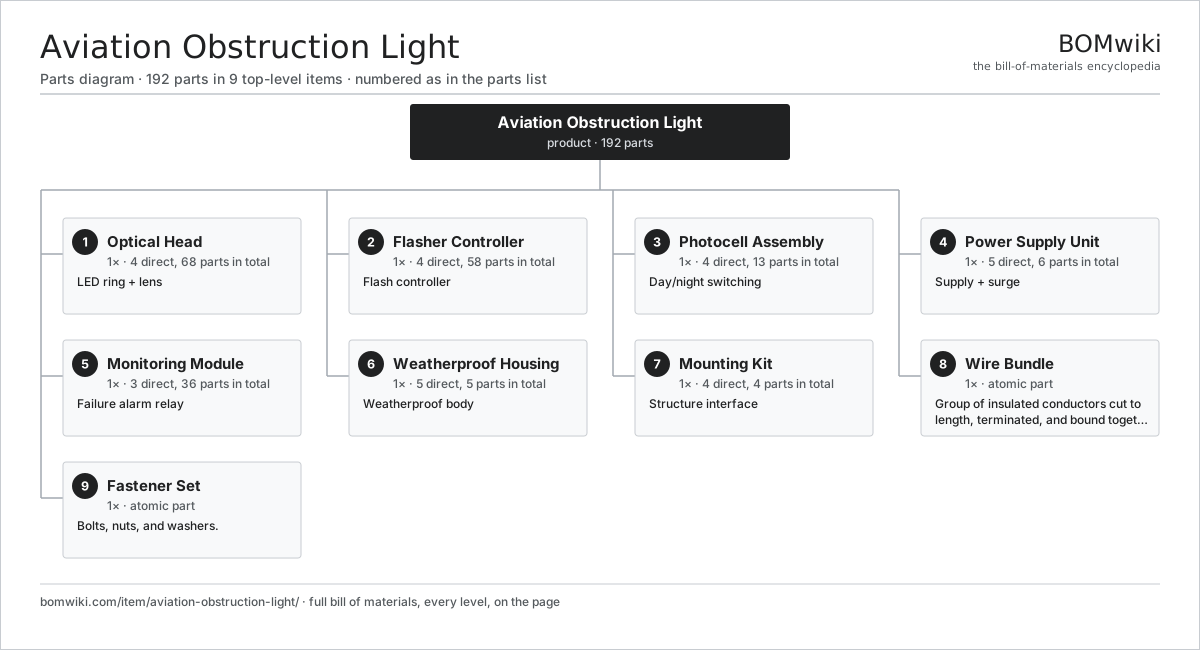
| # | Part | Qty | What it does |
|---|---|---|---|
| 1 | Optical Head 4 parts | 1× | LED ring + lens |
| 2 | Flasher Controller 4 parts | 1× | Flash controller |
| 3 | Photocell Assembly 4 parts | 1× | Day/night switching |
| 4 | Power Supply Unit 5 parts | 1× | Supply + surge |
| 5 | Monitoring Module 3 parts | 1× | Failure alarm relay |
| 6 | Weatherproof Housing 5 parts | 1× | Weatherproof body |
| 7 | Mounting Kit 4 parts | 1× | Structure interface |
| 8 | Wire Bundle | 1× | Group of insulated conductors cut to length, terminated, and bound together to carry power and signals between the assemblies of a machine. |
| 9 | Fastener Set | 1× | Bolts, nuts, and washers. |
3D model
No 3D model yet. Have a CAD file of this? Add a 3D model. STL renders right on this page; STEP, FreeCAD, and OpenSCAD sources are welcome too (openly licensed, like all 3D models on BOMwiki).
Build & assembly graph
expand / collapse · shared sub-assemblies converge · links to related products · est. labourTap an assembly to expand/collapse · tap a part to open it · use “Open page” for any node · drag to pan, scroll to zoom.
Bill of materials for Aviation Obstruction Light
9 top-level lines · 49 rows shown · 192 parts total · indented to 3 levels| # | Item / sub-assembly | Part no. | Qty/assy | Ext. qty | Parts | Type |
|---|---|---|---|---|---|---|
| 1 | Optical Head 4 parts | aviation-obstruction-light-optical | 1× | 1 | 68 | assembly |
| 1.1 | LED Ring Board 3 parts | aviation-obstruction-light-led-ring | 1× | 1 | 65 | assembly |
| 1.1.1 | Bare PCB | pcb-bare | 1× | 1 | · | part |
| 1.1.2 | Red LED Emitter | aviation-obstruction-light-led-emitter | 24× | 24 | · | part |
| 1.1.3 | SMD Passive (R/C/L) | smd-passives | 40× | 40 | · | part |
| 1.2 | Fresnel Drum Lens | aviation-obstruction-light-fresnel-lens | 1× | 1 | · | part |
| 1.3 | Lens Gasket | aviation-obstruction-light-lens-gasket | 1× | 1 | · | part |
| 1.4 | Reflector Cone | aviation-obstruction-light-reflector-cone | 1× | 1 | · | part |
| 2 | Flasher Controller 4 parts | aviation-obstruction-light-flasher | 1× | 1 | 58 | assembly |
| 2.1 | Flasher PCB 4 parts | aviation-obstruction-light-flasher-pcb | 1× | 1 | 54 | assembly |
| 2.1.1 | Bare PCB | pcb-bare | 1× | 1 | · | part |
| 2.1.2 | Microcontroller | mcu | 1× | 1 | · | part |
| 2.1.3 | Power MOSFET | mosfet | 2× | 2 | · | part |
| 2.1.4 | SMD Passive (R/C/L) | smd-passives | 50× | 50 | · | part |
| 2.2 | GPS Sync Module | aviation-obstruction-light-gps-sync | 1× | 1 | · | part |
| 2.3 | Mode Select Switch | aviation-obstruction-light-mode-switch | 1× | 1 | · | part |
| 2.4 | Connector | connector | 2× | 2 | · | part |
| 3 | Photocell Assembly 4 parts | aviation-obstruction-light-photocell | 1× | 1 | 13 | assembly |
| 3.1 | Photodiode Sensor | aviation-obstruction-light-photodiode | 1× | 1 | · | part |
| 3.2 | Photocell Window | aviation-obstruction-light-photocell-window | 1× | 1 | · | part |
| 3.3 | SMD Passive (R/C/L) | smd-passives | 10× | 10 | · | part |
| 3.4 | Connector | connector | 1× | 1 | · | part |
| 4 | Power Supply Unit 5 parts | aviation-obstruction-light-power | 1× | 1 | 6 | assembly |
| 4.1 | Power Supply | power-supply | 1× | 1 | · | part |
| 4.2 | Surge Arrester | aviation-obstruction-light-surge-arrester | 1× | 1 | · | part |
| 4.3 | EMI Filter | aviation-obstruction-light-emi-filter | 1× | 1 | · | part |
| 4.4 | Thermal Fuse | thermal-fuse | 1× | 1 | · | part |
| 4.5 | Connector | connector | 2× | 2 | · | part |
| 5 | Monitoring Module 3 parts | aviation-obstruction-light-monitoring | 1× | 1 | 36 | assembly |
| 5.1 | Monitor PCB 4 parts | aviation-obstruction-light-monitor-pcb | 1× | 1 | 33 | assembly |
| 5.1.1 | Bare PCB | pcb-bare | 1× | 1 | · | part |
| 5.1.2 | SMD Passive (R/C/L) | smd-passives | 30× | 30 | · | part |
| 5.1.3 | Relay | relay | 1× | 1 | · | part |
| 5.1.4 | Current-Sense Element | aviation-obstruction-light-current-sense | 1× | 1 | · | part |
| 5.2 | Alarm Terminal Block | aviation-obstruction-light-alarm-terminal | 1× | 1 | · | part |
| 5.3 | Connector | connector | 2× | 2 | · | part |
| 6 | Weatherproof Housing 5 parts | aviation-obstruction-light-housing | 1× | 1 | 5 | assembly |
| 6.1 | Base Casting | aviation-obstruction-light-base-casting | 1× | 1 | · | part |
| 6.2 | Top Cover | aviation-obstruction-light-top-cover | 1× | 1 | · | part |
| 6.3 | O-Ring Set | oring-set | 1× | 1 | · | part |
| 6.4 | Drain / Breather Vent | aviation-obstruction-light-drain-vent | 1× | 1 | · | part |
| 6.5 | Bird Deterrent Spike | aviation-obstruction-light-bird-spike | 1× | 1 | · | part |
| 7 | Mounting Kit 4 parts | aviation-obstruction-light-mounting | 1× | 1 | 4 | assembly |
| 7.1 | Mounting Flange | aviation-obstruction-light-mount-flange | 1× | 1 | · | part |
| 7.2 | Conduit Entry Gland | aviation-obstruction-light-conduit-entry | 1× | 1 | · | part |
| 7.3 | Grounding Lug | aviation-obstruction-light-ground-lug | 1× | 1 | · | part |
| 7.4 | Fastener Set | fastener-set | 1× | 1 | · | part |
| 8 | Wire Bundle | wire-bundle | 1× | 1 | · | part |
| 9 | Fastener Set | fastener-set | 1× | 1 | · | part |
Something wrong in this list? Report a problem with this BOM.
Related products
same domain, ranked by shared parts Heliport Beacon
39 parts · shares 6 with this page
Industrial UV Curing Lamp
300 parts · shares 5 with this page
Long-Range Searchlight
252 parts · shares 5 with this page
Heliport Beacon
39 parts · shares 6 with this page
Industrial UV Curing Lamp
300 parts · shares 5 with this page
Long-Range Searchlight
252 parts · shares 5 with this page
 Studio Strobe Light
48 parts · shares 4 with this page
Lighthouse Rotating Beacon
250 parts · shares 4 with this page
Explosion-Proof Light Fixture
31 parts · shares 3 with this page
Studio Strobe Light
48 parts · shares 4 with this page
Lighthouse Rotating Beacon
250 parts · shares 4 with this page
Explosion-Proof Light Fixture
31 parts · shares 3 with this page
Sourcing: possible vendors
Browse the supplier directory → Prices, MOQ, and lead times are algorithmic estimates, not quotes, and not claims about these companies. Company mappings are curated by keyword; est. price band $3–$2k. How estimates work| Vendor | HQ | Specialty | MOQ | Lead time |
|---|---|---|---|---|
|
🇳🇱Signify
signify.com ↗
|
Eindhoven, NL | Lighting (Philips Hue) | 2,000 units | 6–10 wks |
| acuitybrands.com ↗ | Atlanta, US | Lighting & controls | 2,000 units | 6–10 wks |
|
🇦🇹Zumtobel
zumtobelgroup.com ↗
|
Dornbirn, AT | Lighting | 2,000 units | 6–10 wks |
| creelighting.com ↗ | Racine, US | LED lighting | 2,000 units | 6–10 wks |
|
🇮🇳Havells
havells.com ↗
|
Noida, IN | Electrical & lighting | 2,000 units | 6–10 wks |
836-word article