Great Highland Bagpipes
ProductOverview
The Great Highland Bagpipes are a wind instrument combining three functional parts: an air storage Bag, a melodic Chanter, and three constant-tone Drones. The player fills the bag by breath through a Blowpipe, then squeezes the bag with the arm and torso to force air through the reeds at regulated pressure. This construction solves the core problem of wind instruments: breath is discontinuous (inhalation gaps), but the reeds require continuous airflow. The bag acts as a pneumatic accumulator, storing breath and releasing it steadily to prevent hiccups.
The Chanter is fingered like a recorder, with eight holes producing a diatonic scale. The three Drones sound continuously, tuned to harmonically complement whatever note the chanter plays. Because the drones never change pitch, the chanter melodically answers them, the instrument is locked into a single harmonic region. The result is a tonal colour recognizable across all ranges: penetrating, reedy, with a continuous low thrum underneath.
Bag and air system
The bagpipes-bag-hide (usually sheep) is softened and tanned, then stitched airtight into a roughly cubical reservoir holding 3–8 litres depending on whether it is constructed from a single sheepskin or the larger seal hide used in loudest piping. The Seams are hand-sewn and waxed. The bag has four openings: three Stock sockets for the chanter and drones, and one for the blowpipe. The Air Valve in the blowpipe stock is a simple flapper preventing air from escaping back up the tube when the player inhales.
The player maintains steady arm and torso pressure (typically 20–100 pascals, measurable by inserting a manometer into the stock) to regulate the bag pressure. Higher pressure raises all reed frequencies slightly and increases sound output. This is both a control input and a constraint: the player has no volume knob, only the gross pressure control.
Chanter and melody
The Chanter is a conical-bore pipe usually made of blackwood (a West African hardwood), though imitation (plastic) chanters are common for student instruments. Its Chanter Reed is a double reed of cane, similar in principle to an oboe but larger and more forgiving. The cane tongue vibrates at ~500 Hz in its fundamental, setting the chanter's base pitch.
Eight Finger Holes are drilled and honed into the chanter body, permitting a two-octave diatonic scale from A4 to E6. Over-blowing (increasing pressure) shifts scale fingerings up an octave. The chanter has no keys, no octave vent, and no fine tuning: it is entirely dependent on the player's embouchure (lip pressure and shape) and hand coverage of the holes to stay in tune. A skilled player compensates continuously, which is one reason bagpipe virtuosity takes years.
The Chanter Stock is a wooden or plastic socket fitted to one of the four bag stocks, embedding the reed and providing the airtight connection.
Drones
The three Drones are single-reed pipes pitched lower than the chanter. The Bass Drone is usually tuned one octave below the chanter's top note (around A3). The two Tenor Drone (first) and Tenor Drone (second) tenors typically sound in the A4 octave, either in unison or slightly different pitches (a common variation has both tenors at A4, the bass at A3, though regional and competition regimes have their own standards).
Each drone is a Drone Tube of fixed length, set by Drone Reed vibration frequency. The Tuning Slider is a loose ferrule (copper or brass band) that can be slid up or down the tube, shortening the effective length and raising the pitch. Players adjust these sliders slowly during a piping session as reeds warm and wooden tubes swell or shrink. Once a drone is approximately tuned, a Tuning Cord holds the slider in place.
The Drone Reed is a single cane reed, usually thinner and stiffer than the chanter reed, because the drone must sound evenly across a wide pressure range and over many minutes without failing. Drone reeds are soaked in water before play and replace every few months to a few years depending on use.
All three drones are bundled together with Drone Cords of braided wool, both for portability and to reinforce them mechanically against the pressure difference across the bag.
Blowpipe
The Blowpipe is a bent or straight tube of cane, cork, or plastic, fitted with a Blow Valve, a simple one-way flapper of leather or rubber. The player's breath enters through the blowpipe into the bag; the valve prevents air from returning when the player pauses to inhale. The blowpipe connects to the bag via a Blow Stock fitting, usually the smallest of the four stocks.
Assembly and tuning
The chanter and three drone Stock units are pressed firmly into the bag using a mortise-and-tenon joint: the stock Stock Tenon is a tapered wooden dowel, and the bag Stock Socket is a reamed hole in the hide. The fit must be airtight but removable; a ring of Stock Ferrule metal reinforces the joint against splitting. Some stocks are re-wrapped with thread to adjust the fit if the joint loosens.
The four Strapping elements (chanter, drone bundle, blowpipe, and shoulder strap) secure the pipes to the bag and allow the player to distribute the 3–4 kg weight across the shoulder and arm. The Shoulder Strap is a broad leather belt worn over the left shoulder, taking the bulk of the bag weight. The Chanter Cord and Drone Cords prevent loose stocks from shifting or dropping during play.
Playing and maintenance
A typical piping session begins with soaking the drone reeds in water for 30 seconds to open the cane pores, ensuring they vibrate freely. The player fills the bag by blowing through the blowpipe while holding the stocks loosely in hand to avoid back-pressure, then seats the stocks firmly into the hide. The first note is a strong arm squeeze to force the bag down rapidly and "strike" the drones and chanter simultaneously, the opening statement of the tune. From there, the player's left hand fingers the chanter melody while the right arm and torso manage bag pressure.
A well-maintained bagpipe can sound for hours before needing a reed change. However, cane reeds eventually split, mould, or go flat, requiring replacement or careful carving and shaping. Wooden stocks may split in very dry climates, and the hide may need re-treating every few years to prevent cracking.
Great Highland Bagpipes parts and their functions
6 top-level parts · 69 parts in total · full bill of materials below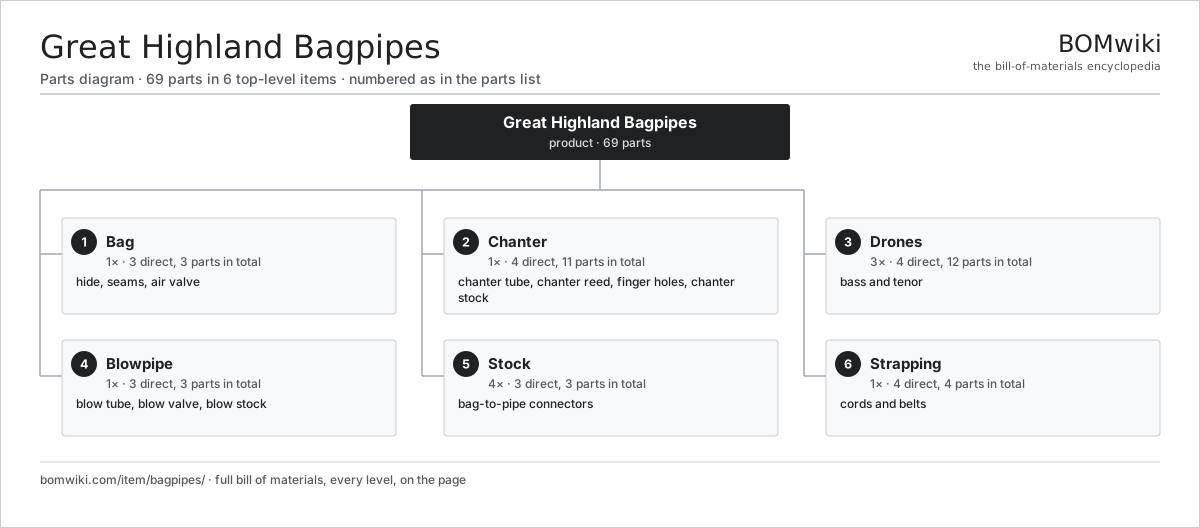
| # | Part | Qty | What it does |
|---|---|---|---|
| 1 | Bag 3 parts | 1× | Leather reservoir that stores and regulates air pressure to the reeds. |
| 2 | Chanter 4 parts | 1× | Melody pipe with fingering holes, played like a recorder to carry the tune. |
| 3 | Drones 4 parts | 3× | bass and tenor |
| 4 | Blowpipe 3 parts | 1× | Tube carrying the player's breath into the bag, with a one-way valve to prevent backflow. |
| 5 | Stock 3 parts | 4× | bag-to-pipe connectors |
| 6 | Strapping 4 parts | 1× | cords and belts |
3D model
No 3D model yet. Have a CAD file of this? Add a 3D model. STL renders right on this page; STEP, FreeCAD, and OpenSCAD sources are welcome too (openly licensed, like all 3D models on BOMwiki).
Build & assembly graph
expand / collapse · shared sub-assemblies converge · links to related products · est. labourTap an assembly to expand/collapse · tap a part to open it · use “Open page” for any node · drag to pan, scroll to zoom.
Bill of materials for Great Highland Bagpipes
6 top-level lines · 36 rows shown · 69 parts total · indented to 3 levels| # | Item / sub-assembly | Part no. | Qty/assy | Ext. qty | Parts | Type |
|---|---|---|---|---|---|---|
| 1 | Bag 3 parts | bagpipes-bag | 1× | 1 | 3 | assembly |
| 1.1 | Hide | bagpipes-hide | 1× | 1 | · | part |
| 1.2 | Seams | bagpipes-seams | 1× | 1 | · | part |
| 1.3 | Air Valve | bagpipes-air-valve | 1× | 1 | · | part |
| 2 | Chanter 4 parts | bagpipes-chanter | 1× | 1 | 11 | assembly |
| 2.1 | Chanter Tube | bagpipes-chanter-tube | 1× | 1 | · | part |
| 2.2 | Chanter Reed | bagpipes-chanter-reed | 1× | 1 | · | part |
| 2.3 | Finger Holes | bagpipes-finger-holes | 8× | 8 | · | part |
| 2.4 | Chanter Stock | bagpipes-chanter-stock | 1× | 1 | · | part |
| 3 | Drones 4 parts | bagpipes-drones | 3× | 3 | 12 | assembly |
| 3.1 | Bass Drone 3 parts | bagpipes-bass-drone | 1× | 3 | 3 | assembly |
| 3.1.1 | Drone Tube | bagpipes-drone-tube | 1× | 3 | · | part |
| 3.1.2 | Drone Reed | bagpipes-drone-reed | 1× | 3 | · | part |
| 3.1.3 | Tuning Slider | bagpipes-tuning-slider | 1× | 3 | · | part |
| 3.2 | Tenor Drone (first) 3 parts | bagpipes-tenor-drone-a | 1× | 3 | 3 | assembly |
| 3.2.1 | Drone Tube | bagpipes-drone-tube | 1× | 3 | · | part |
| 3.2.2 | Drone Reed | bagpipes-drone-reed | 1× | 3 | · | part |
| 3.2.3 | Tuning Slider | bagpipes-tuning-slider | 1× | 3 | · | part |
| 3.3 | Tenor Drone (second) 3 parts | bagpipes-tenor-drone-b | 1× | 3 | 3 | assembly |
| 3.3.1 | Drone Tube | bagpipes-drone-tube | 1× | 3 | · | part |
| 3.3.2 | Drone Reed | bagpipes-drone-reed | 1× | 3 | · | part |
| 3.3.3 | Tuning Slider | bagpipes-tuning-slider | 1× | 3 | · | part |
| 3.4 | Drone Reed Stock | bagpipes-drone-reed-stock | 3× | 9 | · | part |
| 4 | Blowpipe 3 parts | bagpipes-blowpipe | 1× | 1 | 3 | assembly |
| 4.1 | Blow Tube | bagpipes-blow-tube | 1× | 1 | · | part |
| 4.2 | Blow Valve | bagpipes-blow-valve | 1× | 1 | · | part |
| 4.3 | Blow Stock | bagpipes-blow-stock | 1× | 1 | · | part |
| 5 | Stock 3 parts | bagpipes-stock-assembly | 4× | 4 | 3 | assembly |
| 5.1 | Stock Socket | bagpipes-stock-socket | 1× | 4 | · | part |
| 5.2 | Stock Tenon | bagpipes-stock-tenon | 1× | 4 | · | part |
| 5.3 | Stock Ferrule | bagpipes-stock-ferrule | 1× | 4 | · | part |
| 6 | Strapping 4 parts | bagpipes-strapping | 1× | 1 | 4 | assembly |
| 6.1 | Chanter Cord | bagpipes-chanter-cord | 1× | 1 | · | part |
| 6.2 | Drone Cords | bagpipes-drone-cords | 1× | 1 | · | part |
| 6.3 | Shoulder Strap | bagpipes-shoulder-strap | 1× | 1 | · | part |
| 6.4 | Tuning Cord | bagpipes-tuning-cord | 1× | 1 | · | part |
Something wrong in this list? Report a problem with this BOM.
Sourcing: possible vendors
Browse the supplier directory → Prices, MOQ, and lead times are algorithmic estimates, not quotes, and not claims about these companies. Company mappings are curated by keyword; est. price band $50–$5k. How estimates work| Vendor | HQ | Specialty | MOQ | Lead time |
|---|---|---|---|---|
| yamaha.com ↗ | Hamamatsu, JP | Audio & instruments | 200 units | 8–14 wks |
|
🇺🇸Fender
fender.com ↗
|
Los Angeles, US | Guitars & amps | 200 units | 8–14 wks |
|
🇺🇸Gibson
gibson.com ↗
|
Nashville, US | Guitars | 200 units | 8–14 wks |
|
🇯🇵Roland
roland.com ↗
|
Hamamatsu, JP | Electronic instruments | 200 units | 8–14 wks |
| steinway.com ↗ | New York, US | Pianos | 200 units | 8–14 wks |
1,101-word article