Bait Chopper
ProductOverview
A bait chopper is a compact deck-mounted processing machine that reduces whole baitfish (mackerel, capelin, herring, squid) into minced fragments suitable for longline baiting. The system consists of a rotating rotor (200 mm diameter, 6–8 hardened-steel blades) that spins at 1450 rpm inside a fixed housing with 4–6 opposing stationary blades. Material fed from an overhead hopper slides down and is sheared between the rotating and fixed blades into fragments 10–50 mm in size. A hinged mesh safety guard and interlock switch prevent operator contact with moving parts.
The Drive Motor (5–10 hp electric induction or variable-displacement hydraulic) drives the Rotor Assembly directly or through a coupling. The Input Hopper (40–80 L capacity) gravity-feeds bait into the rotor chamber via an adjustable slide gate. Minced product discharges through a Discharge Chute fitted with a control valve, into collection pans or totes.
Bait choppers are standard equipment on longline fishing vessels operating Longline System, where fresh or frozen bait is minced immediately before Baiting Station rigging. This practice improves bait presentation (minced bait releases more scent attractant) and reduces per-hook bait cost by 20–30% versus whole bait. Many vessels operate a bait chopper during night shifts to pre-process bait for the following day's deployment, reducing crew fatigue during actual fishing operations.
How It Works
Input preparation: Whole baitfish (stored in insulated bins with ice or frozen blocks) are dumped into the Input Hopper by crew wearing rubber gloves and aprons. The Hopper Slide Gate is adjusted to control feed rate, full open for rapid processing, partially open for controlled mince size. A second crew member stands at the Discharge Chute with collection containers or a conveyor to catch output.
Rotor operation: The operator presses the green start button on the Control Switch. The Motor Contactor energizes, sending 3-phase power to the Drive Motor. The Rotor Assembly accelerates to 1450 rpm in 2–3 seconds. The rotor and fixed blades begin shearing incoming bait. Whole fish are rapidly fragmented into 10–50 mm pieces as they pass between rotor and stationary blades.
Output control: The operator modulates the Hopper Slide Gate position to adjust feed rate and control output throughput (typically 100–300 kg/hour depending on fish size and desired mince fineness). Finer mince (<10 mm) requires slower feed rate and multiple passes; coarser mince (30–50 mm) is faster but less attractive to hook-wary fish.
Discharge: Minced product exits the discharge tube at approximately 1–2 m/s velocity. The Discharge Gate is manually opened to allow product flow, and closed between batches. A Collection Pan immediately below catches output and can be swapped for a second pan without stopping the machine (continuous operation possible).
Shutdown: Once the hopper is empty, the operator releases the slide gate to stop feed, then presses the red stop button to de-energize the Motor Contactor. The rotor coasts down in 10–15 seconds. If emergency action is needed, the Emergency Stop Button button immediately interrupts motor power.
Cleaning: Between batches or at day-end, the Safety Guard (hinged mesh cover) is swung open via its hinge. This action automatically triggers the Guard Interlock Switch, de-energizing the motor as a safety feature. Crew rinse the rotor, fixed blades, and hopper with fresh water or seawater, removing residual bait particles and slime. Proper cleaning prevents bacterial growth and odor accumulation.
Typical Usage Patterns
Longline operations: A Longline System vessel operating a 1-week fishing cruise may process 500–1000 kg of minced bait total. This is typically done in 2–4 hour processing sessions on deck during evening hours when fishing is slack. Crew take shifts (2–3 people) to feed and collect output, distributing physical effort.
Bait preparation schedule: Many vessels chop bait the evening before deployment, storing minced product in chilled plastic totes (4–5°C) overnight. This reduces fatigue during the next morning's baiting station rush and allows bait to absorb salt (if using saltwater in storage) for better scent dispersal.
Bait types: The chopper works with most baitfish, mackerel, herring, capelin, sardine, squid, and anchovies. Frozen bait can be run through cold (no thawing required) for slight efficiency loss; fresh bait produces marginally better output quality but spoils rapidly if not immediately used.
Operational Considerations
Blade sharpness: The Rotor Blade and Stationary Blade must be razor-sharp for clean mince. Dulled blades produce crushed rather than sheared fragments, which oxidize faster (brown discoloration) and lose attractant potency. Blades are typically hand-sharpened weekly on a whetstones or oil-stone; replacement is every 2–3 seasons depending on intensity of use.
Blade gap adjustment: The clearance between rotor and stationary blade sets mince size. A 2–3 mm gap is standard; tighter gaps risk jamming if large bones are present. Some vessels allow seasonal variation, tighter in calm seas (better bait quality prioritized), looser in rough weather (throughput maximized).
Motor thermal load: Continuous operation at full feed rate heats the Drive Motor. The TEFC enclosure includes internal fan cooling, but extended runs (>2 hours continuous) may require brief rest periods to prevent thermal overload. Most operational protocols limit sessions to 1.5–2 hours with 15-minute rest intervals.
Hydraulic variant efficiency: A hydraulic-driven bait chopper (using a bent-axis motor) can be infinitely variable in speed (0–1450 rpm adjustable), allowing finer control of mince size and throughput. However, hydraulic systems require more maintenance (pump, valves, cooler) and add complexity. Electric motors are simpler and more common on smaller vessels.
Safety Hazards and Mitigation
Entanglement: The rotating rotor is an extreme entanglement hazard. The Safety Guard (wire mesh or perforated-steel enclosure) prevents direct contact, but loose clothing or hair near the hopper inlet can still be caught. All crew are trained to tie back long hair and wear tight-fitting clothing.
Interlock integrity: The Guard Interlock Switch must be tested weekly to ensure it reliably de-energizes the motor when the guard is opened. A failed interlock could allow operation with the guard open, a critical safety failure.
Pinch hazards: At the hopper outlet, fingers can be pinched if fed materials jam. Crew use a wooden tamper or bait shovel to push material downward, never hands.
Freezing fractures: Frozen bait can sometimes contain sharp bone fragments or ice shards that escape the mincing chamber and cause minor lacerations during handling. Crew wear cut-resistant gloves (Kevlar-lined preferred).
Maintenance Schedule
- Daily: Clean rotor, blades, and hopper with fresh water; inspect mesh guard for damage.
- Weekly: Check blade sharpness via visual inspection; hand-sharpen on whetstone if dulled. Check interlock switch functionality (manually trigger and verify motor stops).
- Monthly: Drain motor cooling water (if water-cooled variant); inspect motor bearings for noise or play.
- Quarterly: Disassemble rotor and fixed-blade ring for deep cleaning and inspection; measure blade thickness (replace if worn <50% of original height).
- Annually: Motor bearing replacement; full enclosure pressure-wash for salt buildup; electrical connector inspection.
Variants and Alternatives
Manual meat grinder: Small vessels (<20 m) may use a hand-crank commercial meat grinder instead of powered chopper. Slower (20–50 kg/hour) but requires no electricity and is fully reliable. Common on artisanal longlining operations.
Whole-bait preferred regions: Some fisheries (e.g., Atlantic halibut) show strong bait preference for whole rather than minced; vessels operating these grounds skip the chopper and bait entirely whole. Slight catch-rate loss vs. minced bait is offset by psychological operator simplicity.
Automatic baiting machines: Modern longliner designs integrate automatic baiting machinery that includes internal mincing, loading, and hook-threading in one integrated system. These are expensive (>$200,000) and are typically found only on large industrial vessels.
Environmental and Economic Impact
Minced bait increases hook utilization efficiency, less bait per hook, similar catch rate. This reduces operational cost (bait is 5–10% of fishing cost) and reduces bycatch (smaller bait attracts target species more selectively). Some studies suggest minced-bait longlining reduces seabird interactions compared to whole-bait by 15–20%, likely because smaller bait fragments sink faster, reducing surface-feeding temptation.
Historically, minced-bait longlining was considered "unsporting" in recreational fishing, but commercial longliner fleets have widely adopted the practice for efficiency gains.
Bait Chopper parts and their functions
8 top-level parts · 54 parts in total · full bill of materials below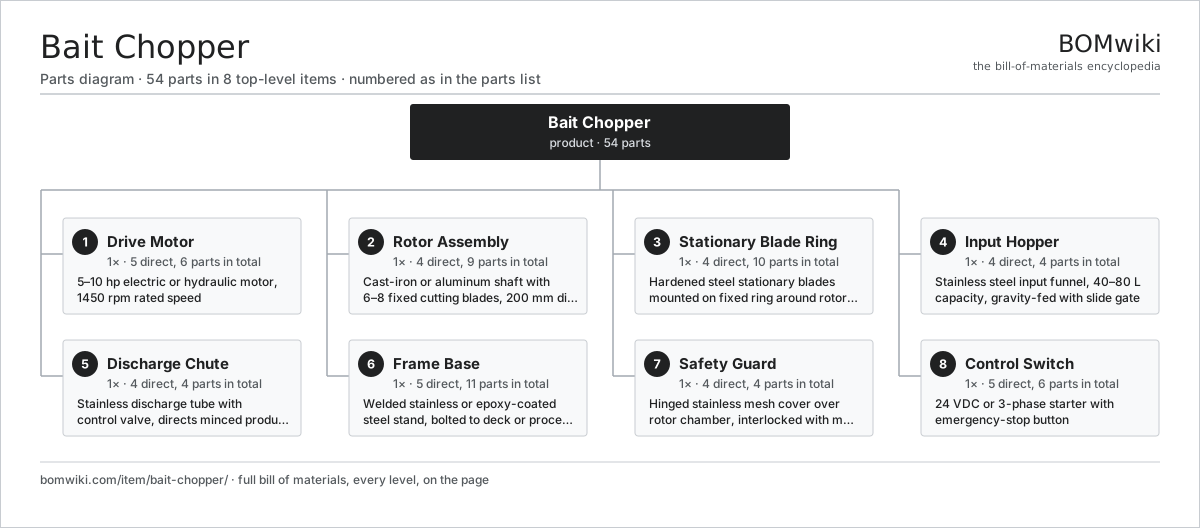
| # | Part | Qty | What it does |
|---|---|---|---|
| 1 | Drive Motor 5 parts | 1× | 5–10 hp electric or hydraulic motor, 1450 rpm rated speed |
| 2 | Rotor Assembly 4 parts | 1× | Cast-iron or aluminum shaft with 6–8 fixed cutting blades, 200 mm diameter |
| 3 | Stationary Blade Ring 4 parts | 1× | Hardened steel stationary blades mounted on fixed ring around rotor, 4–6 blades |
| 4 | Input Hopper 4 parts | 1× | Stainless steel input funnel, 40–80 L capacity, gravity-fed with slide gate |
| 5 | Discharge Chute 4 parts | 1× | Stainless discharge tube with control valve, directs minced product to container |
| 6 | Frame Base 5 parts | 1× | Welded stainless or epoxy-coated steel stand, bolted to deck or processing table |
| 7 | Safety Guard 4 parts | 1× | Hinged stainless mesh cover over rotor chamber, interlocked with motor stop |
| 8 | Control Switch 5 parts | 1× | 24 VDC or 3-phase starter with emergency-stop button |
3D model
No 3D model yet. Have a CAD file of this? Add a 3D model. STL renders right on this page; STEP, FreeCAD, and OpenSCAD sources are welcome too (openly licensed, like all 3D models on BOMwiki).
Build & assembly graph
expand / collapse · shared sub-assemblies converge · links to related products · est. labourTap an assembly to expand/collapse · tap a part to open it · use “Open page” for any node · drag to pan, scroll to zoom.
Bill of materials for Bait Chopper
8 top-level lines · 43 rows shown · 54 parts total · indented to 3 levels| # | Item / sub-assembly | Part no. | Qty/assy | Ext. qty | Parts | Type |
|---|---|---|---|---|---|---|
| 1 | Drive Motor 5 parts | bait-chopper-motor | 1× | 1 | 6 | assembly |
| 1.1 | Motor Stator | bait-chopper-motor-stator | 1× | 1 | · | part |
| 1.2 | Motor Rotor | bait-chopper-motor-rotor | 1× | 1 | · | part |
| 1.3 | Motor Shaft | bait-chopper-motor-shaft | 1× | 1 | · | part |
| 1.4 | Motor Bearing | bait-chopper-motor-bearing | 2× | 2 | · | part |
| 1.5 | Motor Enclosure | bait-chopper-motor-enclosure | 1× | 1 | · | part |
| 2 | Rotor Assembly 4 parts | bait-chopper-rotor | 1× | 1 | 9 | assembly |
| 2.1 | Rotor Shaft | bait-chopper-rotor-shaft | 1× | 1 | · | part |
| 2.2 | Rotor Blade | bait-chopper-rotor-blade | 6× | 6 | · | part |
| 2.3 | Rotor Hub | bait-chopper-rotor-hub | 1× | 1 | · | part |
| 2.4 | Fastener Set | fastener-set | 1× | 1 | · | part |
| 3 | Stationary Blade Ring 4 parts | bait-chopper-blade-set | 1× | 1 | 10 | assembly |
| 3.1 | Blade Ring | bait-chopper-blade-ring | 1× | 1 | · | part |
| 3.2 | Stationary Blade | bait-chopper-stationary-blade | 4× | 4 | · | part |
| 3.3 | Blade Spacer | bait-chopper-blade-spacer | 4× | 4 | · | part |
| 3.4 | Fastener Set | fastener-set | 1× | 1 | · | part |
| 4 | Input Hopper 4 parts | bait-chopper-hopper | 1× | 1 | 4 | assembly |
| 4.1 | Hopper Shell | bait-chopper-hopper-shell | 1× | 1 | · | part |
| 4.2 | Hopper Slide Gate | bait-chopper-hopper-slide-gate | 1× | 1 | · | part |
| 4.3 | Hopper Support Ring | bait-chopper-hopper-support-ring | 1× | 1 | · | part |
| 4.4 | Fastener Set | fastener-set | 1× | 1 | · | part |
| 5 | Discharge Chute 4 parts | bait-chopper-discharge-chute | 1× | 1 | 4 | assembly |
| 5.1 | Discharge Tube | bait-chopper-discharge-tube | 1× | 1 | · | part |
| 5.2 | Discharge Gate | bait-chopper-discharge-gate | 1× | 1 | · | part |
| 5.3 | Collection Pan | bait-chopper-collection-pan | 1× | 1 | · | part |
| 5.4 | Fastener Set | fastener-set | 1× | 1 | · | part |
| 6 | Frame Base 5 parts | bait-chopper-frame-base | 1× | 1 | 11 | assembly |
| 6.1 | Frame Beam | bait-chopper-frame-beam | 4× | 4 | · | part |
| 6.2 | Frame Base Plate | bait-chopper-frame-plate | 1× | 1 | · | part |
| 6.3 | Motor Mount | bait-chopper-motor-mount | 1× | 1 | · | part |
| 6.4 | Vibration Damper | bait-chopper-vibration-damper | 4× | 4 | · | part |
| 6.5 | Fastener Set | fastener-set | 1× | 1 | · | part |
| 7 | Safety Guard 4 parts | bait-chopper-safety-guard | 1× | 1 | 4 | assembly |
| 7.1 | Guard Frame | bait-chopper-guard-frame | 1× | 1 | · | part |
| 7.2 | Guard Mesh | bait-chopper-guard-mesh | 1× | 1 | · | part |
| 7.3 | Guard Hinge | bait-chopper-guard-hinge | 1× | 1 | · | part |
| 7.4 | Guard Interlock Switch | bait-chopper-guard-interlock-switch | 1× | 1 | · | part |
| 8 | Control Switch 5 parts | bait-chopper-control-switch | 1× | 1 | 6 | assembly |
| 8.1 | Switch Enclosure | bait-chopper-switch-enclosure | 1× | 1 | · | part |
| 8.2 | Motor Contactor | bait-chopper-motor-contactor | 1× | 1 | · | part |
| 8.3 | Emergency Stop Button | bait-chopper-emergency-stop | 1× | 1 | · | part |
| 8.4 | Start/Stop Buttons | bait-chopper-start-stop-buttons | 2× | 2 | · | part |
| 8.5 | Indicator Light | bait-chopper-indicator-light | 1× | 1 | · | part |
Something wrong in this list? Report a problem with this BOM.
Sourcing: possible vendors
Browse the supplier directory → Prices, MOQ, and lead times are algorithmic estimates, not quotes, and not claims about these companies. Company mappings are curated by keyword; est. price band $2k–$500M. How estimates work| Vendor | HQ | Specialty | MOQ | Lead time |
|---|---|---|---|---|
| hd.com ↗ | Ulsan, KR | Shipbuilder | made to order | 52–104 wks |
| fincantieri.com ↗ | Trieste, IT | Shipbuilder | made to order | 52–104 wks |
| damen.com ↗ | Gorinchem, NL | Shipbuilder | made to order | 52–104 wks |
| brunswick.com ↗ | Mettawa, US | Marine & boats | made to order | 52–104 wks |
|
🇨🇳CSSC
cssc.net.cn ↗
|
Shanghai, CN | Shipbuilding conglomerate | made to order | 52–104 wks |
1,417-word article