BOMwiki the bill-of-materials encyclopedia

Ball Valve Product

Overview

A ball valve provides on/off isolation by rotating a bored ball one quarter turn between the open and closed positions. When the bore aligns with the flow path the valve is fully open with minimal pressure drop; rotating the Ball ninety degrees presents a solid face to the flow and shuts the line off bubble-tight. The floating-ball design uses line pressure to push the ball against the downstream seat, which makes shutoff tighter as differential pressure rises. This unit is flanged for inline service and driven by an Electric Actuator for remote operation.

Construction

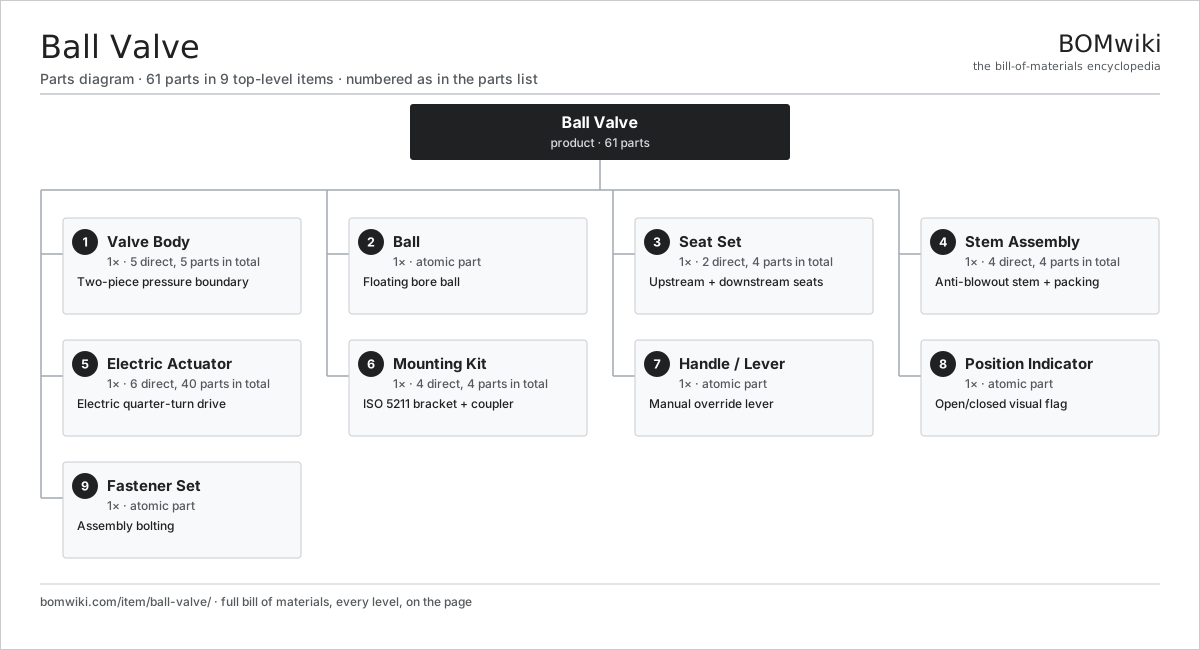
The pressure boundary is a two-piece Valve Body: a main casting carrying one raised-face flange and a threaded end cap carrying the second, clamped together with a graphite-filled body gasket. The ball is captured between a pair of soft seat rings held in the Seat Set; Belleville springs preload each seat so it stays in contact with the ball at low pressure and through thermal cycling. Torque reaches the ball through the Stem Assembly, an anti-blowout shoulder stem that cannot eject under pressure even if the packing is removed, sealed by a PTFE-backed packing stack and gland.

The electric actuator couples to the stem through an Mounting Kit machined to the ISO 5211 bolt pattern, which standardizes the interface between valve and drive. A motor and worm reduction stage turn the stem, while limit switches and a position sensor report end-of-travel. For commissioning or power loss the Handle / Lever gives a manual quarter-turn override, and a Position Indicator dome shows open or closed at a glance. Assembly bolting is supplied as a matched Fastener Set.', },

'butterfly-valve': { specs: [ ['Type', 'Lug-style resilient-seat, quarter-turn'], ['Size range', 'DN50–DN600 (2"–24")'], ['Pressure rating', 'PN16 / 200 psi bidirectional'], ['Flange standard', 'Lug pattern, ASME Class 125/150 drilling'], ['Dead-end service', 'Full rated, downstream flange removed'], ['Flow characteristic', 'Modified equal-percentage (throttling)'], ['Cv (DN150 / 6")', '1,150'], ['Body material', 'Ductile iron, epoxy coated'], ['Disc material', 'Aluminum bronze'], ['Seat material', 'EPDM molded liner'], ['Stem material', '416 / 17-4PH stainless'], ['Temperature range', '−20 °C to +120 °C (EPDM)'], ['Actuator', 'Electric quarter-turn, modulating'], ['Seat leakage', 'Zero leakage to rated pressure'], ], body: '## Overview

A butterfly valve throttles or isolates flow with a disc that rotates on a central shaft inside the pipe bore. A quarter turn swings the Disc / Vane from edge-on, where it offers little resistance, to face-on against the seat, where it seals. Because the disc stays in the flow stream the valve is compact and light relative to its line size, and the modified equal-percentage characteristic of a centred disc makes it usable for modulating control as well as on/off duty. The lug body lets the valve be bolted into the line and serve dead-end without a downstream flange.

How it works

The pressure boundary is the Valve Body, a ductile-iron lug casting with tapped bosses that match the pipe flange bolt circle. The sealing element is a molded Seat Liner elastomer liner that wraps the bore and the flange faces, so the same part seals the disc edge and the pipe joints. The disc is carried on a two-piece Stem Assembly: an upper drive stem and a lower stub stem running in journal bushings, with an anti-blowout collar and graphite gland packing retaining and sealing the shaft.

Rotation comes from a Electric Actuator mounted to the valve neck through the Mounting Flange, machined to the ISO 5211 interface. Inside the actuator a reversible motor drives a worm-and-spur reduction to produce the ninety-degree output, with potentiometric feedback, limit switches and a control board running the positioning loop; a declutchable handwheel allows manual operation on power loss. A Position Indicator beacon on the actuator top reports valve state. Flange and stem seals are supplied as an O-Ring Set and the bolting as a Fastener Set.', },

'control-valve': { specs: [ ['Type', 'Globe, cage-guided, spring-and-diaphragm'], ['Size range', 'DN25–DN300 (1"–12")'], ['Pressure class', 'ANSI Class 300 (PN50)'], ['Flow characteristic', 'Equal-percentage, characterized cage'], ['Rated Cv (DN100 / 4")', '195'], ['Rangeability', '50:1'], ['Body material', 'Cast carbon steel (WCC)'], ['Trim material', '316 SS, hardened seat ring'], ['Packing', 'PTFE V-ring, live-loaded'], ['Shutoff class', 'ANSI/FCI 70-2 Class IV'], ['Actuator', 'Spring-and-diaphragm, air-to-open'], ['Bench range', '0.2–1.0 bar (3–15 psi)'], ['Positioner', 'Digital, 4–20 mA / HART'], ['Air supply', '1.4–7 bar instrument air'], ], body: '## Overview

A control valve modulates process flow in proportion to a controller signal rather than simply opening or closing. The Pneumatic Actuator positions a plug inside the body to a setpoint commanded by a 4–20 mA loop, so the valve becomes the final element that the control system uses to hold a flow, level, pressure or temperature. This is a globe-style valve with a spring-and-diaphragm pneumatic actuator and a digital positioner, the standard configuration for continuous process throttling.

How it works

Flow turns through the cast Valve Body Assembly, a globe body and bolted bonnet that form the pressure envelope and carry the packing box. Inside sits the Valve Trim: a contoured plug, a characterized cage and a hardened seat ring. The cage guides the plug and its windows shape the equal-percentage flow characteristic, where each increment of travel changes flow by a fixed percentage, giving smooth control across a wide range. A PTFE V-ring packing stack seals the stem where it leaves the bonnet.

Above the body, the Pneumatic Actuator converts air pressure into linear travel: instrument air loads a molded diaphragm against a range spring, and the balance between them sets stem position. The valve is driven by a Digital Positioner, a microprocessor module that compares stem feedback to the command signal and meters air to the actuator through an I/P converter and pneumatic relay. Conditioned air is supplied through a Air Filter Regulator filter regulator, and a Handwheel Override provides manual override during commissioning or air failure. Body and bonnet joints are sealed by an O-Ring Set and assembled with a Fastener Set.', },

'diaphragm-pump': { specs: [ ['Type', 'Air-operated double-diaphragm (AODD)'], ['Port size', 'DN50 (2") inlet and outlet'], ['Max flow', '570 L/min (150 gpm)'], ['Max discharge head', '70 m (head equal to air supply)'], ['Max air inlet pressure', '8.4 bar (125 psi)'], ['Max solids', '6.4 mm (¼") diameter'], ['Suction lift (dry)', '5 m'], ['Suction lift (wet)', '9 m'], ['Wetted material', 'Polypropylene / PTFE'], ['Diaphragm material', 'PTFE-faced Santoprene'], ['Check ball / seat', 'PTFE ball on PTFE seat'], ['Air valve', 'Externally serviceable spool, no-stall'], ['Temperature range', '4 °C to +107 °C (PTFE)'], ], body: '## Overview

An air-operated double-diaphragm pump moves fluid using compressed air instead of a rotating shaft, which lets it handle abrasive slurries, viscous liquids and shear-sensitive products that would damage or clog other pump types. Two diaphragms share a common shaft: as compressed air pushes one diaphragm out on its discharge stroke, the shaft pulls the opposite diaphragm in on its suction stroke, so the pump delivers flow on every stroke. It is seal-less and self-priming, runs dry without damage, and stalls safely against a closed discharge.

How it works

The heart of the pump is the Center Section, an air-motor body housing the connecting shaft and a pilot valve. The Air Valve Assembly spool alternately pressurizes one chamber and exhausts the other; at the end of each stroke the pilot valve shifts the spool to reverse direction, and spent air leaves through the Exhaust Muffler. Each Diaphragm Assembly separates air from fluid and is clamped to the shaft between inner and outer plates.

On the wet end, the two Fluid Cap chambers bolt over the diaphragms to form the pumping cavities. Four Ball Check Valve ball checks, two per chamber, control direction: a chamber on its suction stroke draws fluid through its lower check while its upper check holds, then reverses on the discharge stroke. The Inlet Manifold feeds both lower checks and the Outlet Manifold collects from both upper checks. A Pulsation Dampener smooths the inherently pulsing discharge, and the pump sits on a Foot Mount. An optional Stroke Controller counts strokes for batching and run-dry detection.', },

'gear-pump': { specs: [ ['Type', 'External spur-gear, positive displacement'], ['Port size', 'DN40 (1½") flanged'], ['Displacement', '0.25 L/rev'], ['Flow at 1450 rpm', '350 L/min'], ['Max discharge pressure', '16 bar'], ['Viscosity range', '1–100,000 cSt'], ['Self-priming lift', 'Up to 5 m'], ['Casing material', 'Gray cast iron (GG25)'], ['Gear material', 'Hardened alloy steel'], ['Bushing material', 'Sintered bronze'], ['Shaft seal', 'Single rotary lip seal'], ['Relief valve', 'Integral, 2–16 bar adjustable'], ['Drive', 'Close-coupled TEFC motor'], ['Temperature range', '−10 °C to +120 °C'], ], body: '## Overview

An external gear pump is a positive-displacement pump in which two meshing gears trap fluid between their teeth and the casing wall and carry it from suction to discharge. Because each revolution displaces a fixed volume, flow is steady and nearly independent of discharge pressure, which suits the pump to metering, fuel and lube transfer, and pumping viscous oils. The tight running clearances make it most efficient on clean, lubricating fluids. This unit is close-coupled to an electric motor through a flexible coupling.

Construction

Fluid is contained by the Pump Casing: a figure-eight cast-iron body bored for the two gears, closed by front and rear end covers carrying the shaft bushings, with pressure-balanced wear plates sealing the gear faces. The pumping element is the Gear Set, a drive gear and a free idler gear running on hardened shafts in sintered-bronze journal bushings. As the gears unmesh on the suction side they create the void that draws fluid in; the teeth carry it around the casing wall and squeeze it out as they remesh on the discharge side.

Where the drive shaft exits the casing it is sealed by the Shaft Seal, a rotary lip seal running on a replaceable hardened sleeve. To protect the pump and piping against overpressure or a blocked line, an integral Relief Valve cracks open above its setpoint and recirculates flow internally. Torque comes from the Electric Motor, a TEFC induction motor, joined to the pump by a flexible Flexible Coupling that tolerates minor shaft misalignment. The assembly is footed to a baseplate on a Mounting Foot and held together with a matched Fastener Set.', },

'submersible-pump': { specs: [ ['Type', 'Multistage borehole submersible, mixed-flow'], ['Bore diameter', '4" / 6" well (100 mm / 150 mm)'], ['Stages', '8 (impeller + diffuser per stage)'], ['Rated flow', '6 m³/h (26 gpm)'], ['Rated head', '120 m total dynamic head'], ['Max submergence', '150 m'], ['Motor type', 'Water-filled (wet) induction'], ['Motor rating', '2.2 kW (3 HP), single-phase'], ['Impeller material', 'Noryl / 304 stainless'], ['Shaft / shell material', '420 / 304 stainless'], ['Max sand content', '50 g/m³'], ['Fluid temperature', '≤ 35 °C'], ['Cable', '3-core flat submersible, spliced'], ['Discharge', '1¼" NPT riser with integral NRV'], ], body: '## Overview

A borehole submersible pump is installed at depth in a well and pushes water up to the surface, rather than drawing it up by suction from above. Both the motor and the pump run fully submerged: the water-filled motor sits at the bottom and a stacked multistage hydraulic end above it lifts the water through many small pumping stages in series. Because lift is generated by pressure from below, a submersible avoids the suction-lift limit that caps surface pumps, which is what makes deep wells practical.

How it works

Drive comes from the Submersible Motor, a water-filled induction motor whose deionized fill fluid cools and lubricates the bearings while an equalizing diaphragm balances internal pressure against the well. A tilting-pad thrust bearing carries the downthrust of the whole impeller stack. Power reaches it through the Submersible Cable, a flat submersible cable spliced to the potted motor leads, and torque passes to the pump through the splined Motor Coupling.

The Hydraulic End does the lifting. It is a stack of eight identical stages, each an impeller spinning inside a fixed diffuser that converts velocity into pressure and feeds the next stage, so head builds cumulatively up the stack. Water enters through an intake strainer at the suction interconnector and leaves through the discharge head, where an integral check valve prevents backflow and water hammer. A Flow Shroud sleeve forces well water past the motor for cooling. At the surface a Control Box provides motor starting, run capacitance and overload protection, while a Pressure Switch cycles the pump on well demand. Inter-section joints are sealed by an O-Ring Set.

Build & assembly graph

expand / collapse · shared sub-assemblies converge · links to related products · est. labour
product / assembly shared across products atomic part related product

Tap an assembly to expand/collapse · tap a part to open it · use “Open page” for any node · drag to pan, scroll to zoom.

Bill of materials

9 top-level lines · 42 rows shown · 61 parts total · indented to 3 levels
# Item / sub-assembly Part no. Qty/assy Ext. qty Parts Type
1 Valve Body 5 parts ball-valve-body 1 5 assembly
1.1 Body (main half) ball-valve-body-main 1 part
1.2 End Cap / End Flange ball-valve-end-cap 1 part
1.3 Body Gasket ball-valve-body-gasket 1 part
1.4 O-Ring Set oring-set 1 part
1.5 Fastener Set fastener-set 1 part
2 Ball ball-valve-ball 1 part
3 Seat Set 2 parts ball-valve-seat-set 1 4 assembly
3.1 PTFE Seat Ring ball-valve-seat-ring 2 part
3.2 Seat Spring ball-valve-seat-spring 2 part
4 Stem Assembly 4 parts ball-valve-stem-assembly 1 4 assembly
4.1 Stem ball-valve-stem 1 part
4.2 Thrust Washer ball-valve-thrust-washer 1 part
4.3 Packing Gland ball-valve-gland 1 part
4.4 O-Ring Set oring-set 1 part
5 Electric Actuator 6 parts ball-valve-actuator 1 40 assembly
5.1 Actuator Motor 4 parts ball-valve-actuator-motor 1 25 assembly
5.1.1 Stator Assembly 3 parts + deeper › stator-assembly 1 3 assembly
5.1.2 Rotor Assembly 4 parts + deeper › rotor-assembly 1 19 assembly
5.1.3 Motor Housing motor-housing 1 part
5.1.4 Ball Bearing ball-bearing 2 part
5.2 Reduction Gearbox 3 parts ball-valve-actuator-gearbox 1 3 assembly
5.2.1 Helical Gear Pair gear-pair 1 part
5.2.2 Output Drive Bushing ball-valve-output-coupler 1 part
5.2.3 Gearbox Housing gearbox-housing 1 part
5.3 Position Sensor ball-valve-position-sensor 1 part
5.4 Actuator Control Board 5 parts ball-valve-control-board 1 8 assembly
5.4.1 Bare PCB pcb-bare 1 part
5.4.2 Microcontroller mcu 1 part
5.4.3 Relay relay 2 part
5.4.4 Connector connector 3 part
5.4.5 Wire Bundle wire-bundle 1 part
5.5 Limit Switch ball-valve-limit-switch 2 part
5.6 Actuator Housing ball-valve-actuator-housing 1 part
6 Mounting Kit 4 parts ball-valve-mounting-kit 1 4 assembly
6.1 Mounting Bracket ball-valve-bracket 1 part
6.2 ISO 5211 Pad ball-valve-iso-pad 1 part
6.3 Stem Coupler ball-valve-coupler 1 part
6.4 Fastener Set fastener-set 1 part
7 Handle / Lever ball-valve-handle 1 part
8 Position Indicator ball-valve-position-indicator 1 part
9 Fastener Set fastener-set 1 part

Used in 3 assemblies

Sourcing — likely vendors

Companies that make this · indicative price $50–$50k · MOQ & lead are typical
VendorHQSpecialtyMOQLead time
🇩🇰Grundfos
grundfos.com ↗
Bjerringbro, DK Pumps 200 units 6–12 wks
🇺🇸Xylem
xylem.com ↗
Washington, US Water technology 200 units 6–12 wks
🇺🇸Flowserve
flowserve.com ↗
Irving, US Pumps & valves 200 units 6–12 wks
🇩🇪KSB
ksb.com ↗
Frankenthal, DE Pumps & valves 200 units 6–12 wks
parker.com ↗ Cleveland, US Motion & fluid control 200 units 6–12 wks

2,180-word article