Portable Bandsaw Mill
ProductOverview
A portable bandsaw mill is a compact sawing system for on-site lumber milling: cutting logs directly into boards, beams, and timbers. Unlike industrial sawmills (stationary, high-capital equipment), portable mills are gasoline-powered, towed to remote forests or job sites, and set up in minutes, enabling primary milling before transportation (log → lumber grade reduction saves >60% shipping weight).
Bandsaw mills are standard in small-scale forestry, arboriculture, and specialty timber harvesting. A single operator produces 500–1500 m³ per season using a portable mill, generating premium-grade lumber from salvage logs or custom-cut specialty wood.
Band Head Assembly
Vertical Cutting Geometry
The band head is oriented vertically (unlike horizontal chain mills, which are more common industrially). Two wheels upper and lower support a continuous bimetal bandsaw blade (50 mm width, 1.6 mm thickness, 25 mm pitch).
Blade pitch: 25 mm (vs. 3/8" = 9.5 mm on chainsaws). Larger pitch improves chip evacuation and reduces clogging in thick logs.
Blade speed: 2400 rpm wheel × 0.3 m circumference ≈ 60 m/min band velocity, moderate speed ensuring blade durability and controlled kerf.
Blade Materials
Bimetal construction: Hardened high-speed steel teeth brazed to flexible spring steel body. HSS teeth maintain sharpness after 50–100 cuts in hardwood; body flexes without fracturing under tension.
Alternative: All-hardened steel (cheaper, shorter blade life; 20–30 cuts before dulling).
Tooth set: Alternating tooth set (left, straight, right) distributes cutting pressure, reducing lateral drift in the log.
Log Bed and Clamping
Precision Guidance System
A pair of precision ground rails (2000 mm length typical) support the log horizontally. The band head carriage slides vertically along a V-rail guide, maintaining perpendicularity to log surface.
Straightness tolerance: ±1–2 mm over 2 meter cut length. For rough logs (not pre-squared), straightness depends on operator skill and log symmetry.
Log Clamping System
Front and rear clamps (mechanical or hydraulic) secure the log against rotation during sawing. Clamp force ~500 N sufficient to hold 400 mm logs during aggressive cutting.
Quick-release design: Mechanical levers or pneumatic cylinders allow rapid log repositioning (30–60 seconds) for multi-flitch cutting (sequential parallel rips from single log).
Height Adjustment Mechanism
The hand crank height mechanism controls vertical position of the band head, allowing the blade to cut at any height along the log length or width:
Hand crank system: A 400 mm hand wheel coupled to a lead screw (10 mm pitch) with 20:1 gearbox reduction. One full rotation of hand wheel = 0.5 mm vertical movement (slow, precise control).
Travel range: 0–300 mm typical. Allows cutting multiple slices from single log (flitching): first cut at top → manually adjust height down 50 mm → second cut → repeat.
Depth stop: A mechanical stop prevents over-cutting through bottom of log (band blade would crash into bed).
Power and Drive
Gasoline Engine
Standard engines are air-cooled, 4-cycle, single-cylinder designs:
Small (6 hp): Entry-level, low cost (~$300–500), suitable for hobby or small-scale milling. Limited torque; struggles with large logs (>300 mm dia.) or hardwoods.
Medium (10 hp): Industrial standard, ~$800–1200. Adequate power for continuous production; 8–10 hour runtime on 20-liter fuel tank.
Large (13 hp): High-volume, specialist application (~$1500–2000). Sufficient for hardwood milling and rapid repetitive cuts.
Diesel alternative: 4–8 hp diesel engines offer superior fuel economy (efficiency 40% higher than gasoline) and extended engine life (3000+ hours typical vs. 1500 hours gasoline). Premium cost (~$2000–3000) pays back in fuel savings over 1000+ hours operation.
Belt Drive Transmission
A V-belt pulley (100 mm dia.) on the engine shaft drives a larger pulley (300 mm) on the band head, reducing speed by 3:1. Lower speed (2400 rpm) extends blade life vs. direct engine-speed operation.
Belt tension: Automatically maintained by a spring-loaded tensioner wheel. Manual adjustment possible if belt slips.
Hydraulic Log Clamping (Optional)
Some mills integrate a small hydraulic system for power-assisted log clamping:
Pump: 5 cc/rev gear pump, driven by engine via belt/gear transmission. Provides consistent clamp force (500 N typical).
Relief valve: 100 bar setting prevents over-clamping (which can crush log or deform clamp jaws).
Advantage: Operator hands free to guide blade feed, improving cut quality and safety.
Sawing Workflow (Typical Hardwood Log)
Setup
- Log positioning: Roll log onto bed rails; center between clamps.
- Clamp engagement: Manually or hydraulically tighten front and rear clamps.
- First cut planning: Visually assess log for curvature or defects; plan cutting sequence (e.g., "quarter-sawn" for grain orientation or "live-edged" for aesthetic boards).
- Engine start: Prime fuel valve; pull starter cord. Allow 2–3 minutes warm-up.
Primary Cut
- Band head positioning: Crank height wheel to set blade height (e.g., 30 mm down from log top).
- Blade engagement: Slowly lower hand crank, engaging blade into log. Feed pressure moderate (operator controlled by hand crank rate).
- Continuous cutting: Band blade cuts through log width (~4–8 minutes for 400 mm hardwood at 0.5 m/min cutting rate).
- Blade exit: Blade emerges from bottom of log; stop engine.
Repositioning for Second Cut
- Log shift: Loosen clamps; manually roll log for next cut orientation.
- Height adjustment: Crank hand wheel down 50 mm (thickness of first board).
- Repeat cutting sequence.
Typical productivity: 0.5–1.5 m³ per shift (8 hours), depending on log diameter, wood species, and operator skill. Large logs (400+ mm) produce fewer boards per volume; slower per-cut rates but better utilization.
Board Recovery
"Recovery" = volume of finished lumber ÷ log volume. Factors affecting recovery:
Log shape: Straight, symmetric logs: 50–60% recovery (typical). Curved logs: 30–40% recovery (more waste trimming irregular edges).
Grain direction: Quarter-sawn cuts (cutting perpendicular to growth rings) minimize wood movement but generate more waste than plain-sawn (25–35% recovery typical).
Blade kerf: 1.6 mm kerf (bandsaw) removes ~1.5% of log volume per cut. Multi-cut logs accumulate kerf loss; minimized by minimizing number of cuts (fewer, thicker boards).
Species: Softwoods (pine, fir): 55–65% recovery. Hardwoods (oak, walnut): 45–55% recovery (more checking and defect trimming).
Advantages vs. Alternatives
vs. Chainsaw Mill
Chainsaw mills use rotating chain (circular saw chainsaw blade) horizontal to log. Lower cost (~$200–400 vs. $2000–4000 bandsaw mill), portable, but slower (2–4 m³/day) and produces rougher surface requiring secondary planing. Best for low-volume or hobby use.
vs. Portable Lucas Mill
Lucas mills (bow-frame reciprocating blade mills) are faster (2–3 m³/hour) but higher cost ($3000–6000), heavier (1000+ kg), and require periodic blade replacement ($50 per blade). Bandsaw mills offer lower operating cost and simpler maintenance.
vs. Stationary Sawmill
Stationary mills (large-footprint, multi-blade head rigs) are faster (10–50 m³/hour) but high capital ($50k+), require permanent installation, and uneconomical for mobile or small operations.
Maintenance
Daily:
- Check blade tension (pinch midway; deflection should be 5–10 mm).
- Inspect blade for dull teeth (test on scrap; replace if <50% cutting efficiency).
- Drain fuel tank water trap (moisture from humid air condenses).
Weekly:
- Sharpen or replace blade (professional service or DIY; cost ~$20–40 per blade).
- Clean/adjust belt tension (should not slip under load).
- Inspect log clamp jaws for splinter damage; file sharp edges.
Monthly:
- Wash engine air filter (foam element); replace if clogged.
- Inspect carriage rail for rust; apply machine oil.
- Verify hand crank smoothness; lubricate lead screw if binding.
Seasonally:
- Change engine oil (every 50–100 hours operation).
- Inspect gas cap fuel filter; replace if saturated.
- Recalibrate depth stop (mechanical wear may shift reference).
Limitations
Bandsaw mills struggle with very hard exotics (ebony, lignum vitae) dulling blades in 1–2 cuts. Wet or frozen logs clog blade teeth; heating or drying required. Extremely large logs (>600 mm dia.) exceed band wheel diameter and create excessive tension risk; custom wide-wheel mills available but specialized.
Precision milling (matching tolerances <±2 mm) is difficult on portable mills due to log deflection and operator skill variation. Secondary planing equipment typically required for furniture-grade lumber. **High-volume production** (>5 m³/day) favors stationary mills or larger portable head-rigs.
For small-scale custom sawing (specialty timbers, salvage lumber, on-site milling), portable bandsaw mills remain unmatched in cost-to-capability ratio.
Portable Bandsaw Mill parts and their functions
7 top-level parts · 41 parts in total · full bill of materials below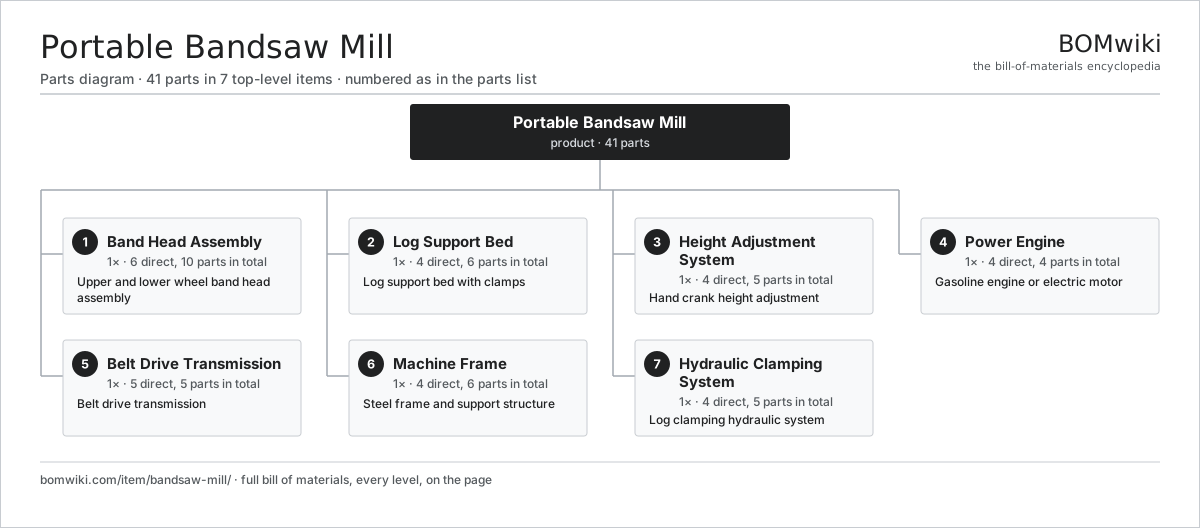
| # | Part | Qty | What it does |
|---|---|---|---|
| 1 | Band Head Assembly 6 parts | 1× | Upper and lower wheel band head assembly |
| 2 | Log Support Bed 4 parts | 1× | Log support bed with clamps |
| 3 | Height Adjustment System 4 parts | 1× | Hand crank height adjustment |
| 4 | Power Engine 4 parts | 1× | Gasoline engine or electric motor |
| 5 | Belt Drive Transmission 5 parts | 1× | Belt drive transmission |
| 6 | Machine Frame 4 parts | 1× | Steel frame and support structure |
| 7 | Hydraulic Clamping System 4 parts | 1× | Log clamping hydraulic system |
3D model
No 3D model yet. Have a CAD file of this? Add a 3D model. STL renders right on this page; STEP, FreeCAD, and OpenSCAD sources are welcome too (openly licensed, like all 3D models on BOMwiki).
Build & assembly graph
expand / collapse · shared sub-assemblies converge · links to related products · est. labourTap an assembly to expand/collapse · tap a part to open it · use “Open page” for any node · drag to pan, scroll to zoom.
Bill of materials for Portable Bandsaw Mill
7 top-level lines · 38 rows shown · 41 parts total · indented to 3 levels| # | Item / sub-assembly | Part no. | Qty/assy | Ext. qty | Parts | Type |
|---|---|---|---|---|---|---|
| 1 | Band Head Assembly 6 parts | bandsaw-mill-band-head | 1× | 1 | 10 | assembly |
| 1.1 | Upper Wheel | bandsaw-mill-upper-wheel | 1× | 1 | · | part |
| 1.2 | Lower Wheel | bandsaw-mill-lower-wheel | 1× | 1 | · | part |
| 1.3 | Saw Blade | bandsaw-mill-saw-blade | 1× | 1 | · | part |
| 1.4 | Wheel Bearing | bandsaw-mill-wheel-bearing | 4× | 4 | · | part |
| 1.5 | Tension Spring | bandsaw-mill-blade-tension-spring | 1× | 1 | · | part |
| 1.6 | Wheel Guard | bandsaw-mill-wheel-guard | 2× | 2 | · | part |
| 2 | Log Support Bed 4 parts | bandsaw-mill-log-bed | 1× | 1 | 6 | assembly |
| 2.1 | Bed Rail | bandsaw-mill-bed-rails | 2× | 2 | · | part |
| 2.2 | Log Clamp Assembly | bandsaw-mill-log-clamp-assy | 2× | 2 | · | part |
| 2.3 | Carriage Track | bandsaw-mill-carriage-track | 1× | 1 | · | part |
| 2.4 | Guide Fence | bandsaw-mill-guide-fence | 1× | 1 | · | part |
| 3 | Height Adjustment System 4 parts | bandsaw-mill-height-mechanism | 1× | 1 | 5 | assembly |
| 3.1 | Height Screw | bandsaw-mill-height-screw | 1× | 1 | · | part |
| 3.2 | Hand Wheel | bandsaw-mill-height-hand-wheel | 1× | 1 | · | part |
| 3.3 | Gearbox | bandsaw-mill-height-gearbox | 1× | 1 | · | part |
| 3.4 | Limit Switch | bandsaw-mill-height-limit-switch | 2× | 2 | · | part |
| 4 | Power Engine 4 parts | bandsaw-mill-engine | 1× | 1 | 4 | assembly |
| 4.1 | Engine | bandsaw-mill-engine-block | 1× | 1 | · | part |
| 4.2 | Alternator | bandsaw-mill-engine-alternator | 1× | 1 | · | part |
| 4.3 | Muffler | bandsaw-mill-engine-muffler | 1× | 1 | · | part |
| 4.4 | Fuel Tank | bandsaw-mill-fuel-tank | 1× | 1 | · | part |
| 5 | Belt Drive Transmission 5 parts | bandsaw-mill-transmission | 1× | 1 | 5 | assembly |
| 5.1 | Engine Pulley | bandsaw-mill-engine-pulley | 1× | 1 | · | part |
| 5.2 | Band Pulley | bandsaw-mill-band-pulley | 1× | 1 | · | part |
| 5.3 | Drive Belt | bandsaw-mill-drive-belt | 1× | 1 | · | part |
| 5.4 | Belt Tensioner | bandsaw-mill-belt-tensioner | 1× | 1 | · | part |
| 5.5 | Belt Guard | bandsaw-mill-belt-guard | 1× | 1 | · | part |
| 6 | Machine Frame 4 parts | bandsaw-mill-frame | 1× | 1 | 6 | assembly |
| 6.1 | Base Beam | bandsaw-mill-base-beam | 2× | 2 | · | part |
| 6.2 | Support Column | bandsaw-mill-support-column | 2× | 2 | · | part |
| 6.3 | Band Carriage | bandsaw-mill-band-head-carriage | 1× | 1 | · | part |
| 6.4 | Handle Grip | bandsaw-mill-handle-grip | 1× | 1 | · | part |
| 7 | Hydraulic Clamping System 4 parts | bandsaw-mill-hydraulics | 1× | 1 | 5 | assembly |
| 7.1 | Hydraulic Pump | bandsaw-mill-hydraulic-pump | 1× | 1 | · | part |
| 7.2 | Relief Valve | bandsaw-mill-pressure-valve | 1× | 1 | · | part |
| 7.3 | Clamp Cylinder | bandsaw-mill-clamp-cylinder | 2× | 2 | · | part |
| 7.4 | Hydraulic Hose | bandsaw-mill-hydraulic-hose | 1× | 1 | · | part |
Something wrong in this list? Report a problem with this BOM.
Sourcing: possible vendors
Browse the supplier directory → Prices, MOQ, and lead times are algorithmic estimates, not quotes, and not claims about these companies. Company mappings are curated by keyword; est. price band $5k–$2M. How estimates work| Vendor | HQ | Specialty | MOQ | Lead time |
|---|---|---|---|---|
| atlascopco.com ↗ | Stockholm, SE | Compressors & industrial | 10 units | 12–20 wks |
|
🇦🇹Andritz
andritz.com ↗
|
Graz, AT | Process plants & machinery | 10 units | 12–20 wks |
| buhlergroup.com ↗ | Uzwil, CH | Food & materials processing | 10 units | 12–20 wks |
| gea.com ↗ | Düsseldorf, DE | Process technology | 10 units | 12–20 wks |
| mhi.com ↗ | Tokyo, JP | Heavy machinery | 10 units | 12–20 wks |
1,463-word article