Banjo
ProductOverview
The five-string banjo is a drum with a neck. Where a guitar's strings drive a wooden soundboard, the banjo's drive a tensioned plastic membrane, the Head, stretched over a metal Tone Ring. The membrane is light and stiff, so it responds fast and loud with little sustain, which is the banjo sound: a percussive attack that decays quickly enough for rapid three-finger rolls to stay articulate.
The instrument splits into the circular Pot Assembly, the Head Assembly tensioned over it, the Neck, the detachable Resonator behind, the Hardware Set that anchors the strings, and the String Set itself. The fifth string is the defining oddity: it is short, starts at the fifth fret via a side-mounted Fifth-String Peg, and is tuned above the first string as a high drone struck by the thumb.
How it works
A plucked string transmits its vibration through the Bridge, a three-footed maple-and-ebony piece about 16 mm tall that is not fixed to anything, string downforce alone holds it on the head. The head, an 11-inch frosted Mylar membrane about 0.25 mm thick, does the work of a soundboard. Its tension is set by 24 Tension Hooks pulling the Tension Hoop down over the head collar; players tighten the Hook Nuts until a tap on the head rings near G♯, the conventional bluegrass setting. Tension must be even around the circle, so nuts are brought up in small increments in a star pattern, like torquing a cylinder head.
The head does not rest on wood. It bears on the Tone Ring, a cast bell-bronze ring of roughly 1.4 kg seated on the Rim. The ring's mass and stiffness raise the impedance at the head edge, reflecting more energy back into the membrane instead of losing it to the rim; the practical result is more volume, more sustain, and a brighter attack than a wood-topped pot. The flathead profile (head surface flush across the ring) became the bluegrass standard after Earl Scruggs's prewar Gibson Mastertones.
Behind the pot, the Resonator Back closes the instrument and reflects rearward sound out past the perforated Resonator Flange toward the audience, worth several decibels over an open-back banjo. Four Resonator Thumbscrews into the Rim Lugs make it removable for setup work.
Neck and strings
The Neck Blank is hard maple carrying an ebony or rosewood Fingerboard with 22 Frets on a 26.25-inch scale. A Truss Rod balances string pull. Four strings run the full scale from the Nut to planetary-geared Tuning Machines; the fifth runs only from its peg at the fifth fret. Strings are light loop-end steel, Plain Strings of 0.009–0.013 inch plus one nickel Wound String for the fourth, hooked into the Tailpiece. The tailpiece's height screw adjusts string pressure behind the bridge: pressing the strings down harder onto the head tightens and brightens the tone.
The neck bolts to the pot through two Coordinator Rods spanning the rim interior. Besides clamping the neck heel, differential tightening of the rod nuts bows the rim slightly to fine-tune neck angle, which sets string action without shimming. An Armrest keeps the player's forearm off the head, since any skin contact damps the membrane audibly.
Setup and variation
Almost everything on a banjo is adjustable, and players exploit it: head tension, bridge placement (set by matching the 12th-fret harmonic to the fretted octave), tailpiece pressure, coordinator-rod angle, and even tone-ring fit all shift the voice. Open-back banjos for clawhammer style omit the resonator and often the heavy tone ring, trading volume for a plunkier, older sound and roughly 2 kg of weight. The resonator bluegrass banjo described here weighs 5–5.5 kg, most of it bronze and maple in the pot.
Banjo parts and their functions
6 top-level parts · 132 parts in total · full bill of materials below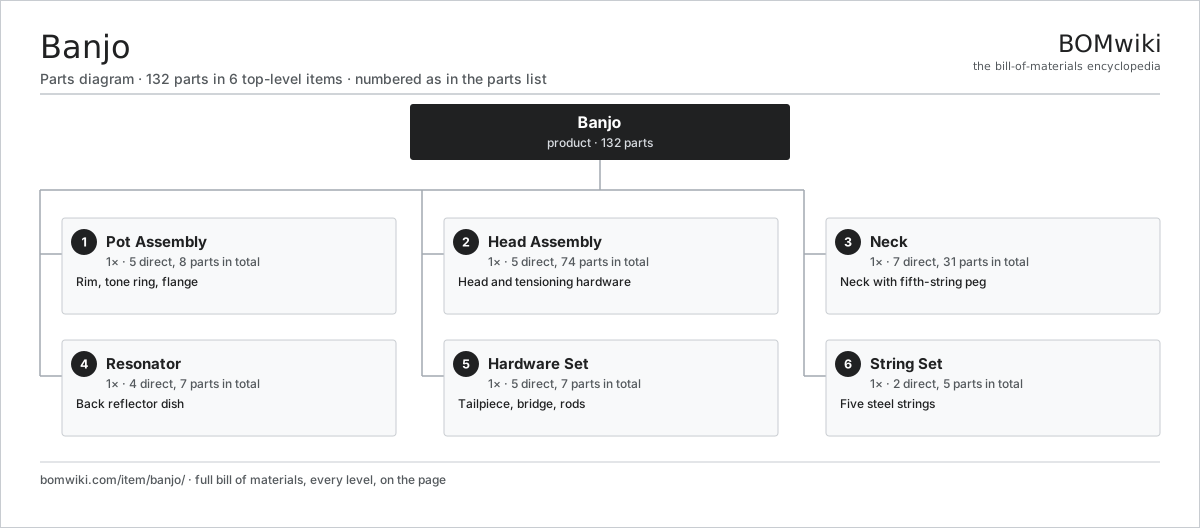
| # | Part | Qty | What it does |
|---|---|---|---|
| 1 | Pot Assembly 5 parts | 1× | Rim, tone ring, flange |
| 2 | Head Assembly 5 parts | 1× | Head and tensioning hardware |
| 3 | Neck 7 parts | 1× | Neck with fifth-string peg |
| 4 | Resonator 4 parts | 1× | Back reflector dish |
| 5 | Hardware Set 5 parts | 1× | Tailpiece, bridge, rods |
| 6 | String Set 2 parts | 1× | Five steel strings |
3D model
No 3D model yet. Have a CAD file of this? Add a 3D model. STL renders right on this page; STEP, FreeCAD, and OpenSCAD sources are welcome too (openly licensed, like all 3D models on BOMwiki).
Build & assembly graph
expand / collapse · shared sub-assemblies converge · links to related products · est. labourTap an assembly to expand/collapse · tap a part to open it · use “Open page” for any node · drag to pan, scroll to zoom.
Bill of materials for Banjo
6 top-level lines · 34 rows shown · 132 parts total · indented to 3 levels| # | Item / sub-assembly | Part no. | Qty/assy | Ext. qty | Parts | Type |
|---|---|---|---|---|---|---|
| 1 | Pot Assembly 5 parts | banjo-pot | 1× | 1 | 8 | assembly |
| 1.1 | Rim | banjo-rim | 1× | 1 | · | part |
| 1.2 | Tone Ring | banjo-tone-ring | 1× | 1 | · | part |
| 1.3 | Resonator Flange | banjo-flange | 1× | 1 | · | part |
| 1.4 | Rim Lug | banjo-rim-lag | 4× | 4 | · | part |
| 1.5 | Fastener Set | fastener-set | 1× | 1 | · | part |
| 2 | Head Assembly 5 parts | banjo-head-assembly | 1× | 1 | 74 | assembly |
| 2.1 | Head | banjo-head | 1× | 1 | · | part |
| 2.2 | Tension Hoop | banjo-tension-hoop | 1× | 1 | · | part |
| 2.3 | Tension Hook | banjo-hook | 24× | 24 | · | part |
| 2.4 | Hook Nut | banjo-hook-nut | 24× | 24 | · | part |
| 2.5 | Bracket Shoe | banjo-bracket-shoe | 24× | 24 | · | part |
| 3 | Neck 7 parts | banjo-neck | 1× | 1 | 31 | assembly |
| 3.1 | Neck Blank | banjo-neck-blank | 1× | 1 | · | part |
| 3.2 | Fingerboard | banjo-fingerboard | 1× | 1 | · | part |
| 3.3 | Fret | banjo-fret | 22× | 22 | · | part |
| 3.4 | Truss Rod | banjo-truss-rod | 1× | 1 | · | part |
| 3.5 | Nut | banjo-nut | 1× | 1 | · | part |
| 3.6 | Tuning Machine | banjo-tuner | 4× | 4 | · | part |
| 3.7 | Fifth-String Peg | banjo-fifth-string-peg | 1× | 1 | · | part |
| 4 | Resonator 4 parts | banjo-resonator | 1× | 1 | 7 | assembly |
| 4.1 | Resonator Back | banjo-resonator-back | 1× | 1 | · | part |
| 4.2 | Resonator Wall | banjo-resonator-wall | 1× | 1 | · | part |
| 4.3 | Resonator Thumbscrew | banjo-resonator-screw | 4× | 4 | · | part |
| 4.4 | Binding | banjo-binding | 1× | 1 | · | part |
| 5 | Hardware Set 5 parts | banjo-hardware | 1× | 1 | 7 | assembly |
| 5.1 | Tailpiece | banjo-tailpiece | 1× | 1 | · | part |
| 5.2 | Bridge | banjo-bridge | 1× | 1 | · | part |
| 5.3 | Coordinator Rod | banjo-coordinator-rod | 2× | 2 | · | part |
| 5.4 | Armrest | banjo-armrest | 1× | 1 | · | part |
| 5.5 | Strap Hook | banjo-strap-hook | 2× | 2 | · | part |
| 6 | String Set 2 parts | banjo-string-set | 1× | 1 | 5 | assembly |
| 6.1 | Plain String | banjo-plain-string | 4× | 4 | · | part |
| 6.2 | Wound String | banjo-wound-string | 1× | 1 | · | part |
Something wrong in this list? Report a problem with this BOM.
Sourcing: possible vendors
Browse the supplier directory → Prices, MOQ, and lead times are algorithmic estimates, not quotes, and not claims about these companies. Company mappings are curated by keyword; est. price band $50–$5k. How estimates work| Vendor | HQ | Specialty | MOQ | Lead time |
|---|---|---|---|---|
| yamaha.com ↗ | Hamamatsu, JP | Audio & instruments | 200 units | 8–14 wks |
|
🇺🇸Fender
fender.com ↗
|
Los Angeles, US | Guitars & amps | 200 units | 8–14 wks |
|
🇺🇸Gibson
gibson.com ↗
|
Nashville, US | Guitars | 200 units | 8–14 wks |
|
🇯🇵Roland
roland.com ↗
|
Hamamatsu, JP | Electronic instruments | 200 units | 8–14 wks |
| steinway.com ↗ | New York, US | Pianos | 200 units | 8–14 wks |
676-word article