Banknote Fitness Sorter
ProductOverview
A banknote fitness sorter is specialized equipment used by central banks and large currency processors to evaluate the physical condition of circulating banknotes. Unlike a teller cash recycler (which accepts customer deposits and dispenses change) or a banknote validator (which merely detects counterfeits), a fitness sorter's sole purpose is to grade notes and segregate unfit notes from the money supply. Central banks and Federal Reserve facilities process billions of banknotes annually, returned from commercial banks, damaged notes, notes suspected of contamination. Each note must be evaluated: Is it still safe to circulate? Does it show excessive wear, stains, chemical damage, or security feature degradation that would compromise public confidence or increase counterfeiting risk? Modern fitness sorters use sophisticated imaging, machine learning, and multi-spectral sensors to answer these questions at rates of 1500 notes per minute, eliminating manual inspection bottlenecks.
The economics of currency management hinge on automation. Manual fitness grading requires trained inspectors to examine notes under magnification, time-consuming and subjective. A fitness sorter replaces 10–15 full-time inspectors, pays for itself in under 2 years, and provides objective audit trails that satisfy regulatory requirements. A modern High-Resolution Image Scanner captures both sides of every note at 300+ dpi; the Defect Analysis & ML Processor analyzes these images using machine learning models trained on thousands of representative worn and counterfeit notes. The machine scores each note on defect severity (tear size, area of stains, fading percentage), applies the central bank's fitness rules (e.g., "any tear >2 mm = unfit"), and sorts it into Fit or Unfit bins in real time.
Sensor Fusion & Defect Scoring
A fitness sorter combines five independent sensor modalities, each measuring different physical properties:
Image Analysis (High-Resolution Image Scanner): The Color Cameras, equipped with banknote-fitness-sorter-telecentric-lenses and precise Lighting Arrays, capture full-resolution images of both note faces. These images are transmitted via Camera Interface (Gigabit Ethernet) to the Defect Analysis & ML Processor at frame rates synchronized with the Precision Transport Belt velocity. A convolutional neural network trained on thousands of examples analyzes each image for visible defects: tears (measured in mm length), creases (quantified by depth and sharpness), stains (area in % of total note), ink fading (reflectance drop %), missing or worn corners, tape or adhesive patches, and writing or marking. The CNN outputs a defect vector: {tear_score: 0.35, crease_score: 0.12, stain_score: 0.08, fade_score: 0.05...}. A weighted combination of these scores produces a single Fitness Grade: e.g., "Grade 2" (fit) or "Grade 5" (severely unfit). The Master Control & Audit System compares this grade to the central bank's fitness threshold (typically Grade 3 or 4 is the cutoff) and sends a sort decision to the Pneumatic/Solenoid Sort Gatess.
Infrared Reflectance (Infrared Reflectance Sensor): The Ir Led at 850 nm is aimed at the note's surface, and the Ir Detector measures reflected intensity. Genuine currency ink is formulated to have specific IR reflectance properties. Worn notes show reduced reflectance in worn areas. Chemically treated notes (bleached or chemically aged to simulate higher denominations) show anomalous reflectance signatures. The IR sensor detects these deviations in milliseconds. A reflectance drop >15% in any region triggers a defect flag.
Ultraviolet Fluorescence (Ultraviolet Authentication Light): The Uv Led at 365 nm illuminates security features, microprinting, security threads, hidden images, that fluoresce under UV light. A genuine note shows characteristic fluorescence patterns. A counterfeit or altered note may show weak, absent, or incorrect patterns. The Uv Camera equipped with a UV-sensitive detector captures these patterns. The Defect Analysis & ML Processor compares the captured pattern to a library of reference patterns for the note denomination. If confidence in the match falls below a threshold (e.g., <95%), the note is flagged for manual review or rejection.
Magnetic Signature (Magnetic Sensor & Coil): The Copper Winding induction coil detects magnetic signatures embedded in modern currency (security threads, magnetized inks). As the note passes through the coil's magnetic field, the Magnetic Sensor & Coil impedance changes. The Defect Analysis & ML Processor demodulates this impedance signature and compares it to a reference for the claimed denomination. If the signature is absent, weak, or shifted, the note is likely counterfeit or heavily damaged (magnetic ink degraded). A signature mismatch triggers rejection.
Mechanical Properties (Optional): Some advanced sorters include thickness sensors or mass sensors that detect notes that have been split (two sheets separated), glued together, or treated chemically. These measurements provide additional evidence but are less common than the optical and magnetic modalities.
All five sensor streams feed real-time data to the Master Control & Audit System, which runs sensor fusion algorithms (e.g., a Bayesian belief network or gradient-boosted decision tree) to integrate all evidence into a single fitness decision. If any single sensor strongly suggests the note is unfit (e.g., "IR reflectance anomaly" + "magnetic signature mismatch"), the note is sorted unfit regardless of image grade. Conversely, a note with minor creasing (image grade 2) but perfect IR and magnetic signatures is graded as Fit.
Machine Learning Adaptation
Modern fitness sorters incorporate updateable machine learning models. The central bank can periodically provide new training data (images of notes that humans have graded as Fit or Unfit) to refine the CNN. The Gpu Card (an NVIDIA Jetson or equivalent) re-trains or fine-tunes the model overnight and deploys it at the start of the next business day. This allows the sorter to adapt to new counterfeiting techniques, paper formula changes (when a central bank redesigns a denomination), or seasonal wear patterns (e.g., notes handled in humid climates show different staining patterns than those in dry climates).
The audit trail recorded by the Master Control & Audit System captures every note's image, all five sensor readings, the raw defect scores from the CNN, and the final sort decision, timestamped and indexed by denomination and batch. If a note later appears in circulation and is discovered to be counterfeit, or if a customer disputes a note being withdrawn from circulation, the central bank can query the sorter's log: "Find all notes sorted as Unfit on 2024-03-15 with magnetic signature anomalies; compare to batch inventory." This accountability is critical for regulatory compliance and public confidence.
Workflow Integration
At a Federal Reserve processing center, bundles of worn or damaged notes arrive from commercial banks daily. An operator loads them into the High-Speed Feeder & Alignment hopper in batches of 500–1000 notes. The High-Speed Feeder & Alignment separates individual notes using the Friction Wheel and Separator Gate, feeding them one per cycle onto the Precision Transport Belt at a programmed speed (typically 1000–1500 notes/min, or ~16–25 notes per second). Each note travels through the scanner area, where all five sensors fire. Images are transmitted to the Gpu Card, which performs CNN inference in parallel. The Master Control & Audit System receives the defect score in ~40–50 ms (while the note is still in transit). By the time the note reaches the Pneumatic/Solenoid Sort Gatess (30 cm downstream), the decision is ready: the Solenoid Gate for Fit notes or Unfit notes actuates, routing the note to the correct output bin. Fit notes continue to a strapping area (optional Optional Auto-Strapping Module) where the Strap Servo automatically bundles them into 100-note or 1000-note packages with kraft paper straps, ready for reissue. Unfit notes fall into a separate bin, which is manually inventoried, photographed, and shredded or incinerated per central bank procedure.
Regulatory Compliance & Audit
Central banks and regulatory bodies (e.g., the Bureau of Engraving and Printing in the U.S., the European Central Bank) mandate that fitness sorters be validated before deployment. This validation includes:
- Accuracy Testing: Running known-good reference notes (Fit and Unfit) through the sorter and verifying 99%+ correct classification.
- Audit Trail Verification: Confirming that the Master Control & Audit System logs are immutable and tamper-evident.
- Sensor Calibration: Verifying that the High-Resolution Image Scanner, Infrared Reflectance Sensor, and Magnetic Sensor & Coil are functioning within specification.
- Security Review: Ensuring that the Gpu Card's machine learning models cannot be externally manipulated or overwritten by unauthorized parties.
Annual re-certification is required; if the sorter's accuracy degrades below 98% (drift due to sensor aging or fouling), it is taken offline for recalibration or replacement of optical components.
Maintenance & Consumables
The High-Speed Feeder & Alignment's Friction Wheel is a wearing part; it should be inspected weekly and replaced every 2000 operating hours (roughly 6–12 months at typical utilization). The Drive Belt on the main transport is also a consumable, rated 5000 hours before replacement. The Lighting Array LED arrays have a lifetime of 50,000 hours; they rarely need replacement but should be cleaned weekly of dust. The Color Cameras are sealed units and do not typically require maintenance, but the Camera Lenses should be cleaned monthly with optical-grade lens paper and alcohol to remove dust that could degrade image quality. The Gpu Card is a solid-state device with no moving parts; it is passive-cooled and does not require replacement unless it fails (rare; MTBF >10,000 hours). The Solenoid Gates are rated 100,000+ cycles; at 1500 cycles per hour (1500 notes/min), they last 66+ hours of operation, or roughly one week at full-time use; replacement is typically annual.
The only true consumable (beyond replacement parts) is the optional Strap Rolls, which cost $10–20 per roll depending on denomination branding and material. A typical sorter at 90,000 notes/day uses roughly 90 straps/day, or 4 strap rolls/month.
Comparison to Other Systems
Unlike a Teller Cash Recycler, which is designed for high-speed accept/reject (accept valid notes, reject counterfeits), a fitness sorter is designed for nuanced grading. It doesn't ask "Is this note counterfeit?" (yes/no). It asks "How fit is this note?" (Grade 1–5 scale). This distinction matters: a teller recycler at a bank branch is optimizing for customer experience (fast service, few rejects). A fitness sorter at a central bank is optimizing for currency quality (remove all unfit notes, create audit accountability). The two machines are complementary: a teller recycler catches obvious counterfeits and prevents circulation of severely damaged notes; a fitness sorter downstream ensures that notes remaining in circulation meet the central bank's fitness standard.
Banknote Fitness Sorter parts and their functions
10 top-level parts · 89 parts in total · full bill of materials below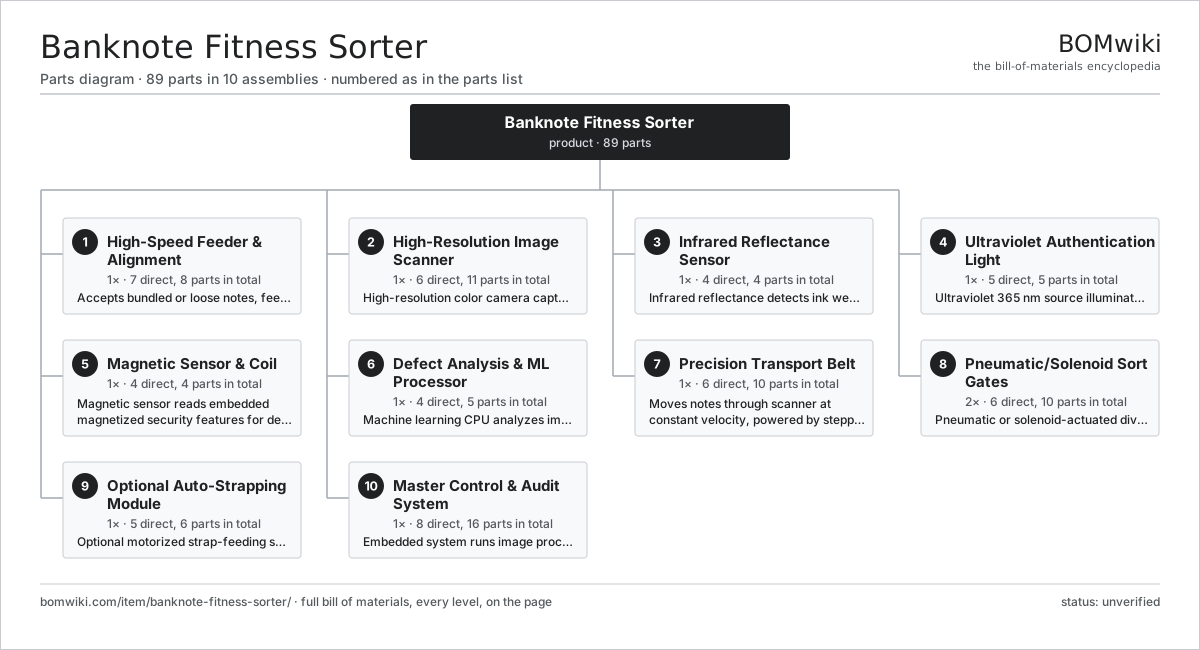
| # | Part | Qty | What it does |
|---|---|---|---|
| 1 | High-Speed Feeder & Alignment 7 parts | 1× | Accepts bundled or loose notes, feeds individually at 1000–1500 notes/min |
| 2 | High-Resolution Image Scanner 6 parts | 1× | High-resolution color camera captures front and back of each note for defect analysis |
| 3 | Infrared Reflectance Sensor 4 parts | 1× | Infrared reflectance detects ink wear, fading, and security thread visibility |
| 4 | Ultraviolet Authentication Light 5 parts | 1× | Ultraviolet 365 nm source illuminates security features for authentication |
| 5 | Magnetic Sensor & Coil 4 parts | 1× | Magnetic sensor reads embedded magnetized security features for denomination and authenticity |
| 6 | Defect Analysis & ML Processor 4 parts | 1× | Machine learning CPU analyzes images for tears, creases, stains, tape, writing, missing corners |
| 7 | Precision Transport Belt 6 parts | 1× | Moves notes through scanner at constant velocity, powered by stepper motor |
| 8 | Pneumatic/Solenoid Sort Gates 6 parts | 2× | Pneumatic or solenoid-actuated diverters route fit vs. unfit notes to separate stacks |
| 9 | Optional Auto-Strapping Module 5 parts | 1× | Optional motorized strap-feeding system bundles sorted notes into 100-note or 1000-note bundles |
| 10 | Master Control & Audit System 8 parts | 1× | Embedded system runs image processing, scoring algorithms, motor control, and audit logging |
3D model
No 3D model yet. Have a CAD file of this? Add a 3D model — STL renders right on this page; STEP, FreeCAD, and OpenSCAD sources are welcome too (openly licensed, like all 3D models on BOMwiki).
Build & assembly graph
expand / collapse · shared sub-assemblies converge · links to related products · est. labourTap an assembly to expand/collapse · tap a part to open it · use “Open page” for any node · drag to pan, scroll to zoom.
Bill of materials for Banknote Fitness Sorter
10 top-level lines · 65 rows shown · 89 parts total · indented to 3 levels| # | Item / sub-assembly | Part no. | Qty/assy | Ext. qty | Parts | Type |
|---|---|---|---|---|---|---|
| 1 | High-Speed Feeder & Alignment 7 parts | banknote-fitness-sorter-feeder | 1× | 1 | 8 | assembly |
| 1.1 | Hopper Tray | banknote-fitness-sorter-hopper-tray | 1× | 1 | · | part |
| 1.2 | Friction Wheel | banknote-fitness-sorter-friction-wheel | 1× | 1 | · | part |
| 1.3 | Separator Gate | banknote-fitness-sorter-separator-gate | 1× | 1 | · | part |
| 1.4 | Feed Motor | banknote-fitness-sorter-feed-motor | 1× | 1 | · | part |
| 1.5 | Straightening Rollers | banknote-fitness-sorter-straightening-rollers | 2× | 2 | · | part |
| 1.6 | Encoder | encoder | 1× | 1 | · | part |
| 1.7 | Fastener Set | fastener-set | 1× | 1 | · | part |
| 2 | High-Resolution Image Scanner 6 parts | banknote-fitness-sorter-image-scanner | 1× | 1 | 11 | assembly |
| 2.1 | Color Camera | banknote-fitness-sorter-color-camera | 2× | 2 | · | part |
| 2.2 | Camera Lens | banknote-fitness-sorter-camera-lens | 2× | 2 | · | part |
| 2.3 | Lighting Array | banknote-fitness-sorter-lighting-array | 2× | 2 | · | part |
| 2.4 | Focus Motor | banknote-fitness-sorter-focus-motor | 2× | 2 | · | part |
| 2.5 | Camera Interface | banknote-fitness-sorter-camera-interface | 1× | 1 | · | part |
| 2.6 | Connector | connector | 2× | 2 | · | part |
| 3 | Infrared Reflectance Sensor 4 parts | banknote-fitness-sorter-ir-sensor | 1× | 1 | 4 | assembly |
| 3.1 | Ir Led | banknote-fitness-sorter-ir-led | 1× | 1 | · | part |
| 3.2 | Ir Detector | banknote-fitness-sorter-ir-detector | 1× | 1 | · | part |
| 3.3 | Bare PCB | pcb-bare | 1× | 1 | · | part |
| 3.4 | Connector | connector | 1× | 1 | · | part |
| 4 | Ultraviolet Authentication Light 5 parts | banknote-fitness-sorter-uv-light | 1× | 1 | 5 | assembly |
| 4.1 | Uv Led | banknote-fitness-sorter-uv-led | 1× | 1 | · | part |
| 4.2 | Uv Camera | banknote-fitness-sorter-uv-camera | 1× | 1 | · | part |
| 4.3 | Uv Lens | banknote-fitness-sorter-uv-lens | 1× | 1 | · | part |
| 4.4 | Uv Blocking Shield | banknote-fitness-sorter-uv-blocking-shield | 1× | 1 | · | part |
| 4.5 | Connector | connector | 1× | 1 | · | part |
| 5 | Magnetic Sensor & Coil 4 parts | banknote-fitness-sorter-mg-coil | 1× | 1 | 4 | assembly |
| 5.1 | Copper Winding | copper-winding | 1× | 1 | · | part |
| 5.2 | Bare PCB | pcb-bare | 1× | 1 | · | part |
| 5.3 | SMD Passive (R/C/L) | smd-passives | 1× | 1 | · | part |
| 5.4 | Connector | connector | 1× | 1 | · | part |
| 6 | Defect Analysis & ML Processor 4 parts | banknote-fitness-sorter-defect-processor | 1× | 1 | 5 | assembly |
| 6.1 | Gpu Card | banknote-fitness-sorter-gpu-card | 1× | 1 | · | part |
| 6.2 | Bare PCB | pcb-bare | 1× | 1 | · | part |
| 6.3 | Power Supply | power-supply | 1× | 1 | · | part |
| 6.4 | Connector | connector | 2× | 2 | · | part |
| 7 | Precision Transport Belt 6 parts | banknote-fitness-sorter-transport-belt | 1× | 1 | 10 | assembly |
| 7.1 | Transport Motor | banknote-fitness-sorter-transport-motor | 1× | 1 | · | part |
| 7.2 | Drive Belt | banknote-fitness-sorter-drive-belt | 1× | 1 | · | part |
| 7.3 | Conveyor Frame | banknote-fitness-sorter-conveyor-frame | 2× | 2 | · | part |
| 7.4 | Belt Tensioner | banknote-fitness-sorter-belt-tensioner | 1× | 1 | · | part |
| 7.5 | Ball Bearing | ball-bearing | 4× | 4 | · | part |
| 7.6 | Encoder | encoder | 1× | 1 | · | part |
| 8 | Pneumatic/Solenoid Sort Gates 6 parts | banknote-fitness-sorter-sort-gate | 2× | 2 | 10 | assembly |
| 8.1 | Solenoid Gate | banknote-fitness-sorter-solenoid-gate | 2× | 4 | · | part |
| 8.2 | Gate Guide | banknote-fitness-sorter-gate-guide | 2× | 4 | · | part |
| 8.3 | Gate Sensor | banknote-fitness-sorter-gate-sensor | 2× | 4 | · | part |
| 8.4 | Bare PCB | pcb-bare | 1× | 2 | · | part |
| 8.5 | Relay | relay | 2× | 4 | · | part |
| 8.6 | Connector | connector | 1× | 2 | · | part |
| 9 | Optional Auto-Strapping Module 5 parts | banknote-fitness-sorter-strapping-interface | 1× | 1 | 6 | assembly |
| 9.1 | Strap Roll | banknote-fitness-sorter-strap-roll | 2× | 2 | · | part |
| 9.2 | Strap Servo | banknote-fitness-sorter-strap-servo | 1× | 1 | · | part |
| 9.3 | Cutter Blade | banknote-fitness-sorter-cutter-blade | 1× | 1 | · | part |
| 9.4 | Bundle Counter | banknote-fitness-sorter-bundle-counter | 1× | 1 | · | part |
| 9.5 | Connector | connector | 1× | 1 | · | part |
| 10 | Master Control & Audit System 8 parts | banknote-fitness-sorter-control-board | 1× | 1 | 16 | assembly |
| 10.1 | Microcontroller | mcu | 1× | 1 | · | part |
| 10.2 | Bare PCB | pcb-bare | 1× | 1 | · | part |
| 10.3 | Rtc Module | safe-deposit-system-rtc-module | 1× | 1 | · | part |
| 10.4 | SMD Passive (R/C/L) | smd-passives | 1× | 1 | · | part |
| 10.5 | Power MOSFET | mosfet | 4× | 4 | · | part |
| 10.6 | Relay | relay | 2× | 2 | · | part |
| 10.7 | Connector | connector | 5× | 5 | · | part |
| 10.8 | Power Supply | power-supply | 1× | 1 | · | part |
Related products
same domain, ranked by shared parts Cash Deposit Machine
64 parts · shares 7 with this page
Coin Counting Kiosk
63 parts · shares 7 with this page
Rotary Deposit Safe
152 parts · shares 5 with this page
Cash Deposit Machine
64 parts · shares 7 with this page
Coin Counting Kiosk
63 parts · shares 7 with this page
Rotary Deposit Safe
152 parts · shares 5 with this page
 Safe Deposit Box System
5,374 parts · shares 4 with this page
Safe Deposit Box System
5,374 parts · shares 4 with this page
 Pneumatic Tube Station
201 parts · shares 6 with this page
Drive-Through Teller Unit
178 parts · shares 5 with this page
Pneumatic Tube Station
201 parts · shares 6 with this page
Drive-Through Teller Unit
178 parts · shares 5 with this page
Sourcing: possible vendors
Prices, MOQ, and lead times are algorithmic estimates, not quotes, and not claims about these companies. Company mappings are curated by keyword; est. price band $50–$15k. How estimates work| Vendor | HQ | Specialty | MOQ | Lead time |
|---|---|---|---|---|
|
🇯🇵Canon
canon.com ↗
|
Tokyo, JP | Imaging & optics | 500 units | 8–12 wks |
|
🇯🇵Ricoh
ricoh.com ↗
|
Tokyo, JP | Office imaging | 500 units | 8–12 wks |
|
🇺🇸Xerox
xerox.com ↗
|
Norwalk, US | Printers & copiers | 500 units | 8–12 wks |
|
🇯🇵Epson
epson.com ↗
|
Suwa, JP | Printers & projectors | 500 units | 8–12 wks |
|
🇯🇵Brother
brother.com ↗
|
Nagoya, JP | Printers & sewing | 500 units | 8–12 wks |
1,838-word article