Mechanical Bar Screen
ProductOverview
A mechanical bar screen is the first primary treatment stage in wastewater plants, removing large solids (rags, plastics, wood, grit) >5 mm from raw sewage. The rotating rake mechanism periodically clears the vertical or inclined bar rack, conveying screenings to a discharge chute for disposal.
Bar screens protect downstream equipment (pumps, treatment tanks) from blockage and abrasion, while producing a quantifiable screenings waste stream (typically 10–80 L per 1000 m³ of influent). Automatic control via differential pressure sensing triggers rake operation only when blockage occurs, minimizing energy consumption.
Screenings Characteristics
Typical municipal wastewater screenings composition (% by volume):
- Rags, cloth, paper: 40–50%
- Plastics, bags, film: 20–30%
- Hair, fibers: 10–15%
- Food waste, debris: 5–10%
- Grit, sand: 5–10%
Mass loading:
- Small plants: 10–20 L/1000 m³ (poor sewer maintenance)
- Average plants: 30–50 L/1000 m³ (typical)
- Combined sewer systems: 50–80 L/1000 m³ (stormwater inflow)
Moisture content: 80–90% water; oven-dry solids = 10–20% of wet mass.
Hydraulics
Head Loss Calculation:
The blockage-free bar rack induces minimal head loss (0.05–0.15 m), calculated as:
h_L = (v²/2g) × [(α × A_bar) / A_open]
Where:
- v = approach velocity = Q / A_total
- α = drag coefficient (~1.0 for cylinder)
- A_bar = projected area of bars = n × d × L (n = bar count, d = diameter, L = length)
- A_open = free flow area between bars
For a 2 m wide × 1 m high bar rack with 10 mm bars at 20 mm spacing and 1 m³/min flow:
- v = 1 m³/min / (2 m × 1 m) = 0.5 m/min = 0.0083 m/s
- A_total = 2 × 1 = 2 m²
- A_bar = 10 bars × 0.01 m × 2 m = 0.2 m²
- A_open = 2 - 0.2 = 1.8 m²
- h_L = (0.0083² / 19.6) × (1.0 × 0.2 / 1.8) = negligible
As blockage accumulates, head loss increases. At 50% blockage:
- h_L ≈ 0.3–0.5 m
- Differential pressure across rack: ΔP = ρgh = 1000 × 9.81 × 0.4 / 10,000 ≈ 0.39 bar
The controller triggers rake at 0.15–0.25 bar setpoint (50–100% blockage level).
Raking Mechanism Operation
The drive system rotates the rake arm at 0.5–5 rpm. Typical cycle:
- Contact Phase: Rake descends, teeth engage trapped solids and pull them upward and into the Discharge Chute
- Travel Speed: 0.1–0.3 m/min (slow to allow water draining from screenings)
- Dwell Time: 5–10 seconds at top position
- Return: Rapid descent for next cycle
Cycle duration is programmable: 5–30 minutes. Demand-based control (pressure sensing) overrides time and initiates immediate rake operation if blockage setpoint is reached.
Torque Considerations:
At blockage onset, the rake encounters maximum resistance. The torque limiter provides slip-clutch protection, allowing the motor to stall or slip rather than break the rake arm.
Typical stall torque: 500–2000 N·m depending on motor power and rake size.
Differential Pressure Control
The differential pressure transmitter measures the pressure drop across the bar rack:
ΔP_transducer = P_upstream - P_downstream
A differential pressure switch (0.1–0.3 bar setpoint) is wired to the PLC. Two control modes:
Mode 1: Timed Intervals
- Rake cycles every 5–15 minutes regardless of blockage
- Simple but potentially wasteful (energy for unnecessary raking)
- Used in small plants with consistent screenings load
Mode 2: Demand-Based (Pressure Sensing)
- Rake activates only when ΔP exceeds setpoint (typically 0.2 bar)
- PLC monitors transmitter signal (4–20 mA)
- Improves efficiency; rake runs only when blockage warrants it
- Suitable for variable-load plants (combined sewers, seasonal variation)
Screenings Discharge
The Discharge Chute conveys wet screenings gravity or vibration-assisted. Two scenarios:
Gravity Discharge (Simple):
- Chute slope: 45–60°
- Water drains back to channel via perforations
- Manual dumpster or conveyor at bottom
- Suitable for small plants; labor-intensive
Vibrating Chute (Mechanical):
- Electromagnetic vibrator oscillates chute at 10–60 Hz
- Fluidizes wet screenings, accelerating discharge
- Reduces blockages and bridging
- Typical for larger plants; adds 0.5–2 kW power consumption
Wash Water System:
The Flushing System applies wash water during/after rake operation:
- Flow: 1–5 m³/h at 2–5 bar
- Purpose: Clean trapped silt/sand from screenings, reducing odor and volume
- Wash water is recirculated to channel (nutrients recovered)
Screening Quality vs. Plant Size
| Plant Capacity | Annual Screenings | Moisture | Disposal |
|---|---|---|---|
| 100 m³/day | 50–100 m³/yr | 85% | Manual pickup |
| 1000 m³/day | 500–1000 m³/yr | 85% | Weekly pickup |
| 10,000 m³/day | 5000–10,000 m³/yr | 80–85% | Landfill or composting |
Operational Issues
Bridging: Large rags or plastic bags jam between bars before rake reaches them. Prevention:
- Undersized bar spacing (5 mm instead of 10 mm)
- Increased rake frequency (every 5 min)
- Staggered bar arrangement
Grit Accumulation: Sand and gravel settle in the channel below screenings. If not removed:
- Increases solids load to downstream treatment
- Abrades pump impellers and compressor valves
- Necessitates a Grit Classifier for grit recovery
Screenings Odor: Decomposition in wet screenings produces H₂S and mercaptans. Mitigation:
- Frequent rake cycles (minimize dwell time in channel)
- Wash water flushing (oxidizes some sulfur compounds)
- Screenings dewatering/composting off-site
Design Considerations
Flow Distribution: Uneven flow across the bar rack causes local blockages. Design requires:
- Smooth transition inlet (no sharp bends)
- Approach channel width ≥ rack width
- Uniform approach velocity 0.3–0.5 m/s (prevents grit settling before bar rack)
Bypass Capacity: During peak flows (combined sewer overflow), flow exceeding bar-screen capacity must bypass without damaging the equipment. Typical:
- Movable stoplogs or sectional gates
- Emergency weir overflow to bypass channel
- Sized for 2 × design flow
Replacement Interval: Bar racks are subject to corrosion and abrasion:
- Stainless steel (304/316): 10–15 years typical life
- Carbon steel with paint: 5–8 years (high corrosion risk)
- Stainless-preferred given long-term maintenance cost
Standards and Guidelines
- ASME B29.1: Roller Chain and Sprockets
- ISO 11571: Bar screen design and testing
- WPCF MOP 8: Preliminary Treatment
- EPA Design Manual: Preliminary Treatment
Mechanical Bar Screen parts and their functions
7 top-level parts · 42 parts in total · full bill of materials below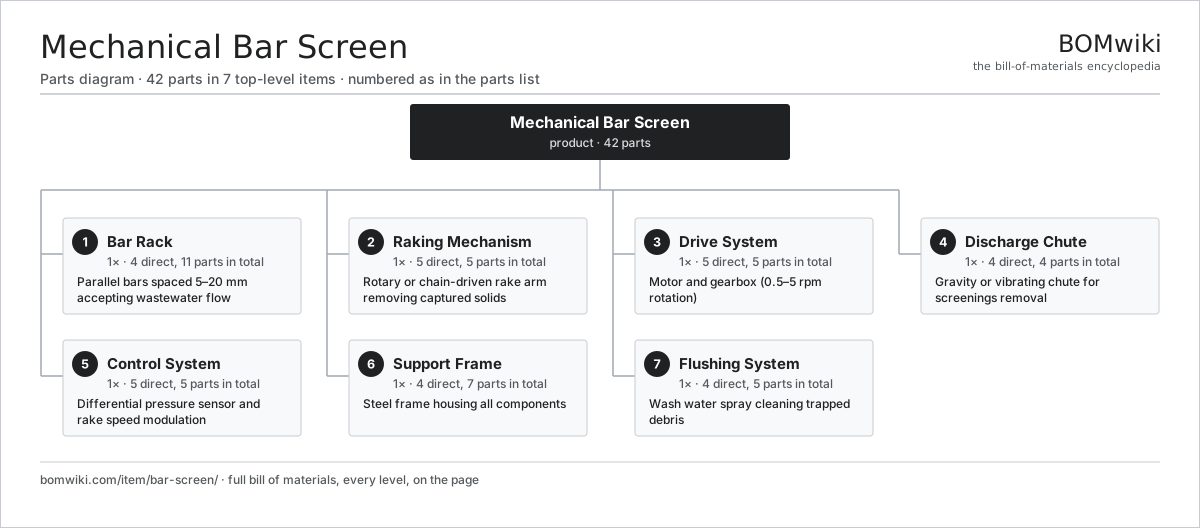
| # | Part | Qty | What it does |
|---|---|---|---|
| 1 | Bar Rack 4 parts | 1× | Parallel bars spaced 5–20 mm accepting wastewater flow |
| 2 | Raking Mechanism 5 parts | 1× | Rotary or chain-driven rake arm removing captured solids |
| 3 | Drive System 5 parts | 1× | Motor and gearbox (0.5–5 rpm rotation) |
| 4 | Discharge Chute 4 parts | 1× | Gravity or vibrating chute for screenings removal |
| 5 | Control System 5 parts | 1× | Differential pressure sensor and rake speed modulation |
| 6 | Support Frame 4 parts | 1× | Steel frame housing all components |
| 7 | Flushing System 4 parts | 1× | Wash water spray cleaning trapped debris |
3D model
No 3D model yet. Have a CAD file of this? Add a 3D model. STL renders right on this page; STEP, FreeCAD, and OpenSCAD sources are welcome too (openly licensed, like all 3D models on BOMwiki).
Build & assembly graph
expand / collapse · shared sub-assemblies converge · links to related products · est. labourTap an assembly to expand/collapse · tap a part to open it · use “Open page” for any node · drag to pan, scroll to zoom.
Bill of materials for Mechanical Bar Screen
7 top-level lines · 38 rows shown · 42 parts total · indented to 3 levels| # | Item / sub-assembly | Part no. | Qty/assy | Ext. qty | Parts | Type |
|---|---|---|---|---|---|---|
| 1 | Bar Rack 4 parts | bar-screen-bar-rack | 1× | 1 | 11 | assembly |
| 1.1 | Bar Element | bar-screen-bar-element | 1× | 1 | · | part |
| 1.2 | Rack Frame | bar-screen-rack-frame | 1× | 1 | · | part |
| 1.3 | Upstream Guide | bar-screen-upstream-guide | 1× | 1 | · | part |
| 1.4 | Bar Support Pin | bar-screen-bar-support-pin | 8× | 8 | · | part |
| 2 | Raking Mechanism 5 parts | bar-screen-raking-mechanism | 1× | 1 | 5 | assembly |
| 2.1 | Rake Arm | bar-screen-rake-arm | 1× | 1 | · | part |
| 2.2 | Rake Teeth | bar-screen-rake-teeth | 1× | 1 | · | part |
| 2.3 | Chain Drive | bar-screen-chain-drive | 1× | 1 | · | part |
| 2.4 | Return Sprocket | bar-screen-return-sprocket | 1× | 1 | · | part |
| 2.5 | Guide Rail | bar-screen-rake-guide-rail | 1× | 1 | · | part |
| 3 | Drive System 5 parts | bar-screen-drive-system | 1× | 1 | 5 | assembly |
| 3.1 | Blower Motor | blower-motor | 1× | 1 | · | part |
| 3.2 | Gearbox | bar-screen-gearbox | 1× | 1 | · | part |
| 3.3 | Motor Starter | bar-screen-motor-starter | 1× | 1 | · | part |
| 3.4 | Torque Limiter | bar-screen-torque-limiter | 1× | 1 | · | part |
| 3.5 | Drive Sprocket | bar-screen-chain-sprocket | 1× | 1 | · | part |
| 4 | Discharge Chute 4 parts | bar-screen-discharge-chute | 1× | 1 | 4 | assembly |
| 4.1 | Chute Pan | bar-screen-chute-pan | 1× | 1 | · | part |
| 4.2 | Chute Vibrator | bar-screen-chute-vibrator | 1× | 1 | · | part |
| 4.3 | Scraper Blade | bar-screen-scraper-blade | 1× | 1 | · | part |
| 4.4 | Discharge Opening | bar-screen-discharge-opening | 1× | 1 | · | part |
| 5 | Control System 5 parts | bar-screen-controls | 1× | 1 | 5 | assembly |
| 5.1 | Differential Pressure Sensor | bar-screen-differential-sensor | 1× | 1 | · | part |
| 5.2 | PLC Module | bar-screen-plc-module | 1× | 1 | · | part |
| 5.3 | Speed Controller | bar-screen-speed-controller | 1× | 1 | · | part |
| 5.4 | Operation Timer | bar-screen-timer | 1× | 1 | · | part |
| 5.5 | LCD Panel | lcd-panel | 1× | 1 | · | part |
| 6 | Support Frame 4 parts | bar-screen-support-structure | 1× | 1 | 7 | assembly |
| 6.1 | Main Frame | bar-screen-main-frame | 1× | 1 | · | part |
| 6.2 | Drive Motor Mount | bar-screen-drive-mount | 1× | 1 | · | part |
| 6.3 | Anchor Bolts | bar-screen-anchor-bolt | 4× | 4 | · | part |
| 6.4 | Fastener Set | fastener-set | 1× | 1 | · | part |
| 7 | Flushing System 4 parts | bar-screen-flushing-system | 1× | 1 | 5 | assembly |
| 7.1 | Wash Pump | bar-screen-wash-pump | 1× | 1 | · | part |
| 7.2 | Wash Nozzles | bar-screen-wash-nozzles | 2× | 2 | · | part |
| 7.3 | Wash Solenoid Valve | bar-screen-wash-valve | 1× | 1 | · | part |
| 7.4 | Pressure Sensor | pressure-sensor | 1× | 1 | · | part |
Something wrong in this list? Report a problem with this BOM.
Related products
same domain, ranked by shared parts Cable Coiling Machine
36 parts · shares 3 with this page
Cable Coiling Machine
36 parts · shares 3 with this page
 Cable Extrusion Line
46 parts · shares 3 with this page
Cable Extrusion Line
46 parts · shares 3 with this page
 DAF System
41 parts · shares 3 with this page
Glass Tempering Furnace
79 parts · shares 3 with this page
DAF System
41 parts · shares 3 with this page
Glass Tempering Furnace
79 parts · shares 3 with this page
Sourcing: possible vendors
Browse the supplier directory → Prices, MOQ, and lead times are algorithmic estimates, not quotes, and not claims about these companies. Company mappings are curated by keyword; est. price band $5k–$2M. How estimates work| Vendor | HQ | Specialty | MOQ | Lead time |
|---|---|---|---|---|
| atlascopco.com ↗ | Stockholm, SE | Compressors & industrial | 10 units | 12–20 wks |
|
🇦🇹Andritz
andritz.com ↗
|
Graz, AT | Process plants & machinery | 10 units | 12–20 wks |
| buhlergroup.com ↗ | Uzwil, CH | Food & materials processing | 10 units | 12–20 wks |
| gea.com ↗ | Düsseldorf, DE | Process technology | 10 units | 12–20 wks |
| mhi.com ↗ | Tokyo, JP | Heavy machinery | 10 units | 12–20 wks |
1,018-word article