Barograph
ProductOverview
The barograph is a self-recording barometer that continuously transcribes atmospheric pressure variations onto a moving paper chart, creating a permanent record of weather-driven pressure changes over a week. Unlike simple mercury or aneroid barometers that require manual reading, the barograph automates record-keeping, enabling meteorologists and engineers to identify pressure trends, storm fronts, and atmospheric systems.
Operating principle: the Aneroid Mechanism senses atmospheric pressure changes through sealed metal capsule expansion and contraction. This microscopic motion is amplified mechanically through a series of levers (Amplification System) and translated into vertical movement of a pen arm (Pen Arm). Simultaneously, a clockwork motor (Clockwork Drive) rotates a drum (Drum Assembly) at a precise constant rate, typically one revolution per 7 days. The pen traces a curve on the chart paper, with vertical position encoding pressure and horizontal position encoding time.
Aneroid Element
The core sensing element is the Aneroid Mechanism, a stack of 3 or more aneroid capsules. Each capsule is a thin-walled brass chamber (0.1 mm wall thickness) sealed at a partial vacuum (approximately 70 mb, or 0.7 atmospheres absolute pressure). The capsule is corrugated or wavy to allow expansion and contraction without buckling.
When external atmospheric pressure increases, the capsule walls are pushed inward by the higher external pressure, compressing the internal partial vacuum. Conversely, when atmospheric pressure decreases, the partial vacuum inside pushes the walls outward, expanding the capsule. The displacement is small, typically 0.5–1.0 mm for a 100 mb pressure change, but sufficient for amplification.
Multiple capsules are stacked in a Capsule Frame and connected in series so that displacement is cumulative. The top of the capsule stack is rigidly attached to a linkage rod that feeds into the amplification system.
Amplification
The Amplification System is a multi-stage lever system providing mechanical advantage (magnification ratio) of 15–30×. This magnification is necessary because aneroid displacement is small; without amplification, the pen would barely move, and pressure changes would be barely distinguishable on the chart.
A typical three-stage amplification:
- Primary lever (5:1): The short end connects to the capsule linkage; the long end extends upward and connects to the secondary lever. A capsule displacement of 0.5 mm is magnified to 2.5 mm.
- Secondary lever (3:1): Receives the 2.5 mm motion and magnifies it to 7.5 mm.
- Tertiary lever (2:1): Further magnifies to 15 mm final pen displacement.
Each lever pivots on a fulcrum block, a hardened steel point that rests in a notch, minimizing friction. The levers are connected by rigid rods or are directly pinned to one another. A calibration screw allows fine zero-pressure adjustment, ensuring the pen rests at the baseline (700 mb) when no pressure variation is applied.
Pen Arm and Writing
The Pen Arm is a rigid arm (aluminum or steel tube, 200–300 mm long) that extends radially inward toward the rotating drum. One end is pinned to the top of the tertiary lever; the other end holds a pen holder containing a Pen, typically a siphon ink pen or modern felt-tip nib.
Pen pressure is maintained by a spring pressing the pen tip against the drum with consistent force (typically 10–20 grams-force). This prevents scratching (too heavy) and skipping (too light).
A guide rail constrains the pen arm to move purely radially, preventing angular deflection. As pressure increases, the capsule expands, the levers push upward, the pen arm rotates about its pivot, and the pen traces a line higher on the drum. As pressure decreases, the opposite occurs. The result is a curve recording pressure trends.
Clockwork Drive
The Clockwork Drive is a spring-powered mechanism providing constant-speed rotation of the drum. The system consists of:
- Mainspring: A wound steel ribbon (0.5–1.0 mm thick) providing rotational energy. It is wound tightly in a barrel and unwinds over a 7-day period.
- Gear train: A series of gears reducing motor speed from approximately 2 rpm (spring barrel) to 0.04 rpm (drum), a step-down ratio of ~50:1.
- Escapement: A regulator mechanism (typically an anchor or lever escapement borrowed from clock design) that meters energy release from the spring, preventing speed variation. The escapement releases a fixed energy quantum to the gear train at regular intervals.
- Escape wheel: A precision-cut gear that interacts with the escapement, controlling timing.
The winding key, a detachable crank, tightens the mainspring weekly. As the spring unwinds, the escapement maintains constant speed, ensuring a uniform time axis on the chart. A seven-day wind interval is common, allowing the operator to rewind on a regular schedule (e.g., every Monday morning).
The drum makes one complete rotation per 7 days, meaning the chart paper travels at a rate of approximately 5–10 cm per day. This slow speed allows fine temporal resolution: a pressure change occurring over 12 hours is visible as a distinct feature on the chart.
Drum and Chart
The Drum Assembly is a cylinder (150–200 mm diameter, 300–350 mm wide) rotating on bearings driven by the gear train. The drum is made of aluminum or brass and is wrapped with chart paper, a specially printed strip (30–40 cm wide, 200–250 cm total length) with a grid printed on it.
The grid shows:
- Horizontal axis: Time (in 7 days, typically marked hourly or every 3 hours).
- Vertical axis: Pressure (700–800 mb, or 26–32 inHg, depending on regional convention).
The chart guide rails ensure the paper aligns smoothly; clamps hold the paper ends in place and provide tension. The drum rotates with bearings minimizing friction; journal bearings or low-friction ball bearings support the shaft.
Once the 7-day period is complete, the paper is removed and the drum is restarted with a fresh chart. The old chart is archived as a permanent pressure record.
Calibration and Accuracy
Before deployment, a barograph is calibrated against a standard mercury barometer. The operator adjusts the knob (connected to the Adjustment Screw) to align the pen trace with the known pressure reading. This zeroing is critical; a miscalibration of 1 mm on the lever pivot introduces a 15–30 mb error.
Aneroid barometers are inherently less accurate than mercury barometers (mercury provides a direct, absolute pressure reading via fluid height). A well-maintained aneroid barograph typically achieves ±2 mb accuracy over a full 7-day period, with nonlinearity and hysteresis (capsule history-dependence) being the primary error sources. However, for meteorological trend analysis, identifying high-pressure systems, falling barometer before storms, rising barometer after frontal passage, aneroid barographs are quite adequate.
Historical and Modern Use
Barographs saw widespread adoption from the 1880s through the 20th century by meteorological services, airports, and research institutions. They provided the first continuous pressure records, enabling the identification of cyclone formation, anticyclone movement, and local weather patterns. Large networks of barographs were essential to early weather forecasting.
Modern barographs are rarely used for operational meteorology, having been replaced by electronic barometric sensors and digital data logging. However, barographs remain valued by:
- Meteorological museums and historical institutions.
- Enthusiasts of mechanical instruments.
- Some maritime and aviation facilities that maintain backup mechanical instruments.
- Research on historical climate and weather patterns (using archived barograph charts).
The mechanical elegance of the barograph, the transformation of an invisible pressure change into a visible, permanent trace, makes it a compelling example of mechanical measurement engineering.
Barograph parts and their functions
6 top-level parts · 35 parts in total · full bill of materials below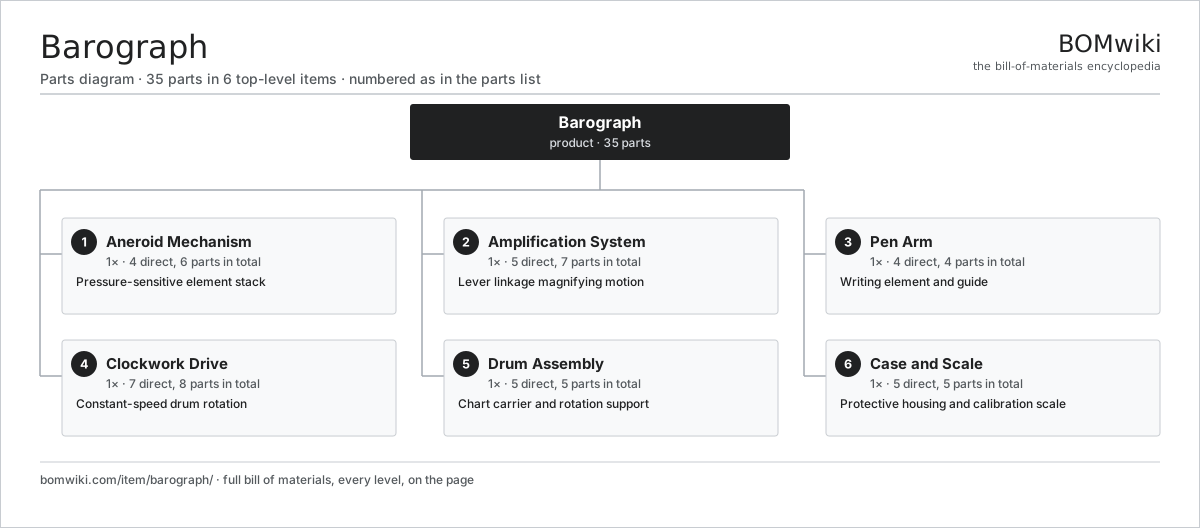
| # | Part | Qty | What it does |
|---|---|---|---|
| 1 | Aneroid Mechanism 4 parts | 1× | Pressure-sensitive element stack |
| 2 | Amplification System 5 parts | 1× | Lever linkage magnifying motion |
| 3 | Pen Arm 4 parts | 1× | Writing element and guide |
| 4 | Clockwork Drive 7 parts | 1× | Constant-speed drum rotation |
| 5 | Drum Assembly 5 parts | 1× | Chart carrier and rotation support |
| 6 | Case and Scale 5 parts | 1× | Protective housing and calibration scale |
3D model
No 3D model yet. Have a CAD file of this? Add a 3D model. STL renders right on this page; STEP, FreeCAD, and OpenSCAD sources are welcome too (openly licensed, like all 3D models on BOMwiki).
Build & assembly graph
expand / collapse · shared sub-assemblies converge · links to related products · est. labourTap an assembly to expand/collapse · tap a part to open it · use “Open page” for any node · drag to pan, scroll to zoom.
Bill of materials for Barograph
6 top-level lines · 36 rows shown · 35 parts total · indented to 3 levels| # | Item / sub-assembly | Part no. | Qty/assy | Ext. qty | Parts | Type |
|---|---|---|---|---|---|---|
| 1 | Aneroid Mechanism 4 parts | barograph-aneroid-mechanism | 1× | 1 | 6 | assembly |
| 1.1 | Aneroid Capsule | barograph-aneroid-capsule | 3× | 3 | · | part |
| 1.2 | Capsule Frame | barograph-capsule-frame | 1× | 1 | · | part |
| 1.3 | Capsule Seal | barograph-capsule-seal | 1× | 1 | · | part |
| 1.4 | Capsule Linkage | barograph-lever-linkage | 1× | 1 | · | part |
| 2 | Amplification System 5 parts | barograph-amplification-system | 1× | 1 | 7 | assembly |
| 2.1 | Primary Lever | barograph-primary-lever | 1× | 1 | · | part |
| 2.2 | Secondary Lever | barograph-secondary-lever | 1× | 1 | · | part |
| 2.3 | Tertiary Lever | barograph-tertiary-lever | 1× | 1 | · | part |
| 2.4 | Fulcrum Blocks | barograph-fulcrum-blocks | 3× | 3 | · | part |
| 2.5 | Adjustment Screw | barograph-adjustment-screw | 1× | 1 | · | part |
| 3 | Pen Arm 4 parts | barograph-pen-arm | 1× | 1 | 4 | assembly |
| 3.1 | Pen Holder | barograph-pen-holder | 1× | 1 | · | part |
| 3.2 | Pen | barograph-pen | 1× | 1 | · | part |
| 3.3 | Pen Tension Spring | barograph-spring-tension | 1× | 1 | · | part |
| 3.4 | Guide Rail | barograph-guide-rail | 1× | 1 | · | part |
| 4 | Clockwork Drive 7 parts | barograph-clockwork-drive | 1× | 1 | 8 | assembly |
| 4.1 | Mainspring | barograph-mainspring | 1× | 1 | · | part |
| 4.2 | Spring Barrel | barograph-spring-barrel | 1× | 1 | · | part |
| 4.3 | Gear Train | barograph-gear-train | 1× | 1 | · | part |
| 4.4 | Escapement | barograph-escapement | 1× | 1 | · | part |
| 4.5 | Escape Wheel | barograph-escape-wheel | 1× | 1 | · | part |
| 4.6 | Winding Key | barograph-winding-key | 1× | 1 | · | part |
| 4.7 | Ball Bearing | ball-bearing | 2× | 2 | · | part |
| 5 | Drum Assembly 5 parts | barograph-drum-assembly | 1× | 1 | 5 | assembly |
| 5.1 | Drum | barograph-drum | 1× | 1 | · | part |
| 5.2 | Drum Shaft | barograph-drum-shaft | 1× | 1 | · | part |
| 5.3 | Drum Bearing | barograph-drum-bearing | 1× | 1 | · | part |
| 5.4 | Chart Clamp | barograph-chart-clamp | 1× | 1 | · | part |
| 5.5 | Chart Guide | barograph-chart-guide | 1× | 1 | · | part |
| 6 | Case and Scale 5 parts | barograph-case | 1× | 1 | 5 | assembly |
| 6.1 | Case Body | barograph-case-body | 1× | 1 | · | part |
| 6.2 | Case Glass | barograph-case-glass | 1× | 1 | · | part |
| 6.3 | Mounting Plate | barograph-mounting-plate | 1× | 1 | · | part |
| 6.4 | Pressure Scale | barograph-pressure-scale | 1× | 1 | · | part |
| 6.5 | Adjustment Knob | barograph-adjustment-knob | 1× | 1 | · | part |
Something wrong in this list? Report a problem with this BOM.
Related products
same domain, ranked by shared parts All-Electric Injection Molding Machine
851 parts · shares 1 with this page
All-Electric Injection Molding Machine
851 parts · shares 1 with this page
 Ampoule Filling-Sealing Machine
53 parts · shares 1 with this page
AOI Machine
38 parts · shares 1 with this page
Automated Paint Spray Line
2,003 parts · shares 1 with this page
Ampoule Filling-Sealing Machine
53 parts · shares 1 with this page
AOI Machine
38 parts · shares 1 with this page
Automated Paint Spray Line
2,003 parts · shares 1 with this page
Sourcing: possible vendors
Browse the supplier directory → Prices, MOQ, and lead times are algorithmic estimates, not quotes, and not claims about these companies. Company mappings are curated by keyword; est. price band $5k–$2M. How estimates work| Vendor | HQ | Specialty | MOQ | Lead time |
|---|---|---|---|---|
| atlascopco.com ↗ | Stockholm, SE | Compressors & industrial | 10 units | 12–20 wks |
|
🇦🇹Andritz
andritz.com ↗
|
Graz, AT | Process plants & machinery | 10 units | 12–20 wks |
| buhlergroup.com ↗ | Uzwil, CH | Food & materials processing | 10 units | 12–20 wks |
| gea.com ↗ | Düsseldorf, DE | Process technology | 10 units | 12–20 wks |
| mhi.com ↗ | Tokyo, JP | Heavy machinery | 10 units | 12–20 wks |
1,309-word article