Ice Cream Batch Freezer
ProductOverview
A batch ice cream freezer is a refrigerated churn that transforms liquid ice cream mix into finished product. The Freezing Drum is a double-jacketed cylinder where cold ammonia or synthetic refrigerant flows through an external jacket while the mix tumbles inside. The Dasher & Scraper Assembly assembly prevents ice formation on the walls and incorporates air via the dasher blade, which creates texture and prevents crystal growth. The machine is simple in concept but demands precise thermal and mechanical control: overfreezing produces grainy product; underfreezing leaves the mix too soft to hold shape or toppings.
Batch freezers range from 20 L countertop units to 100+ L floor models used in ice cream shops and gelato artisan production. They are favored where small batches, custom flavors, or frequent flavor changes justify the longer cycle time (8–12 min) compared to continuous freezers. The operator loads premixed base into the hopper, starts the cycle, and after freezing, manually or semi-automatically dispenses the finished ice cream into cups or cones from the Dispensing Door Assembly.
How it works
The core thermodynamic cycle runs a Refrigeration Circuit loop: the Reciprocating Compressor draws cold vapor from the Freezing Drum jacket, compresses it to high pressure, and rejects heat in the Air-Cooled Condenser. Liquid refrigerant returns through the Expansion Valve, which meters flow and drops pressure so the refrigerant evaporates in the jacket, absorbing heat from the drum.
The Drive & Bearings rotates the Stainless Shaft at 25–35 rpm. The rotating Stationary Scraper Blade blades are fixed to the drum and continuously strip ice crystals off the inner walls as they form; the Rotating Dasher Blade blade, mounted on the shaft, paddles the mix and incorporates air. The geometry ensures that the dasher arm traces the full cylinder profile as it rotates, reaching corners where the scraper alone would leave frozen deposits.
Refrigeration and heat rejection
Most batch freezers use ammonia (R717) because of its high latent heat and efficiency, though sealed HFC or hydrofluoroolefin blends are common where ammonia is prohibited. The system is sealed: there is no water pump or external cooling tower. Air-cooled condensers mounted on the cabinet cool the compressor discharge gas with a fan, rejecting the compressive work and evaporative load to the room. A liquid Refrigerant Receiver smooths transient pressure spikes and provides liquid reserve. Oil separation is critical: any oil carryover into the jacket clogs the expansion valve or insulates the drum walls, stalling heat transfer.
The Compressor Drive Motor is often soft-started or equipped with a crankcase heater to prevent liquid slugging on restart. The compressor speed is constant (typically 1450 rpm at 50 Hz), so the capacity is controlled by cycling the magnetic starter on and off or by a hot-gas bypass valve that recirculates compressor discharge around the expansion valve, reducing the cooling effect without stopping the motor.
Dasher and scraper operation
The Dasher & Scraper Assembly is a critical module. The stationary Stationary Scraper Blade blades must maintain light contact with the drum wall (0.5–2 mm clearance) to scrape ice but not bind. They are typically made of PTFE or hard rubber so they compress slightly under pressure without gouging the drum or jamming. The rotating Rotating Dasher Blade is usually synthetic rubber or spring-steel, designed to beat the mix without shattering ice crystals, too aggressive a dasher produces grainy ice; too gentle, and crystals grow too large.
The gear ratio between the Dasher Drive Motor and drum is chosen so the dasher speed (typically 30–40 rpm relative to the room) produces good texture in the 8–12 minute window. Variable-frequency drives (VFDs) are increasingly common, allowing the operator to slow the dasher near the end of the cycle to firm the product or speed it up early to incorporate more air.
Control and interface
The Control Panel presents buttons or a touchscreen for start, stop, and cycle time. The NTC Temperature Probe measures the mix temperature; when it reaches the setpoint (typically −10 to −15 °C for soft serve, colder for scoopable), a timer sounds and the operator manually unloads or the machine triggers an automatic dispensing mechanism.
Some units include weight-based control: a load cell under the drum monitors product density, allowing the operator to dial in the exact air content or overrun. The cycle can be interrupted: if the mix hardens too quickly due to cold mix in or too much air injection, the operator hits the override and dispenses early.
Materials and cleanability
The Cabinet Shell is stainless steel or epoxy-coated steel for hygiene. The drum, jacket, and piping are all stainless or nickel-plated steel to resist refrigerant attack and corrosion. Rubber gaskets and seals are nitrile or EPDM, chosen to resist ammonia or the synthetic refrigerant in use.
The Dispensing Door Assembly is usually accessed by tilting the entire drum on hinges or by motorized rotation to align the discharge chute with cups or cones. Some units have a pump mechanism to soft-serve the product; others rely on gravity and a damper to control flow.
Maintenance and reliability
Daily cleaning involves hot water rinse and air-drying. Weekly, the Stationary Scraper Blade blades are inspected for wear and replaced if they no longer maintain pressure. The compressor oil is checked monthly; if it looks dark or smells burnt, it indicates thermal stress or moisture ingress. The refrigerant charge should not change unless there is a leak; any loss requires recovery, repair, and recharge under EPA or local regulations.
The Drum Shaft Seal prevents refrigerant leakage past the rotating shaft: it is a mechanical face seal with a spring, carbon, and tungsten carbide surfaces. If it weeps slightly, it is usually symptom of wrong lubrication film or too-low jacket pressure; if it leaks freely, the seal is worn and must be replaced.
Batch freezers are operationally rugged and need minimal calibration. Most failures are bearing or motor wear after 5–10 years of heavy use. The drum shaft is the largest wearing part; if it becomes scored or bent, the drum becomes unbalanced.
Ice Cream Batch Freezer parts and their functions
8 top-level parts · 99 parts in total · full bill of materials below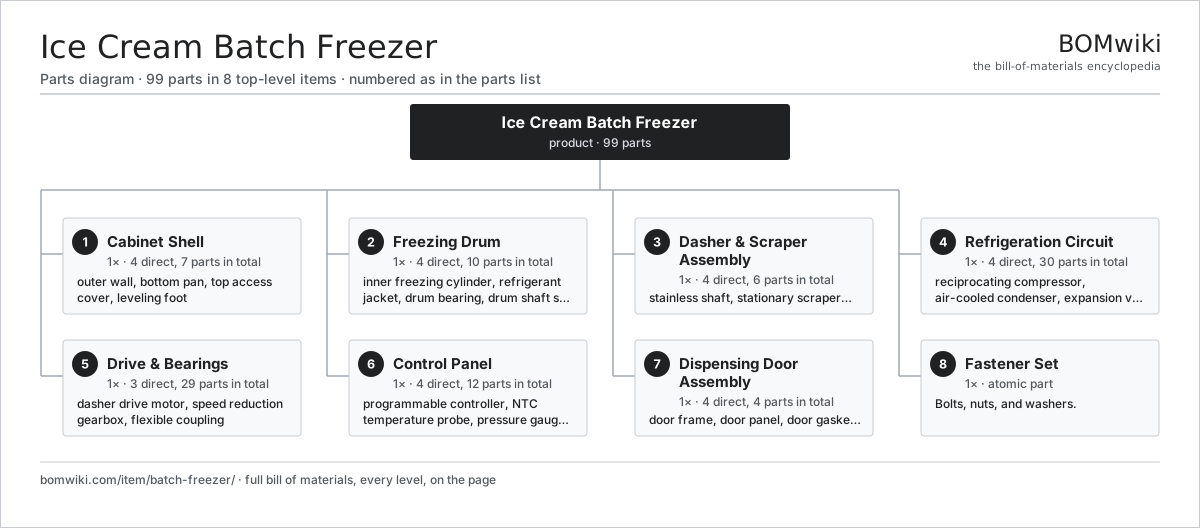
| # | Part | Qty | What it does |
|---|---|---|---|
| 1 | Cabinet Shell 4 parts | 1× | Stainless steel outer body with insulated walls. |
| 2 | Freezing Drum 4 parts | 1× | Double-jacketed cylinder where mixture freezes and is churned. |
| 3 | Dasher & Scraper Assembly 4 parts | 1× | Rotating shaft with fixed scrapers and rotating dasher blades that prevent ice crystal growth. |
| 4 | Refrigeration Circuit 4 parts | 1× | Compressor and piping delivering cold refrigerant to the freezing jacket. |
| 5 | Drive & Bearings 3 parts | 1× | Motor and gearbox that rotate the dasher-scraper assembly at 25–35 rpm. |
| 6 | Control Panel 4 parts | 1× | Touch interface and relays managing cycle time, temperature, and motor speeds. |
| 7 | Dispensing Door Assembly 4 parts | 1× | Hinged access point for removing finished product. |
| 8 | Fastener Set | 1× | Bolts, nuts, and washers. |
3D model
No 3D model yet. Have a CAD file of this? Add a 3D model. STL renders right on this page; STEP, FreeCAD, and OpenSCAD sources are welcome too (openly licensed, like all 3D models on BOMwiki).
Build & assembly graph
expand / collapse · shared sub-assemblies converge · links to related products · est. labourTap an assembly to expand/collapse · tap a part to open it · use “Open page” for any node · drag to pan, scroll to zoom.
Bill of materials for Ice Cream Batch Freezer
8 top-level lines · 60 rows shown · 99 parts total · indented to 3 levels| # | Item / sub-assembly | Part no. | Qty/assy | Ext. qty | Parts | Type |
|---|---|---|---|---|---|---|
| 1 | Cabinet Shell 4 parts | batch-freezer-cabinet | 1× | 1 | 7 | assembly |
| 1.1 | Outer Wall | batch-freezer-outer-wall | 1× | 1 | · | part |
| 1.2 | Bottom Pan | batch-freezer-bottom-pan | 1× | 1 | · | part |
| 1.3 | Top Access Cover | batch-freezer-top-cover | 1× | 1 | · | part |
| 1.4 | Leveling Foot | batch-freezer-legs | 4× | 4 | · | part |
| 2 | Freezing Drum 4 parts | batch-freezer-drum-assembly | 1× | 1 | 10 | assembly |
| 2.1 | Inner Freezing Cylinder | batch-freezer-inner-drum | 1× | 1 | · | part |
| 2.2 | Refrigerant Jacket | batch-freezer-jacket-wall | 1× | 1 | · | part |
| 2.3 | Drum Bearing 2 parts | batch-freezer-drum-bearing | 2× | 2 | 2 | assembly |
| 2.3.1 | Ball Bearing | ball-bearing | 1× | 2 | · | part |
| 2.3.2 | Bearing Housing | batch-freezer-bearing-housing | 1× | 2 | · | part |
| 2.4 | Drum Shaft Seal 2 parts | batch-freezer-drum-seal | 2× | 2 | 2 | assembly |
| 2.4.1 | Oil Seal | oil-seal | 1× | 2 | · | part |
| 2.4.2 | Seal Pressure Spring | batch-freezer-seal-spring | 1× | 2 | · | part |
| 3 | Dasher & Scraper Assembly 4 parts | batch-freezer-dasher-scraper | 1× | 1 | 6 | assembly |
| 3.1 | Stainless Shaft | batch-freezer-shaft | 1× | 1 | · | part |
| 3.2 | Stationary Scraper Blade | batch-freezer-stationary-scraper | 2× | 2 | · | part |
| 3.3 | Rotating Dasher Blade 2 parts | batch-freezer-rotating-dasher | 1× | 1 | 2 | assembly |
| 3.3.1 | Dasher Blade Element | batch-freezer-dasher-blade | 1× | 1 | · | part |
| 3.3.2 | Blade Mounting Block | batch-freezer-blade-mount | 1× | 1 | · | part |
| 3.4 | Dasher Hub | batch-freezer-hub | 1× | 1 | · | part |
| 4 | Refrigeration Circuit 4 parts | batch-freezer-refrigeration | 1× | 1 | 30 | assembly |
| 4.1 | Reciprocating Compressor 3 parts | batch-freezer-compressor | 1× | 1 | 25 | assembly |
| 4.1.1 | Compressor Drive Motor 3 parts + deeper › | batch-freezer-compressor-motor | 1× | 1 | 23 | assembly |
| 4.1.2 | Pump Head | batch-freezer-pump-head | 1× | 1 | · | part |
| 4.1.3 | Oil Sump | batch-freezer-oil-reservoir | 1× | 1 | · | part |
| 4.2 | Air-Cooled Condenser 3 parts | batch-freezer-condenser | 1× | 1 | 3 | assembly |
| 4.2.1 | Condenser Core | batch-freezer-condenser-core | 1× | 1 | · | part |
| 4.2.2 | Blower Motor | blower-motor | 1× | 1 | · | part |
| 4.2.3 | Fan Shroud | batch-freezer-fan-shroud | 1× | 1 | · | part |
| 4.3 | Expansion Valve | batch-freezer-expansion-valve | 1× | 1 | · | part |
| 4.4 | Refrigerant Receiver | batch-freezer-receiver | 1× | 1 | · | part |
| 5 | Drive & Bearings 3 parts | batch-freezer-drive-system | 1× | 1 | 29 | assembly |
| 5.1 | Dasher Drive Motor 4 parts | batch-freezer-drive-motor | 1× | 1 | 25 | assembly |
| 5.1.1 | Stator Assembly 3 parts + deeper › | stator-assembly | 1× | 1 | 3 | assembly |
| 5.1.2 | Rotor Assembly 4 parts + deeper › | rotor-assembly | 1× | 1 | 19 | assembly |
| 5.1.3 | Motor Housing | motor-housing | 1× | 1 | · | part |
| 5.1.4 | Ball Bearing | ball-bearing | 2× | 2 | · | part |
| 5.2 | Speed Reduction Gearbox 3 parts | batch-freezer-gearbox | 1× | 1 | 3 | assembly |
| 5.2.1 | Helical Gear Pair | batch-freezer-gear-pair | 1× | 1 | · | part |
| 5.2.2 | Gearbox Housing | gearbox-housing | 1× | 1 | · | part |
| 5.2.3 | Gear Oil | batch-freezer-gearbox-oil | 1× | 1 | · | part |
| 5.3 | Flexible Coupling | batch-freezer-coupling | 1× | 1 | · | part |
| 6 | Control Panel 4 parts | batch-freezer-control-panel | 1× | 1 | 12 | assembly |
| 6.1 | Programmable Controller 4 parts | batch-freezer-controller | 1× | 1 | 7 | assembly |
| 6.1.1 | Microcontroller | mcu | 1× | 1 | · | part |
| 6.1.2 | Bare PCB | pcb-bare | 1× | 1 | · | part |
| 6.1.3 | HMI Touchscreen 2 parts + deeper › | batch-freezer-hmi-screen | 1× | 1 | 2 | assembly |
| 6.1.4 | Connector | connector | 3× | 3 | · | part |
| 6.2 | NTC Temperature Probe | batch-freezer-temperature-probe | 1× | 1 | · | part |
| 6.3 | Pressure Gauge | batch-freezer-pressure-gauge | 1× | 1 | · | part |
| 6.4 | Relay & Contactor Bank 2 parts | batch-freezer-relay-bank | 1× | 1 | 3 | assembly |
| 6.4.1 | Relay | relay | 2× | 2 | · | part |
| 6.4.2 | Magnetic Motor Starter | batch-freezer-magnetic-starter | 1× | 1 | · | part |
| 7 | Dispensing Door Assembly 4 parts | batch-freezer-dispensing-door | 1× | 1 | 4 | assembly |
| 7.1 | Door Frame | batch-freezer-door-frame | 1× | 1 | · | part |
| 7.2 | Door Panel | batch-freezer-door-panel | 1× | 1 | · | part |
| 7.3 | Door Gasket | batch-freezer-door-gasket | 1× | 1 | · | part |
| 7.4 | Cam Latch | batch-freezer-latch | 1× | 1 | · | part |
| 8 | Fastener Set | fastener-set | 1× | 1 | · | part |
Something wrong in this list? Report a problem with this BOM.
Related products
same domain, ranked by shared parts Pasta Drying Line
150 parts · shares 16 with this page
Pasta Drying Line
150 parts · shares 16 with this page
 Soft Serve Ice Cream Machine
142 parts · shares 16 with this page
Soft Serve Ice Cream Machine
142 parts · shares 16 with this page
Sourcing: possible vendors
Browse the supplier directory → Prices, MOQ, and lead times are algorithmic estimates, not quotes, and not claims about these companies. Company mappings are curated by keyword; est. price band $1k–$500k. How estimates work| Vendor | HQ | Specialty | MOQ | Lead time |
|---|---|---|---|---|
| gea.com ↗ | Düsseldorf, DE | Process technology | 20 units | 12–20 wks |
| buhlergroup.com ↗ | Uzwil, CH | Food & materials processing | 20 units | 12–20 wks |
| tetrapak.com ↗ | Pully, CH | Food packaging & processing | 20 units | 12–20 wks |
| jbtc.com ↗ | Chicago, US | Food processing equipment | 20 units | 12–20 wks |
| alfalaval.com ↗ | Lund, SE | Heat transfer & separation | 20 units | 12–20 wks |
1,045-word article