Powder Coating Booth
ProductAlso known as: Powder Coating System
Overview
Powder coating is a dry finishing process where finely divided thermosetting plastic powder particles are electrostatically sprayed onto metal, composite, or plastic parts and then heat-fused to form a continuous protective film. The Powder Coating Booth is an enclosed spray chamber that captures and recycles overspray powder, drastically reducing waste and material cost compared to wet paint systems. Powder coating offers superior coverage, better corrosion resistance, lower environmental impact (zero VOC), and faster production cycles than traditional liquid coatings. The process divides into spray application (in the booth) and thermal cure (in an oven, not shown in this BOM).
The Electrostatic Spray Gun is the primary applicator. Each gun consists of a Gun Body aluminum housing with a 150 mL powder cup, an Atomizer Cap air cap with tiny perforations, and a high-voltage Electrode Pin needle. Compressed air at 80–100 psi enters the air cap and atomizes powder into a fine mist. Simultaneously, the electrode pin injects high-voltage charge (60–100 kV DC) into the powder particles. This charge is electrostatic, each powder particle becomes negatively charged (or positively, depending on polarity), creating mutual repulsion between particles and strong attraction to any grounded conductor nearby. The booth operator or a conveyor fixture electrically grounds the metal part; powder particles are strongly attracted to the grounded part surface, depositing in a uniform layer even on complex geometries with recesses and back sides.
The Powder Hopper & Feeder is the central powder reservoir. A stainless steel Hopper Vessel (50 L capacity) stores bulk powder with a Level Indicator visual gauge. A Metering Auger rotary screw feeder (0–50 rpm, 20–100 g/min range) is driven by a Feeder Motor (24 V DC, 50 W) with PWM speed control. As the auger rotates, powder drops into a Carrier Air Generator venturi or low-pressure pump that creates a gentle air stream (0.5–2 bar) carrying powder into the supply line to the spray guns.
When the operator triggers the Electrostatic Spray Gun, a Trigger Valve solenoid valve (24 V) opens both powder and atomization air. Powder-laden carrier air flows to the spray gun. Inside the gun, atomization air (80–100 psi) from the shop compressor passes through the Air Supply System system (which includes a Air Inlet Filter, Air Regulator, and Air Dryer), is regulated to 80–100 psi, and then sprays into the Atomizer Cap. The cap perforations break the powder stream into a fine mist. A Cap Orifice Insert ceramic orifice controls the spray pattern (fan or round, replaceable per powder type). The Electrode Pin needle carries high voltage (60–100 kV DC, sourced from the HV Power Supply) positioned at the spray cloud, charging particles as they exit.
The spray booth Booth Enclosure is a sealed chamber designed to capture and direct airflow. Two Side Panel aluminum-frame polycarbonate walls, a removable Roof Panel, and a Drain Tray stainless floor form the enclosure (typical 2 m wide × 2 m tall × 3 m deep). An Exhaust Duct inlet duct (250 mm diameter) draws air downward and out of the booth. Fresh air enters via an Intake Pre-filter 20 µm pre-filter on the opposite end, creating laminar downward airflow through the work zone. This airflow carries overspray powder toward the exhaust duct.
The Recovery Cyclone is the heart of waste reduction. Overspray powder, approximately 85–95% excess that doesn't stick to the part, is captured in the exhaust airstream and directed into the Cyclone Separator cone separator. Inside the cyclone, air velocity and the tangential inlet geometry create a centrifugal field. Heavier powder particles are thrown outward and downward, settling in the cone. A Cyclone Cone Liner polyurethane replaceable insert protects the steel from wear; this is a consumable, replaced every 500 operating hours. A Rotary Inlet Valve non-mechanical inlet seal at the cyclone inlet allows gravity and internal airflow to manage powder feed without moving parts prone to jamming. Recovered powder drops out of the cyclone bottom and flows via an Return Outlet Tube stainless tube back to the Powder Hopper & Feeder. A Fine Powder Bleed Port fine metering orifice directs ultra-fine powder fines (which have poor charge retention) to a collection bin for disposal rather than recirculation.
After cyclone recovery, the air stream still carries fine powder dust. A Filter Cartridge pleated filter removes this dust. The Filter Housing aluminum casting contains a Filter Media polyester cartridge (3 µm fiberglass/polyester media, 6 m² surface area, washable). A Pulse Jet Cleaner solenoid-driven pulse jet (24 V, 100 ms on every 5 sec cycle) reverses air through the cartridge to dislodge dust and keep it clean. This keeps filter pressure drop low and maintains booth airflow stability.
Electrical control of the Grounding & HV System is critical for spray quality. The HV Power Supply DC supply (60–100 kV, <10 µA output) energizes the Electrode Pin needle via a HV Cable shielded 60 kV-rated cable. The booth cage itself (the Cage Electrode conductive mesh lining booth walls) is held at a fixed potential (typically –10 kV) relative to ground, creating a more uniform electric field and reducing "corona" (sparking) risk. The workpiece is grounded via a Part Ground Clamp alligator clamp providing low-resistance contact. A Door Interlock Switch door switch immediately de-energizes the high voltage whenever the booth door opens, protecting operators from shock hazard.
Recovery and recirculation of 85–95% of overspray powder is the key economic advantage of powder coating. Unlike liquid paint, where overspray becomes waste, powder overspray is mechanically recovered, is chemically stable (it doesn't cure without heat), and can be reused indefinitely. Over a coating's lifetime, this reuse eliminates 80–90% of powder material waste compared to wet spray systems.
In automotive, powder coats provide durable exterior finishes on body panels, bumpers, and trim. HVAC manufacturers powder coat air handlers, coils, and casings. Furniture and fixtures use powder extensively for aesthetic color and durability. Electrical enclosures, cable trays, and structural steel all benefit from powder's corrosion resistance and appearance.
How it works
- Compressed air from the shop compressor enters the Air Supply System system. The Air Inlet Filter removes oil mist and dust. The Air Regulator reduces inlet pressure to 80–100 psi. The Air Dryer silica-gel cartridge removes moisture to -40°C dew point.
- Operator loads parts into the Booth Enclosure booth and electrically grounds the part via the Part Ground Clamp. A conveyor or manual fixture holds the part at 15–25 cm distance from the spray gun.
- Operator energizes the booth. The HV Power Supply DC supply activates, charging the Electrode Pin to 60–100 kV. The Cage Electrode conductive mesh inside the booth is biased to –10 kV relative to ground.
- The Feeder Motor (24 V DC, PWM-controlled) spins the Metering Auger at a preset speed (typically 20–50% duty cycle), scooping powder from the Hopper Vessel and dispensing it into the Carrier Air Generator.
- The Carrier Air Generator venturi or pump generates low-pressure air (0.5–2 bar) that carries powder particles down a supply hose to the Electrostatic Spray Gun.
- Operator depresses the trigger on the Electrostatic Spray Gun. The Trigger Valve solenoid opens, allowing atomization air from the upstream regulator (80–100 psi) to flow through the gun.
- Inside the gun, powder-laden carrier air meets atomization air in the gun cup. The Atomizer Cap with its perforations sprays the powder stream into a fine mist. The Cap Orifice Insert ceramic orifice shapes the spray pattern (fan or round).
- The Electrode Pin needle, positioned at the spray pattern cloud and carrying 60–100 kV DC charge, injects high voltage into the powder cloud as it exits. Each powder particle acquires 10–20 µC/g electrostatic charge.
- Charged powder particles are electrostatically attracted to the grounded workpiece. Despite air movement, the electrostatic force (pulling particles toward ground) dominates, causing powder to deposit uniformly across all surfaces, tops, bottoms, recesses, even back sides.
- Overspray powder (85–95% of the total sprayed) that misses the part is entrained in the booth exhaust air. This air is drawn toward the Exhaust Duct inlet, which feeds it to the Recovery Cyclone.
- Inside the Cyclone Separator, air and powder enter tangentially at high velocity. Centrifugal forces throw heavier powder particles outward and downward. Powder settles in the cone, sliding down to the Rotary Inlet Valve inlet at the bottom.
- Settled powder drops from the cyclone via the Return Outlet Tube and returns to the Hopper Vessel. Ultra-fine powder particles (high surface area, poor charge retention) bleed out via the Fine Powder Bleed Port metering orifice to a collection bin for disposal.
- After cyclone separation, the exhaust air still carries fine powder dust. This air passes through the Filter Cartridge. The Filter Media polyester cartridge (3 µm) traps all remaining powder. Periodically, the Pulse Jet Cleaner solenoid pulse-jet (100 ms on, 5 sec cycle) reverses air through the cartridge, dislodging dust so it falls back to the cyclone.
- Cleaned air exits the booth to atmosphere (or is ducted outdoors). A Intake Pre-filter 20 µm pre-filter on the fresh-air side prevents external powder from entering the booth.
- Once spray application is complete, parts are removed and transferred to a curing oven (not shown). Heat (180–220°C, 10–20 minutes depending on powder type) causes powder particles to melt, flow, and chemically cross-link, forming a continuous cured film.
- The Door Interlock Switch switch on the booth door immediately de-energizes the HV Power Supply electrode voltage if the door is opened, protecting anyone entering the booth.
Powder Coating Booth parts and their functions
7 top-level parts · 39 parts in total · full bill of materials below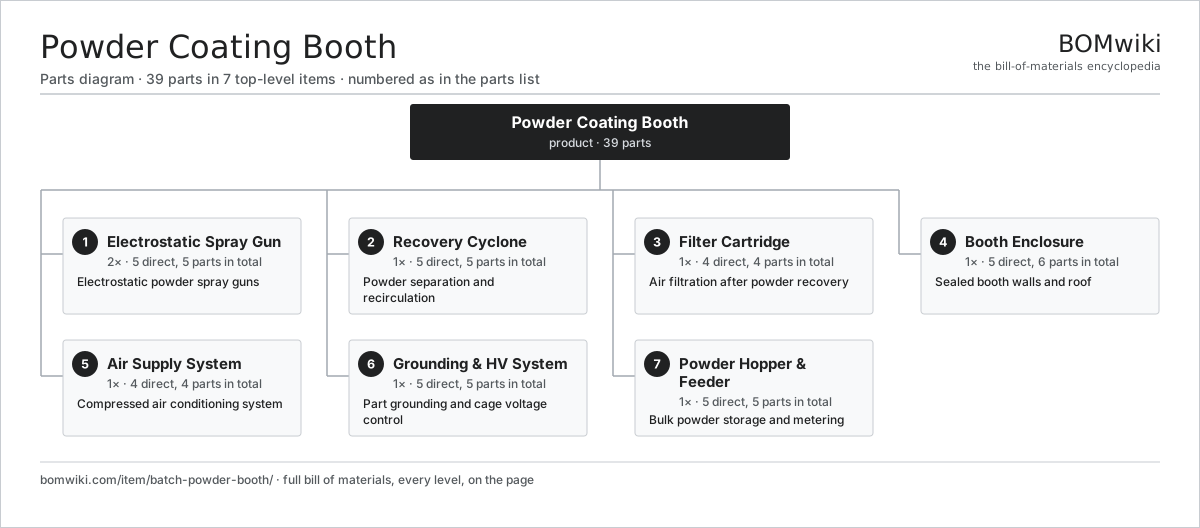
| # | Part | Qty | What it does |
|---|---|---|---|
| 1 | Electrostatic Spray Gun 5 parts | 2× | Electrostatic powder spray guns |
| 2 | Recovery Cyclone 5 parts | 1× | Powder separation and recirculation |
| 3 | Filter Cartridge 4 parts | 1× | Air filtration after powder recovery |
| 4 | Booth Enclosure 5 parts | 1× | Sealed booth walls and roof |
| 5 | Air Supply System 4 parts | 1× | Compressed air conditioning system |
| 6 | Grounding & HV System 5 parts | 1× | Part grounding and cage voltage control |
| 7 | Powder Hopper & Feeder 5 parts | 1× | Bulk powder storage and metering |
3D model
No 3D model yet. Have a CAD file of this? Add a 3D model. STL renders right on this page; STEP, FreeCAD, and OpenSCAD sources are welcome too (openly licensed, like all 3D models on BOMwiki).
Build & assembly graph
expand / collapse · shared sub-assemblies converge · links to related products · est. labourTap an assembly to expand/collapse · tap a part to open it · use “Open page” for any node · drag to pan, scroll to zoom.
Bill of materials for Powder Coating Booth
7 top-level lines · 40 rows shown · 39 parts total · indented to 3 levels| # | Item / sub-assembly | Part no. | Qty/assy | Ext. qty | Parts | Type |
|---|---|---|---|---|---|---|
| 1 | Electrostatic Spray Gun 5 parts | batch-powder-booth-spray-gun | 2× | 2 | 5 | assembly |
| 1.1 | Gun Body | batch-powder-booth-gun-body | 1× | 2 | · | part |
| 1.2 | Atomizer Cap | batch-powder-booth-atomizer-cap | 1× | 2 | · | part |
| 1.3 | Electrode Pin | batch-powder-booth-electrode-pin | 1× | 2 | · | part |
| 1.4 | Cap Orifice Insert | batch-powder-booth-cap-insert | 1× | 2 | · | part |
| 1.5 | Trigger Valve | batch-powder-booth-trigger-valve | 1× | 2 | · | part |
| 2 | Recovery Cyclone 5 parts | batch-powder-booth-recovery-cyclone | 1× | 1 | 5 | assembly |
| 2.1 | Cyclone Separator | batch-powder-booth-cyclone-vessel | 1× | 1 | · | part |
| 2.2 | Cyclone Cone Liner | batch-powder-booth-cone-liner | 1× | 1 | · | part |
| 2.3 | Rotary Inlet Valve | batch-powder-booth-rotary-valve | 1× | 1 | · | part |
| 2.4 | Return Outlet Tube | batch-powder-booth-outlet-tube | 1× | 1 | · | part |
| 2.5 | Fine Powder Bleed Port | batch-powder-booth-bleed-port | 1× | 1 | · | part |
| 3 | Filter Cartridge 4 parts | batch-powder-booth-filter-cartridge | 1× | 1 | 4 | assembly |
| 3.1 | Filter Housing | batch-powder-booth-filter-housing | 1× | 1 | · | part |
| 3.2 | Filter Media | batch-powder-booth-filter-media | 1× | 1 | · | part |
| 3.3 | Pulse Jet Cleaner | batch-powder-booth-filter-cleaning-pulse | 1× | 1 | · | part |
| 3.4 | Fastener Set | fastener-set | 1× | 1 | · | part |
| 4 | Booth Enclosure 5 parts | batch-powder-booth-enclosure | 1× | 1 | 6 | assembly |
| 4.1 | Side Panel | batch-powder-booth-side-panels | 2× | 2 | · | part |
| 4.2 | Roof Panel | batch-powder-booth-roof-panel | 1× | 1 | · | part |
| 4.3 | Exhaust Duct | batch-powder-booth-exhaust-duct | 1× | 1 | · | part |
| 4.4 | Intake Pre-filter | batch-powder-booth-intake-filter | 1× | 1 | · | part |
| 4.5 | Drain Tray | batch-powder-booth-drain-tray | 1× | 1 | · | part |
| 5 | Air Supply System 4 parts | batch-powder-booth-air-supply | 1× | 1 | 4 | assembly |
| 5.1 | Air Inlet Filter | batch-powder-booth-inlet-filter | 1× | 1 | · | part |
| 5.2 | Air Regulator | batch-powder-booth-regulator | 1× | 1 | · | part |
| 5.3 | Air Dryer | batch-powder-booth-air-dryer | 1× | 1 | · | part |
| 5.4 | Gauge Panel | batch-powder-booth-gauge-panel | 1× | 1 | · | part |
| 6 | Grounding & HV System 5 parts | batch-powder-booth-grounding-system | 1× | 1 | 5 | assembly |
| 6.1 | HV Power Supply | batch-powder-booth-hv-power-supply | 1× | 1 | · | part |
| 6.2 | Cage Electrode | batch-powder-booth-cage-electrode | 1× | 1 | · | part |
| 6.3 | Part Ground Clamp | batch-powder-booth-part-ground-clamp | 1× | 1 | · | part |
| 6.4 | HV Cable | batch-powder-booth-hv-cable | 1× | 1 | · | part |
| 6.5 | Door Interlock Switch | batch-powder-booth-safety-interlock | 1× | 1 | · | part |
| 7 | Powder Hopper & Feeder 5 parts | batch-powder-booth-powder-hopper | 1× | 1 | 5 | assembly |
| 7.1 | Hopper Vessel | batch-powder-booth-hopper-vessel | 1× | 1 | · | part |
| 7.2 | Level Indicator | batch-powder-booth-level-indicator | 1× | 1 | · | part |
| 7.3 | Metering Auger | batch-powder-booth-metering-auger | 1× | 1 | · | part |
| 7.4 | Feeder Motor | batch-powder-booth-auger-motor | 1× | 1 | · | part |
| 7.5 | Carrier Air Generator | batch-powder-booth-carrier-generator | 1× | 1 | · | part |
Something wrong in this list? Report a problem with this BOM.
Sourcing: possible vendors
Browse the supplier directory → Prices, MOQ, and lead times are algorithmic estimates, not quotes, and not claims about these companies. Company mappings are curated by keyword; est. price band $5k–$2M. How estimates work| Vendor | HQ | Specialty | MOQ | Lead time |
|---|---|---|---|---|
| atlascopco.com ↗ | Stockholm, SE | Compressors & industrial | 10 units | 12–20 wks |
|
🇦🇹Andritz
andritz.com ↗
|
Graz, AT | Process plants & machinery | 10 units | 12–20 wks |
| buhlergroup.com ↗ | Uzwil, CH | Food & materials processing | 10 units | 12–20 wks |
| gea.com ↗ | Düsseldorf, DE | Process technology | 10 units | 12–20 wks |
| mhi.com ↗ | Tokyo, JP | Heavy machinery | 10 units | 12–20 wks |
1,820-word article