Belt Loader
ProductAlso known as: Aircraft Belt Loader
Overview
An aircraft belt loader transfers baggage and cargo between aircraft and ground vehicles during turnaround, eliminating manual handling and reducing labor-intensive loader truck operations. The belt loader combines a hydraulic scissor lift (raising the conveyor platform 0–2.5 m to match aircraft door sill heights) with an electrically-driven conveyor belt (moving baggage up to the aircraft or down to carts) into a single ground-support vehicle.
The foundation is a heavy-duty commercial truck chassis: a 3.0–4.0 L turbocharged diesel producing 120–150 hp, paired with a six-speed automatic transmission. The air-spring suspension with auto-leveling maintains stable truck height across uneven apron surfaces, critical for preventing conveyor belt incline variation that would cause baggage to slip.
The conveyor belt is 600 mm wide, inclined at 25° to the horizontal, and 6 m long from tail (ground level) to head (aircraft door height). The 25° angle is a compromise: steep enough to minimize baggage rolling back under gravity (static friction limit ~27° for typical luggage on rubber conveyor), but shallow enough that a 15 kW motor can efficiently drive a fully laden belt at 30 m/min. At maximum speed, a single belt loader can transfer 200–300 pieces of baggage per hour from aircraft to ground vehicles.
A 15 kW three-phase electric motor drives the conveyor through a gearbox (3:1 reduction) and timing belt to the head pulley. A variable-frequency drive (VFD) allows the operator to adjust belt speed from 0 to 30 m/min in response to baggage volume and ground-vehicle availability. At 10 m/min (typical unloading speed), a single operator can maintain steady baggage flow without bottlenecking the apron turnaround.
The conveyor is mounted on a scissor lift mechanism consisting of welded steel linkage with two double-acting hydraulic cylinders (80 mm bore, 1200 mm stroke). A 20 kW variable-displacement piston pump driven from the truck's engine PTO shaft powers the hydraulic system. A proportional directional valve (controlled via joystick) allows the operator to raise or lower the conveyor platform smoothly. At full extension, the platform reaches 2.5 m above ground, aligning with the main-deck door sill of a Boeing 737 (door height ~2.4 m from apron) and the lower-deck door of a Boeing 747 (main-deck height ~2.4 m). Wide-body aircraft main-deck heights reach 2.6–2.8 m, requiring manual alignment or adjustment.
The operator sits on an elevated platform (2 m above ground) mounted on the lift frame, providing clear visibility of baggage flow and aircraft positioning. The control station features a proportional joystick controlling lift up/down and conveyor speed simultaneously. A digital display shows lift height (0–2.5 m) and conveyor belt speed (0–30 m/min), allowing precise positioning and speed adjustment. An emergency stop button (red mushroom) cuts all power immediately in case of baggage jam or personnel safety hazard.
How it works
An aircraft parks at a gate after arriving and is towed to the baggage-handling position. Baggage handlers on the apron position the belt loader alongside the aircraft's main-deck cargo door (~2.4 m height). The operator engages the truck parking brake, ensuring stability.
The operator uses the joystick to raise the conveyor platform, watching the digital height display. When the platform reaches ~2.35 m (slightly below the aircraft door sill), the platform is locked in place by proportional valve neutral position. The Inclined Conveyor Belt tail (ground end) now rests in a cart, and the head (aircraft end) is ~2 cm below the door sill lip, allowing baggage to slide smoothly from cart onto the conveyor.
Ground handlers place baggage on the conveyor tail platform. The operator engages conveyor motion via the joystick, setting belt speed to 20 m/min (moderate unloading speed). The AC Induction Motor spins the head pulley via the gearbox, pulling the conveyor belt upward. Baggage is carried upward along the 6 m length of the Conveyor Belt, progressing from tail to head in ~18 seconds at this speed.
The first bag reaches the aircraft door sill and is manually transferred into the cargo hold by aircraft loaders. The second bag immediately follows, creating continuous flow. Baggage handlers on the ground maintain steady placement to prevent conveyor starvation (idle conveyor waiting for baggage).
If baggage volume overwhelms the conveyor (cart being emptied faster than the belt can handle), the operator reduces belt speed to 15 m/min, slowing transit time and allowing ground handlers to pace their loading. If baggage flow is slow (waiting for next cart), the operator reduces speed to 8 m/min, minimizing energy consumption.
After unloading is complete (aircraft cargo hold is full or all ground-cart baggage has been transferred), the operation reverses. Empty carts are positioned at the conveyor tail, and the operator engages the conveyor in reverse mode. Aircraft loaders transfer bags from the hold down the conveyor, which descends toward the carts at 15–20 m/min. The smooth descent prevents fragile items (instruments, artworks) from sustaining shock damage that would occur if dropped 2+ meters.
The hydraulic lift system maintains constant pressure during loading and unloading: the Hydraulic Accumulator stores energy, allowing smooth height maintenance even if baggage distribution shifts the load. The Pressure Gauge monitors system pressure; if pressure exceeds 210 bar (indicating conveyor jam or overload), the Pressure Relief vents excess pressure, protecting the system.
Once baggage operations are complete, the operator lowers the conveyor platform to ground level using the joystick. The truck is repositioned for the next aircraft.
Operational constraints
Motor power limits throughput: a 15 kW motor driving a 6 m conveyor belt at full baggage load (3000 kg continuous distribution) can sustain 20–25 m/min. At higher speeds, motor current draws exceed 30 A (typical three-phase 480 V circuit limit), causing VFD current limiting and speed reduction. Overloaded conveyors (e.g., attempting to haul 500 kg of cargo at 30 m/min) will stall.
Conveyor belt life is limited by friction heating and UV exposure: typical belt replacement intervals are 2–3 years for high-use airport loaders (loading 500+ flights per year). Worn belts slip, reducing effective speed and increasing motor load.
Lift synchronization is critical: if the two hydraulic cylinders are not perfectly synchronized, the conveyor platform tilts, causing baggage to slide off the side. Modern designs use electronic proportional valves with pressure-compensation and load-sensing circuits to maintain synchronized lift at all times.
Baggage size limitations are inherent: the 600 mm belt width accommodates standard rolling luggage (carry-on, 22 inch), but oversized bags (31 inch rolling luggage, guitars, surfboards) may not fit. These are manually transferred or loaded via separate gravity-flow chutes.
Apron surface condition impacts operations: soft asphalt or gravel aprons allow the truck to sink unevenly, tilting the conveyor and causing baggage to jam. Hard-stand concrete aprons are required for stable operation.
Weather extremes challenge operations: rain reduces rubber-belt friction, causing slippage at speeds above 20 m/min; operators must reduce speed or deploy belt conditioners (liquid coatings increasing friction). Extreme heat (above 40°C) causes belt expansion and thermal stress; arctic conditions (below −20°C) cause belt embrittlement and cracking.
Market and variants
Major airports operate fleets of 20–50 belt loaders, managed by ground-handling companies. High-volume airports (Atlanta, Dubai, Beijing) operate multiple loaders simultaneously, with dedicated maintenance and fuel depots.
Specialized variants include:
- Narrow-body loaders: 600 mm belt, 2.5 m lift height, optimized for Boeing 737, A320 service.
- Wide-body loaders: 800 mm belt, 3.0 m lift height, for Boeing 747, A380 main-deck access.
- Lower-deck loaders: 2.0 m lift height, specialized for wide-body lower-cargo-hold access (below main deck).
- High-speed loaders: 40 m/min belt speed for congested aprons requiring rapid turnaround.
- Hybrid/electric loaders: Battery-powered motor and hydraulic pump, eliminating diesel engine noise and emissions (emerging technology).
Some airports are exploring autonomous belt loaders with automated positioning relative to aircraft, reducing operator fatigue. However, safety concerns (baggage handler proximity, aircraft movement) have slowed adoption.
Older belt loaders (1990s–2000s) used fixed-speed motors (no VFD) and mechanical lift controls, requiring operator skill to prevent jerky motion and baggage spillage. Modern loaders incorporate proportional controls, proportional valves, and digital displays, significantly improving ease of operation and safety.
International cargo hubs (Memphis, Frankfurt, Singapore) operate specialized loaders for heavy pallets and containers (up to 9000 kg distributed load on roller decks rather than conveyor belts), representing a significant technical evolution from passenger baggage loaders.
Belt Loader parts and their functions
8 top-level parts · 87 parts in total · full bill of materials below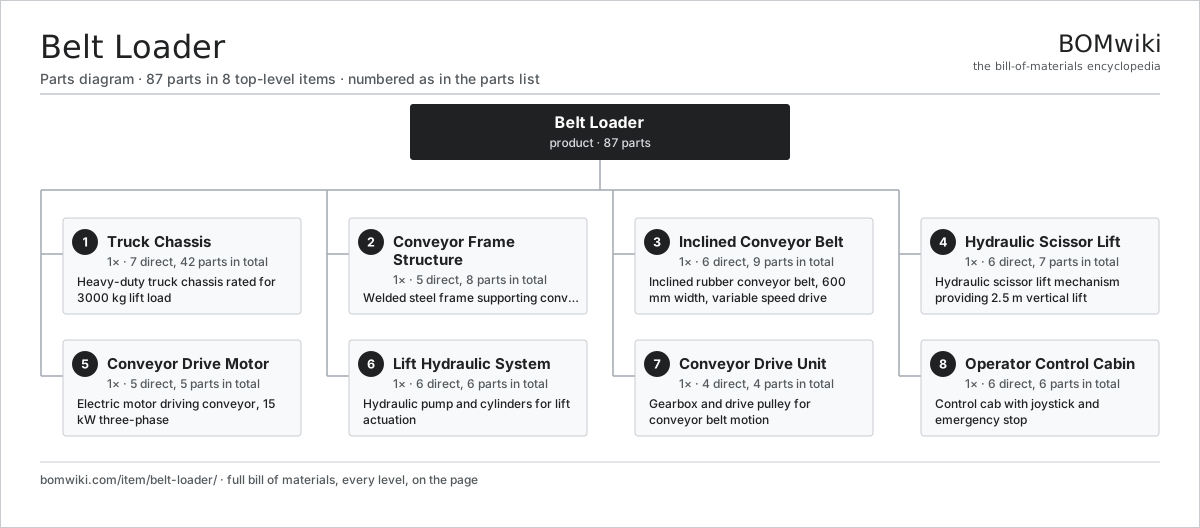
| # | Part | Qty | What it does |
|---|---|---|---|
| 1 | Truck Chassis 7 parts | 1× | Heavy-duty truck chassis rated for 3000 kg lift load |
| 2 | Conveyor Frame Structure 5 parts | 1× | Welded steel frame supporting conveyor and lift mechanisms |
| 3 | Inclined Conveyor Belt 6 parts | 1× | Inclined rubber conveyor belt, 600 mm width, variable speed drive |
| 4 | Hydraulic Scissor Lift 6 parts | 1× | Hydraulic scissor lift mechanism providing 2.5 m vertical lift |
| 5 | Conveyor Drive Motor 5 parts | 1× | Electric motor driving conveyor, 15 kW three-phase |
| 6 | Lift Hydraulic System 6 parts | 1× | Hydraulic pump and cylinders for lift actuation |
| 7 | Conveyor Drive Unit 4 parts | 1× | Gearbox and drive pulley for conveyor belt motion |
| 8 | Operator Control Cabin 6 parts | 1× | Control cab with joystick and emergency stop |
3D model
No 3D model yet. Have a CAD file of this? Add a 3D model. STL renders right on this page; STEP, FreeCAD, and OpenSCAD sources are welcome too (openly licensed, like all 3D models on BOMwiki).
Build & assembly graph
expand / collapse · shared sub-assemblies converge · links to related products · est. labourTap an assembly to expand/collapse · tap a part to open it · use “Open page” for any node · drag to pan, scroll to zoom.
Bill of materials for Belt Loader
8 top-level lines · 58 rows shown · 87 parts total · indented to 3 levels| # | Item / sub-assembly | Part no. | Qty/assy | Ext. qty | Parts | Type |
|---|---|---|---|---|---|---|
| 1 | Truck Chassis 7 parts | belt-loader-chassis | 1× | 1 | 42 | assembly |
| 1.1 | Diesel Engine | belt-loader-engine | 1× | 1 | · | part |
| 1.2 | Automatic Transmission | belt-loader-transmission | 1× | 1 | · | part |
| 1.3 | Chassis Frame | belt-loader-frame-base | 1× | 1 | · | part |
| 1.4 | Air Suspension | belt-loader-suspension | 1× | 1 | · | part |
| 1.5 | Brake System | belt-loader-brakes | 1× | 1 | · | part |
| 1.6 | Power Steering | belt-loader-steering | 1× | 1 | · | part |
| 1.7 | Wheel Assembly 5 parts | wheel-assembly | 4× | 4 | 9 | assembly |
| 1.7.1 | Alloy Wheel | alloy-wheel | 1× | 4 | · | part |
| 1.7.2 | Tire | tire | 1× | 4 | · | part |
| 1.7.3 | TPMS Sensor | tpms-sensor | 1× | 4 | · | part |
| 1.7.4 | Lug Nut | lug-nut | 5× | 20 | · | part |
| 1.7.5 | Valve Stem | valve-stem | 1× | 4 | · | part |
| 2 | Conveyor Frame Structure 5 parts | belt-loader-frame | 1× | 1 | 8 | assembly |
| 2.1 | Main Structural Frame | belt-loader-main-frame | 1× | 1 | · | part |
| 2.2 | Support Legs | belt-loader-support-legs | 4× | 4 | · | part |
| 2.3 | Handrail and Landing | belt-loader-handrail | 1× | 1 | · | part |
| 2.4 | Safety Guardrail | belt-loader-guardrail | 1× | 1 | · | part |
| 2.5 | Fastener Set | fastener-set | 1× | 1 | · | part |
| 3 | Inclined Conveyor Belt 6 parts | belt-loader-conveyor | 1× | 1 | 9 | assembly |
| 3.1 | Conveyor Belt | belt-loader-belt | 1× | 1 | · | part |
| 3.2 | Head Pulley | belt-loader-head-pulley | 1× | 1 | · | part |
| 3.3 | Tail Pulley | belt-loader-tail-pulley | 1× | 1 | · | part |
| 3.4 | Idler Rollers | belt-loader-idler-rollers | 4× | 4 | · | part |
| 3.5 | Belt Tensioner | belt-loader-tensioner | 1× | 1 | · | part |
| 3.6 | Belt Scrapers | belt-loader-scrapers | 1× | 1 | · | part |
| 4 | Hydraulic Scissor Lift 6 parts | belt-loader-lift | 1× | 1 | 7 | assembly |
| 4.1 | Scissor Linkage | belt-loader-scissor-frame | 1× | 1 | · | part |
| 4.2 | Lift Cylinder | belt-loader-lift-cylinder | 2× | 2 | · | part |
| 4.3 | Hydraulic Pump | belt-loader-pump | 1× | 1 | · | part |
| 4.4 | Directional Valve | belt-loader-directional-valve | 1× | 1 | · | part |
| 4.5 | Pressure Relief | belt-loader-pressure-relief | 1× | 1 | · | part |
| 4.6 | Hydraulic Hose | belt-loader-hose | 1× | 1 | · | part |
| 5 | Conveyor Drive Motor 5 parts | belt-loader-motor | 1× | 1 | 5 | assembly |
| 5.1 | AC Induction Motor | belt-loader-electric-motor | 1× | 1 | · | part |
| 5.2 | Variable Frequency Drive | belt-loader-vfd | 1× | 1 | · | part |
| 5.3 | Speed Reducer | belt-loader-gearbox | 1× | 1 | · | part |
| 5.4 | Motor Coupling | belt-loader-motor-coupling | 1× | 1 | · | part |
| 5.5 | Motor Mounts | belt-loader-motor-mounting | 1× | 1 | · | part |
| 6 | Lift Hydraulic System 6 parts | belt-loader-hydraulics | 1× | 1 | 6 | assembly |
| 6.1 | Hydraulic Pump | belt-loader-pump | 1× | 1 | · | part |
| 6.2 | Pump Drive Motor | belt-loader-pump-motor | 1× | 1 | · | part |
| 6.3 | Hydraulic Accumulator | belt-loader-accumulator | 1× | 1 | · | part |
| 6.4 | Directional Valve | belt-loader-directional-valve | 1× | 1 | · | part |
| 6.5 | Pressure Gauge | belt-loader-pressure-gauge | 1× | 1 | · | part |
| 6.6 | Hose Assembly | belt-loader-hose-assembly | 1× | 1 | · | part |
| 7 | Conveyor Drive Unit 4 parts | belt-loader-drive-unit | 1× | 1 | 4 | assembly |
| 7.1 | Speed Reducer | belt-loader-gearbox | 1× | 1 | · | part |
| 7.2 | Drive Pulley | belt-loader-drive-pulley | 1× | 1 | · | part |
| 7.3 | Timing Belt | belt-loader-timing-belt | 1× | 1 | · | part |
| 7.4 | Pulley Guard | belt-loader-pulley-guard | 1× | 1 | · | part |
| 8 | Operator Control Cabin 6 parts | belt-loader-operator-station | 1× | 1 | 6 | assembly |
| 8.1 | Control Platform | belt-loader-control-platform | 1× | 1 | · | part |
| 8.2 | Proportional Joystick | belt-loader-joystick | 1× | 1 | · | part |
| 8.3 | Foot Pedals | belt-loader-pedal-box | 1× | 1 | · | part |
| 8.4 | Height Indicator | belt-loader-height-display | 1× | 1 | · | part |
| 8.5 | Speed Indicator | belt-loader-speed-display | 1× | 1 | · | part |
| 8.6 | Emergency Stop Button | belt-loader-emergency-stop | 1× | 1 | · | part |
Something wrong in this list? Report a problem with this BOM.
Related products
same domain, ranked by shared parts


Sourcing: possible vendors
Browse the supplier directory → Prices, MOQ, and lead times are algorithmic estimates, not quotes, and not claims about these companies. Company mappings are curated by keyword; est. price band $30k–$1.5M. How estimates work| Vendor | HQ | Specialty | MOQ | Lead time |
|---|---|---|---|---|
| oshkoshaerotech.com ↗ | Orlando, US | Airport ground support | made to order | 16–30 wks |
| tld-group.com ↗ | Paris, FR | Ground support equipment | made to order | 16–30 wks |
| textrongse.txtsv.com ↗ | Augusta, US | Ground support equipment | made to order | 16–30 wks |
| vestergaardcompany.com ↗ | Skanderborg, DK | De-icers & GSE | made to order | 16–30 wks |
| mallaghangse.com ↗ | Dungannon, GB | Ground support equipment | made to order | 16–30 wks |
1,446-word article