Belt Loop Attaching Machine
ProductOverview
The belt loop attaching machine is a fully automated system for securing belt loops onto garment waistbands with precise positioning and security stitching. Belt loops, typically narrow (12–20 mm) folded fabric strips, are a functional necessity on trousers and shorts, holding a belt in place. However, belt loops also serve a quality indicator: well-executed loops with perfect stitch placement and uniform spacing signal premium manufacturing.
Manual belt loop attachment requires an operator to manually position each loop, stitch it with multiple passes for security, trim excess thread, and move to the next position. An automatic machine completes all three loops (left side, right side, and optional center back) on a single trouser panel in 15–20 seconds with perfect consistency and zero defects. The machine uses automated loop feeding from a reel, vision-based alignment to detect waistband edges, and programmable carriage positioning to place loops at exact locations.
These machines are standard equipment in high-volume trouser and shorts manufacturing, essential for meeting production targets without sacrificing quality.
How It Works
The belt loop attachment cycle involves seven synchronized operations:
Step 1: Fabric Positioning and Clamping
The operator positions a trouser panel (pre-cut waistband) on the Machine Base Plate, aligning the waistband beneath the Soft Clamp Jaw. The Programmable Logic Controller (programmable logic controller) initiates a cycle by signaling the Pneumatic Air Cylinder to lower and clamp the waistband with controlled pneumatic pressure (30–80 kg, adjustable via Operator Touchscreen).
Step 2: Vision-Based Edge Detection
A Industrial Vision Camera mounted above the clamp area captures an image of the waistband and any pre-marked alignment dots or embossed centerlines. The Vision Processing Module analyzes the image using edge-detection algorithms, identifying the waistband edges and calculating the exact position of the left seam (reference). This vision compensation allows the machine to adapt to slight variations in fabric position (±5 mm) without operator intervention.
Step 3: Stepper-Driven Carriage Positioning (First Loop)
The Linear Positioning Carriage, driven by a Stepper Motor, positions the clamp carriage to the first loop location (typically the left side seam). The stepper motor advances in precisely calibrated steps; the Programmable Logic Controller calculates the step count needed based on vision feedback and programmed loop spacing.
Step 4: Loop Feeding and Cutting
Simultaneously, the Strip Feeder Wheel (another stepper-driven component) advances the pre-wound belt loop reel by one increment, feeding a new loop strip. A Loop Cutter Blade, a solenoid-actuated blade, then cuts the loop to exact length (e.g., 50 mm), and the Loop Positioning Guide positions the cut loop directly above the clamp, ready for stitching.
Step 5: Bartack Stitching
The Bartack Sewing Head descends, and the Narrow Needle Bar begins oscillating vertically with minimal horizontal motion (2–3 mm stitch width). The Bartack Intermittent Cam, an intermittent-drive profile, causes the needle to stitch, reverse, and restitch the same location multiple times (typically 4–6 passes), creating a dense security stitch that locks the loop to the waistband. The Lockstitch Hook ensures consistent lockstitches throughout the bartack.
The narrow stitch width (2–3 mm) is critical: it concentrates force on a small waistband area, maximizing pull-off strength, while appearing neat and tailored.
Step 6: Carriage Repositioning and Loop 2
After completing the first bartack (approximately 8–10 seconds), the sewing head retracts. The Pneumatic Air Cylinder advances the carriage to the second loop location (e.g., right side seam), which is typically 200–250 mm away. Simultaneously, the Strip Feeder Wheel feeds and cuts the second loop. Steps 4 and 5 repeat for the second loop.
Step 7: Final Loop and Unclamp
A third loop (often positioned at center back) is fed, positioned, and stitched using the same sequence. After the final bartack, the Pneumatic Air Cylinder retracts the clamp, and the operator removes the finished panel. All three loops are now permanently secured with bartack stitches, ready for garment assembly.
Bartack Stitch Mechanism
The bartack is a specialized security stitch, distinct from a standard lockstitch. The Bartack Intermittent Cam is the key: as the main crankshaft rotates, the cam profile causes the needle bar to advance normally for several stitches, then reverse direction partway through, causing the needle to restitch and overlap the previous stitches. This creates a dense, interlocked pattern with 4–6 stitches per millimeter (compared to 2–3 for standard stitches).
Pull testing on a bartack-secured loop typically shows break force of 20–30 kg on light woven fabrics and 15–20 kg on knit fabrics, far exceeding functional requirements. Manual bartack stitching is notoriously difficult: operators often produce irregular, sparse bartacks due to fatigue or timing errors. Automated bartacking eliminates this variability.
Vision-Based Alignment
The Vision Processing Module runs real-time image analysis to detect:
- Waistband edges: Horizontal lines indicating fabric boundaries.
- Seam positions: Vertical lines where side seams are located.
- Alignment marks: Pre-embossed or laser-printed dots indicating where loops should be positioned.
The vision system compensates for fabric misalignment up to ±5 mm, allowing operators to place panels roughly without precise manual alignment. This dramatically reduces cycle time and operator fatigue.
Advanced systems integrate with the factory's CAM (Computer-Aided Manufacturing) system, downloading specific loop positions for different garment styles (child size, regular, extended sizes) automatically.
Reel-Fed Loop Supply
Pre-wound belt loop reels are available commercially in standard widths (12, 16, 20 mm) and folded styles. A reel containing 500–1000 meters of loop allows continuous production without manual reload for several hours. The Loop Reel Spindle holds the reel with adjustable tension to prevent slack or over-advance.
Operators periodically inspect the reel for thread nesting or damage and replace when depleted. This level of automation eliminates hand-cutting and pre-folding loops, reducing labor cost and increasing consistency.
Control and Adjustment
The Operator Touchscreen interface allows operators to:
- Select loop spacing: Enter left, right, and center loop positions in millimeters. The PLC calculates stepper step counts automatically.
- Adjust clamp force: Dial pressure from 30–80 kg for different fabric weights.
- Monitor production: Display cycle count, average cycle time, and defect flags (loop not cut, vision error, clamp slip).
- Stitch count and bartack parameters: Adjust the number of bartack passes (default 4–6) to tune security vs. thread consumption.
Experienced operators fine-tune bartack timing by listening for the characteristic stitch-reverse-stitch rhythm and observing the finished bartack appearance on test panels.
Applications
Trouser manufacturing: Standard waistband loop attachment on men's, women's, and children's trousers.
Shorts and swim trunks: Belt loop placement on casual and performance shorts.
Cargo pants and workwear: Reinforced belt loops on durable trousers.
Custom tailoring: Alteration shops use smaller machines to replace broken or repositioned belt loops on individual garments.
Comparison to Manual Work
A skilled operator hand-stitching three belt loops takes 2–3 minutes per panel. An automatic machine completes the same work in 15–20 seconds, delivering 8–10x higher throughput. Defect rates (weak loops, misaligned stitches, thread nesting) drop to near zero with automation. On a production line running 10,000 pairs of trousers annually, automation justifies its capital cost within 12–18 months.
Maintenance
Daily: Inspect reel for tangles; check loop cutter blade for dullness; clean thread path and vision camera lens.
Weekly: Lubricate feeder wheel and carriage guide rail; check air lines for leaks or water accumulation; verify vision system calibration.
Monthly: Inspect and replace loop cutter blade if dulled; check clamp jaw for wear; test air cylinder pressure.
Quarterly: Replace gearbox oil; inspect all bearings for play; check crankshaft runout.
Annually: Professional overhaul by manufacturer; replace all seals, bearings, and vision camera if scratched.
Properly maintained machines operate reliably for 10+ years, with service intervals extending to 12,000–15,000 operating hours between major rebuild. The sealed transmission and modular electrical design allow rapid component replacement without full machine shutdown.
Belt Loop Attaching Machine parts and their functions
7 top-level parts · 84 parts in total · full bill of materials below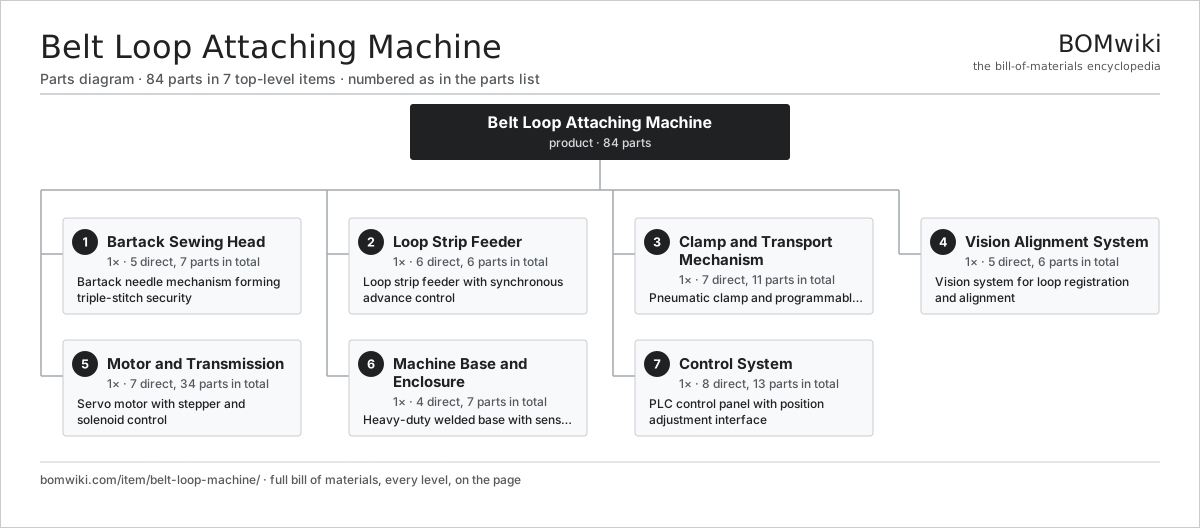
| # | Part | Qty | What it does |
|---|---|---|---|
| 1 | Bartack Sewing Head 5 parts | 1× | Bartack needle mechanism forming triple-stitch security |
| 2 | Loop Strip Feeder 6 parts | 1× | Loop strip feeder with synchronous advance control |
| 3 | Clamp and Transport Mechanism 7 parts | 1× | Pneumatic clamp and programmable carriage motion |
| 4 | Vision Alignment System 5 parts | 1× | Vision system for loop registration and alignment |
| 5 | Motor and Transmission 7 parts | 1× | Servo motor with stepper and solenoid control |
| 6 | Machine Base and Enclosure 4 parts | 1× | Heavy-duty welded base with sensor mounting |
| 7 | Control System 8 parts | 1× | PLC control panel with position adjustment interface |
3D model
No 3D model yet. Have a CAD file of this? Add a 3D model. STL renders right on this page; STEP, FreeCAD, and OpenSCAD sources are welcome too (openly licensed, like all 3D models on BOMwiki).
Build & assembly graph
expand / collapse · shared sub-assemblies converge · links to related products · est. labourTap an assembly to expand/collapse · tap a part to open it · use “Open page” for any node · drag to pan, scroll to zoom.
Bill of materials for Belt Loop Attaching Machine
7 top-level lines · 53 rows shown · 84 parts total · indented to 3 levels| # | Item / sub-assembly | Part no. | Qty/assy | Ext. qty | Parts | Type |
|---|---|---|---|---|---|---|
| 1 | Bartack Sewing Head 5 parts | belt-loop-machine-sewing-head | 1× | 1 | 7 | assembly |
| 1.1 | Narrow Needle Bar | belt-loop-machine-needle-bar | 1× | 1 | · | part |
| 1.2 | Lockstitch Hook | belt-loop-machine-hook | 1× | 1 | · | part |
| 1.3 | Bartack Intermittent Cam | belt-loop-machine-bartack-cam | 1× | 1 | · | part |
| 1.4 | Ball Bearing | ball-bearing | 3× | 3 | · | part |
| 1.5 | Fastener Set | fastener-set | 1× | 1 | · | part |
| 2 | Loop Strip Feeder 6 parts | belt-loop-machine-feed-system | 1× | 1 | 6 | assembly |
| 2.1 | Loop Reel Spindle | belt-loop-machine-reel-stand | 1× | 1 | · | part |
| 2.2 | Strip Feeder Wheel | belt-loop-machine-feeder-wheel | 1× | 1 | · | part |
| 2.3 | Loop Cutter Blade | belt-loop-machine-cutter | 1× | 1 | · | part |
| 2.4 | Loop Positioning Guide | belt-loop-machine-guide-rail | 1× | 1 | · | part |
| 2.5 | Solenoid Coil | solenoid | 1× | 1 | · | part |
| 2.6 | Fastener Set | fastener-set | 1× | 1 | · | part |
| 3 | Clamp and Transport Mechanism 7 parts | belt-loop-machine-clamp-transport | 1× | 1 | 11 | assembly |
| 3.1 | Soft Clamp Jaw | belt-loop-machine-clamp-jaw | 1× | 1 | · | part |
| 3.2 | Pneumatic Air Cylinder | belt-loop-machine-air-cylinder | 2× | 2 | · | part |
| 3.3 | Solenoid Air Control Valve | belt-loop-machine-air-valve | 2× | 2 | · | part |
| 3.4 | Linear Positioning Carriage | belt-loop-machine-linear-stage | 1× | 1 | · | part |
| 3.5 | Stepper Motor | belt-loop-machine-stepper-motor | 1× | 1 | · | part |
| 3.6 | Ball Bearing | ball-bearing | 3× | 3 | · | part |
| 3.7 | Fastener Set | fastener-set | 1× | 1 | · | part |
| 4 | Vision Alignment System 5 parts | belt-loop-machine-position-sensor | 1× | 1 | 6 | assembly |
| 4.1 | Industrial Vision Camera | belt-loop-machine-camera | 1× | 1 | · | part |
| 4.2 | Vision Ring Light | belt-loop-machine-lighting | 1× | 1 | · | part |
| 4.3 | Vision Processing Module | belt-loop-machine-vision-controller | 1× | 1 | · | part |
| 4.4 | Connector | connector | 2× | 2 | · | part |
| 4.5 | Fastener Set | fastener-set | 1× | 1 | · | part |
| 5 | Motor and Transmission 7 parts | belt-loop-machine-drive | 1× | 1 | 34 | assembly |
| 5.1 | Servo Motor 4 parts | servo-motor | 1× | 1 | 24 | assembly |
| 5.1.1 | Stator Assembly 3 parts + deeper › | stator-assembly | 1× | 1 | 3 | assembly |
| 5.1.2 | Rotor Assembly 4 parts + deeper › | rotor-assembly | 1× | 1 | 19 | assembly |
| 5.1.3 | Encoder | encoder | 1× | 1 | · | part |
| 5.1.4 | Motor Housing | motor-housing | 1× | 1 | · | part |
| 5.2 | Sewing Drive Crankshaft | belt-loop-machine-crankshaft | 1× | 1 | · | part |
| 5.3 | Gearbox Housing | gearbox-housing | 1× | 1 | · | part |
| 5.4 | Ball Bearing | ball-bearing | 4× | 4 | · | part |
| 5.5 | Oil Seal | oil-seal | 2× | 2 | · | part |
| 5.6 | Stepper Motor | belt-loop-machine-stepper-motor | 1× | 1 | · | part |
| 5.7 | Fastener Set | fastener-set | 1× | 1 | · | part |
| 6 | Machine Base and Enclosure 4 parts | belt-loop-machine-frame | 1× | 1 | 7 | assembly |
| 6.1 | Machine Base Plate | belt-loop-machine-base-plate | 1× | 1 | · | part |
| 6.2 | Vertical Support Column | belt-loop-machine-vertical-column | 1× | 1 | · | part |
| 6.3 | Vibration Damping Foot | belt-loop-machine-vibration-foot | 4× | 4 | · | part |
| 6.4 | Fastener Set | fastener-set | 1× | 1 | · | part |
| 7 | Control System 8 parts | belt-loop-machine-controls | 1× | 1 | 13 | assembly |
| 7.1 | Programmable Logic Controller | belt-loop-machine-plc | 1× | 1 | · | part |
| 7.2 | Operator Touchscreen | belt-loop-machine-touchscreen | 1× | 1 | · | part |
| 7.3 | Relay Control Module | belt-loop-machine-relay-module | 1× | 1 | · | part |
| 7.4 | Servo Drive Amplifier | belt-loop-machine-servo-drive | 1× | 1 | · | part |
| 7.5 | Stepper Motor Driver | belt-loop-machine-stepper-drive | 1× | 1 | · | part |
| 7.6 | Bare PCB | pcb-bare | 1× | 1 | · | part |
| 7.7 | Connector | connector | 6× | 6 | · | part |
| 7.8 | Fastener Set | fastener-set | 1× | 1 | · | part |
Something wrong in this list? Report a problem with this BOM.
Related products
same domain, ranked by shared parts Automatic Fabric Cutting Machine
1,695 parts · shares 4 with this page
Automatic Pocket Welt Machine
98 parts · shares 4 with this page
Automatic Winding Machine
288 parts · shares 4 with this page
Blindstitch Hemming Machine
67 parts · shares 4 with this page
Automatic Fabric Cutting Machine
1,695 parts · shares 4 with this page
Automatic Pocket Welt Machine
98 parts · shares 4 with this page
Automatic Winding Machine
288 parts · shares 4 with this page
Blindstitch Hemming Machine
67 parts · shares 4 with this page
 Chainstitch Machine
82 parts · shares 4 with this page
Chainstitch Machine
82 parts · shares 4 with this page
Sourcing: possible vendors
Browse the supplier directory → Prices, MOQ, and lead times are algorithmic estimates, not quotes, and not claims about these companies. Company mappings are curated by keyword; est. price band $10k–$1M. How estimates work| Vendor | HQ | Specialty | MOQ | Lead time |
|---|---|---|---|---|
|
🇨🇭Rieter
rieter.com ↗
|
Winterthur, CH | Spinning machinery | 10 units | 14–24 wks |
| truetzschler.com ↗ | Mönchengladbach, DE | Textile machinery | 10 units | 14–24 wks |
|
🇧🇪Picanol
picanol.be ↗
|
Ypres, BE | Weaving machines | 10 units | 14–24 wks |
| karlmayer.com ↗ | Obertshausen, DE | Warp knitting machines | 10 units | 14–24 wks |
|
🇨🇭Saurer
saurer.com ↗
|
Arbon, CH | Spinning & embroidery | 10 units | 14–24 wks |
1,366-word article