Bench Power Supply
ProductOverview
A bench power supply is a laboratory instrument that provides precise, adjustable direct current (DC) voltage and current to circuits under test or development. The operator sets two parameters, output voltage and maximum current limit, and the supply delivers whatever current the load demands, up to the limit, at the chosen voltage.
Bench supplies are fundamental in electronics design and troubleshooting. They allow engineers to prototype circuits at controlled voltage levels, test component behavior, power embedded systems during firmware development, and validate power-distribution designs. Unlike batteries (fixed voltage) or commercial power cords (120 V line voltage), bench supplies offer full adjustability and built-in protection.
How It Works
The supply chain begins with mains AC power (120 or 240 V):
- Step-down transformer: Reduces AC voltage to a lower secondary voltage (e.g., 48 V AC for a 50 V output supply)
- Full-wave rectifier: Converts AC to unregulated (pulsating) DC
- Filter and smoothing: Large capacitors and optional choke reduce ripple to <100 mV
- Output regulation stage: Series pass transistor or buck converter maintains constant output voltage despite load or input changes
The operator adjusts the front-panel voltage knob, which changes the setpoint of an error amplifier. If output voltage drops (due to increased load), the feedback circuit increases pass transistor conduction, raising voltage back to setpoint.
Current limit is set via a second potentiometer. A current-sense resistor monitors load current; if it exceeds the limit, the error amplifier reduces pass-transistor conduction, clamping current. If the output is shorted or overloaded, current naturally limits to the set value, protecting both the power supply and the circuit under test.
Power Transformer and Rectification
The transformer is the largest passive component, typically 500–3000 VA rating. Multi-tap or multiple secondary windings allow different output ranges (e.g., ±5V, ±12V, ±15V, 0–50V) from a single transformer.
The rectifier bridge converts AC to pulsating DC. For a 48 V AC secondary and 60 Hz mains frequency, the rectifier output contains:
- DC level: 48 V × 1.414 ÷ 2 ≈ 34 V (average)
- Ripple frequency: 120 Hz (full-wave, two pulses per AC cycle)
- Ripple magnitude: ±20 V peak (unfiltered)
The filter capacitors (10,000–100,000 μF total) and optional choke inductance smooth the ripple. With proper LC filtering, ripple voltage drops to <100 mV peak-to-peak.
Linear vs. Switched-Mode Regulation
Linear regulators use a series pass transistor dissipating excess voltage as heat. For a 50 V 10 A supply, if input is 60 V and output is 50 V at 10 A load:
- Power dissipated: (60 − 50) V × 10 A = 100 W
- Efficiency: 50 V × 10 A ÷ (60 V × 10 A) = 83%
At light loads, efficiency improves but absolute dissipation remains constant, requiring substantial heatsinking.
Switched-mode supplies (SMPS) switch the pass transistor on/off at kHz frequencies, reducing dissipation:
- Efficiency: typically 85–95%
- Smaller transformer and heatsink
- Lower heat generation, quieter operation
- Higher cost (PWM controller IC required)
Most laboratory benchtop supplies use linear regulation for simplicity and low EMI; high-capacity supplies (>30 A) often employ SMPS.
Metering and Display
The meter assembly displays output voltage and load current:
Analog meters: Panel-mounted galvanometers with 1% accuracy. Two dedicated meters (voltage and current) are standard, reducing confusion and allowing simultaneous observation of both parameters.
Digital displays: LCD readouts (3–4 digits) showing 0.1 V and 0.1 A resolution. Some supplies include both analog and digital for operator preference.
Meter scaling: A 50 V 30 A supply typically has two meters: 0–60 V (voltage) and 0–30 A (current), with an 10% overage allowance for transients and measurement margin.
Protection and Shutdown
The overvoltage protection (OVP) circuit prevents dangerous voltage spikes:
- A precision comparator detects when output voltage exceeds setpoint + margin (e.g., >55 V on a 50 V supply)
- A silicon-controlled rectifier (SCR) crowbars the output to ground, clamping voltage and tripping a front-panel "OVP" indicator
- The operator must then remove the short-circuit condition and reset
Overcurrent protection (OCP) works via current limiting: when load current exceeds the user-set limit, the error amplifier automatically reduces pass-transistor conduction, preventing current from rising further. This is "fold-back" or "soft-limit" behavior, limiting dissipation on the pass transistor even with continuous overload.
Thermal shutdown: An internal thermistor or bimetallic cutoff protects against sustained overheating. If junction temperature exceeds ~100–120°C, the supply shuts down output and illuminates a front-panel thermal indicator.
Output Connectors and Cable Safety
The output binding posts (color-coded red for positive, black for negative) or 4 mm banana jacks provide safe connection points. Large gauges (15–30 A continuous) reduce voltage drop and resistive heating in the external load cable.
Standard practice:
- Use heavy-gauge wire (10–12 AWG) for external loads exceeding 5 A
- Keep load cable <2 meters to minimize voltage drop
- Tie together multiple negative leads to ensure return current distribution
Applications
Power Electronics Testing
Prototype switch-mode supplies, battery chargers, LED drivers, and motor controllers at controlled voltage and current, allowing safe circuit development without risking expensive equipment.
Embedded Systems
Program and debug microcontroller boards (Arduino, STM32, etc.) at stable 3.3 V or 5 V supply, with current limiting protecting the development board from firmware bugs.
Component Characterization
Measure I-V curves of diodes, transistors, and other devices by sweeping voltage and recording current response.
Sensor Excitation
Provide precise excitation voltage for strain gauges, thermistors, and other analog sensors during measurement system development.
Educational and Training
Teach fundamental circuit theory with visible, adjustable power source, encouraging hands-on learning and safe experimentation.
Specifications and Standards
- IEEE 149: Standard test procedure for power supplies (dynamic load, transient response, ripple, noise)
- ANSI/ISA-67.04.01: Instrument safety (electrical safety of benchtop instruments)
- EN 61010-1: Safety of electrical equipment for measurement, control, and laboratory use
Quality laboratory supplies conform to these standards and include three-conductor AC power cords (with separate ground), fused primary circuits, and double-insulated enclosures rated 2 kVAC isolation.
Bench Power Supply parts and their functions
8 top-level parts · 46 parts in total · full bill of materials below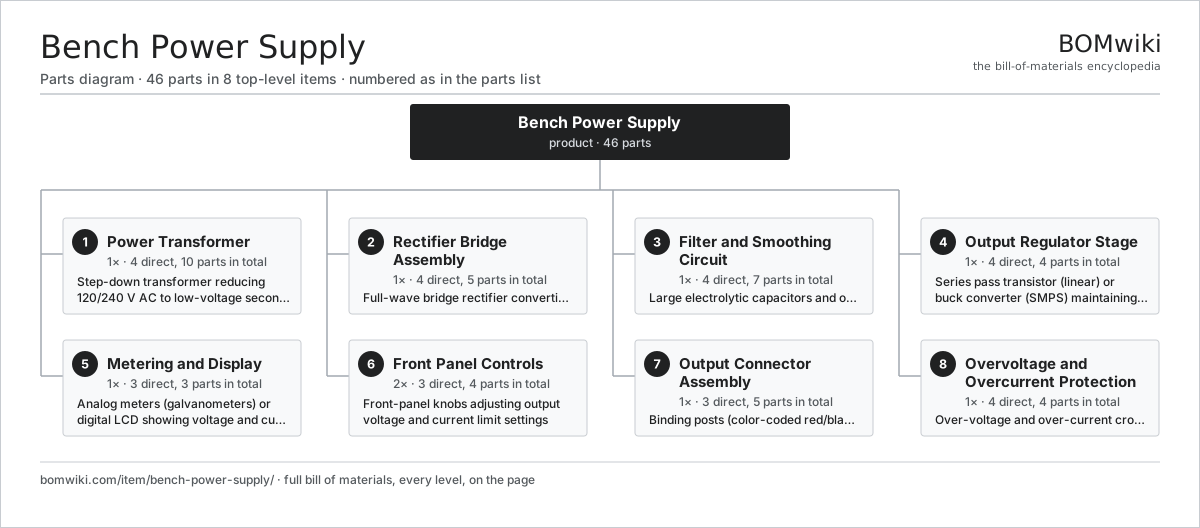
| # | Part | Qty | What it does |
|---|---|---|---|
| 1 | Power Transformer 4 parts | 1× | Step-down transformer reducing 120/240 V AC to low-voltage secondary (12–48 V AC) |
| 2 | Rectifier Bridge Assembly 4 parts | 1× | Full-wave bridge rectifier converting transformer AC secondary to unregulated DC |
| 3 | Filter and Smoothing Circuit 4 parts | 1× | Large electrolytic capacitors and optional choke coil smoothing rectified output to <100 mV ripple |
| 4 | Output Regulator Stage 4 parts | 1× | Series pass transistor (linear) or buck converter (SMPS) maintaining constant output voltage/current |
| 5 | Metering and Display 3 parts | 1× | Analog meters (galvanometers) or digital LCD showing voltage and current |
| 6 | Front Panel Controls 3 parts | 2× | Front-panel knobs adjusting output voltage and current limit settings |
| 7 | Output Connector Assembly 3 parts | 1× | Binding posts (color-coded red/black) or banana jacks for external load connections |
| 8 | Overvoltage and Overcurrent Protection 4 parts | 1× | Over-voltage and over-current crowbar circuit with thermal shutdown |
3D model
No 3D model yet. Have a CAD file of this? Add a 3D model. STL renders right on this page; STEP, FreeCAD, and OpenSCAD sources are welcome too (openly licensed, like all 3D models on BOMwiki).
Build & assembly graph
expand / collapse · shared sub-assemblies converge · links to related products · est. labourTap an assembly to expand/collapse · tap a part to open it · use “Open page” for any node · drag to pan, scroll to zoom.
Bill of materials for Bench Power Supply
8 top-level lines · 37 rows shown · 46 parts total · indented to 3 levels| # | Item / sub-assembly | Part no. | Qty/assy | Ext. qty | Parts | Type |
|---|---|---|---|---|---|---|
| 1 | Power Transformer 4 parts | bench-power-supply-transformer | 1× | 1 | 10 | assembly |
| 1.1 | Transformer Core | bench-power-supply-core | 1× | 1 | · | part |
| 1.2 | Copper Winding | copper-winding | 3× | 3 | · | part |
| 1.3 | Primary Winding Lead | bench-power-supply-primary-lead | 2× | 2 | · | part |
| 1.4 | Secondary Winding Lead | bench-power-supply-secondary-lead | 4× | 4 | · | part |
| 2 | Rectifier Bridge Assembly 4 parts | bench-power-supply-rectifier | 1× | 1 | 5 | assembly |
| 2.1 | Rectifier Diode Module | bench-power-supply-diode-bridge | 1× | 1 | · | part |
| 2.2 | Rectifier Heatsink | bench-power-supply-rectifier-heatsink | 1× | 1 | · | part |
| 2.3 | Reverse Protection Diode | bench-power-supply-protect-diode | 1× | 1 | · | part |
| 2.4 | Fastener Set | fastener-set | 2× | 2 | · | part |
| 3 | Filter and Smoothing Circuit 4 parts | bench-power-supply-filter | 1× | 1 | 7 | assembly |
| 3.1 | Filter Capacitor | bench-power-supply-filter-cap | 4× | 4 | · | part |
| 3.2 | Smoothing Choke Coil | bench-power-supply-filter-choke | 1× | 1 | · | part |
| 3.3 | Bleed Resistor | bench-power-supply-cap-bleed | 1× | 1 | · | part |
| 3.4 | Fastener Set | fastener-set | 1× | 1 | · | part |
| 4 | Output Regulator Stage 4 parts | bench-power-supply-regulator | 1× | 1 | 4 | assembly |
| 4.1 | Pass Transistor | bench-power-supply-pass-transistor | 1× | 1 | · | part |
| 4.2 | Current Sense Resistor | bench-power-supply-current-sense-resistor | 1× | 1 | · | part |
| 4.3 | Error Amplifier Op-Amp | bench-power-supply-error-amplifier | 1× | 1 | · | part |
| 4.4 | Voltage Reference | bench-power-supply-reference | 1× | 1 | · | part |
| 5 | Metering and Display 3 parts | bench-power-supply-display | 1× | 1 | 3 | assembly |
| 5.1 | Voltage Meter | bench-power-supply-voltage-meter | 1× | 1 | · | part |
| 5.2 | Current Meter | bench-power-supply-current-meter | 1× | 1 | · | part |
| 5.3 | Meter Multiplier/Driver Circuit | bench-power-supply-meter-circuit | 1× | 1 | · | part |
| 6 | Front Panel Controls 3 parts | bench-power-supply-control-potentiometer | 2× | 2 | 4 | assembly |
| 6.1 | Voltage Adjust Potentiometer | bench-power-supply-voltage-pot | 1× | 2 | · | part |
| 6.2 | Current Limit Potentiometer | bench-power-supply-current-pot | 1× | 2 | · | part |
| 6.3 | Control Knob | bench-power-supply-control-knob | 2× | 4 | · | part |
| 7 | Output Connector Assembly 3 parts | bench-power-supply-output-connectors | 1× | 1 | 5 | assembly |
| 7.1 | Binding Post | bench-power-supply-binding-post | 2× | 2 | · | part |
| 7.2 | Binding Post Hardware | bench-power-supply-post-nut | 2× | 2 | · | part |
| 7.3 | Output Interlock Relay | bench-power-supply-inter-lock | 1× | 1 | · | part |
| 8 | Overvoltage and Overcurrent Protection 4 parts | bench-power-supply-protection | 1× | 1 | 4 | assembly |
| 8.1 | Crowbar SCR | bench-power-supply-crowbar-scr | 1× | 1 | · | part |
| 8.2 | Overvoltage Comparator | bench-power-supply-crowbar-comparator | 1× | 1 | · | part |
| 8.3 | Primary-Side Fuse | bench-power-supply-fuse | 1× | 1 | · | part |
| 8.4 | Thermal Fuse | thermal-fuse | 1× | 1 | · | part |
Something wrong in this list? Report a problem with this BOM.
Related products
same domain, ranked by shared parts Electric Hand Planer
57 parts · shares 1 with this page
Electric Hand Planer
57 parts · shares 1 with this page
 Electronic Torque Wrench
42 parts · shares 1 with this page
Electronic Torque Wrench
42 parts · shares 1 with this page
 Heat Gun
183 parts · shares 1 with this page
Heat Gun
183 parts · shares 1 with this page
 HEPA Dust Extractor
51 parts · shares 1 with this page
HEPA Dust Extractor
51 parts · shares 1 with this page
 Industrial Hot Glue Gun
28 parts · shares 1 with this page
Industrial Hot Glue Gun
28 parts · shares 1 with this page
Sourcing: possible vendors
Browse the supplier directory → Prices, MOQ, and lead times are algorithmic estimates, not quotes, and not claims about these companies. Company mappings are curated by keyword; est. price band $30–$800. How estimates work| Vendor | HQ | Specialty | MOQ | Lead time |
|---|---|---|---|---|
| stanleyblackanddecker.com ↗ | New Britain, US | Tools (DeWalt, Craftsman) | 500 units | 6–12 wks |
| bosch-professional.com ↗ | Leinfelden, DE | Power tools | 500 units | 6–12 wks |
| ttigroup.com ↗ | Hong Kong, CN | Tools (Milwaukee, Ryobi) | 500 units | 6–12 wks |
|
🇯🇵Makita
makita.com ↗
|
Anjo, JP | Power tools | 500 units | 6–12 wks |
|
🇨🇭Hilti
hilti.com ↗
|
Schaan, CH | Construction tools | 500 units | 6–12 wks |
1,076-word article