GPS Bike Computer
ProductOverview
A GPS bike computer is a dedicated handlebar instrument that does three jobs: it fixes the rider's position continuously from satellite signals, it aggregates data from wireless sensors on the bike and body, and it records everything to a file for later analysis. Dedicated units persist alongside smartphones because they are sunlight-readable, sealed against immersion, operable with gloves, and run 15-45 hours on a charge, a phone doing the same job with its screen on lasts a few hours.
Position: the GNSS chain
The GNSS Receiver subsystem starts at the GNSS Patch Antenna, a ceramic patch tuned to 1.575 and 1.176 GHz and mounted sky-facing under the case top. Satellite signals arrive at about -130 dBm, below the thermal noise floor, so the RF Front End amplifies and band-filters them before the GNSS Chipset correlates them against known spreading codes. Modern chipsets track 30+ satellites across GPS, Galileo, GLONASS, and BeiDou simultaneously; the more important recent upgrade is dual-frequency reception (L1 + L5), which lets the receiver identify and reject multipath, signals bounced off buildings, cutting urban position error from 5-10 m to 1-2 m. A TCXO holds the frequency reference stable within ±0.5 ppm as case temperature swings.
Altitude is the exception: GNSS vertical error is several times horizontal error, so the Barometric Altimeter barometric MEMS sensor, resolving about 10 cm of height change, supplies the elevation and gradient numbers. This only works because the Vent Membrane in the Enclosure equalizes internal pressure with the outside air while keeping water out; a fully sealed case would trap a pressure offset and bias every climb reading.
Sensors: ANT+ and BLE
Ride data beyond position arrives over 2.4 GHz radio. The ANT+/BLE Radio runs two protocols on one chip. ANT+ is a broadcast scheme: a power meter or Heart Rate Strap transmits its profile openly at 4 Hz and any number of displays can listen, which is why ANT+ remains standard in cycling, a coach's tablet, the rider's watch, and the head unit can all read one sensor. Bluetooth LE is connection-oriented (normally one listener per sensor) and handles phone tethering for live tracking, text notifications, and ride upload. The Wi-Fi Module is used only at rest, syncing rides and maps when the unit sees a known network.
The typical Wireless Sensor Set includes a Speed Sensor on the hub (counting actual wheel revolutions, which beats GNSS speed under tree cover or in tunnels), a Cadence Sensor on the crank arm, the chest strap, whose electrodes read the ECG R-wave directly and outperform wrist optical sensors at high heart rates, and increasingly a Rear Radar, a 24 GHz rear-facing unit that tracks overtaking vehicles up to 140 m back and plots them as dots climbing the screen edge.
Display and recording
The screen is the component most shaped by the use case. The Transflective Display is transflective: ambient light passes through the pixels, hits a reflective layer, and returns, so the display gets more readable as sunlight gets brighter and the backlight is reserved for night use, the opposite of a phone screen, and the main reason for the battery endurance. A Touch Digitizer handles map panning, but the sealed Button Set duplicate every critical function because capacitive touch misregisters under rain droplets and full gloves. The Cover Lens is optically bonded glass, removing the internal air gap that causes glare.
Processing runs on the Main Logic Board: a Compute SoC Module application processor executes turn-by-turn routing against maps held in Flash Storage, fuses sensor streams, and writes the ride as a FIT file at 1 Hz, roughly 200-400 KB per hour, so storage is effectively unlimited. The IMU watches for the acceleration signature of a crash and triggers an incident alert through the paired phone.
Power and mounting
The Power Subsystem subsystem runs everything from a 1,000-2,000 mAh LiPo Cell managed by a Power Management IC; a coulomb-counting Fuel Gauge IC keeps the percentage honest. Charging is through a gasket-sealed USB-C Port, the seal itself, not a rubber flap, provides the IPX7 rating. The unit rides on the Mount Kit: a quarter-turn socket on an Out-Front Mount arm that cantilevers the screen ahead of the stem at the rider's natural sightline, with a Tether as backup if the mount tabs shear in a crash.
GPS Bike Computer parts and their functions
8 top-level parts · 40 parts in total · full bill of materials below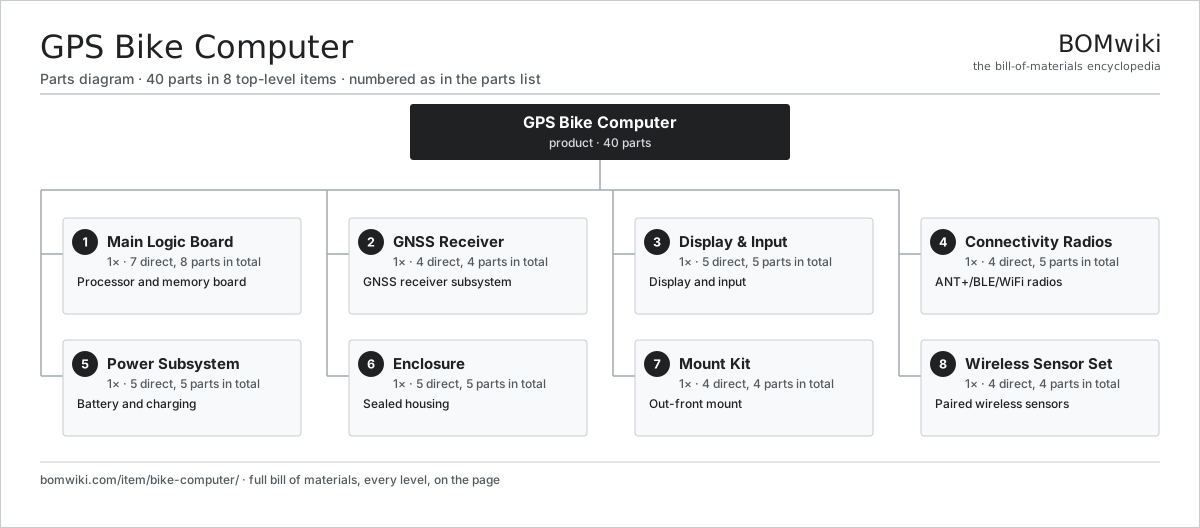
| # | Part | Qty | What it does |
|---|---|---|---|
| 1 | Main Logic Board 7 parts | 1× | Processor and memory board |
| 2 | GNSS Receiver 4 parts | 1× | GNSS receiver subsystem |
| 3 | Display & Input 5 parts | 1× | Display and input |
| 4 | Connectivity Radios 4 parts | 1× | ANT+/BLE/WiFi radios |
| 5 | Power Subsystem 5 parts | 1× | Battery and charging |
| 6 | Enclosure 5 parts | 1× | Sealed housing |
| 7 | Mount Kit 4 parts | 1× | Out-front mount |
| 8 | Wireless Sensor Set 4 parts | 1× | Paired wireless sensors |
3D model
No 3D model yet. Have a CAD file of this? Add a 3D model. STL renders right on this page; STEP, FreeCAD, and OpenSCAD sources are welcome too (openly licensed, like all 3D models on BOMwiki).
Build & assembly graph
expand / collapse · shared sub-assemblies converge · links to related products · est. labourTap an assembly to expand/collapse · tap a part to open it · use “Open page” for any node · drag to pan, scroll to zoom.
Bill of materials for GPS Bike Computer
8 top-level lines · 46 rows shown · 40 parts total · indented to 3 levels| # | Item / sub-assembly | Part no. | Qty/assy | Ext. qty | Parts | Type |
|---|---|---|---|---|---|---|
| 1 | Main Logic Board 7 parts | bike-computer-mainboard | 1× | 1 | 8 | assembly |
| 1.1 | Bare PCB | pcb-bare | 1× | 1 | · | part |
| 1.2 | Compute SoC Module | soc-module | 1× | 1 | · | part |
| 1.3 | Flash Storage | bike-computer-flash | 1× | 1 | · | part |
| 1.4 | Barometric Altimeter | bike-computer-baro | 1× | 1 | · | part |
| 1.5 | IMU | bike-computer-imu | 1× | 1 | · | part |
| 1.6 | SMD Passive (R/C/L) | smd-passives | 1× | 1 | · | part |
| 1.7 | Connector | connector | 2× | 2 | · | part |
| 2 | GNSS Receiver 4 parts | bike-computer-gnss | 1× | 1 | 4 | assembly |
| 2.1 | GNSS Chipset | bike-computer-gnss-chip | 1× | 1 | · | part |
| 2.2 | GNSS Patch Antenna | bike-computer-gnss-antenna | 1× | 1 | · | part |
| 2.3 | TCXO | bike-computer-tcxo | 1× | 1 | · | part |
| 2.4 | RF Front End | bike-computer-rf-frontend | 1× | 1 | · | part |
| 3 | Display & Input 5 parts | bike-computer-display-stack | 1× | 1 | 5 | assembly |
| 3.1 | Transflective Display | bike-computer-display | 1× | 1 | · | part |
| 3.2 | Touch Digitizer | touch-digitizer | 1× | 1 | · | part |
| 3.3 | Button Set | bike-computer-buttons | 1× | 1 | · | part |
| 3.4 | Cover Lens | bike-computer-lens | 1× | 1 | · | part |
| 3.5 | Ambient Light Sensor | bike-computer-ambient-sensor | 1× | 1 | · | part |
| 4 | Connectivity Radios 4 parts | bike-computer-radio-suite | 1× | 1 | 5 | assembly |
| 4.1 | ANT+/BLE Radio | bike-computer-ant-ble-radio | 1× | 1 | · | part |
| 4.2 | Wi-Fi Module | bike-computer-wifi-module | 1× | 1 | · | part |
| 4.3 | 2.4 GHz Chip Antenna | bike-computer-2g4-antenna | 2× | 2 | · | part |
| 4.4 | SMD Passive (R/C/L) | smd-passives | 1× | 1 | · | part |
| 5 | Power Subsystem 5 parts | bike-computer-power | 1× | 1 | 5 | assembly |
| 5.1 | LiPo Cell | lipo-cell | 1× | 1 | · | part |
| 5.2 | Power Management IC | bike-computer-pmic | 1× | 1 | · | part |
| 5.3 | USB-C Port | bike-computer-usbc-port | 1× | 1 | · | part |
| 5.4 | Fuel Gauge IC | bike-computer-fuel-gauge | 1× | 1 | · | part |
| 5.5 | Thermal Fuse | thermal-fuse | 1× | 1 | · | part |
| 6 | Enclosure 5 parts | bike-computer-enclosure | 1× | 1 | 5 | assembly |
| 6.1 | Front Case | bike-computer-case-front | 1× | 1 | · | part |
| 6.2 | Back Case | bike-computer-case-back | 1× | 1 | · | part |
| 6.3 | O-Ring Set | oring-set | 1× | 1 | · | part |
| 6.4 | Vent Membrane | bike-computer-vent-membrane | 1× | 1 | · | part |
| 6.5 | Fastener Set | fastener-set | 1× | 1 | · | part |
| 7 | Mount Kit 4 parts | bike-computer-mount-kit | 1× | 1 | 4 | assembly |
| 7.1 | Out-Front Mount | bike-computer-outfront-mount | 1× | 1 | · | part |
| 7.2 | Stem Mount | bike-computer-stem-mount | 1× | 1 | · | part |
| 7.3 | Tether | bike-computer-tether | 1× | 1 | · | part |
| 7.4 | Fastener Set | fastener-set | 1× | 1 | · | part |
| 8 | Wireless Sensor Set 4 parts | bike-computer-sensor-set | 1× | 1 | 4 | assembly |
| 8.1 | Speed Sensor | bike-computer-speed-sensor | 1× | 1 | · | part |
| 8.2 | Cadence Sensor | bike-computer-cadence-sensor | 1× | 1 | · | part |
| 8.3 | Heart Rate Strap | bike-computer-hr-strap | 1× | 1 | · | part |
| 8.4 | Rear Radar | bike-computer-radar | 1× | 1 | · | part |
Something wrong in this list? Report a problem with this BOM.
Related products
same domain, ranked by shared parts E-Bike Conversion Kit
133 parts · shares 4 with this page
E-Bike Conversion Kit
133 parts · shares 4 with this page
 Smart Bike Trainer
370 parts · shares 4 with this page
Smart Bike Trainer
370 parts · shares 4 with this page
 Velomobile
112 parts · shares 2 with this page
Velomobile
112 parts · shares 2 with this page
 Cargo Bicycle
500 parts · shares 4 with this page
Cargo Bicycle
500 parts · shares 4 with this page
 Cargo E-Bike
366 parts · shares 4 with this page
Cyclocross Bike
309 parts · shares 4 with this page
Cargo E-Bike
366 parts · shares 4 with this page
Cyclocross Bike
309 parts · shares 4 with this page
Sourcing: possible vendors
Browse the supplier directory → Prices, MOQ, and lead times are algorithmic estimates, not quotes, and not claims about these companies. Company mappings are curated by keyword; est. price band $200–$12k. How estimates work| Vendor | HQ | Specialty | MOQ | Lead time |
|---|---|---|---|---|
|
🇹🇼Giant
giant-bicycles.com ↗
|
Taichung, TW | Bicycles | 500 units | 6–12 wks |
|
🇺🇸Trek
trekbikes.com ↗
|
Waterloo, US | Bicycles | 500 units | 6–12 wks |
| specialized.com ↗ | Morgan Hill, US | Bicycles | 500 units | 6–12 wks |
|
🇹🇼Merida
merida-bikes.com ↗
|
Yuanlin, TW | Bicycles | 500 units | 6–12 wks |
| cannondale.com ↗ | Wilton, US | Bicycles | 500 units | 6–12 wks |
780-word article