Bilge Pump System
ProductOverview
A bilge pump system keeps a ship's lowest compartment (the bilge) free of seawater accumulation that would add weight, reduce stability, and corrode the hull structure. Every operating vessel develops bilge water from engine cooling systems, rain infiltration, leaking hull seams, and condensation. Without continuous removal, this water pools in the deepest hold and must be manually pumped, a labor-intensive and inefficient solution. A modern ship carries an automatic electric bilge pump mounted in the bilge well itself, connected to a float switch that monitors water level and triggers the pump when the water rises above a safe threshold. The pump runs until the level drops, then shuts off automatically. Seawater is drawn through a strainer basket that filters debris, pumped through a discharge hose, and ejected overboard via a through-hull fitting above the waterline.
The system integrates several key components: a submersible electric pump motor and impeller sealed against seawater intrusion, a buoyant float mechanism triggering the pump automatically, a manual control panel allowing the captain to run the pump manually or override automatic mode, a one-way check valve preventing backflow when the pump stops, and a manual shutoff valve for maintenance. International maritime regulations require that all vessels over a certain size carry at least one automatic bilge pump capable of removing water faster than normal seepage rates.
How it works
The submersible pump sits in the bilge well, the lowest and most isolated compartment, where it is constantly submerged in whatever water accumulates. The pump is a sealed unit with an electric motor (either AC or DC depending on ship power system) driving a centrifugal or turbine-type impeller. Seawater is drawn in through a strainer basket that traps rags, wood splinters, scale, and other particles that could jam the impeller. The stainless steel mesh (typically 400–800 micron openings) provides coarse filtration; crew members can open a drain plug at the bottom of the strainer to flush accumulated debris periodically.
The impeller accelerates the water radially outward, converting kinetic energy into pressure. Water is discharged into the discharge hose, which carries it up through the ship to a through-hull fitting mounted above the waterline on the hull side. This is critical: if the discharge is below the waterline, seawater can siphon back into the bilge through the open hose when the pump stops and the ship pitches. The check valve is a backup safeguard, it allows flow only outward during pumping and closes automatically when the pump stops, preventing siphoning.
The float switch is the automatic trigger. A buoyant sphere or rod rises as water level increases; when water reaches a set level (typically 10–20 cm above the bilge floor), the rising float arm closes an electrical contact. This signal is sent to the control panel, where a relay energizes, which in turn closes a magnetic contactor that switches the pump motor ON. As the pump runs, water level drops, and the float sinks. When water falls below the set threshold, the float contact opens, de-energizing the relay and contactor, and the pump stops. A hysteresis spring introduces a 5–10 cm deadband between the on and off levels, preventing rapid on-off chatter if water level hovers at the threshold.
The control panel on the bridge or engine room provides three modes: Off disables the pump entirely (used during dry-dock or maintenance), Automatic enables the float-switch control, and Manual bypasses the float and runs the pump continuously (used for rapid dewatering in emergencies or when the float switch fails). A thermal overload circuit breaker protects the motor from damage if it stalls or is overloaded. Indicator lights show whether the system is in Auto mode (green) and whether the pump is currently running (red). The isolation valve allows the pump to be shut off without draining the entire bilge system, useful for seal replacement or impeller inspection.
Power comes from the ship's main electrical bus: AC bilge pumps require 230 V 3-phase (standard on large commercial vessels) or 110 V single-phase on smaller ships. DC pumps run on the 24 V ship service battery, often installed on fishing vessels or yachts. The pump motor and control circuits are rated for continuous duty, meaning they can run all day without thermal damage. Most marine bilge pumps are designed to self-prime, if the suction line is initially filled with air, the pump can eject air and draw in water without requiring manual priming.
Capacity and performance
Bilge pump capacity is rated in cubic meters per hour (m³/h) at a reference discharge pressure. A typical 1.5 kW pump delivers 20–30 m³/h at the discharge head (height of water lift) of ~5 m. The ''maximum head'' is the vertical distance the pump can raise water; exceeding this stalls the pump. Typical bilge pumps are sized to pump a ship's maximum normal seepage rate (usually 10–20 m³/h) at a discharge height of 10–15 m (from bilge to deck). For emergency rapid dewatering, large ships carry multiple bilge pumps that can be connected in series or parallel to increase capacity.
The Intake Strainer Basket is essential for preventing pump failure. Seawater contains suspended rust scale, barnacle shell fragments, and silt that accumulate over months of operation. If a strainer becomes completely blocked, the pump loses suction and cavitates (air bubbles form in the discharge, reducing flow to zero). Ships on long ocean passages typically inspect and clean the bilge strainer monthly; a blocked strainer is one of the most common causes of bilge pump failure in service.
Regulations and certification
SOLAS Chapter II-1 (Construction) mandates that all cargo vessels and passenger ships above 100 GT carry at least one automatic bilge pump. Large ships carry two or more independent systems, often one AC and one DC powered from separate electrical buses, so that a single power failure does not leave the ship without dewatering capability. The pump and system must be approved by a recognized classification society (ABS, DNV, Lloyd's) and must pass endurance testing: continuous operation for 30 minutes with bilge water containing suspended sediment, proof that the mechanical seal survives repeated start-stop cycles, and pressure testing of the hull fitting to 2.5 times nominal discharge pressure.
An important regulation is the segregation of bilge systems: the pump discharge must not be directly connected to the seawater intake (cooling system), as contaminated bilge discharge could enter the cooling loop and damage the engine. The discharge is routed above the waterline and terminates in an open scupper or overboard connection, with no valves that could trap pressure and cause backflow. Older ships sometimes illegally pump bilge directly overboard without treatment, releasing oil-contaminated water into the ocean; modern MARPOL regulations require that bilge water be treated by an oily water separator before discharge, removing oil and sludge so that only clean water is released.
Bilge Pump System parts and their functions
8 top-level parts · 50 parts in total · full bill of materials below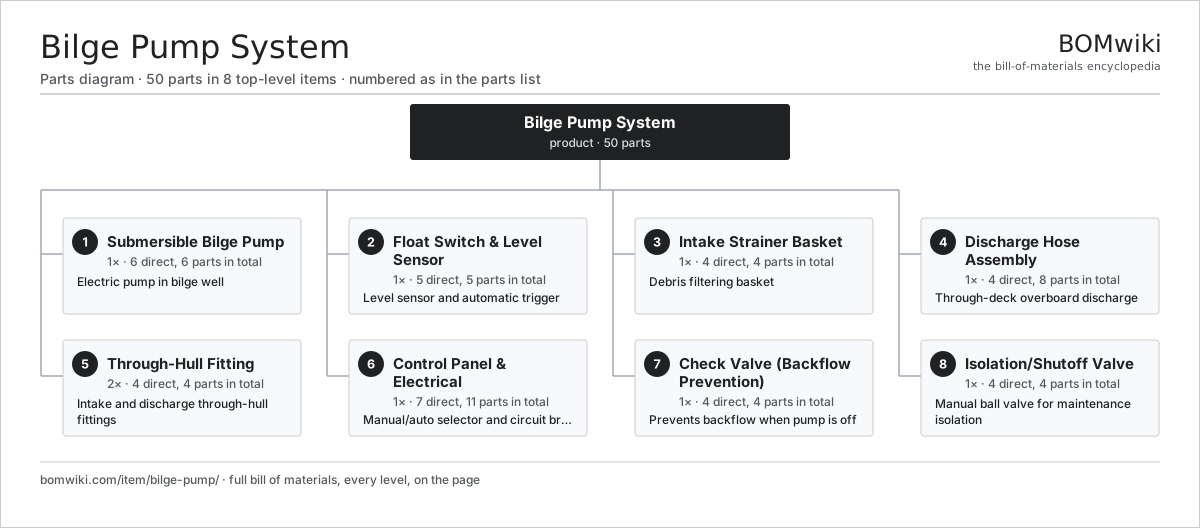
| # | Part | Qty | What it does |
|---|---|---|---|
| 1 | Submersible Bilge Pump 6 parts | 1× | Electric pump in bilge well |
| 2 | Float Switch & Level Sensor 5 parts | 1× | Level sensor and automatic trigger |
| 3 | Intake Strainer Basket 4 parts | 1× | Debris filtering basket |
| 4 | Discharge Hose Assembly 4 parts | 1× | Through-deck overboard discharge |
| 5 | Through-Hull Fitting 4 parts | 2× | Intake and discharge through-hull fittings |
| 6 | Control Panel & Electrical 7 parts | 1× | Manual/auto selector and circuit breaker |
| 7 | Check Valve (Backflow Prevention) 4 parts | 1× | Prevents backflow when pump is off |
| 8 | Isolation/Shutoff Valve 4 parts | 1× | Manual ball valve for maintenance isolation |
3D model
No 3D model yet. Have a CAD file of this? Add a 3D model. STL renders right on this page; STEP, FreeCAD, and OpenSCAD sources are welcome too (openly licensed, like all 3D models on BOMwiki).
Build & assembly graph
expand / collapse · shared sub-assemblies converge · links to related products · est. labourTap an assembly to expand/collapse · tap a part to open it · use “Open page” for any node · drag to pan, scroll to zoom.
Bill of materials for Bilge Pump System
8 top-level lines · 46 rows shown · 50 parts total · indented to 3 levels| # | Item / sub-assembly | Part no. | Qty/assy | Ext. qty | Parts | Type |
|---|---|---|---|---|---|---|
| 1 | Submersible Bilge Pump 6 parts | bilge-pump-submersible-pump | 1× | 1 | 6 | assembly |
| 1.1 | Electric Motor | bilge-pump-motor | 1× | 1 | · | part |
| 1.2 | Pump Impeller | bilge-pump-impeller | 1× | 1 | · | part |
| 1.3 | Pump Housing | bilge-pump-housing | 1× | 1 | · | part |
| 1.4 | Mechanical Seal Assembly | bilge-pump-seal-assembly | 1× | 1 | · | part |
| 1.5 | Power Cord | bilge-pump-power-cord | 1× | 1 | · | part |
| 1.6 | Connector | connector | 1× | 1 | · | part |
| 2 | Float Switch & Level Sensor 5 parts | bilge-pump-float-switch | 1× | 1 | 5 | assembly |
| 2.1 | Float Ball | bilge-pump-float-ball | 1× | 1 | · | part |
| 2.2 | Float Arm | bilge-pump-float-arm | 1× | 1 | · | part |
| 2.3 | Switch Contact | bilge-pump-switch-contact | 1× | 1 | · | part |
| 2.4 | Hysteresis Spring | bilge-pump-hysteresis-spring | 1× | 1 | · | part |
| 2.5 | O-Ring Set | oring-set | 1× | 1 | · | part |
| 3 | Intake Strainer Basket 4 parts | bilge-pump-intake-strainer | 1× | 1 | 4 | assembly |
| 3.1 | Strainer Bowl | bilge-pump-strainer-bowl | 1× | 1 | · | part |
| 3.2 | Strainer Basket | bilge-pump-strainer-basket | 1× | 1 | · | part |
| 3.3 | Drain Plug | bilge-pump-strainer-drain-plug | 1× | 1 | · | part |
| 3.4 | O-Ring Set | oring-set | 1× | 1 | · | part |
| 4 | Discharge Hose Assembly 4 parts | bilge-pump-discharge-hose | 1× | 1 | 8 | assembly |
| 4.1 | Discharge Hose | bilge-pump-hose-tubing | 1× | 1 | · | part |
| 4.2 | Hose Clamp | bilge-pump-hose-clamp | 4× | 4 | · | part |
| 4.3 | Hose Fitting | bilge-pump-hose-fitting | 2× | 2 | · | part |
| 4.4 | Deck Clamp | bilge-pump-deck-routing | 1× | 1 | · | part |
| 5 | Through-Hull Fitting 4 parts | bilge-pump-thru-hull-fitting | 2× | 2 | 4 | assembly |
| 5.1 | Through-Hull Valve | bilge-pump-thru-hull-valve | 1× | 2 | · | part |
| 5.2 | Hull Flange | bilge-pump-thru-hull-flange | 1× | 2 | · | part |
| 5.3 | Hull Gasket | bilge-pump-thru-hull-gasket | 1× | 2 | · | part |
| 5.4 | Fastener Set | fastener-set | 1× | 2 | · | part |
| 6 | Control Panel & Electrical 7 parts | bilge-pump-control-panel | 1× | 1 | 11 | assembly |
| 6.1 | Panel Enclosure | bilge-pump-panel-enclosure | 1× | 1 | · | part |
| 6.2 | Mode Selector | bilge-pump-mode-switch | 1× | 1 | · | part |
| 6.3 | Circuit Breaker | bilge-pump-circuit-breaker | 1× | 1 | · | part |
| 6.4 | Contactor/Relay | bilge-pump-contactor | 1× | 1 | · | part |
| 6.5 | Float Relay | bilge-pump-float-relay | 1× | 1 | · | part |
| 6.6 | Indicator Light | bilge-pump-indicator-light | 2× | 2 | · | part |
| 6.7 | Connector | connector | 4× | 4 | · | part |
| 7 | Check Valve (Backflow Prevention) 4 parts | bilge-pump-check-valve | 1× | 1 | 4 | assembly |
| 7.1 | Check Body | bilge-pump-check-body | 1× | 1 | · | part |
| 7.2 | Check Flapper | bilge-pump-check-flapper | 1× | 1 | · | part |
| 7.3 | Check Spring | bilge-pump-check-spring | 1× | 1 | · | part |
| 7.4 | O-Ring Set | oring-set | 1× | 1 | · | part |
| 8 | Isolation/Shutoff Valve 4 parts | bilge-pump-isolation-valve | 1× | 1 | 4 | assembly |
| 8.1 | Valve Body | bilge-pump-isolation-body | 1× | 1 | · | part |
| 8.2 | Ball | bilge-pump-isolation-ball | 1× | 1 | · | part |
| 8.3 | Handle | bilge-pump-isolation-handle | 1× | 1 | · | part |
| 8.4 | O-Ring Set | oring-set | 1× | 1 | · | part |
Something wrong in this list? Report a problem with this BOM.
Related products
same domain, ranked by shared parts Anchor Handling Tug
1,196 parts · shares 1 with this page
Anchor Handling Tug
1,196 parts · shares 1 with this page
 Anchor Windlass
79 parts · shares 1 with this page
Aquarium Wave Maker
22 parts · shares 1 with this page
Aviary Misting System
83 parts · shares 1 with this page
Bass Fishing Boat
306 parts · shares 1 with this page
Anchor Windlass
79 parts · shares 1 with this page
Aquarium Wave Maker
22 parts · shares 1 with this page
Aviary Misting System
83 parts · shares 1 with this page
Bass Fishing Boat
306 parts · shares 1 with this page
 Boat Davit Crane
94 parts · shares 1 with this page
Boat Davit Crane
94 parts · shares 1 with this page
Sourcing: possible vendors
Browse the supplier directory → Prices, MOQ, and lead times are algorithmic estimates, not quotes, and not claims about these companies. Company mappings are curated by keyword; est. price band $2k–$500M. How estimates work| Vendor | HQ | Specialty | MOQ | Lead time |
|---|---|---|---|---|
| hd.com ↗ | Ulsan, KR | Shipbuilder | made to order | 52–104 wks |
| fincantieri.com ↗ | Trieste, IT | Shipbuilder | made to order | 52–104 wks |
| damen.com ↗ | Gorinchem, NL | Shipbuilder | made to order | 52–104 wks |
| brunswick.com ↗ | Mettawa, US | Marine & boats | made to order | 52–104 wks |
|
🇨🇳CSSC
cssc.net.cn ↗
|
Shanghai, CN | Shipbuilding conglomerate | made to order | 52–104 wks |
1,254-word article